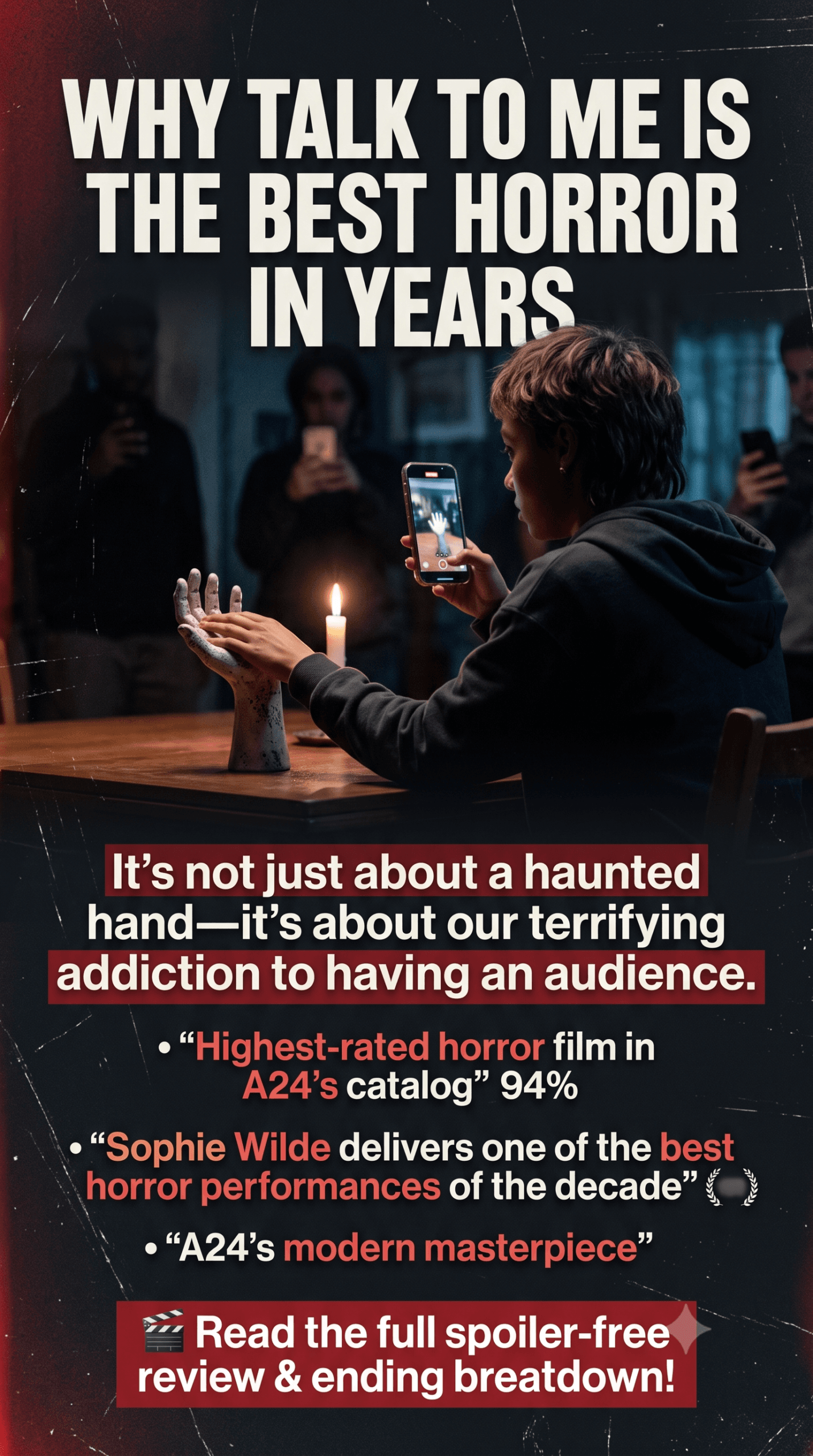
Short answer, for anyone weighing a Talk to Me review before committing two hours: yes, absolutely, and here’s exactly why. Talk to Me (2023), the feature debut of Australian twin directors Danny and Michael Philippou, is the best use of a horror premise in years, because the premise and the theme are built from the same material. An embalmed hand lets teenagers commune with the dead for ninety timed seconds, filmed by their friends for an audience — and the ritual doesn’t exist without that audience.
Take the phones away and nobody does this alone, in the dark, with no one to show.
There’s a specific relief in deleting an app off your phone and not looking back — the quiet, undramatic fact of a phone with one less thing on it, and nobody watching you decide that. I did it once with Twitter, on a Thursday afternoon, after forty minutes of reading a discussion about journalism that left me angrier than the subject deserved. I uninstalled it before I’d finished being angry. I never reinstalled it. What I remember isn’t the discussion.
It’s the specific, disproportionate heat of having an audience for my own reaction, and how fast that heat went away the second the audience did.
Talk to Me Review: What Makes the 2023 Premise Work
Talk to Me opens with a phone already up and recording, and it never really puts it down. The cold open belongs to a stranger — a kid named Duckett, mid-breakdown, a stabbing about to happen — and the other teenagers at that party are doing the thing an audience does now: watching first and feeling later, if there’s time at all, phones up before anyone thinks to actually help him.
The Philippou brothers, making their first feature after a decade running RackaRacka — the YouTube channel where the twins built an audience in the millions shooting fast, violent, deliberately unserious videos with titles like “Ronald McDonald Chicken Store Massacre” — clearly know exactly what that reflex looks like from the inside.
That RackaRacka pedigree became a talking point against them in early meetings — Danny Philippou has said flatly that financiers didn’t think two YouTubers could handle a real film — right up until Talk to Me premiered at Sundance in 2023’s Midnight lineup and set off a bidding war A24 won, the same studio behind horror as different as Get Out. The math on the other side of that bet: a $4.5 million budget against a $92 million worldwide gross, and a 94% Rotten Tomatoes score that made it the highest-rated horror film in A24’s catalog, ahead of Hereditary’s 90%. Two guys nobody would fund got the receipts anyway.
The horror isn’t the spirit that gets in. It’s the audience that makes letting it in worth the risk.
Sophie Wilde and Joe Bird Carry Talk to Me
Sophie Wilde plays Mia, and this is one of the best horror performances of the decade, built less on any single scene than on what she does across a hundred small ones. The New York Times and the Los Angeles Times were both saying as much out of Sundance, and they were right. Mia is grieving her mother, an overdose the film initially frames as an accident: sleeping pills, a locked door, scratches in the wood that Mia describes so fluently it barely sounds like trauma anymore.
What Wilde plays in the scene where her father finally reads the real note aloud is a decade of narrative collapsing in six seconds — the eyes doing the collapsing, almost nothing else on her face moving enough to name.
Wilde won Best Lead Actress at the Australian Academy of Cinema and Television Arts Awards for this role, which is a rare thing for a horror performance to collect from any awards body, let alone from home. It’s deserved. There’s a moment mid-film where Mia has to be simultaneously convincing to her friends, unconvincing to herself, and unraveling underneath both, and Wilde holds all three at once without ever tipping the balance toward melodrama.
Joe Bird, as Jade’s younger brother Riley, has the harder job. When the entity wearing Riley’s body starts speaking as Mia’s dead mother — soft, loving, entirely convincing for a few seconds before it curdles into a stuttering, mechanical loop of “got, got, got, got” — what Bird plays is a child’s body being used as a delivery system for somebody else’s grief. It’s a violation more specific and more upsetting than any of the film’s practical gore, because it stays anchored to Riley’s actual face the whole time.
Editor Geoff Lamb’s choking match-cut holds exactly as long as it needs to and not a frame longer, which is its own kind of cruelty.
The Rules of the Hand in Talk to Me Are Never Explained
The rules of the hand are never explained, and that’s doing real work rather than functioning as a cop-out. Nobody agrees on where the hand came from — a psychic, a medium, a Satanist, three kids will tell you three different stories at the same party and none of them will blink. Nobody knows for certain what the ninety-second rule is protecting anyone from, only that going over it once already went badly and going over it with Riley goes catastrophically.
The candle that opens and closes the connection gets the same shrugging authority a group of fifteen-year-olds brings to any rule half-remembered from someone older and cooler than them — the same borrowed, half-verified logic behind a haunted object with its own passed-down mythology. That’s the found-object realism so much elevated-sounding horror gets embarrassingly wrong.
The Craft Behind Talk to Me
Cinematographer Aaron McLisky shoots almost the entire film at a distance that never quite lets you settle — tight over-the-shoulder framing during the party scenes that puts you in the crowd rather than above it, so that when a phone comes up to film someone’s possession, you’re standing exactly where the other kids are standing. There’s no clean wide shot that would let you process the ritual as an outside observer.
Composer Cornel Wilczek mostly withholds — long stretches of near-silence and low tonal drones rather than stings — then, when a possession goes wrong, shifts into something closer to distorted, seasick pressure than music. Wilczek lets the air in the room feel wrong before anyone on screen has noticed, which does more work than a sting ever could.
What Talk to Me Is Really About
What the film is actually about, once the ceramic hand and the candle rules are stripped away, is the way a real crisis gets processed by people trained by their phones to treat everything as content first and consequence second. After Riley collapses, the first instinct among Hayley and Joss is damage control about the footage — get the story straight, don’t bring up the hand, the police are already asking about Duckett — while a fourteen-year-old is dying in the next room.
That’s the whole film’s thesis, delivered as behavior instead of dialogue, and it’s more devastating for never once being stated out loud.
There’s a recovered phone clip midway through the film — an old recording of Mia and her mother, alive, mugging for the camera, answering “what’s your message to the haters” with a cheerful “suck my arse.” It plays like a home video, and it plays in the exact same visual language as the possession videos the teenagers are filming at these parties — the same internet mythology built entirely by an audience, with no cue telling you to notice the overlap. By the time you do notice, you’ve already absorbed the point: this isn’t a generational quirk invented by the possession plot.
Mia’s mother was doing this too, cheerfully, years before any of this started. The hand didn’t teach anyone to perform for a camera. It found people who were already fluent.
Danny Philippou has talked about where some of this came from, and it isn’t abstract. Part of the film’s inspiration was real footage he’d seen of a neighbor trying drugs for the first time, reacting badly, while his friends filmed and laughed. The hand itself wasn’t in early drafts of the script at all — it was added later, deliberately built to feel like an object that had already passed through hundreds of hands before this one. Everything the ritual does to these teenagers, the film’s own origin story already did to somebody, once, for real.
The Honest Flaw in Talk to Me
An enthusiastic review isn’t the same as an uncritical one, so here’s the honest complaint: the last twenty minutes move fast enough, cutting between enough simultaneous crises — Riley missing from his hospital bed, Mia’s father needing an ambulance, a car accident staged with cross-cutting that trusts you to keep up without a compass — that a few connective beats have to be inferred rather than watched. Danny Philippou has talked about wanting the ending open to interpretation, clues left rather than spelled out, and on a rewatch that defense holds up better than I expected.
But there’s a difference between ambiguity that rewards a second look and ambiguity covering for a rushed final act, and this sits closer to the first than I initially gave it credit for, without being entirely innocent of the second either.
How Talk to Me Ends
The directors have described this as a tragedy rather than a scare machine with a twist bolted on, and the final shot earns that label. Mia — by every visual and structural implication the film gives you, without a single line of dialogue confirming it outright — ends up on the other side of the exact connection she spent the whole film chasing: the one a stranger, an ocean away, says “I let you in” to, at a party she’ll never see except from wherever the possessed now watch from.
The ritual changes hands, literally, and keeps running exactly the way it always has — a new audience, a new kid, no memory at all of the one before.
I keep thinking about that phone I deleted. Mine was a small, safe, reversible version of the exact thing this film is about — an audience amplifying a feeling of mine past the size it actually deserved, and the specific, unglamorous relief of removing the audience and finding the feeling shrink back down to normal size on its own. Nobody in Talk to Me gets to do that.
Every one of these kids has an audience they can’t delete, filming the worst thing that will ever happen to them, and by the time they understand the phones were never optional, it’s too late to put the hand down.
I haven’t left a horror film this energized in years. Every mechanism here does exactly the work it was built to do, all the way through to the last shot: a hand nobody in that room yet understands they should be afraid of.
Talk to Me Review — Final Verdict
Score: 9/10
Talk to Me — Frequently Asked Questions
Is Talk to Me based on a true story?
No. Talk to Me is fictional, but directors Danny and Michael Philippou have said its emotional core came from a real car accident where his sister held his hand until his shaking stopped, and that part of the inspiration was real footage of a neighbor reacting badly to drugs while friends filmed and laughed.
What happens at the end of Talk to Me?
Mia is implied to be struck by a car while chasing Riley through traffic. The final scene, confirmed by the directors to be set in Greece, shows a stranger completing the ritual and saying “I let you in” — implying Mia is now one of the spirits on the other side of the hand.
Who plays Mia in Talk to Me?
Sophie Wilde plays Mia. The role became a breakout for the Australian actress, drawing direct praise from The New York Times and The Los Angeles Times and widely cited as one of the strongest horror performances of the 2020s.
How long can you hold the hand in Talk to Me?
The film’s teenagers treat 90 seconds as the safe limit for a possession, timed by whoever’s filming. Going over that window is what turns Riley’s session catastrophic — the film never explains the number, only shows what happens when characters ignore it.
Is there a Talk to Me 2 sequel?
Yes. A24 confirmed a sequel, Talk 2 Me, in August 2023. As of Danny Philippou’s own stated timeline, it isn’t a near-term priority: Bring Her Back (2025), a documentary (2026), and another original horror film (2027) are all scheduled before it.