The film that inspired the Babadook is
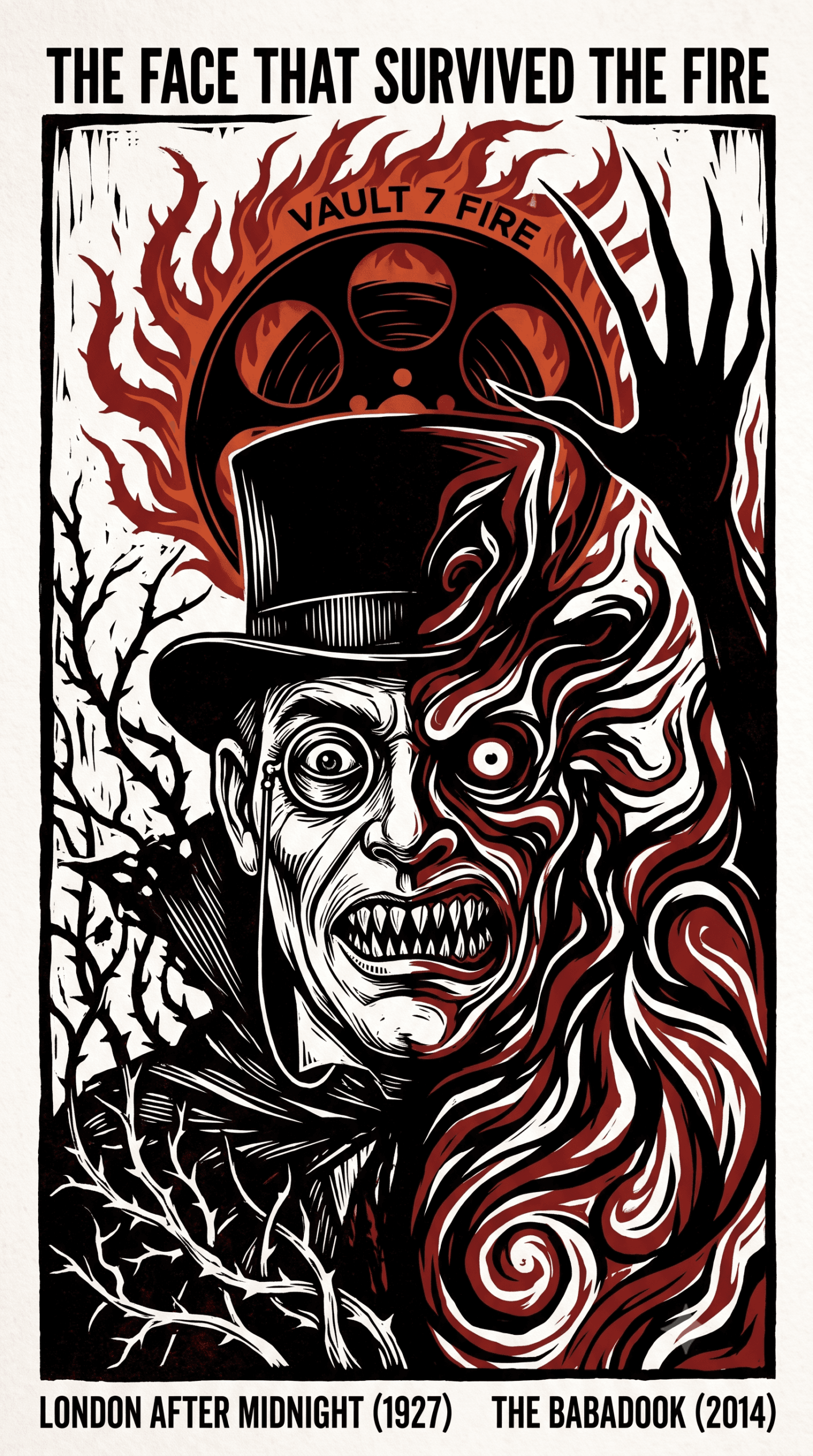
London After Midnight, a 1927 silent horror film directed by Tod Browning and starring Lon Chaney as a disguised detective known as the Man in the Beaver Hat. The last known copy of it burned in a 1965 MGM vault fire and has never been recovered, which means the image behind one of modern horror’s most recognizable faces technically no longer exists as a moving picture.You have already seen this face, even if you have never seen the film it came from: the wide black-rimmed eyes, the mouth pulled into something between a grin and a wound, the top hat sitting on it all like a joke nobody found funny. When Jennifer Kent’s
The Babadook premiered in 2014, critics and audiences reached for comparisons and mostly landed on the same one — this looked like something out of the silent era, something older than any of them had actually seen. They were right.That’s the part of this story that sits with me longer than it should. The Babadook is one of the most recognizable faces in modern horror, printed on shirts, turned into memes, argued about in film theory papers. The actual, original face it was built from — worn by a working actor on a soundstage in Culver City in the summer of 1927 — no longer exists as a moving image anywhere on earth.
The Story Nobody Can Watch Anymore
London After Midnight began as “The Hypnotist,” an original story by Browning himself, adapted into screenplay form by Waldemar Young. Young had spent years as a journalist in San Francisco before he ever wrote for the studios, covering enough real murder investigations that trade papers at the time described him as knowing mystery “from actual experience” rather than from other scripts. It shows in how procedural the setup is before anything supernatural gets introduced.Roger Balfour is found dead in his London home, and Scotland Yard inspector Edward Burke rules it a suicide over the objections of Balfour’s neighbor, Sir James Hamlin. Five years pass. Lights start appearing in the long-empty Balfour mansion.The new tenants are two figures nobody in the neighborhood recognizes — a tall man in a beaver-felt top hat with sharpened teeth and unnervingly wide eyes, and a silent, pale woman in flowing robes who is seen flying down from the ceiling like a bat. Balfour’s grave, when they check it, is empty.Burke returns to investigate, and what follows is a slow unmasking. The vampiric tenants are staged. The whole elaborate apparition — the hat, the teeth, the bat-woman, all of it — turns out to be Burke’s own construction, a theatrical trap built to force a confession out of Hamlin, who murdered Balfour five years earlier over the right to marry his daughter. Chaney plays both roles: the detective and his own disguise.The film cost MGM $152,000 to make and brought in roughly $1 million between domestic and foreign rentals, a hit substantial enough that the studio renewed Browning’s directing contract on the strength of it alone, even as reviewers argued over whether the mystery plot actually made sense.Whatever else it was, it worked at the box office because of exactly the thing nobody could stop describing afterward: the most frightening image in the film was built by the one character trying to do right by a dead man, deployed with a cruelty toward the guilty that the film never apologizes for.Critics have noted the same silhouette resurfacing decades later in Ethan Hawke’s Grabber in
The Black Phone. It resurfaces again in the Babadook. What neither later creature inherited is the specific irony that made Browning’s version work — the thing everyone in the story fears turns out to be the only honest character in it.Browning had a personal reason to build a plot around staged death and disguise. Before he ever directed a film, he ran away from a middle-class home in Louisville to work carnival and vaudeville circuits, where one of his acts was being buried alive — climbing into a coffin, going under the dirt, and getting dug back up for an audience that had paid to feel the specific dread of watching someone fake their own death convincingly.He carried that fascination with staged mortality and hidden identity into nearly every film he made with Chaney, and later into
Dracula (1931) and
Freaks (1932), the latter cast partly with real sideshow performers and so upsetting to audiences on release that it was banned in the United Kingdom for three decades.
London After Midnight sits early in a career that kept returning to the same idea: the most convincing hoax is the one built by someone who has personally practiced the difference between looking dead and being dead.
A Face Built Out of Pain
Chaney earned the nickname “the Man of a Thousand Faces” honestly — he designed and applied his own makeup and prosthetics for nearly every role, a level of control almost no actor of the era had, and almost none since have bothered to reclaim.For the Man in the Beaver Hat, he used small wire fittings, worn like monocles, that pulled his eyes into a wide, glassy, unblinking stare. Then came the mouth: a set of small, shark-like sharpened teeth, held in place by a device contemporary accounts describe as genuinely painful, one Chaney reportedly could only keep in for a few minutes at a time before removing it.The nickname wasn’t marketing. By 1927 Chaney had already built the skull-like face of the Phantom by pulling his own nose upward with wire and blacking out his eye sockets and nostrils, and had strapped a heavy padded hump to his back under a leather harness to play Quasimodo in
The Hunchback of Notre Dame.Both of those faces are still available to anyone with a streaming subscription. The Man in the Beaver Hat, arguably the most purely frightening of the three according to the people who actually sat in theaters and watched it happen, is the one nobody can rewatch to check.Contemporary reviewers were not shy about what it did to them. Australia’s
Sydney Morning Herald, reviewing the film in April 1928, described “a squat black figure like a bat, with glaring eyes and enormous teeth” appearing alongside “a woman in grey robes, whose face is terrifying in its corpse-like absence of expression,” adding that the images “imprint themselves very strongly on the mind.”The
Brooklyn Daily Eagle wrote that Chaney “obligingly applies a figurative bit of ice to the vertebrae.”
Photoplay called the disguise “as gruesome as any he has ever worn.”Decades later, horror historian David J. Skal, writing in
The Monster Show, read the sharpened teeth as something closer to psychoanalysis than makeup design: “the primitive razor-mouth, superimposed on a human face, is a clear evocation of a Freudian concept: the devouring, castrating
vagina dentata.”The film around the makeup got a rougher reception —
The New York Times called the plot “somewhat incoherent,” and
Variety found Burke himself “mechanical and wooden” — but across nearly a century of scattered reviews, nobody has ever seemed lukewarm about the face itself.
Vault 7: How the Film Was Destroyed
The specific mechanism of the loss is almost too mundane for what it destroyed. On August 10, 1965, an electrical short in Vault 7 of the MGM storage facility in Culver City ignited a cache of nitrate film stock — the same wildly flammable material every studio used before safety stock became standard, which made vault fires a routine, expected hazard of the era rather than some singular catastrophe.The fire took the last known surviving print of
London After Midnight with it. It also took
The Big City, the only other surviving Chaney-Browning collaboration, so a single electrical fault erased essentially the entire physical record of one of silent horror’s most important director-actor partnerships in one night.Original camera negatives for the three-strip Technicolor sequences of
Singin’ in the Rain went with it, along with the uncut version of the Laurel and Hardy short
Blotto, reels of
An American in Paris and
Annie Get Your Gun, and the original prints of dozens of Tom and Jerry and Tex Avery cartoons.A studio that had made a fortune off these properties simply hadn’t prioritized keeping them, and the fire took whatever nitrate happened to be sitting in that room.None of this was unusual for its era, which is its own kind of quietly awful fact. Nitrate stock decomposes and combusts on its own given enough time and the wrong storage conditions, and studios spent decades treating their own back catalogs as expendable inventory rather than cultural record.Researchers cataloguing American cinema’s silent period now estimate that somewhere between 75 and 90 percent of films made before 1929 are lost entirely or survive only in incomplete form.
London After Midnight is simply the most famous entry on a list that runs into the thousands.What survives is a script, a novelization, a small number of production stills, and the poster — the only known copy of which sold at auction in December 2014 for $478,000 to Metallica’s Kirk Hammett, a world record for a movie poster at the time, later broken by a 1931
Dracula poster that sold for $525,800 in 2017.In 2002, Turner Classic Movies commissioned producer Rick Schmidlin to build a forty-five-minute reconstruction out of those stills, panning and holding on still photographs in sequence with the surviving script and a new score by Robert Israel, standing in for a film that no longer technically exists. It’s the closest thing to watching
London After Midnight that anyone alive will get. It is also, by definition, a guess wearing the original’s clothes.The absence hasn’t stopped people from trying to fill it back in. A previously unknown 11,000-word magazine account of the film’s plot, printed in a 1928 movie magazine and rediscovered decades later, became the basis for a full new written reconstruction of the story published in 2016.Another historian published a book built around freshly surfaced nitrate fragments in 2022, timed to the film’s ninety-fifth anniversary. In 2023, a full-cast audio drama recorded the original script from scratch, with actors reading Browning and Young’s dialogue aloud for an audience that will never see it performed.None of these are the film. Every one of them is someone refusing to let it stay gone. Every few years, somewhere online, a rumor also resurfaces that a print has turned up in a private collection or a forgotten vault. None of them has ever held up.
The Film That Inspired the Babadook’s Face
Jennifer Kent has been direct about the debt. In a 2014 interview with
Mountain Xpress, she said Chaney’s image from the film “really impressed itself upon me,” and described exactly what she found in it: “What I loved about that particular image — and you can also see it in the footage we used of him in the movie on TV from
Phantom of the Opera — is that you can see that it’s a person’s face.“It’s just a face that’s been distorted — without CGI obviously — but manipulated so that it looks human, but almost not. And I think that
London After Midnight, shot with his face and his mouth pulled apart like that, is really frightening.”That’s a specific, technical debt — Kent wanted the uncanny quality of a real human face pushed just past the edge of recognizable, the same effect Chaney built out of monocle wires and a mouthpiece he could barely stand to wear. It’s the clearest confirmation on record of the film that inspired the Babadook’s most iconic image.There’s a structural echo underneath the visual one that I haven’t seen Kent confirm directly, so I’ll say plainly that it’s my own read and not her stated intent: in both films, the thing that looks like a monster requires something other than destruction to resolve.Burke’s disguise had to be endured before the truth underneath it could do its work. The Babadook, at the end of Kent’s film, isn’t destroyed either — we’ve
written elsewhere on this site about exactly what that ending does and doesn’t resolve. Eighty-seven years apart, both films land on the same idea: the most frightening face in the story belongs to something the protagonist has to live alongside rather than defeat.
What We’re Actually Mourning
Here’s the part I have to be honest about, because pretending otherwise would insult everyone who worked on the reconstruction and everyone who has spent decades hunting for a surviving print. Film historian Jon C. Mirsalis, who has studied Chaney’s career closely, has argued that
London After Midnight would probably disappoint most people if it turned up tomorrow.Contemporary reviews were lukewarm at best — incoherent plotting, a detective character critics found wooden, comic relief that felt tacked on. Mirsalis has pointed out that Browning’s own 1935 sound remake,
Mark of the Vampire, with Bela Lugosi and Lionel Barrymore sharing Chaney’s old dual role, was by most accounts the stronger film.There’s a real possibility that
London After Midnight is remembered as a masterpiece largely because it’s unavailable for anyone to disagree with. Absence is an extraordinary editor. It cuts every scene that would have been merely fine and leaves only the handful of images too strange to fully die.None of that touches the one thing about this film we can actually verify, repeatedly, across a century of independent witnesses: the face worked. It worked on 1928 audiences who wrote about ice on their spine.It worked on Jennifer Kent in whatever theater or archive reel first showed it to her, badly enough that she rebuilt it, on purpose, eighty-seven years later, for an audience that has never once questioned whether the Babadook looks convincingly wrong.That part of
London After Midnight didn’t burn in Vault 7. It was already loose in the culture — in stills, in secondhand descriptions, in one director’s memory of what a distorted human face could do — waiting for someone to pick it back up.Chaney never got to see what he’d started. He died on August 26, 1930, of a throat hemorrhage from bronchial lung cancer, weeks after the release of his only talking picture.He spent his whole career building faces meant to be looked at, and never had to watch one of them outlive the film it was built for, wandering around in other people’s nightmares for a century, recognizable long after the thing that made it was gone.Somewhere between how completely a film can vanish and how stubbornly one image from it can refuse to, that’s the actual shape of what we lost — a man’s face, distorted on purpose, still doing the job ninety-nine years later, with nobody left alive who can tell us whether the rest of the movie around it was ever any good.
The Real Boogeyman: Quick Answers
Is London After Midnight really the film that inspired the Babadook?
London After Midnight (1927), directed by Tod Browning and starring Lon Chaney as the Man in the Beaver Hat. Jennifer Kent has said Chaney’s distorted, wide-eyed, sharp-toothed image “really impressed itself upon me” while she was developing the Babadook’s look.
Why can’t anyone watch London After Midnight today?
The last known surviving print was destroyed in a fire at an MGM storage vault in Culver City on August 10, 1965. No other complete copy has ever surfaced, making it one of the most sought-after lost films in cinema history.
Is there any way to watch a version of it now?
Turner Classic Movies aired a 45-minute reconstruction in 2002, built from surviving script pages and production stills with a new score. It approximates the story but is not the original film.For the full argument about what the Babadook’s ending actually resolves, see our
Babadook Ending Explained, and for the grief-metaphor reading this piece builds on, our
Babadook review. Full cast, crew, and release details for the 1927 film are available on
IMDb.