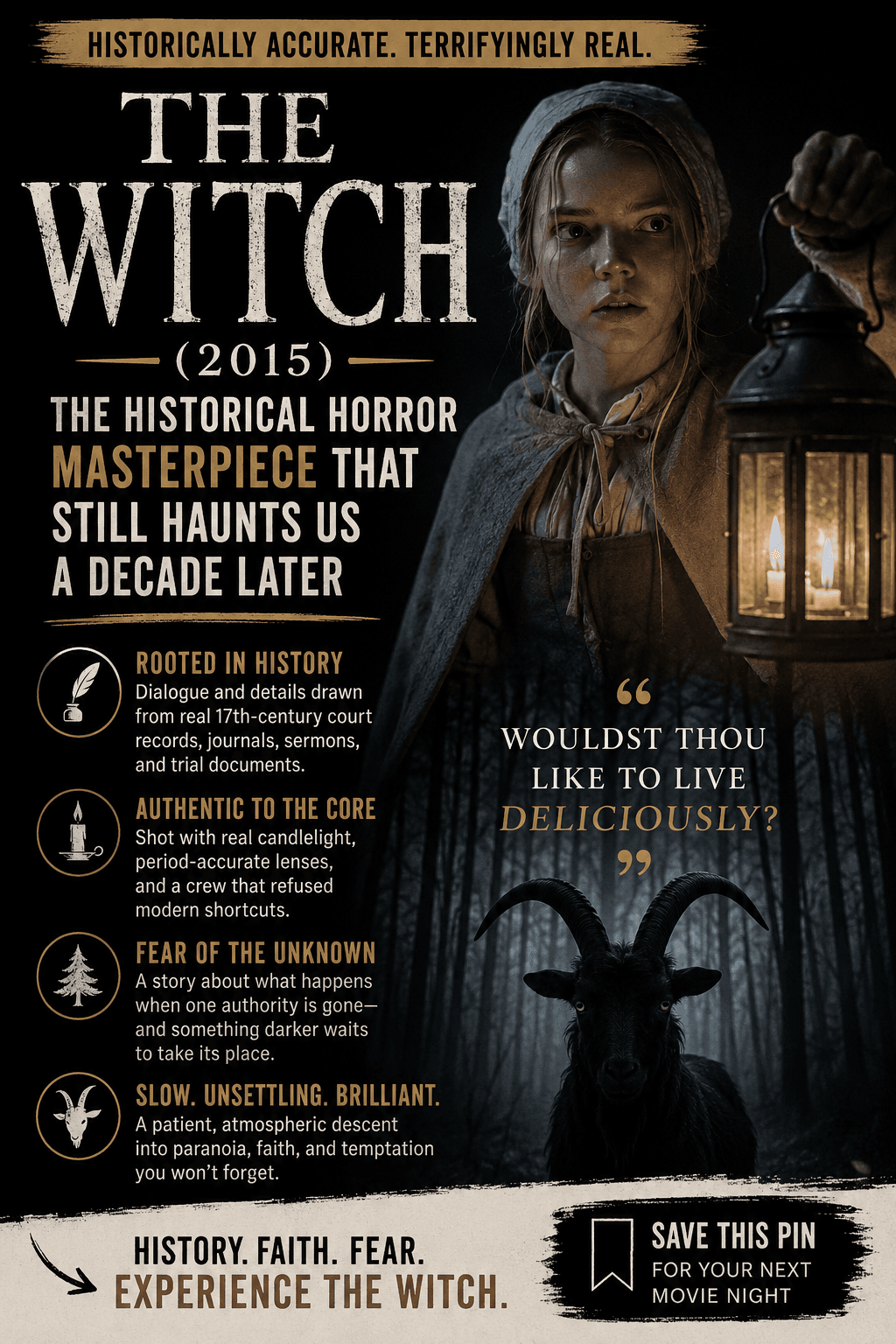
The Witch (2015) historical accuracy is the reason this Robert Eggers debut still works a decade after a Sundance crowd first saw it, in January 2015, and didn’t know what to make of it. Eggers didn’t invent a Puritan family and dress them in scary language. He built the family, the farm, and most of the dialogue out of real seventeenth-century court records, journals, and sermons.
The Witch (2015) Historical Accuracy: Where the Dialogue Actually Comes From
Eggers spent close to five years researching before he shot a single frame. He read period journals, court depositions, sermons, and captivity narratives, and drew directly from sources like Cotton Mather’s Memorable Providences, Samuel Willard’s possession accounts, and surviving Salem-era trial records.
The screenplay’s own title page states plainly that “much of the dialogue, in fact, comes directly from those sources.” I read that screenplay against the released film this week, checking scene after scene against the subtitles.
In every passage I compared — Thomasin’s opening confession, William’s catechism with Caleb about corrupt nature, Katherine’s dream of Christ’s love “far exceeding the affection of the kindest husband,” Black Phillip’s final temptation — the dialogue survived from page to final cut without a word changed.
That’s rare enough to be worth naming. Most historical horror softens its dialogue for modern ears, trims the “thees” and “dosts” down to something an audience can absorb without concentrating. The Witch refuses, and the refusal is the movie’s entire spine.
Why The Witch (2015) Earns Its Reputation
Here is my position on it, and I’ll give it early because I don’t believe in saving an argument for the end: this is a film that treats theological terror as its native emotional register from the first frame.
The static wides, the near-total absence of a score for long stretches, the refusal to explain whether Black Phillip actually speaks or whether these children have simply been driven half-mad by isolation and grief — all of it is doing exactly what it’s built to do, second by second, long before anything resembling a scare shows up.
It is one of the two or three best horror debuts of this century, and it earns every inch of the reputation it’s built since that Sundance crowd sat down, uncertain what genre they were even watching.
I’ll admit the middle stretch — the days of failed hunts and shrunken corn and Katherine’s unraveling grief before Caleb ever reaches the wood — asks more patience than most horror audiences bring to a theater. I don’t think Eggers entirely solves that problem. It’s the one place in the film where formal discipline tips into drag. Everything after Caleb’s disappearance earns that patience back tenfold.
The Craft Behind The Witch (2015)
Jarin Blaschke’s Cinematography
Start with Jarin Blaschke, because Ethan Vance always starts with the cinematographer, and this is the film where that habit pays off hardest.
Blaschke and Eggers lit interiors with actual beeswax candles imported from Alaska for anything on camera, supplementing with tea lights just out of frame. They shot the whole thing on 1940s Cooke lenses mounted to an ARRI Alexa Plus — lenses more convex than anything a working DP would normally reach for, smearing the corners of the frame into something Blaschke has described as looking through a porthole into the past.
He’s called using a modern lighting instrument like a Kino Flo a betrayal of the film’s whole premise. It’s the product of a production that refused every shortcut a 2015 crew would normally take — real flame standing in for lighting instruments — and the dark in this film behaves the way dark actually behaved before electricity: thick, total, unwilling to give you anything for free.
Mark Korven’s Score
Mark Korven’s score does the same work from the other direction. It’s an entirely acoustic recording built around instruments most audiences have never consciously heard: a Swedish nyckelharpa, a hurdy-gurdy, a waterphone, a small chamber ensemble, and the Element Choir out of Toronto, a group that specializes in vocal improvisation rather than written parts.
Korven has talked about generating a lot of the score’s low percussive menace by, in his words, abusing a cello — bowing and striking it in ways that have nothing to do with how a cello is supposed to sound.
What you get is a score that never once tells you when to be afraid. It just makes the wood itself sound like it has a nervous system, and the choir’s wordless keening arrives less like music than like something the family should be able to hear if they’d only stop praying long enough to listen.
Louise Ford’s Editing
Louise Ford’s editing is the part almost nobody credits, and it’s doing more structural work than most viewers register on a first pass. Ford, who’d go on to cut The Lighthouse for Eggers as well, builds the film’s early stretches out of long, unhurried holds — Thomasin scrubbing linens at the stream, William failing at a hare hunt, the family at prayer.
Those holds train you into a rhythm of rural tedium before the film starts intercutting locations with increasing speed once Caleb goes missing in the wood.
Watching Caleb’s exorcism scene again, the cutting felt faster and more fragmented to me than anything earlier in the film, which reads like a deliberate choice — Ford accelerating the film’s internal clock at roughly the same rate the family’s grip on reality is loosening. I’d call it as precise a use of editing rhythm as horror managed in the 2010s, though that’s my read of the cutting, not something Ford has confirmed in an interview.
The Performances
Anya Taylor-Joy as Thomasin
Anya Taylor-Joy, in her feature debut, plays Thomasin with a specific and difficult trick: she has to be simultaneously the character every other family member decides to blame and the only character who never actually lies about anything that matters.
Watch what she does with her eyes in the scene where she invents the “I am the witch of the wood” story to frighten Mercy into silence about the missing silver cup. There’s real cruelty in it, an older sister’s casual weaponizing of fear, and Taylor-Joy commits to it completely, giving the audience no wink that Thomasin is secretly innocent underneath.
That commitment is what makes the ending land. When she asks Black Phillip, alone in the wrecked goat shed, “what canst thou give?”, Taylor-Joy plays curiosity first and surrender second. The laughter she works up to in the final minute — genuine, escalating, tear-streaked — reads as someone finally being asked what she wants, for the first time in the entire film, by anyone.
Ralph Ineson as William
Ralph Ineson’s William is the performance I find myself returning to most, because Ineson refuses the easy version of this character. William is a man who insists, over and over, that he’s building a godly farm through will and labor alone.
Ineson plays every one of his failures — the misfired musket, the traded silver cup, the empty traps — with a shame that curdles into rage precisely because he cannot admit the shame first.
There’s a moment late in the film where he swallows fistfuls of dirt while confessing his pride to God, believing no one is watching, and Ineson plays it without a shred of vanity: this is a man eating soil because he has run out of other ways to punish himself. William dies on his own goat’s horns in a woodpile he built with his own hands, and Ineson has spent the whole film building toward a death that reads as inevitability, the specific kind a man assembles for himself one failure at a time.
Harvey Scrimshaw as Caleb
Harvey Scrimshaw, as Caleb, gets one of the strangest scenes any child actor has been asked to carry in modern horror — the deathbed sequence where his possession curdles into full religious ecstasy, quoting Song of Solomon-adjacent language (“kiss me with the kisses of thy mouth”) while his body convulses.
The shooting script’s own stage direction calls the moment “disturbingly erotic” in its intent, though what actually plays on screen reads to me more as a body in theological crisis than anything explicitly sexual — a distinction worth making given who’s performing it.
It’s a scene that refuses to let the audience separate the theology from the body, which is uncomfortable to sit through and is exactly the kind of discomfort the rest of the film builds toward more patiently.
What The Witch (2015) Is Actually About
Here is what the film is actually about, underneath the genre dressing: a family that left one system of total authority and rebuilt an identical one in miniature.
The Puritan theocracy of the plantation had governors and ministers passing judgment from a raised platform. At the edge of the wood, William becomes the governor, Katherine becomes the minister, and God’s silence stands in for the congregation’s verdict.
Every fight in this house is a fight about who gets to interpret God’s will. Every accusation of witchcraft is a scramble to relocate blame within a system that has already decided someone must be guilty of something, because the corn is rotting and the crops are failing and someone has to be at fault.
Nobody in this family ever considers that maybe nothing supernatural needs to be true for all of this to happen. The society was built to require a devil the moment it stopped being able to require a king — a lens that isn’t so different from how Hereditary treats family as a closed system that transmits its own damage generationally, with love as the delivery mechanism.
The Ending of The Witch (2015), Explained
I read the ending as something more specific than either the liberation or the tragedy it usually gets filed under.
Thomasin’s walk into the wood and her ascent with the coven trade one authority for another that flatters her more — butter, a pretty dress, a book to sign — while asking for exactly what the plantation asked for: total submission, marked on her own body, guided by someone else’s hand because she’s told outright that she cannot write her own name.
That’s the difference between what happened to Thomasin and what happened to me on that Thursday afternoon. I got to just stop, with nothing rushing in to take Twitter’s place. Thomasin never gets that option. Not the plantation, not her father’s farm, not her mother’s grief ever taught her that a life without an authority figure standing over it was a thing a person was allowed to have.
Critics vs. Audiences: The CinemaScore Split
The film’s reputation has always had a strange split running through it. Ninety-one percent of critics loved it when it opened wide through A24 in February 2016. The same audiences gave it a C-minus CinemaScore.
A decent chunk of the people who bought tickets expecting a haunted-house movie got two hours of Puritan theology and left furious that nothing jumped out of the dark at them. I understand the frustration, even if I don’t share it — this was never a film built to startle anyone.
The Witch was built to recreate, as faithfully as a film has managed, what it felt like to live inside a belief system that offered no comfort against the dark and required you to manufacture your own devil the moment the harvest failed. Ten years on, it hasn’t lost an inch of that discipline, and it still makes most of what gets marketed as elevated horror look like it’s cosplaying seriousness instead of earning it.
Which is, in its own way, its own kind of honesty — the discipline never blinks, even when the audience wanted it to.
I still haven’t gone back to Twitter, and I don’t think about it the way I used to, as a clean escape I should feel proud of. The Witch has made me less sure that any exit is ever entirely clean.
Every time a person leaves one thing that had a grip on their attention, there’s a wood at the edge of the clearing, patient, waiting to see what fills the space. Sometimes nothing does, and that turns out to be the whole victory. Sometimes something is standing there in the dark asking whether you’d like to live deliciously, and you say yes before you’ve even worked out what you’re agreeing to.
For the same historical seriousness about faith applied to a different century, my review of Rosemary’s Baby (1968) covers it from the other side, and my review of Midsommar traces what happens when the same communal control gets rebranded as belonging instead of punishment.
Frequently Asked Questions
Is The Witch (2015) based on a true story?
Not on one specific case, but on real historical material. Robert Eggers spent nearly five years researching period journals, sermons, court depositions, and witchcraft-trial records from New England and Western Europe before Salem, and pulled much of the film’s dialogue directly from those documents rather than inventing it.
How accurate is The Witch (2015) to Puritan life and belief?
The Witch (2015) historical accuracy is strongest in tone and language, and Eggers treats the family’s folkloric and religious beliefs as true within the film’s world rather than as superstition to be debunked. It comes less from plot events and more from how faithfully the dialogue and worldview are reconstructed from primary sources.
Who composed the score for The Witch (2015)?
Mark Korven, using an entirely acoustic ensemble built around a Swedish nyckelharpa, a hurdy-gurdy, a waterphone, and the Toronto-based Element Choir, an improvisational vocal group, rather than a conventional orchestral horror score.
Why did audiences and critics disagree so sharply on The Witch (2015)?
Critics scored it 91% positive, while general audiences gave it a C-minus CinemaScore. The split came from expectation: many viewers went in expecting jump scares and left with two hours of Puritan theological dread instead, which the film was never built to apologize for.
Score: 9/10 — one of the two or three best horror debuts of the century, docked only for a second act that asks more patience than it earns.