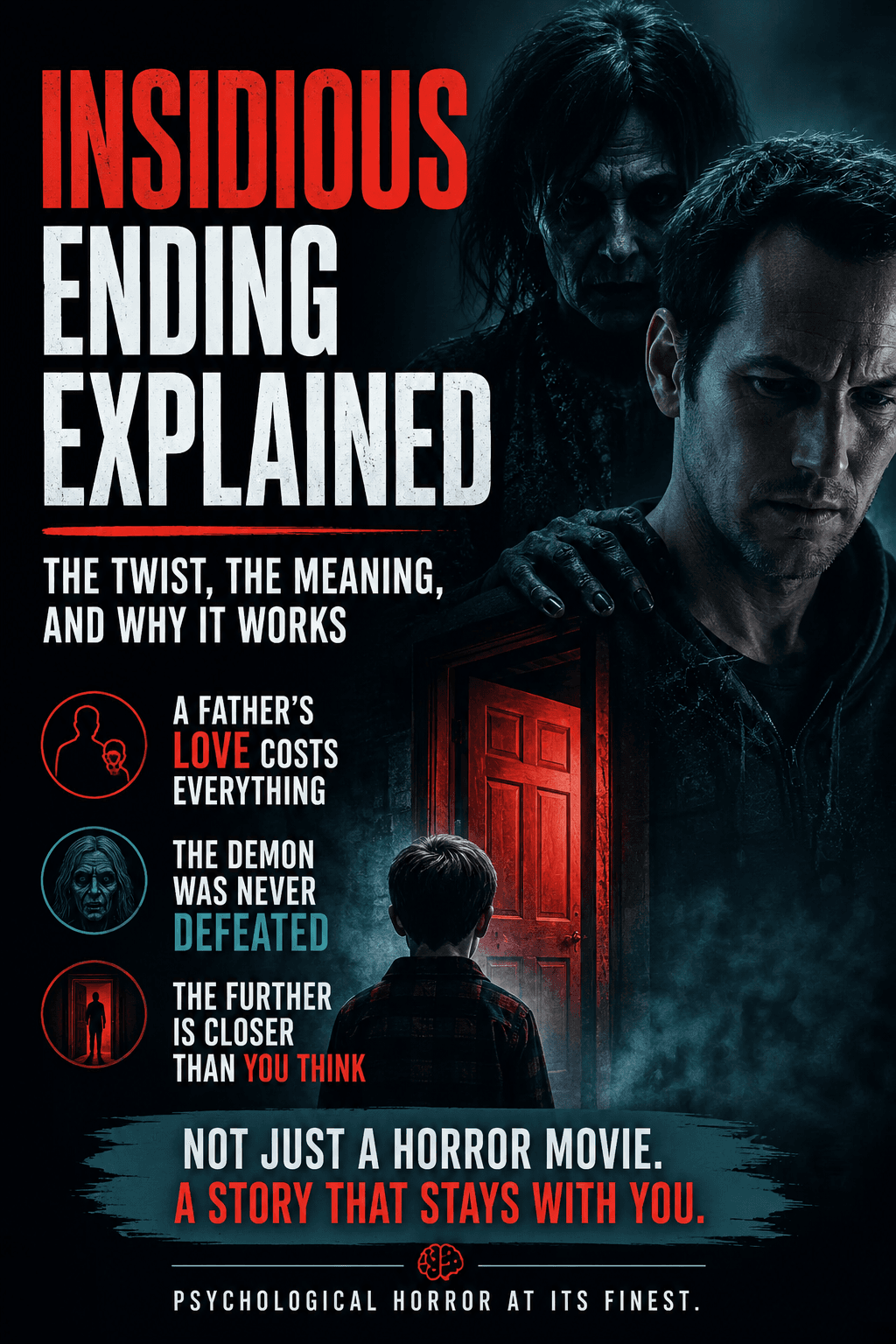
Insidious (2010) ends with a father saving his son and losing himself in the process. Directed by James Wan and written by Leigh Whannell, the film’s final scene reveals that Josh Lambert (Patrick Wilson) is now possessed by the same demonic old woman who tormented him as a child — the same spirit he believed he’d beaten minutes earlier. She kills psychic investigator Elise Rainier (Lin Shaye) and is left standing behind Renai (Rose Byrne) in the film’s last shot.
This is the Insidious ending explained in full: what happens to Josh, why the twist works, and why the “shaky third act” so many critics complained about in 2011 was never a mistake.
My father taught me how to fix a leaking faucet over the phone, four months before he died. I was twenty-four, living alone for the first time, and I called him panicking about a drip that had turned into a puddle.
He walked me through it step by step — shut the valve, pull the cartridge, don’t overtighten the packing nut — the way he’d talked me through a hundred smaller things growing up, except this time it was the last thing. I have fixed every leaking faucet I’ve owned since without calling a plumber, and every single time, some part of my brain runs the instructions in his voice. It is the most useless kind of inheritance.
It solved nothing that mattered. It just kept working, forever, after the person who gave it to me stopped.
Insidious is about a father who does the one competent, correct, loving thing available to him, and the film hands him nothing for it. Josh goes into a realm called The Further, finds his son chained in the demon’s lair, and gets him out. He succeeds completely. And then the film takes it all back.
Why Critics Called the Third Act a Mistake — and Got It Wrong
I want to say something that isn’t fashionable to say about this film: the third act, the one nearly every contemporaneous review flagged as where Insidious falls apart, is the moment the entire film was built toward. The critics who wrote it off in 2011 were grading a haunted-house movie against the rules of a haunted-house movie that James Wan and Leigh Whannell had already abandoned by minute sixty — which is exactly why any honest Insidious ending explained piece has to start there instead of apologizing for it.
Mike Hale at the New York Times called the back half a less poetic Shyamalan fairy tale. James Berardinelli said the film couldn’t live up to its own first hour. Ethan Gilsdorf, writing for the Boston Globe, said the “crazy train” ran off the rails once the movie started explaining itself with astral projection and possession. I understand the complaint.
I think it’s wrong, and I think it’s wrong in a way that matters, because it treats mythology-building as a concession — as the film cashing out its atmosphere for plot, the way a magician explains the trick and kills the wonder along with it.
Not every critic missed it. John Anderson at the Wall Street Journal wrote that what makes a movie scary isn’t what jumps out of the closet, it’s what might — and praised the film for operating on that principle without gore or gimmick. Michael Phillips at the Chicago Tribune called it a film that understood fright exists on a spectrum from blatant to insidiously subtle. Peter Travers at Rolling Stone got there too, and even Roger Ebert, who landed at two and a half stars and clearly wasn’t fully won over, still described a film that depends on characters and mounting dread rather than shock for its own sake.
Read those two camps side by side and the split isn’t really about quality. It’s about whether a critic was willing to follow the film somewhere the marketing hadn’t prepared them to go.
The Making of Insidious: A $1.5 Million Ghost Story
Wan and Whannell wrote this on the other side of Saw — a franchise that made Wan, by his own account, uneasy about being defined by gore — specifically to prove they could scare an audience with almost nothing. A budget of roughly $1.5 million. Three weeks of shooting in the spring of 2010, most of it inside the Herald Examiner Building in downtown Los Angeles, the location standing in for the bulk of the film’s interiors.
It premiered at TIFF’s Midnight Madness program on September 14, 2010, and Sony had bought the U.S. and worldwide sequel rights before the sun came up the next day. It would go on to make over a hundred million dollars. The math on that return is obscene, and it’s obscene specifically because the film is built almost entirely out of restraint — a choice, not a limitation dressed up as one.
Restraint, here, means something specific. Joseph Bishara’s score — performed with a small quartet and piano, much of it improvised and stitched together during the edit rather than locked in ahead of the shoot — spends most of the runtime training the ear to read silence as safety, then punishes that trust with atonal violin and hard piano strikes right after the quiet has convinced you nothing is coming.
Wan has talked about wanting the scare sequences to play in near silence for exactly that reason. It’s the same withholding logic John R. Leonetti and David M. Brewer’s camera uses in the opening minutes, when it drifts through a dark bedroom and down a hallway toward a window where a woman in Victorian dress stands with her back turned. The film lets you assume you’re looking at Dalton’s room.
The boy asleep under the dinosaur blanket is Josh, decades earlier, and the film doesn’t tell you that until it’s ready to — the same trick it plays on you again at the very end, except this time nobody tells you at all. You have to notice the wrong hand yourself, the way Elise does.
There’s a small joke buried in the credits that most first-time viewers never clock: Bishara, the composer training your ear to distrust silence for ninety minutes, is also the actor under the red paint playing the thing that finally breaks it.
The Astral Projection Mythology That Makes the Ending Work
That opening misdirection is the whole movie in miniature. Here’s the part of the Insidious ending explained that the “went off the rails” crowd treated as filler and got backward: the mythology isn’t decoration bolted onto a ghost story. It’s the thing that makes Josh’s arc devastating instead of merely spooky.
Astral projection, in this film’s internal logic, is presented almost as a family trait — something Dalton was “born with,” something Josh did as a child without understanding what he was doing, something that leaves the body vacant and available to whatever’s patient enough to wait nearby. It functions the way certain kinds of inheritance function in real families: not chosen, not always visible, passed down whether or not anyone decides to pass it.
Lorraine’s solution, when young Josh’s night terrors got bad enough, was to make him forget. She hid the Polaroids that showed the old woman getting closer in every frame — a shadow behind a boy at a birthday, then a shape by his bed, then a hand reaching for his neck by a car. She told Elise to help him bury it.
That’s the instinct almost every parent has, to protect a child from a truth by removing the truth rather than the danger. And it fails completely, thirty years later, because the thing she buried didn’t go anywhere. It waited. Nobody lied to Josh. They just decided he didn’t need to know what he was carrying.
There’s a second family thread the film doesn’t spend much time on, and it deserves more than it gets. Lorraine (Barbara Hershey) and Renai spend most of the runtime as two women managing a crisis neither of them created, adjusting to each other under duress after years of quiet friction.
Hershey plays Lorraine with a starch that only cracks once, in the scene where she hands over the photographs, and the film earns that crack by making her carry the guilt alone for three decades first. Rose Byrne’s Renai gets the film’s most thankless job: she has to be disbelieved, medicated, told by a husband who loves her that she needs a therapist instead of a priest — and proven right anyway. The astral projection plot resolves Josh’s arc.
It never resolves hers. She’s the one left holding a house full of children and a husband’s body with someone else driving it, and the film ends before anyone has to answer for that.
Inside The Further: Josh’s Rescue of Dalton
Which brings us to the sequence the film is actually about, the one all the atmosphere in the first hour was purchasing time for: Josh going in.
Elise sets the metronome ticking, walks him through detachment in that flat, practiced voice, and the film cuts to a version of Josh’s own street rendered as absence: no cars, no people, houses lit from inside with nobody home, visibility for a hundred yards in every direction and blackness past that, like the world has been built only exactly as far as he needs it built.
He passes a family frozen mid-scene in their own living room, still playing out an ordinary Sunday afternoon, a teenage boy holding the rifle that killed them, caught in a loop none of them can leave. He finds his son chained in the demon’s lair, guarded by a creature reapplying its lipstick in a mirror — a detail the film doesn’t dwell on and doesn’t need to; you understand exactly what kind of appetite that room belongs to.
And he gets Dalton out. He fights off the Long-Haired Fiend, a figure whose seed came from something closer to home than most horror villains: Wan has described a friend’s account of waking to see a man pacing outside his room, an ordinary domestic memory that became the raw material for the film’s design.
Josh gets angry instead of afraid, which the film frames as the actual weapon — Elise’s insistence, mid-trance, that he is the one thing in that place still alive, and that fear is the only real threshold between him and getting out. It works.
He carries his son through door after door until Renai’s voice reaches him, and Dalton wakes up gasping in his own bed, and for about ninety seconds, the movie lets you have the ending you paid for.
The Hidden Detail Even Longtime Fans Miss on Rewatch
Watch the scene again knowing what’s coming, and one moment reads completely differently: Josh confronts the old woman a second time, in the basement of his childhood home, and screams at her to leave him alone. She smiles, snuffs out her candle, and the film cuts away as though he’s won. He hasn’t won anything.
He’s watched her retreat before, as a boy, and Lorraine’s photographs prove that retreat was never the same thing as defeat — it was patience, dressed up as surrender, buying another thirty years. The film shows you the exact shape of the trap a second time and trusts you not to recognize it, because Josh doesn’t recognize it either.
That’s the cruelest kind of dramatic irony: not the audience knowing something a character doesn’t, but the character having already lived the lesson once and forgetting it fast enough to walk into it again.
The Insidious Ending Explained: How the Old Woman Gets Josh
Then Josh hands Elise back the photographs of himself as a child, and his hand is an old woman’s hand.
I want to sit with how quietly that turn is staged, because it’s the best piece of craft in the film and it gets buried under “twist” as a word, like it’s a magic trick instead of an argument. There’s no score sting. No push-in. Just Elise noticing, the way you’d notice a stranger’s hand on someone you love, and reaching for the camera instead of saying anything — because what do you say.
The photograph does the talking the way photographs did all through the film: Lorraine’s Polaroids showed the old woman inching closer across years Josh doesn’t remember; this last one shows her arrived. It’s the same visual language the film has been speaking since minute one, deployed one final time to close the loop it opened with a sleeping boy who wasn’t the boy you thought.
What happens next is the part I think the third-act critique really can’t forgive, and it’s the part I’d defend hardest. Josh — or what’s using Josh — kills Elise. He strangles the one person in the film who has spent decades trying to protect him, in the house he just fought to get his son out of, minutes after telling his wife he loves her more than he’s ever told her anything.
There is no reading of that sequence where the family wins. Dalton is safe. Renai is not. The last image of the film is her face, and the thing that used to be her husband standing behind her, and the specific cruelty of that shot is a monster wearing eighteen years of a marriage she chose.
That’s a harder thing to sit with than a jump scare, and I think a certain kind of 2011 review reached for “the film loses control” because sitting with “the film did exactly what it meant to and it’s unbearable” is a harder sentence to write on deadline.
What It Means That Josh Did Everything Right
Because here is what actually happened to Josh Lambert, stated plainly: he did the only correct thing. Every instinct that mattered — going in when nobody else could, refusing to let fear win the way it beat him as a child, getting Dalton out and getting him out completely — he executed without a single failure. And the story punishes the execution itself, not a mistake, not a moment of weakness, not a door he should have kept locked.
The parasite got him because he went to the one place he had to go, and did the one thing that worked. That’s a different animal from the haunted-house convention where curiosity or grief or greed opens the door. He walked through this one on purpose, for the best possible reason, and it closed behind him a different way than he walked in.
It’s worth saying, too, that the film knows exactly how much comic ballast a story like this needs and applies it with real precision. Whannell wrote himself into the film as Specs, paired with Angus Sampson’s Tucker — a paranormal-investigator double act not unlike Ed and Lorraine Warren’s real-life partnership, minus the reverence.
The two of them argue about who’s the “assistant” while carrying equipment that measures for ghosts, a running bit that has no business working as well as it does, except that it’s there to let the audience exhale between the scenes that don’t. Take that duo out and the second half becomes unwatchable, not because the horror gets weaker, but because there’s nowhere left to breathe.
That’s a screenwriting decision as deliberate as anything Bishara did with the score, and it rarely gets credited as part of why the ending lands as hard as it does: you have to be relaxed for a film to really hurt you.
I keep circling back to what I told you at the start, about a faucet and a phone call I didn’t know at the time was the last one. My father gave me something that day that had nothing to do with plumbing. He gave me a version of competence that survives him, that I still use, that fixes nothing about the fact that he’s gone and just quietly keeps functioning anyway, sixteen years from where I learned it.
Watching Josh Lambert do everything right and lose everything for it, I don’t think about jump scares.
I think about the specific, unglamorous horror of a skill or an instinct or a piece of yourself that gets passed down whether you asked for it or not — inherited the way Dalton inherited his father’s ability to leave his body, the way Josh inherited a trauma his own mother tried to erase by simply not naming it — and how none of that inheritance asks your permission before it decides what to do with you.
My father’s voice in my head fixing a faucet is a gentle version of that mechanism. Josh Lambert’s is not. It’s the same mechanism, though. Something moves from one generation into the next without consent, and it doesn’t care whether the thing it’s carrying is a home repair or a parasite that’s been waiting since 1970 for a body to wear.
If you want to see how the same idea plays out as a curse passed through blood instead of memory, the Hereditary ending is the darker mirror of this one. If you want to see it play out as a woman choosing her own erasure instead of having it forced on her, that’s the Midsommar ending
Insidious has a reputation, fifteen years on, as the movie with the red-faced demon jump scare — the frame everyone’s seen out of context, divorced from the ninety minutes of quiet that made it land the first time. That’s a genuinely great scare, and Bishara earned the right to appear in his own soundtrack. But it’s the wrong scene to remember the film for.
The scene worth remembering is a good father doing the bravest, most competent thing available to him, succeeding without qualification, and a story that looks at that success and decides it isn’t enough to save him — decides, in fact, that succeeding is exactly how you lose.
That’s the version of the Insidious ending explained that actually holds up fifteen years later: a third act that knew precisely where the rails led the entire time, and had the nerve to actually take you there.
Ethan’s Score: 8.5 / 10
Insidious (2010) FAQ
A few quick answers, for anyone who wants the Insidious ending explained in a single scroll before going back through the full breakdown above.
How is the Insidious (2010) ending explained?
Josh Lambert rescues his son Dalton from a realm called The Further, but on the way out he confronts the same demonic old woman who haunted him as a child. He believes he’s beaten her. He hasn’t. She possesses his body during the confrontation, and the film reveals this only after he’s home, when Elise photographs him and sees a withered, aged hand where Josh’s should be.
Is Josh possessed at the end of Insidious?
Yes. The old woman spirit who tormented Josh in childhood follows him out of The Further and takes over his body during his rescue of Dalton. The final scene shows the possessed Josh standing behind Renai, unnoticed, setting up the character’s arc across the sequels.
Who is the old woman in Insidious?
In the 2010 film, she’s identified only as a parasitic spirit who tormented Josh as a boy and wants a living body to inhabit. Insidious: Chapter 2 would later reveal her true identity as Parker Crane, a serial killer known as “the Bride in Black” — information the original film never discloses.
Does Elise die in Insidious?
Yes. Moments after Josh returns from The Further, Elise (Lin Shaye) notices something wrong with his hand and takes a photograph to confirm it. The possessed Josh strangles her before she can warn Renai, making her the film’s final on-screen victim.