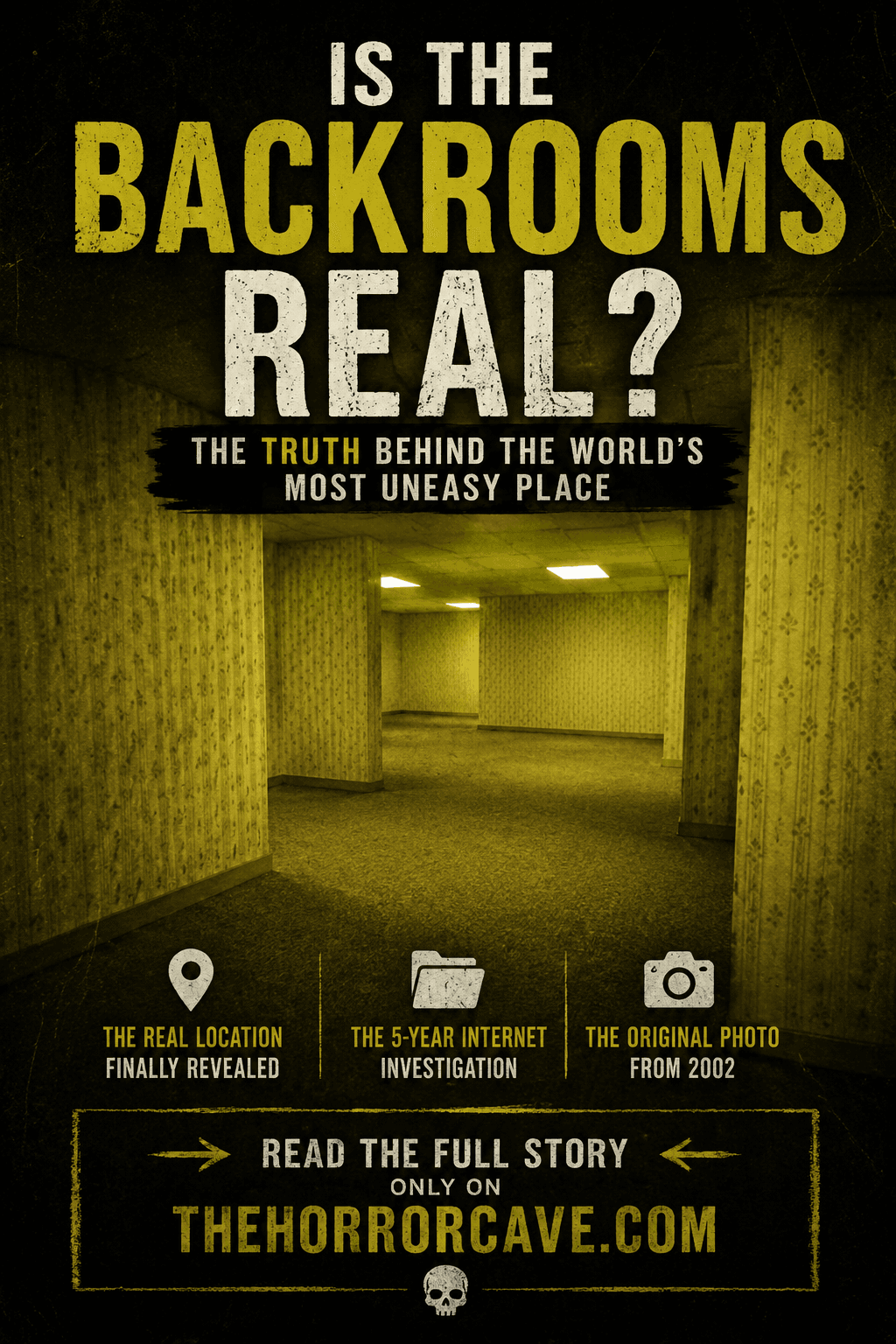
Is the Backrooms real? That question splits into two, and the honest answer is different for each half. The room in the viral photograph that inspired Kane Parsons’ 2026 A24 film Backrooms was real — an actual second-floor space inside a hobby shop in Oshkosh, Wisconsin, photographed during a 2002 renovation.
The demonic mythology built on top of that photograph — the noclip glitch, the endless identical hallways, the thing that might be in there with you — was invented by anonymous strangers on 4chan, starting in 2019. Both halves of the story are stranger than they sound, and only one of them shows up in the movie.
I’ve spent enough of my life inside haunted houses built by other people’s imaginations that I don’t usually stop to ask if the source material is real. Ghosts, demons, cults in the woods — nobody’s asking for my ID at the door. The Backrooms is different, and it took me an embarrassingly long time to articulate why: somewhere at the bottom of this mythology is an actual photograph, taken by an actual person, of a place that actually existed, before several thousand strangers built a religion out of it.
Kane Parsons’ film adaptation, out now from A24, is the fourth or fifth generation of that religion. The photograph is the first.
The 2019 Thread Where “The Backrooms” Got Its Name
Here’s what actually happened, as far as five years of internet archaeology and one very stubborn hobby shop can confirm it. In May 2019, an anonymous user posted on 4chan’s paranormal board, /x/, asking people to submit images that felt disquieting — not scary, not gory, just off. Wrong in a way you couldn’t quite name.
Somebody replied with a photograph: a windowless room bathed in the specific sick yellow of old fluorescent lighting, striped wallpaper repeating into a hallway that didn’t seem to end anywhere sensible, carpet the shade of institutional beige that exists nowhere except in places designed by people who never had to spend time in them.
Somebody else, riffing on the glitch language of first-person video games, wrote the line that made the whole thing catch — the idea that if you “noclip out of reality in the wrong areas,” you end up in the Backrooms. The copypasta that followed built out the rest of the mythology fast: endless identical rooms, the smell of old carpet, the specific kind of madness that sets in when a space refuses to end.
It’s good internet folklore, and it works the way the best internet folklore works — by describing something that sounds like it’s already happened to you. Everyone has been in that hallway. Everyone has felt the specific dread of a space built for people but currently occupied by no one.
What set the Backrooms apart from a thousand other creepypastas is that the founding image looked real — not staged, not rendered, an actual photograph with the specific imperfections a camera produces and a mood board never does. And for years, nobody could prove it, which turns out to be a much stranger fact than it sounds.
Is the Backrooms Real? Why Nobody Could Prove It for Five Years
I want to sit with this part, because it’s the part of the story I find genuinely thrilling, in a way I don’t get to say often about anything involving 4chan. A community of people who spend an unhealthy amount of time being suspicious of everything — staged photos, doctored EXIF data, AI slop before AI slop had a name — collectively failed for half a decade to answer a question that should have had an easy answer: where is this?
Some concluded the geometry was too clean, the repetition too perfect, and decided the photo must be a 3D render, an early, unusually convincing one. That theory held for years — less because anyone had proof than because five years of failing to find the real building will eventually harden into its own kind of certainty.
The Tweet Everyone Ignored
In May 2019 — the same month the thread was catching fire — a Twitter user going by @rkfg_me quietly posted that he thought he’d found the source. “FWIW, I’ve probably found the source image here,” he wrote, with a link and a note that the file’s EXIF data put its creation in 2002. He had almost no followers. Nobody engaged. The lead sat there, correct and completely ignored, for five years.
What finally cracked it was a small, obsessive cluster of internet researchers doing the unglamorous archival work that real detection actually requires. A user called Semliot combed old 4chan archives. Another, Serrara, worked the image hash — the photo’s digital fingerprint — trying to match it against anything else circulating from the same era.
That led them to a filename. The filename led a third researcher, PerditusRedux, back to the dead 2019 tweet everyone had scrolled past. And a fourth, xaft, took that thread to the Wayback Machine, the internet’s own haunted archive, and pulled up a page nobody had looked at in twenty years.
The photo, it turned out, had been sitting in public view the entire time, on a website belonging to a hobby shop.
The Real Location Behind the Backrooms Photo
Here’s the actual answer, the one that took five years and four strangers coordinating across usernames to produce: the building is at 807 Oregon Street in Oshkosh, Wisconsin. For most of the twentieth century it housed Rohner’s Furniture, which closed in 1994. In 2002, a hobby-and-toy retailer called HobbyTown bought the address and began renovating it for their own move-in. Somebody on staff walked the building with a camera during that renovation — the way you do, documenting a space before it becomes something else — and photographed the second floor.
Empty. Fluorescent-lit. Papered in a repeating pattern that, cropped tight and out of context, reads as a hallway extending into nothing. They uploaded it to their own site seven months later, on March 2, 2003, as part of a renovation blog nobody was reading, under the filename Dsc00161.jpg. The renovation finished in 2004.
What’s There Now
The room in the photograph is now an RC-car racetrack. The image that colonized a decade of internet nightmares turns out to have zero design behind it — a furniture store closed, a hobby shop moved in, and somebody photographed the renovation the way you’d photograph a kitchen before you gut it.
The picture sat unread on a blog for twenty-one years while an entire subculture built an afterlife around it, and the actual space it depicted was, this whole time, a few coats of paint away from being where local kids race remote-control cars on Saturdays. That gap — between the mythology’s scale and the banality of its source — is, if you want my honest read, the real horror content of this story. The room got scarier the moment it stopped needing an architect.
Kane Parsons Turned an Internet Myth Into A24’s Youngest Directorial Debut
Kane Parsons had nothing to do with any of that archival work, which matters, because the popular version of this story — teen genius discovers viral photo — isn’t quite right either. He grew up in Petaluma, California, the son of a video game developer and a therapist. I can’t write past that detail without noting his film casts its protagonist as a therapist chasing someone into an alternate dimension; make of that what you will, I certainly did.
As a kid he made Minecraft videos and short films nobody watched. Then he taught himself After Effects, then Blender, and by his own account, 2020 — spent mostly indoors, like everyone’s 2020 — was the year his skills actually clicked. What he brought to the Backrooms was standards the fan content circulating online didn’t have: the videos looked low-fidelity, unconvincing, beneath what the concept deserved. So he built his own version.
“The Backrooms (Found Footage)” went up on his channel, Kane Pixels, on January 7, 2022. He was sixteen. It has since pulled around 78 million views, and it’s a genuinely unnerving piece of work — controlled in a way that made the internet do a double take, because sixteen-year-olds aren’t supposed to direct atmosphere that precisely.
It wasn’t supposed to become a series. Parsons has said the short was meant to stand alone, that he had an entirely different project already in development. The response changed his mind.
By February 2023, Deadline was reporting that A24, Atomic Monster, Chernin Entertainment, and 21 Laps were developing a feature adaptation of “viral horror shorts by 17-year-old Kane Parsons” — a byline worth sitting with, because it means the deal closed while the director was still legally a minor, with his parents sitting in on the early studio Zoom calls. He was 19 when the film released this past May, making him the youngest director in A24’s history.
What Backrooms (2026) Does With the True Story
What A24 actually built him is a full-scale physical commitment to the premise: production constructed more than 30,000 square feet of Backrooms set in Vancouver, enough that people reportedly got lost inside it during the shoot, which is either the most delightful irony in recent memory or the most on-brand production anecdote, possibly both.
Parsons ran roughly fifty separate wallpaper tests hunting for the exact correct sickly shade of yellow — the one the internet had already decided, through five years of screenshots and knockoffs, was the only acceptable version. That’s a strange kind of fidelity to answer to: not a script’s stage directions, but a crowd’s collective memory of a color.
The film understands the assignment on this specific point better than I expected. Chiwetel Ejiofor plays Clark, a man who owns — and by the time we meet him, lives inside — a discount furniture store, following an ugly separation from his wife. Renate Reinsve plays the therapist who goes looking for a missing patient and finds Clark’s dimension instead.
Nobody involved has said on record that the production deliberately echoed Rohner’s Furniture, the real business that once occupied the real building in Oshkosh — so call it coincidence rather than intent. But it’s a coincidence worth sitting with: a film about a man trapped inside a furniture store, adapting a myth born from a photograph of a furniture store’s empty upper floor. It’s the kind of thing horror hands you for free, if you’ve done the homework to catch it.
Critics have been kind to it — Ejiofor in particular keeps getting singled out for how he lets Clark’s grief and his stubbornness sit in the same expression without resolving into either — and audiences turned it into Kane Parsons’ first Certified Fresh, number-one box office opening: $118 million worldwide, the best directorial debut opening in A24’s history.
I already told you what I think of the movie itself in my full review, and walked through what actually happens to Clark in the ending explained, so I won’t relitigate either here. What I want to leave you with is the true story, because it’s better than the marketing, and better than most of the fan theories that circulated before anyone found the receipts.
Is the Backrooms Real? The Short Answer
Is the Backrooms based on a true story?
Partly. The viral photograph behind the Backrooms creepypasta is real — taken in 2002 inside a HobbyTown store in Oshkosh, Wisconsin, during renovation. The lore built around it — the noclip glitch, the entity, the endless rooms — is fiction, invented on 4chan starting in 2019.
Where was the original Backrooms photo taken?
On the second floor of 807 Oregon Street in Oshkosh, Wisconsin — a building that housed Rohner’s Furniture until 1994, then HobbyTown starting in 2002. The space photographed is now an RC-car racetrack.
Who found the real Backrooms location?
Internet researchers Semliot, Serrara, PerditusRedux, and xaft identified it in May 2024, five years after a 2019 tweet by @rkfg_me first flagged the source image and was ignored.
So here’s where the question actually lands. A room existed, for about two years, on the second floor of a building on Oregon Street in Oshkosh, before it became a hobby shop and then a racetrack. A photograph of that room sat on a renovation blog for twenty-one years before four strangers, working independently across old forum archives and a dead tweet, matched a filename to a business record and closed the case.
What actually happened is smaller and stranger than the mythology it produced: an image that caught something true about institutional dread got loose from its source and kept traveling long after the source stopped mattering to anyone but four very persistent internet researchers. That’s the rarest kind of horror story — the ordinary explanation relocates the fear instead of ending it. Somewhere between a furniture store that failed in 1994 and a photo nobody meant to make famous, for twenty-one years, nobody was driving.
— Ethan Vance
For the doll that proves the same point about manufactured belief outliving its source, the real Annabelle doll is worth reading next. Full source on the location itself: the original research writeup at Boing Boing.