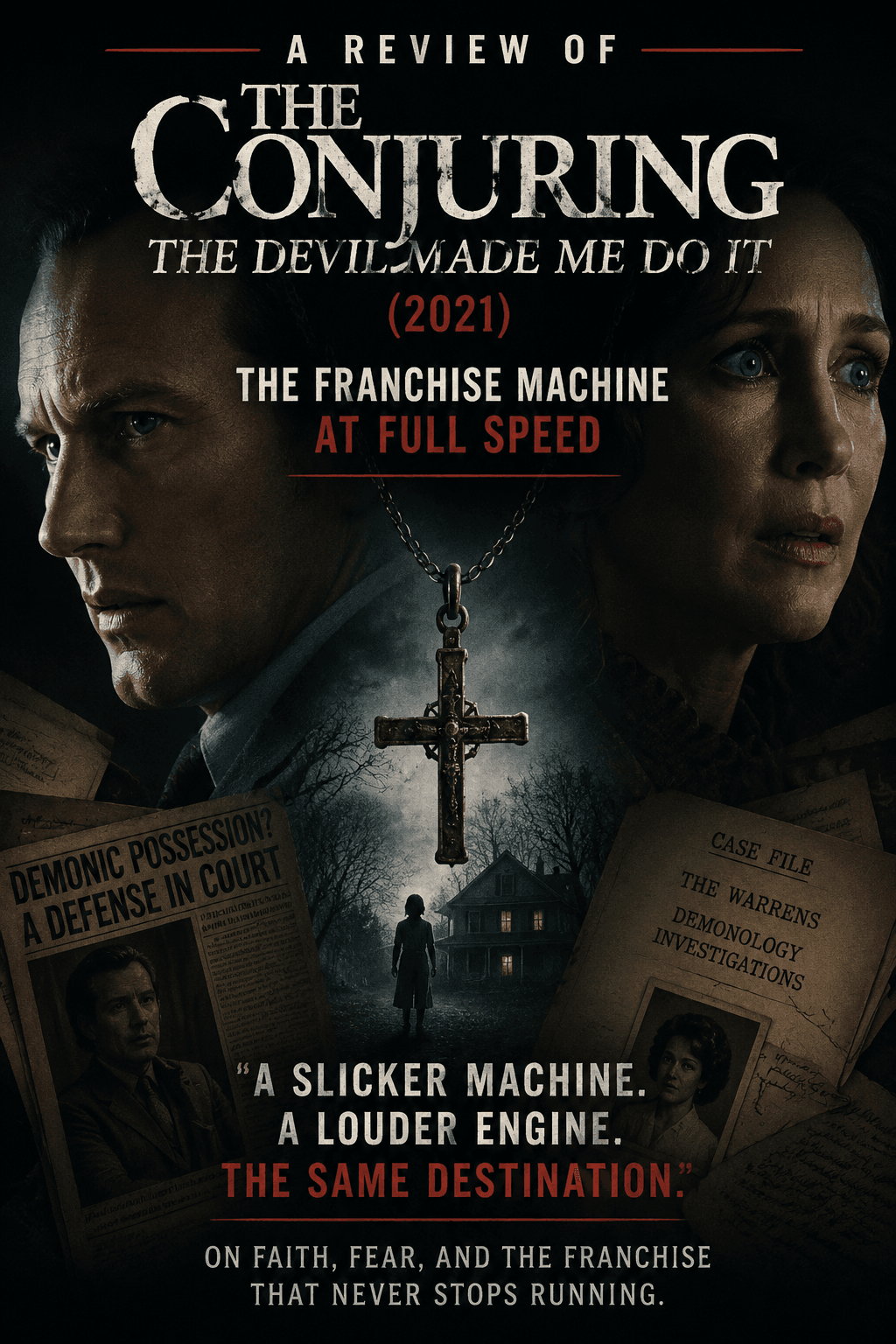
The Conjuring: The Devil Made Me Do It (2021) Review — The Franchise Machine at Full Speed
The Conjuring: The Devil Made Me Do It opens with an exorcism that leaves no room for interpretation. David Glatzel, eleven years old, convulses in a rented Connecticut house while Ed Warren narrates what’s happening in real time: the demon, its hierarchy, its intentions. There is no ambiguity in the room, none in the film’s grammar, none in the way Michael Chaves shoots it — released June 4, 2021, the third Conjuring film and the first directed without James Wan in the chair. Possession is real. Ed Warren knows it is real. Lorraine Warren feels it in her bones. The camera agrees. This is the thesis, delivered in the first four minutes, and it does not waver across the remaining one hundred and eight.
James Wan produced and stepped aside after two entries in a franchise he established and has remained conspicuously distant from ever since. The assignment went to Chaves, who directed The Curse of La Llorona for Wan’s production company and whose primary qualification for the job appears to be comfort operating inside an established grammar. Chaves is a competent craftsman — steady camera, clean editing rhythm, no instinct toward strangeness — and what he brings to the Conjuring universe is precisely what the Conjuring universe wanted: continuity. The same machine, running at temperature, with a new hand on the controls and no intention of altering anything. The film was released simultaneously in theaters and on HBO Max, a pandemic-era concession that revealed something accurate about the franchise’s relationship with its audience: these are films you can watch on a Tuesday evening at home, with reasonable light, and lose approximately nothing. Wan understood this. The franchise restaurant does not require the chef who built the kitchen. It requires someone who can replicate the menu correctly and keep service moving.
What The Conjuring: The Devil Made Me Do It Changes About the Real Case
What the machine chose to build this time is a detective thriller. This is, structurally, the most ambitious thing the franchise has attempted. The Warrens, in this entry, are investigators pursuing a murder — following a curse backwards through victims, uncovering a Satanist conspiracy that connects the Glatzel possession to a subsequent killing and eventually to an underground altar with a totem-based mechanism for initiating possession at a distance. They carry flashlights and consult case files. Ed interviews witnesses. Lorraine has visions and touches objects and receives information that cannot be gathered by conventional means. They are detectives in a thriller solving a supernatural crime.
The detective thriller structure is worth examining as a genre choice, because detective thrillers and horror films need opposite things from their narrative logic. A detective thriller requires resolution — the crime explained, the culprit found, the mechanism of the murder made legible. Horror, at its best, requires an event that remains partially unaccounted for, a residue of the unexplained that persists after the credits. The franchise has spent eight years making films where Ed and Lorraine Warren provide the explanation, where possession is confirmed and the demonic is named and catalogued. The detective structure makes explicit what was already true about the Conjuring universe: these are films about solving the supernatural, and solved problems are exactly what horror cannot survive. You cannot dread a locked room once someone has opened it and identified what was inside.
This is an interesting structural choice given what the real case actually produced. Judge Robert Callahan dismissed the demonic possession defense the day it was proposed — “irrelative and unscientific” were his words — and Arne Johnson was convicted of manslaughter. The film’s response to this inconvenient ruling is elegant in the way that franchise machinery is always elegant: it invents a villain. The Occultist is Father Kastner’s unnamed secret daughter, a practicing Satanist who placed a totem beneath the Glatzel home, initiating the possession that eventually led to Alan Bono’s death. In the real case, no cult existed, no occultist existed, no mechanism existed. What existed was a drunk man who grabbed a young girl and a pocket knife. The legal system required evidence and the possession defense failed because there was none. The film reinstates the defense by manufacturing the evidence.
The Occultist is played by Eugenie Bondurant with elongated, hollow-eyed menace that reads well in trailers and registers as decoration inside the film. She is a narrative function — the external cause the franchise requires to absolve everyone inside the Warren mythology of ambiguity — and Bondurant can only do so much with that. She does what she’s asked. The machine needed a villain and it ordered one, and here she is. More precisely: the franchise needed a villain external to the Warrens — something to stand in the dock in place of the question of whether the Warrens were right. The Occultist exists so that the Warrens never have to be questioned. The case has a solution, the solution has an author, and the author can be confronted in an underground altar. The legal inconvenience disappears behind the thriller.
Patrick Wilson and Vera Farmiga in The Conjuring: The Devil Made Me Do It
What Patrick Wilson and Vera Farmiga do with Ed and Lorraine is something different, and the honest answer is they are the best thing in the film by a margin large enough to be uncomfortable about. These are two actors who have built a real marriage across three films — one that carries the accumulated weight and history the word implies in its older, less romantic sense. Wilson plays Ed as a man whose physical certainty has always been slightly ahead of his body’s actual capabilities, now being tested by a cardiac event that keeps threatening to outrun him. The hospitalization that follows the opening exorcism is the only moment in the film where the Warrens’ certainty has a human cost, and Wilson plays it with a quality the franchise rarely asks of him: genuine diminishment. Ed in a hospital bed, connected to monitors, unable to pursue the case, is Ed stripped of the function the mythology requires of him. Wilson finds something real in that briefly, and the film moves past it quickly. Farmiga understands Lorraine as a woman whose gift is also a cost — when she touches an object and receives a vision, Farmiga plays the impact across the body before the information reaches the voice. The vision sequences — where Lorraine reaches through objects and time to collect pieces of what happened — are the film’s visual showcase, and Farmiga plays them as a woman receiving damage as much as information. Each vision takes something from her. Late in the film, while Ed is in the grip of whatever the possession has opened in him, Farmiga plays Lorraine’s search with something mainstream horror rarely produces: genuine fear for another person. She’s carrying something every time she enters a room and you feel it across the entire film, in the quiet scenes and in the ones the screenplay foregrounds. The “Remember me” device that closes the third act — Lorraine’s whispered invocation pulling Ed back from whatever the demon has done to him — is the most nakedly sentimental gesture in the Conjuring filmography, and Farmiga earns it. The moment works because the marriage was already built. That’s craft applied with discipline, and it is being spent on a film that needs it to function.
Craft in The Conjuring: The Devil Made Me Do It — Chaves, Burgess, and Bishara
Michael Burgess shot the film, reproducing the visual grammar of the first two entries — warm interiors going cold at the edges, deep Connecticut shadows, period texture signaling 1981 without quite landing there. Execution is correct throughout. The limitation is that the grammar contains no room for something the machine didn’t already expect. Wan shot the first Conjuring with John R. Leonetti, who understood how to use the camera’s patience as a form of threat — stillness that precedes the scare, slow revelation that makes the horror cost something before it arrives. Burgess uses stillness as an aesthetic. The camera rests because that’s how these films look. The film reaches for a seventies thriller register — the detective structure, period color grading in the flashback sequences — and captures the surface of that decade while the substance remains out of reach. What made the paranoid thrillers of that era genuinely frightening was institutional rot at their center, the sense that the systems designed to protect you were themselves the threat. The Conjuring universe cannot go there. Its institutions — the Church, the Warrens, the archive of the supernatural — are the solution. That shot doesn’t exist in this grammar. Chaves is a filmmaker who works well within defined parameters, and this franchise is an excellent fit for both.
Joseph Bishara’s score is the franchise’s most reliable constant, and here it continues to be reliable. Atonal string work, carefully calibrated dissonance, cues that escalate without telegraphing the peak. Bishara has scored enough of these films to know exactly what the machine needs from him, and he delivers it at the right moments — professional work in the specific sense that professional means: the job gets done with craft and without exceeding the brief. The genre shift to detective thriller creates a tonal problem that the score partially reveals. Haunted house horror needs ambient dread — sound that accumulates beneath conscious attention and works on the body before the mind catches up. Detective thrillers need propulsion, the forward pull of a case moving toward resolution. Bishara’s atonal palette is built for the former, and here it is providing the latter, and the seam shows in the third act, where the pacing accelerates and the score keeps reaching for dread in a film that has already committed to solution. The ending, where Van Morrison’s “Brand New Day” plays over the resolution, is the most revealing choice the film makes — and the revelation is one the film seems unaware of. Bruno Sauls is dead. Alan Bono’s name is not in the credits. Arne Johnson served five years of a ten-to-twenty-year sentence for the death of an actual man in an actual altercation. The sun comes out. The saxophone plays. The franchise has determined that this case ended well, and it plays that determination over Van Morrison with no apparent awareness of the distance between the song and the history underneath it.
Why Certainty Is What Kills the Horror in The Conjuring: The Devil Made Me Do It
Ruairi O’Connor plays Arne Johnson with more nuance than the screenplay provides for. The film asks him to be sympathetically possessed and convincingly frightened inside a narrative that has already decided his guilt was supernatural, with the legal verdict as a technicality. He manages it. There are moments where the trance states land as genuinely unsettling — the movement between Johnson and whatever the film says inhabits him achieves a quality the script doesn’t earn on its own. The film gives O’Connor very little room before it makes up its mind. Johnson was convicted of first-degree manslaughter in November 1981, sentenced to ten to twenty years, and served five. The film has no real interest in what those five years meant or what the case cost him — he is the protagonist, but the protagonist’s interiority is subordinated to the mechanism. O’Connor does the best work available to him inside those constraints, and those constraints are severe.
There is a version of this material that is genuinely frightening: taking the Warren mythology as a closed epistemic system — one that cannot be questioned, cannot be wrong, and from which there is no exit — and letting that structure produce its own horror. The Conjuring universe, in eight years and eight films, has built a grammar in which that version is structurally impossible. Ed and Lorraine see clearly, they are right, the darkness retreats when they advance. That grammar requires certainty as its foundation, and certainty is the specific thing horror cannot survive. A film where the Warrens face a real possibility of being wrong would be the most frightening entry in the franchise. It is also the entry the franchise would never permit, because the franchise’s grammar and the possibility of Warren error are mutually exclusive.
The Conjuring: The Devil Made Me Do It is the most structurally ambitious entry the franchise has produced and the least frightening film in it. The relationship between those two facts is worth naming: the more the Warrens function as detectives with the answer before the case begins, the less the horror functions as horror. Horror requires uncertainty. The Conjuring universe has manufactured a version of Ed and Lorraine Warren in which uncertainty was a premise they defeated before the franchise started — they arrive at every scene already knowing — and you cannot dread what the protagonists are certain to defeat. The detective thriller structure makes this explicit. They are always going to find the villain. The villain was always going to be findable. The machine demands a resolution, and so one exists. In eight films, across multiple documented Warren cases, the franchise has never once let the Warrens be wrong about what they were looking at. Ed saw possession. Lorraine felt the demonic presence. The camera confirmed it. A certainty machine is expensive to run, and what it produces is testimony delivered with full conviction. The Conjuring universe is the horror equivalent of a franchise restaurant — consistent, competent, and spiritually empty. You know what you’re ordering before you sit down.
Chaves ran the machine correctly. Wilson and Farmiga gave it more than it deserved. Van Morrison played at the end. The real Alan Bono has been dead since 1981, in a case a Connecticut judge decided in a single session, and the franchise made over $200 million on the version where the Warrens were right.
Ethan’s Score: 5.5 / 10
Frequently Asked Questions About The Conjuring: The Devil Made Me Do It
Is The Conjuring: The Devil Made Me Do It based on a true story?
It’s based on the Warrens’ account of the 1981 Arne Johnson murder case — the only US trial to plead demonic possession as a murder defense. The film substantially alters the real record: it invents a Satanist villain (The Occultist), renames the murder victim Alan Bono as Bruno Sauls, and adds a supernatural conspiracy the trial judge dismissed as “irrelative and unscientific.”
Who directed The Conjuring: The Devil Made Me Do It?
The Conjuring: The Devil Made Me Do It (2021) was directed by Michael Chaves, with James Wan producing. Wan directed the first two Conjuring films (2013 and 2016). Chaves previously directed The Curse of La Llorona (2019) for Wan’s production company before taking over the main franchise with this entry.
How does The Conjuring: The Devil Made Me Do It compare to the original films?
It’s the first entry to function as a detective thriller — the Warrens pursue an invented Satanist villain across a murder investigation. It’s the most structurally ambitious Conjuring film and the least frightening. When certainty is the franchise’s primary product, dread has nowhere to accumulate. Score: 5.5/10.