
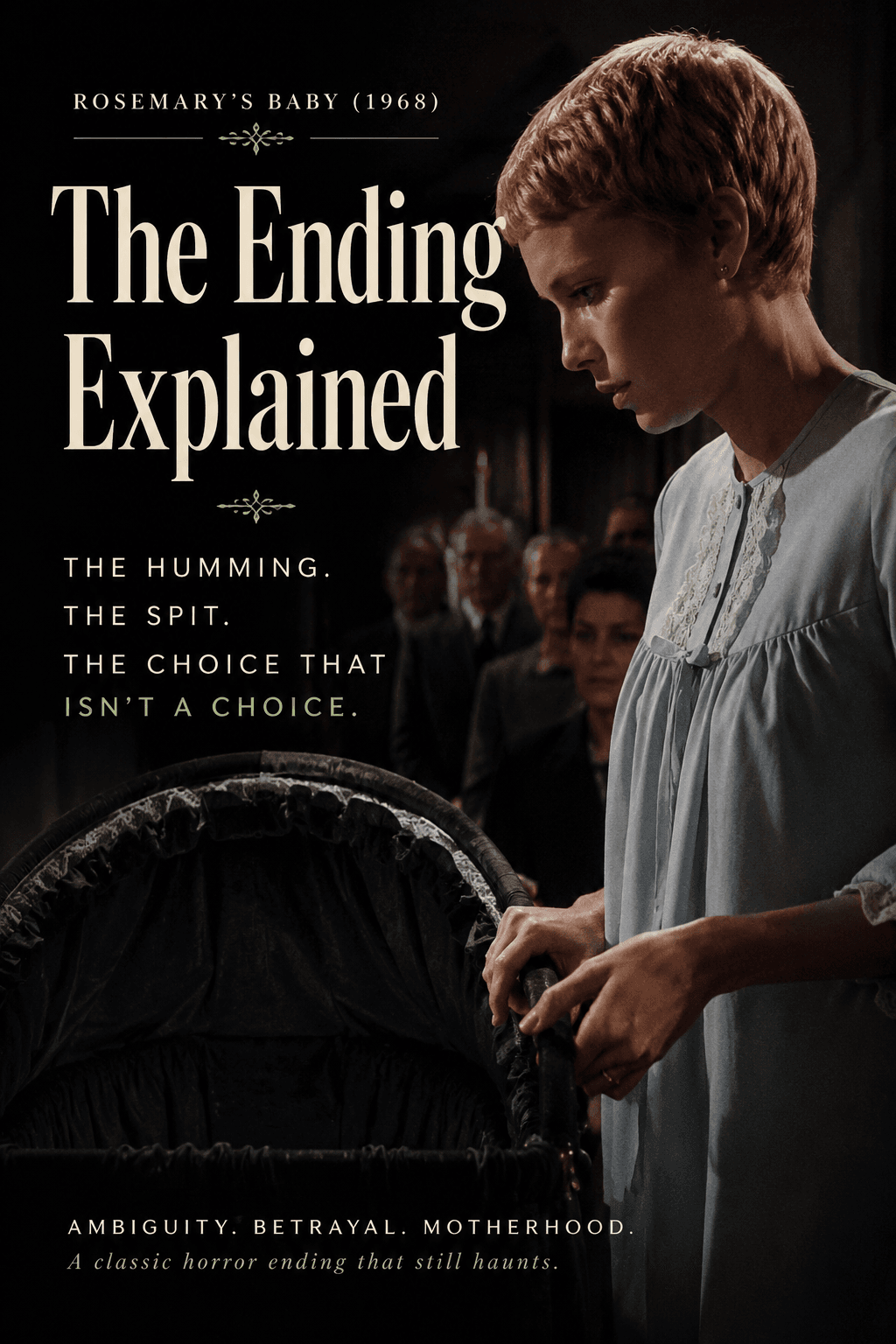
Rosemary’s Baby Ending Explained: What the Humming Means
In 2004, my father took me to the Super Bowl in Houston. Walter was the kind of man who was entirely, physically present in loud spaces — he ate two hot dogs, drank three beers, was on his feet for most of the second half. I stood next to him and performed something that looked like the same experience. I didn’t have the same experience. I was surviving the crowd pressure the whole time, conserving energy the way introverts do in stadiums with seventy thousand people.
He died in 2009. He went to his grave thinking I’d loved that game.
I think about this every time I reach the last four minutes of Rosemary’s Baby (1968). The camera can show you behavior. It has no access to the interior. And the Rosemary’s Baby ending explained depends entirely on that limitation.
What Actually Happens in the Final Scene
The Rosemary’s Baby ending explained begins here: Rosemary enters the Castevet apartment through the passage in her closet, carrying a kitchen knife. She finds the coven gathered around a black bassinet. She walks toward it. The crowd parts — not to stop her, because they’ve been expecting this, managing toward this moment for the better part of a year. She swings the bassinet to face her, looks in. She smiles briefly, automatically, the way a mother does with a new baby. Then her expression changes.
“What have you done to its eyes? What have you done to them?”
The knife falls. She backs away. Roman Castevet steps toward her: “He has His Father’s eyes.” Then, with the precision of a man who has been waiting to say this for nine months: “Satan is His Father, not Guy. He came up from Hell and begat a Son of mortal woman.”
The coven chants. Rosemary shakes her head, says no, backs further away, sits down in a chair. She stares at them. Then Guy comes back from the kitchen.
Guy’s Speech, and Why the Spit Is More Important Than the Knife
To understand the Rosemary’s Baby ending explained, start with the knife — the obvious weapon. Rosemary entered with it. When she finds what’s in the bassinet, the knife falls before she makes any decision about it. What she encounters removes the tool’s purpose before she can act on it.
But Guy’s speech is the real cruelty, and Cassavetes delivers it with the measured tone of someone who has rehearsed this justification until it stopped feeling like lying.
“They promised me you wouldn’t be hurt, and you haven’t been, really. I mean, suppose you’d had a baby and lost it; wouldn’t it be the same? And we’re getting so much in return, Ro.”
The logic is the horror. Guy is explaining this to Rosemary the way you explain something unfortunate to someone who, in the end, simply needs to understand. He has translated his wife’s systematic violation into a cost-benefit calculation and arrived at a comfortable answer. Wouldn’t it be the same is the sentence that reveals what Guy actually believes about the value of her experience. If you want the full accounting of what Cassavetes builds across the film to reach this moment, the piece on Guy Woodhouse as the film’s real horror goes scene by scene through the architecture of that betrayal.
She spits at him.
This is the most important ten seconds in the ending, and it doesn’t get enough attention. The spit is precise — a refusal that skips argument, skips performance, skips any request for Guy to understand what he did. She simply registers that whatever he just said is beneath language. Then she puts the handkerchief on the table and looks at nothing.
She won’t join the coven. She won’t accept what happened. And then, a few minutes later, she starts rocking the baby.
“He Has His Father’s Eyes” — What the Line Does to the Film
Every horror film has a line that functions as the hinge — the moment where the film’s ambiguity either closes or reveals how fully it intended to stay open.
In Rosemary’s Baby, that line arrives later than you think. The review covers at length how Polanski maintained deniability across the entire film — how everything that happens can be explained away, how the horror accumulates in gaps rather than declarations. “He has His Father’s eyes” is the first moment the film drops that strategy. Roman is declaring, within the film’s internal logic, that this is real. The father is real. The nine months of management and isolation and violation were orchestrated for this.
And yet Polanski still refuses to show you the baby.
You hear the coven react. You see Rosemary’s face. You see Argyron Stavropoulos — a man who has traveled to witness this child — lower himself to his knees before the bassinet. The baby’s eyes are confirmed as inhuman, the visual mark of its parentage. But the camera withholds the direct image. The line lands as fact inside the story while the image keeps the audience one remove away from full confirmation.
This choice is often cited as the film’s most sophisticated formal decision. There’s a second withheld image I find more unsettling: Rosemary’s interior. The camera can show her face. It cannot show what she’s deciding, if she’s deciding anything at all. That gap — between the behavior the camera records and the state the camera cannot reach — is what the rest of the Rosemary’s Baby ending explained is built on.
The Humming — What the Body Knows Before the Mind Does
After Rosemary objects that Laura-Louise is rocking the baby too fast, after Roman says “Aren’t you His mother?” and she takes the bassinet handle, she starts humming. Softly, without announcement. The film ends — the camera pulls away to the window, city sounds return, pleasant evening light, and Rosemary is humming.
The melody is the one that plays over the opening credits. Mia Farrow’s voice. The same lullaby.
Most discussions treat this as formal bookending — the film returning to where it started. The bookending earns more examination than that.
The opening lullaby plays over an aerial shot of New York: the Bramford building, the city, the world before anything has happened. It sounds maternal, soft, slightly off in a way you can sense but can’t yet locate. By the time Rosemary hums that same melody over the cradle, you know exactly why it was always slightly off. The off-ness was never about the melody. It was about what the melody was attached to. And it was attached to this, all along.
Two readings circulate about what Rosemary is doing in these final moments. The first: she is defeated — the coven wins absolutely, motherhood becomes the final mechanism of capture. The second: she is claiming the child — making an active choice that the system around her cannot make, because she alone sees a baby rather than an instrument.
Both readings assume a decision. The film shows no decision.
What Polanski films is a woman who sits in a chair after spitting at her husband, gets up when she hears the baby cry, objects that he’s being rocked wrong, takes the handle when it’s offered, and starts humming. There is no visible moment of resolution. The body simply moves toward the child. It was already oriented there before she opened the closet door. The humming starts because something in Rosemary is operating on a logic that doesn’t wait for the situation to be processed before it functions.
What Polanski understood about how people accommodate the unacceptable is that it doesn’t happen through dramatic resolution. It happens through the continuation of small, automatic functions. The body that keeps moving. The hands that adjust the blanket. The voice that hums a melody it has always known.
The horror of the Rosemary’s Baby ending explained is that accommodation has already happened at a level below where choice operates. The spit at Guy is the truest thing in the scene: she refuses, completely, what he did and what it means. And then she hums. Both of those things are true simultaneously. The film holds them without resolving the tension between them, because there is no resolution. That’s what the ending looks like.
What the Ending Leaves Intact
The camera pulls to the window. The city continues. Evening light. The sound of traffic.
Polanski withholds the image that would make this feel like a conclusion — the baby’s face, a tear, a look of horror or tenderness or surrender. He gives you the humming and the window. Which is to say, he gives you life continuing in the form that life takes after the worst thing has happened: forward, without announcement, because the body has already made whatever accommodation it’s going to make.
The ambiguity the film maintained for two hours and sixteen minutes survives into the final frame — the accurate depiction of what that moment actually contains. Which is, I think, the point. That is the Rosemary’s Baby ending explained in its final form: Polanski doesn’t resolve your uncertainty because Rosemary’s uncertainty isn’t resolved. She just keeps moving. So does the film.
FAQ: Rosemary’s Baby Ending Explained
Does Rosemary join the coven at the end of Rosemary’s Baby?
No. Roman explicitly tells her she doesn’t have to join if she doesn’t want to — she only has to be a mother to the child. The ending shows Rosemary orienting toward her baby. It shows nothing resembling acceptance of the cult, its beliefs, or what was done to her. She spits at Guy before she takes the bassinet handle. Those two things happen in the same scene. She has turned her back on everyone in that room. She faces the child.
Why does Rosemary drop the knife?
The film doesn’t explain it, and Polanski is right not to. A knife is a tool for a problem you’ve defined in advance. What Rosemary finds in the bassinet is something she hadn’t defined yet. The weapon becomes irrelevant — it falls before she makes any decision about it. What follows is the film’s real question: what do you do when the thing you came to destroy turns out to be yours.
What does the baby in Rosemary’s Baby actually look like?
The film never shows the baby directly. What the audience receives: Rosemary’s expression of horror, Roman’s declaration that the child has its father’s eyes, Argyron Stavropoulos dropping to his knees before the bassinet. The baby’s eyes are described within the film as inhuman — the visual mark of its parentage. Everything else is withheld. The decision reads as Polanski’s recognition that the baby the audience imagines is more disturbing than anything a practical effect could provide.
What does the humming mean at the end of Rosemary’s Baby?
In the Rosemary’s Baby ending explained, Rosemary hums the same melody that opens the film — the lullaby sung over the aerial shots of New York at the start. The loop it completes was always there: the same voice, the same melody, now attached to what it was always going to be attached to. The humming begins without announcement, without a visible decision. It’s the film’s most precise image of what accommodation looks like when it hasn’t been chosen — when the body simply continues functioning in the direction it was always pointed.
Is the ending of Rosemary’s Baby hopeful or despairing?
The Rosemary’s Baby ending explained refuses both. The final image — Rosemary humming over the cradle, the city carrying on outside — is an accurate picture of what life looks like after catastrophic loss: it continues, and you continue inside it, and whether that continuation constitutes survival or surrender is a question the film does not answer. Polanski ends on the window. The city doesn’t care. The evening is pleasant. The answer is yours.