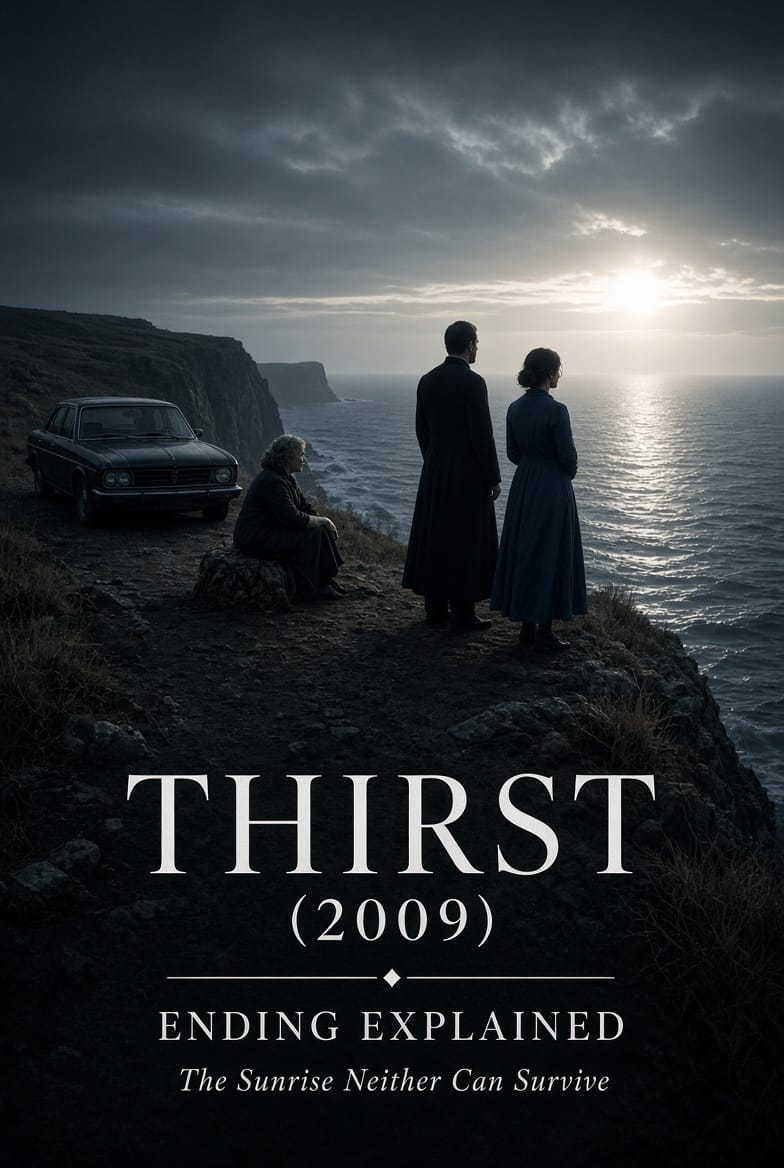
This Thirst 2009 ending explained breakdown starts with the direct answer: Sang-hyun drives Tae-ju to the coast at dawn, refuses to keep killing to survive, and waits with her for a sunrise neither of them can outlast, while Kang-woo’s paralyzed mother is brought along to watch. The plot mechanics are plain enough on a first viewing.What needs explaining is why Park Chan-wook builds that ending out of two things nobody talks about enough: a piece of the film’s own opening scene that Sang-hyun seems to have forgotten he ever said, and a mechanism lifted almost whole from the novel the film is based on. Most writing about this ending treats it as a fairly conventional vampire-movie close — sunlight kills, the leads accept it, the credits roll — and stops there.That reading captures the mechanics but misses the accounting: who actually pays for the ending’s sense of closure, and who’s just standing there when the bill arrives.
The Confessional Scene Thirst Buries in Its Opening Ten Minutes
Start with the forgotten scene, because the film buries the key to its own ending in the first ten minutes and never points back at it. Before any of this happens — before the virus, before Tae-ju, before a single drop of blood is drawn from anyone who didn’t offer it — Sang-hyun sits in a confessional and counsels a parishioner who wants to kill herself. He is not gentle about it. He quotes Saint Bruno directly: suicide is to die a martyr for Satan, worse than murder, worth a life sentence in hell.He prescribes Hail Marys, sunlight, a cold shower, and tells her to stop thinking about it and forget the man who left her. It is the voice of a young priest reciting doctrine he has never had to test against his own life.He tests it at the end of the film. Driving Tae-ju out to a sunrise he knows will kill them both is, by the exact standard Sang-hyun laid out in that confessional, an act of self-destruction — and by his own earlier ruling, that makes it a mortal sin worse than the murders he’s already committed. The film trusts the audience to make the connection itself: it already told us what Sang-hyun believes suicide costs a soul, and then it lets him choose something that fits every definition of suicide except the one he’d need to survive his own theology.Whether that makes his death a genuine penance or the final, hollow performance of a man still practicing a faith he no longer believes protects him is the actual question the ending asks, and Thirst is smart enough to leave both readings live.
The Sunlight Rule the Film Plants Early
The film also does something quieter earlier on that pays off at the very end: it establishes the sunlight rule out loud, in a scene that has nothing to do with the ending on its surface. Kang-woo, dying and desperate for a cure, begs for vampire blood as his last option and says he wants to still see the sunrise over the sea, the moon, the stars, even a firefly. He’s told flatly that vampires can’t have sunlight — that whatever else the blood would fix, it would cost him daylight completely. It’s a rule the film treats as absolute, even though sunlight as a vampire’s death sentence is a much more recent addition to the myth than most viewers assume, as the
real history of vampires makes clear.It plays in the moment like a small, almost cruel piece of world-building, the kind of rule a genre film has to state once so the audience knows the stakes. By the time Sang-hyun drives toward that same sunrise on purpose at the very end, the film has already spent its one explicit explanation of what daylight does to a body like his. The ending is cashing in a rule the film planted earlier, in a scene about somebody else begging to keep the exact thing Sang-hyun chooses to walk into.
What Park Chan-wook Has Said About Guilt vs. Culpability
Park Chan-wook has talked about this choice in terms of guilt rather than culpability, and the distinction matters more than it sounds like it should. In one interview, he draws a clear line: Sang-hyun probably doesn’t have to take responsibility for what he’s become, since he was infected against his will and revived by a transfusion nobody asked his permission for. He takes it anyway.Park has also described the shape of that struggle directly — Sang-hyun spends the film trying to live as a vampire while still holding onto a human, Catholic conscience, which,
Park told ScreenAnarchy, pushes him into “ridiculous, contradictory situations” rather than a clean arc of fall and redemption.And Park is specific about what finally breaks that contradiction: Sang-hyun comes to understand that he is morally corrupt, that he has sinned, and that — despite suicide being its own sin in the Catholic framework he was ordained into — he has to take responsibility for having created something that will keep killing people if he doesn’t stop it. He’s doing the math on two competing sins and picking the one that stops the killing, even though it damns him by his own rule either way.Park’s point is about what a person does once they’ve decided they’re accountable regardless of legal or theological fault — and Sang-hyun’s answer, consistent with the confessional scene at the start, is to treat his own death as the only currency left that means anything. He spends the whole film absorbing what other people need from him — the same appetite this site’s
Thirst (2009) review traces from the very first scene. The ending is the first time he spends something on himself, and it happens to be his life.
How the Ending Adapts Thérèse Raquin’s Own Ending
That’s the half of the ending sourced from Sang-hyun’s arc. The other half belongs to Mrs. Ra, and this is where the film’s relationship to its source material stops being loose. Thirst adapts Émile Zola’s 1867 novel Thérèse Raquin, and most of what gets said about that adaptation focuses on the obvious parallel: a woman trapped in a marriage she didn’t choose, a lover who helps her kill her husband, guilt that never fully clears. What gets skipped is the ending mechanism specifically.In Zola’s novel, Thérèse and Laurent — the murderous couple — eventually stop being able to stand their own guilt or each other. Laurent poisons a glass of sugar water with prussic acid while Thérèse hides a kitchen knife, each secretly planning to kill the other first; when they realize at the same moment what the other is holding, the fight goes out of both of them, and they drink the poison together instead, collapsing in the one moment of physical closeness the novel ever grants them.They die in front of Laurent’s aunt: Madame Raquin, the murdered man’s own mother. She has suffered a stroke earlier in the book that leaves her paralyzed and mute. She can’t speak, can’t move, can’t intervene. Zola’s own text has her sit over the two bodies for the next twelve hours, understanding everything, saying nothing, savoring — the novel is explicit about this — the one form of justice she has left.Park gives that same mechanism a medical name for a modern audience — a stroke, the same device Zola used a century and a half earlier — and casts Mrs. Ra in the exact role Zola wrote for Madame Raquin: present, aware, and completely unable to do anything but watch.
Mrs. Ra as Narrative Device
Park has said directly what he wanted that presence to do. Rather than staging Sang-hyun’s final recognition as an internal monologue or a literal mirror, he’s described using Mrs. Ra’s eyes for the job — when Sang-hyun’s gaze meets hers in that last scene and he sees his own horror reflected back at him, that’s the moment he understands what he’s actually done. It’s a clean piece of filmmaking, and it’s also, if you sit with it for more than a few seconds, a genuinely ugly use of a woman who has already lost everything.Mrs. Ra didn’t choose to become a mirror. She lost a son to the two people who then arranged her stroke-induced silence as convenient collateral, and the film’s ending treats her paralysis as a narrative device that lets Sang-hyun see himself clearly, full stop. The film simply never shows what happens to her once the sun comes up, having already gotten what it needed from her by then.This is worth being angry about, and it’s worth noticing that the film’s own dialogue tips its hand about it earlier without meaning to. During one of the mahjong nights before Mrs. Ra’s stroke, a character jokes about how expressive eyes can be — that a subject and a verb, not just a yes or no, live in where a person chooses to look. It’s a throwaway line about a party game, tossed off before anyone needed it to mean anything.By the film’s end, the same idea is doing real work: Mrs. Ra’s eyes are the only language she has left, and the film spends that language entirely on somebody else’s arc. She gets to communicate exactly once with any agency of her own — spelling out, letter by letter, at the same table where the family used to play for fun, that she knows her son was killed — and even that moment belongs to the plot’s mechanics more than to her as a person the film has any further use for.
Tae-ju Doesn’t Walk to the Sunrise — She’s Dragged to It
Tae-ju’s half of the ending runs on a different logic entirely, and the contrast is the point — though it’s a harsher contrast than it first looks like. Where Sang-hyun spends the film’s back half negotiating with his own conscience, drinking from IV lines instead of throats, rationing violence like a man on a diet he keeps failing, Tae-ju simply stops rationing anything once she’s turned. She kills efficiently, stores blood with the same competence she once applied to running a household, and never performs guilt for the audience’s benefit.It would be tempting to read the ending as the film punishing her specifically for that — the appetite-driven woman dying alongside the conscience-driven man, tidy and moralistic. The staging argues against it. Tae-ju fights the sunrise rather than walking to it. She tries to hide in the car’s trunk; Sang-hyun tears the lid off. She scrambles underneath the car itself; he simply drives it forward and takes the cover away. He drags her physically toward the light while she cries and pleads, and only once there is nowhere left to run does the fight finally leave her.That’s when the exchange happens — “Together again in hell then,” and then, to Sang-hyun specifically, “It’s been fun, Father.” It lands like the joke of someone who has simply run out of moves, gallows humor from a woman with nothing left to fight with.
The Tonal Whiplash Critics Noticed
One critic reviewing the film singled out exactly this scene for how uncomfortable its tonal mix is — Sang-hyun’s calm, resolute refusal to let Tae-ju escape played against her genuinely frantic physical panic, the trunk torn open, the car driven forward to expose her again, over and over, until the scene reads simultaneously as tragic and, in its sheer mechanical repetition, almost darkly funny.That tonal whiplash is consistent with everything the film has been doing all along, now applied to its own climax: Park Chan-wook has never let the audience settle into one register for long, and he isn’t about to grant the ending an exemption. A viewer who laughs, even briefly, at the absurdity of a man calmly dismantling every hiding spot his partner finds is laughing at exactly the moment they should probably be looking away, and the film seems to know that and let it happen anyway.
Thirst 2009 Ending Explained: Who Actually Pays for This Ending
That’s the real shape of the ending this Thirst 2009 ending explained argument has been building toward, once all three pieces are on the table, and it’s a bleaker shape than the film’s own craft — which stages this scene with that genuine, unsettling mix of tragedy and dark comedy — might suggest at a glance. Sang-hyun gets a death that resolves his theology, even if imperfectly and even if it technically damns him by his own earlier rule, and he gets to choose the terms of it.Tae-ju gets dragged into the same ending by the one person she trusted to give her something other people hadn’t already decided for her — one more decision made on her behalf, made worse for arriving disguised as an act of love. And Mrs. Ra gets nothing at all. She becomes the instrument that lets Sang-hyun see himself and the audience understand what’s happening, and then the film simply ends, sunlight rising over three people, only one of whom gets to survive into whatever comes next, and none of whom the film seems interested in returning to.It says something about how the ending is built that Mrs. Ra’s fate afterward barely comes up in writing about this film at all. What happens to a paralyzed, mute woman left alone at a cliffside once the two people who drove her there have burned to nothing is not a small logistical question — someone eventually has to find her, explain nothing, and take her home to a house that no longer has anyone left in it who once claimed to love her — and the film simply cuts away before any of it.It might be the most accurate thing the ending does. The story that mattered, as far as Thirst’s own camera is concerned, was always Sang-hyun’s, and Mrs. Ra’s actual survival was never going to earn its own scene. The silence around her afterward isn’t an oversight. It’s the ending telling you, one more time, who this was really for.
The Counter-Argument: Was This a Mercy Killing?
There’s a version of this reading that pushes back, and it deserves to be taken seriously before it gets dismissed. Tae-ju said it herself, earlier in the film: there’s a blood-thirsty beast growling inside her, and she’d been trying not to hurt anyone despite it. By the ending she’s stopped trying. On that reading, Sang-hyun is stopping a killing spree that would only have widened — sparing whatever victim would have come after Young-du and Evelyn. That’s a real argument, and it’s not one the film asks you to reject outright.But it doesn’t actually undo the problem with how the ending is staged. A mercy killing and a forced one can look identical from the outside, and the film chooses to show this one from the outside almost entirely — the trunk, the car, the dragging — rather than from anywhere close to Tae-ju’s own interior experience of it.If Park wanted the audience to read this as Sang-hyun saving her from herself, he had every tool available to make that reading the obvious one, and he uses none of them: no lingering close-up on relief, no softened score cue, no visual signal of mercy anywhere in the scene. What’s left on screen is a man who has decided, unilaterally, what happens to a woman who has spent her entire life having that decision made for her by somebody else. Whether his reasons are good doesn’t change whose hands are on the wheel.
The Sunrise Returns, and What It Costs
The visual staging underlines the same point the plot mechanics already make. This sunrise is reportedly the first time the sun itself appears on screen since the film’s opening scenes — everything in between has been staged in artificial light, hospital fluorescents, mahjong-night lamps, the deepening dark of a house two vampires have taken over.Bringing the actual sun back for exactly one scene, after withholding it for the entire back half of the film, turns the ending into something closer to a return than an intrusion: the film’s very first images belonged to daylight, before any of this happened, and the ending simply closes that circle on the two people no longer allowed to live inside it.Cinematographer Chung Chung-hoon stages it with plain, unshowy clarity — a cliff, a car, two bodies going still in direct light after ninety minutes of shadow — which fits a film that has spent its whole runtime treating restraint as more disturbing than spectacle. There’s no dramatic countdown, no last stand against the coming light. There’s just daylight arriving on schedule, the way it always does, indifferent to who happens to be standing in it.
Thirst (2009) Ending Explained: Final Verdict
Whether that’s a flaw in Thirst or the most honest thing about it depends on what you think the film is actually arguing. If Thirst is a redemption story, this Thirst 2009 ending explained reading has a real problem to answer: the person most wronged by everything that happened gets no resolution at all, just a front-row seat to somebody else’s. But Thirst was never trying to be a redemption story in the way that phrase usually gets used.It’s a film about hunger finding out what it costs, and the true cost was never going to fall only on the two people doing the consuming. Mrs. Ra losing her son, her voice, her body’s ability to protect itself, and finally her front-row view of the two people responsible finding their own version of peace — that’s the actual bill. The film hands that bill to the audience instead, and dares them to notice that nobody in the frame ever will — one more reason Thirst keeps earning its place among
the best vampire movies ever made.
Ethan’s Score: 8 / 10Thirst (2009) Ending Explained — Frequently Asked Questions
What’s the Short Answer in This Thirst 2009 Ending Explained Breakdown?
Neither happy nor sad, exactly. Sang-hyun and Tae-ju both accept their deaths by the final scene, which keeps the ending from playing as pure tragedy, but the film withholds any resolution for Mrs. Ra, the character who has lost the most and gained nothing. It plays less like a happy or sad ending than like an account finally settled — and one person at the table never agreed to the terms.
Does Tae-ju Want to Die at the End of Thirst?
No. She fights it physically — hiding in the car’s trunk, then underneath the car itself — while Sang-hyun tears away each hiding place and drags her toward the sunrise. Her final line, “it’s been fun, Father,” plays as gallows humor once the fight finally leaves her — the exhausted joke of someone with no moves left.