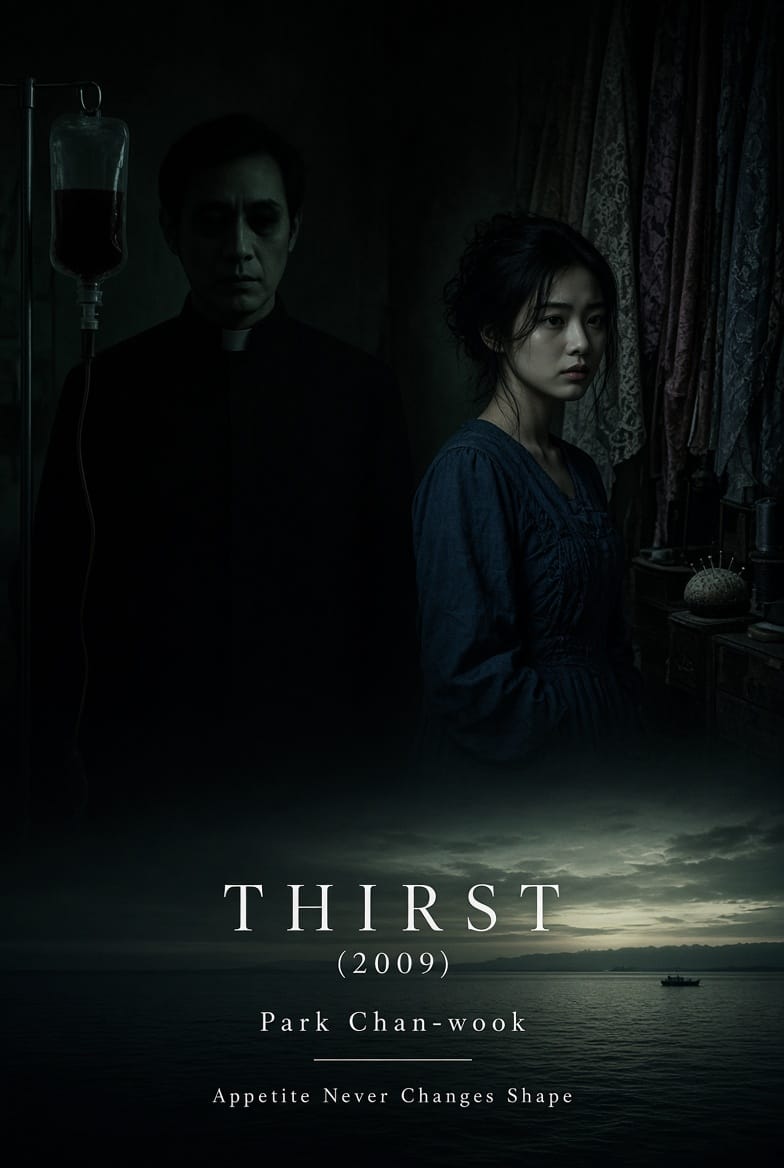
This Thirst 2009 review answers the obvious question first: Park Chan-wook’s Korean vampire film, about a Catholic priest turned vampire by a failed vaccine trial, is a colder, more appetite-driven film than horror’s gentler entries like
Let the Right One In, built on restraint that eventually runs out. Park Chan-wook’s Thirst (2009) is a vampire film that never once uses the word vampire as an excuse. Sang-hyun, a Catholic priest played by Song Kang-ho, contracts the disease the way a man might contract a bad habit: by volunteering for something he thought was virtue.What the film is actually about, underneath the blood and the pale skin and the late-film immolation, is appetite as the one organ that never changes shape no matter what it’s asked to want. Sang-hyun spends the entire film hungry. He is hungry before he is infected, hungry for a version of goodness large enough to matter, and the film’s cruelest joke is that the thing that finally lets him feed does nothing to satisfy that hunger, only gives it a body count.
The Vaccine Trial That Turns Sang-hyun Into a Vampire
The setup is almost administrative in its cruelty. Sang-hyun volunteers for an experimental vaccine trial for a fictional hemorrhagic disease called Emmanuel Virus, hoping to help the parishioners dying of it under his own care. He is warned there is no cure and that infection during the trial means certain death.He goes anyway, and the film treats this decision with more skepticism than reverence — his own bishop wanted him funneled into ophthalmology instead, not martyrdom, and there’s a version of Sang-hyun’s decision that reads less like faith and more like a man volunteering for the only kind of significance available to him. He dies of the virus. He is revived by a transfusion no one fully explains to him. He comes back the trial’s sole survivor, and Korea, hungry for its own kind of miracle, turns him into “the Bandaged Saint” before he’s even finished healing.
Sainthood and Vampirism as the Same Appetite
By the time he’s home, the film has already made its argument: sainthood and vampirism are two names for the same transaction, a person absorbing what other people need from him until there’s nothing left underneath the performance. The crowds outside his church don’t want a priest. They want proof, something to touch, a body that survived what killed everyone else. Sang-hyun gives it to them because giving people what they want is the only fluency he has.It isn’t until he starts drinking blood from a comatose parishioner’s IV line, sneaking into a hospital room at night with the same quiet competence he’d bring to a sacrament, that the film lets its real subject surface: he has always been a person who consumes other people’s need and calls it service. The disease only changed what he had to consume to survive it.
Tae-ju: A Marriage That Was Always a Kind of Servitude
Tae-ju, played by Kim Ok-vin, is where the film’s argument gets its second half. She was taken in as a child by the mother of Sang-hyun’s boyhood friend Kang-woo, raised less as a daughter than as unpaid labor with a bed, and eventually married off to the son she grew up next to — a marriage that functions, in the film’s own telling, as a lifetime extension of the same arrangement. She sleepwalks. She runs barefoot through the streets at night without knowing why.When she finally tells Sang-hyun the truth of it, late in the film, it isn’t a confession so much as an inventory: the mother, the husband she calls an idiot, the years spent feeding and bathing and helping a grown man who couldn’t do it himself. Kim plays this without asking for pity, in the flat tone of someone reporting a fact she stopped being surprised by years ago, which is what makes it land.What Sang-hyun offers her isn’t rescue. It’s permission. Once she learns what he is and what he needs, and once she becomes complicit in getting it for him, something in her that had been rationed her entire life gets handed an unlimited budget, and Kim’s performance turns on a hinge so small you could miss it if you weren’t watching for it — a shift from a woman flinching at her own house to a woman walking through it like she already owns the furniture.When Tae-ju eventually becomes a vampire herself, later in the film, she inherits none of Sang-hyun’s restraint along with his condition. She kills without the hours of internal negotiation he puts himself through, stores blood in kitchen containers with the same efficiency she once applied to a household budget, and the film treats this less as corruption than as permission: the truth of her finally getting to want things out loud, with nobody left whose feelings she has to manage first.
The Cinematography and the Score
Chung Chung-hoon’s cinematography does something specific and unglamorous with this shift. Working with Park for the fourth time, Chung widens his compositions here compared to their earlier collaborations, giving Song and Kim more physical room inside the frame, and the color work leans on green and tungsten light stacked against each other rather than resolved into one register. The film’s first act, before the infection, is comparatively bright — hospital fluorescents, daylight through hospital windows, the flat overhead lighting of the mahjong nights at the Ra family’s shop.Once Sang-hyun can no longer survive sunlight, the film’s palette collapses inward with him, and by the second half whole scenes are staged in spaces so dim the actors’ faces have to do work a wider shot would have done for them. It’s a visual argument that never announces itself as one, built into the plot rather than layered on top of it: the character it’s following can no longer stand to be in daylight, so the film stops giving him any.The score, by composer Cho Young-uk, plays a similar game with restraint. Its recurring musical idea is a recorder rendition of Bach’s Cantata BWV 82 — the aria known as “Ich habe genug,” roughly “I have enough” — which Sang-hyun is shown literally playing on a recorder for the blind priest who mentored him, a small, deliberately unglamorous instrument for a piece about spiritual satisfaction and the willingness to die content.Set against a man who will spend the rest of the film unable to say the words “I have enough” about anything, the cue works less as mood music than as a diagnosis Park hands the audience before the character can articulate it himself. Elsewhere the score leaves room for old Korean pop recordings from the 1940s, used sparingly enough that when they do show up — during the film’s most exposed, most human scenes — they land like a language the characters half-remember from before any of this happened to them.
Production Design and Kim Hae-sook’s Performance
Ryu Seong-hie’s production design carries the same logic as the cinematography, just at the level of rooms instead of light. Sang-hyun’s spaces, before and even somewhat after his transformation, stay austere — white walls, minimal furniture, a monastic emptiness that reads as discipline right up until it starts reading as isolation instead. Tae-ju’s world is the opposite: the family’s dressmaker shop is cluttered and visually discordant on purpose, mixing textures and eras in a way that mirrors her own state, a life assembled out of other people’s leftover choices rather than her own.When her wardrobe eventually shifts from soft nude tones into blue as her transformation completes, it’s the kind of detail that would be silly stated outright and instead works exactly because nobody in the film ever mentions it.Kim Hae-sook, playing Kang-woo’s mother, does the film’s most technically demanding work in its back third with almost none of the tools actors usually get. After Kang-woo’s death — engineered by Sang-hyun and Tae-ju to look like a drowning accident on one of the family’s regular fishing trips, a murder the film stages with a coldness that never asks the audience to enjoy it — Mrs. Ra suffers a stroke that leaves her paralyzed and unable to speak.For a long stretch of the film’s final act, she communicates only through eye movement and a single trembling finger spelling out letters during the same mahjong nights that used to be recreation, and Kim finds a register of pure, wordless accusation that never tips into camp. She becomes the film’s actual conscience once its two leads have stopped having one, watching everything from a body that can no longer intervene, which by the film’s ending is exactly the position Park puts the audience in too.
The Ending, and What It Costs
That ending is where the film’s argument closes its loop. Sang-hyun, watching what Tae-ju has become and what he made possible in letting her become it, drives them both out to the water at dawn, Mrs. Ra brought along as an unwilling witness. He doesn’t kill Tae-ju. He simply waits with her for the sun neither of them can survive, and the film holds on the two of them dissolving in daylight rather than cutting away from it, a choice broken down scene by scene in
Thirst 2009 Ending Explained.It’s the closest thing to penance a character like this gets to perform, staged with the flat clarity of arithmetic rather than triumph or tragedy — a debt finally called in. Mrs. Ra is left alive at the end, the one person who wanted least to survive this story and did anyway, watching the sunrise she can no longer explain to anyone.
Thirst 2009 Review: How the Film Adapts Thérèse Raquin
Thirst is loosely adapted from Émile Zola’s 1867 novel Thérèse Raquin, and the debt is closer than “loosely” usually implies — a woman trapped in an arranged marriage, a lover who helps her drown her husband, guilt that outlives the crime it was meant to erase.Park has said he wanted a vampire film without the genre’s usual furniture: no bats, no stakes, no garlic, the vampire condition used instead as what he’s called a metaphor for exploitation in general, which tracks with a film more interested in what people do once restraint stops being a physical requirement than in anything a cross could ward off.That willingness to sit inside its own unpleasantness is also, in a roundabout way, what got the film made at the scale it was: Thirst was the first Korean production financed and released with a U.S. studio as a genuine co-production partner, not just a distribution pickup after the fact, which meant a story this strange and this committed to discomfort got a real budget behind it instead of being quietly scaled down to something more exportable.
Cannes, Roger Ebert, and the Let the Right One In Comparison
It won the Jury Prize at Cannes in 2009, shared that year with Andrea Arnold’s Fish Tank, and the reception since has split roughly the way you’d expect a film this committed to discomfort to split.
Roger Ebert gave it two stars out of four, praising Park as, in his words, today’s most successful director of horror films “because there’s always more than horror to them,” while still finding Thirst itself too willing to chase “sensation and carnal excess” past the point of philosophical payoff — and he singled out Let the Right One In, released the year before, as the better vampire film for comparison. It’s a fair fight to have, and Ebert isn’t wrong that Let the Right One In finds more in restraint than Thirst ever tries to.But that comparison also misses what makes Thirst worth watching on its own terms: it was never trying to be the tender one. Alfredson’s film is about a boy learning that love and hunger arrive from the same direction. Park’s is about two adults discovering that hunger was always there first, and love was just the excuse they gave it.
Song Kang-ho’s Performance
Song Kang-ho carries the film’s most difficult note, which is that Sang-hyun has to stay legible as a decent man for over two hours while doing things a decent man wouldn’t. He plays the character’s restraint as genuinely effortful rather than as a given — you can watch him talk himself down from violence the way you’d watch someone white-knuckle through a craving, and it’s that visible effort, more than any single scene, that keeps the character from curdling into simple hypocrisy.When it finally breaks, late in the film, the moment reads less like a mask slipping and more like exhaustion winning an argument it had been losing since the opening scene.
Thirst (2009) Review: Final Verdict
This Thirst 2009 review keeps circling back to one idea, so it’s worth ending on it plainly: none of this makes the film an easy recommendation, and it shouldn’t be sold as one. It’s a film about two people finding out what they actually are once nothing external is stopping them, and it refuses to let either the horror or the romance carry more weight than the other.What lingers isn’t the blood, though there’s plenty of it, or the transformation, though it’s handled with real craft by everyone from Chung to Ryu to the actors doing the quiet work in between the bigger scenes, in a film that belongs on any serious list of
the best vampire movies ever made. What lingers is the arithmetic at the end — the specific, terrible clarity of a man finally admitting he never knew how to want less than everything, and choosing, once, to want nothing instead.
Ethan’s Score: 8 / 10Thirst (2009) — Frequently Asked Questions
What’s the Verdict of This Thirst 2009 Review?
This Thirst 2009 review lands at 8 out of 10. Park Chan-wook’s vampire film, adapted from Zola’s Thérèse Raquin, is colder and more demanding than horror’s gentler vampire romances, built around a Catholic priest whose restraint finally gives out. It rewards patience with one of the most fully realized vampire films of its decade.
Is Thirst (2009) Based on a True Story?
No. Thirst is a horror-drama written and directed by Park Chan-wook, loosely adapted from Émile Zola’s 1867 novel Thérèse Raquin, with its setting moved to contemporary South Korea and its adulterous couple reimagined as a vampire priest and his childhood friend’s wife. There is no real vaccine trial, virus, or historical case behind it.