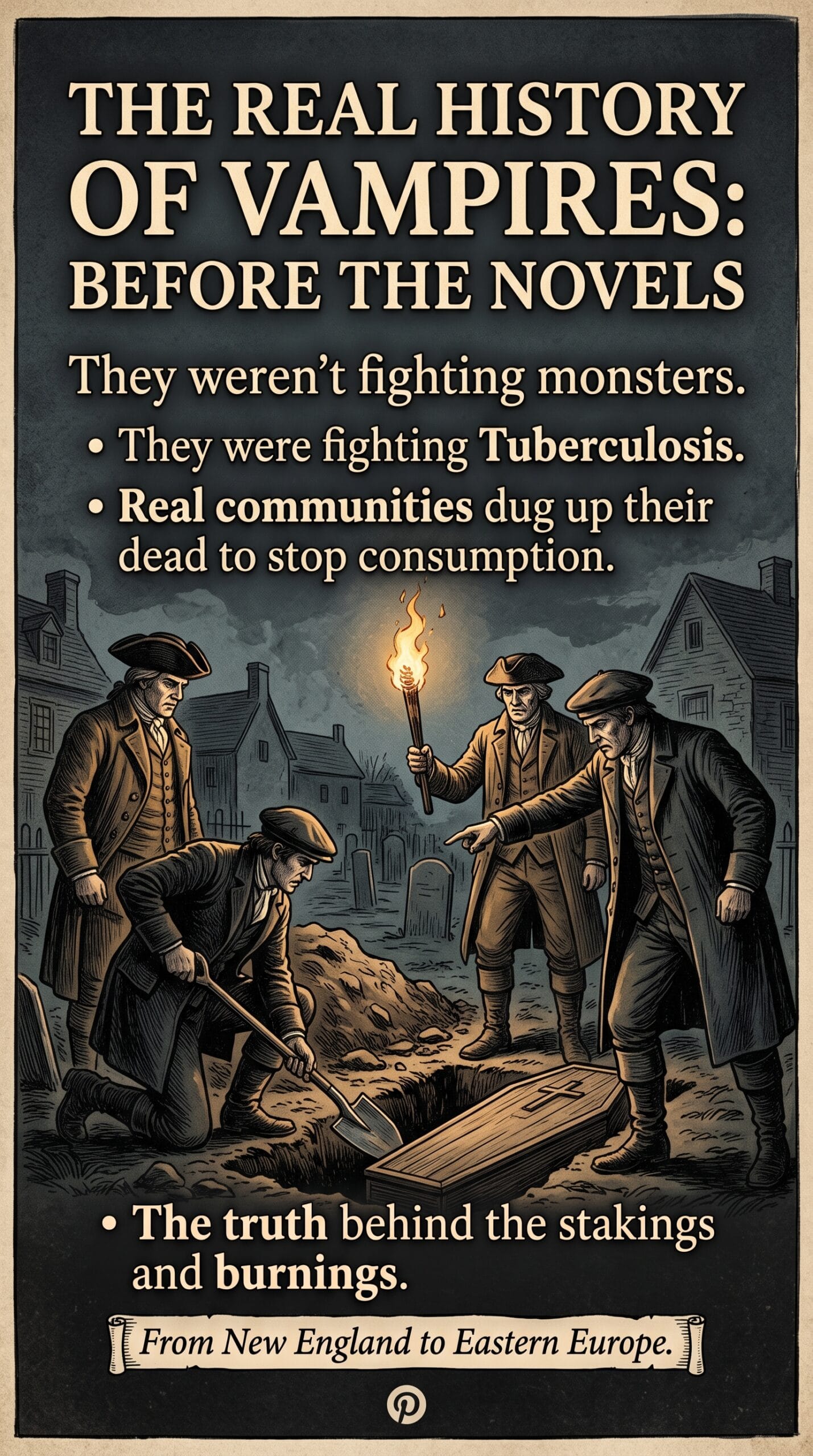
The first time I understood why a community might dig up its own dead, I wasn’t thinking about vampires at all. I was in a small town in interior Texas, on an assignment about rural mental health care that had nothing to do with horror movies, sitting across from a Catholic priest who spent three hours telling me about the people he counseled who had nowhere else to go. He knew exactly what he lacked — no psychology degree, no psychiatric training, nothing that would qualify him to treat the things some of his parishioners were carrying.He did it anyway, because in that town, at that time, he was what was available. He had clarity about the limits of what he could offer and an honesty about the cases where he’d failed that I didn’t expect walking in. I think about that conversation every time I read another breathless article about “the real history of vampires” that treats eighteenth-century villagers digging up their neighbors as a punchline about superstition and ignorance.They were doing exactly what the priest was doing — using the only tool available to them, in the absence of anything better, against something that was actually killing people.Here’s the real history of vampires, direct, before anything else: vampires, as a documented historical phenomenon rather than a folklore motif, are almost entirely a story about tuberculosis, decomposition science nobody yet understood, and grief-stricken communities with no germ theory trying to stop a disease from spreading through their own families. The staking, the burning, the exhumations — all of it happened. People really did dig up their dead relatives, cut out their hearts, and burn them. The thing being fought was consumption, and the ritual was the only medicine on offer.
The Tuberculosis Panics That Started New England’s Vampire Scares
Start in New England, because the record there is unusually good — court documents, newspaper coverage, and, in the case that ends up mattering most, an actual physician’s report written the same week the exhumation happened. Between the late 1700s and the close of the nineteenth century, families across Rhode Island, eastern Connecticut, Vermont, and southern Massachusetts periodically dug up recently deceased relatives to check them for “vampiric condition.” The trigger was always the same shape: one family member died of tuberculosis, and then, over months or years, other members of the same household sickened and died in turn.Nobody in these towns had any way of knowing that tuberculosis spreads person to person through prolonged close contact — that a household sharing a bed, a table, and close quarters through a New England winter was, medically speaking, a transmission chamber. What they could see was a family being consumed from within, one member at a time, and a folk explanation that had circulated in the region for generations: that the first person to die hadn’t really stopped. That something of them kept feeding on the family that survived them.
Mercy Brown: The Last Documented Vampire Exhumation
The most fully documented case is also the last. In March of 1892, in Exeter, Rhode Island, George Brown had already buried his wife and one daughter to consumption when a second daughter, nineteen-year-old Mercy Lena Brown, died of the same disease, and his son Edwin began showing symptoms. Neighbors pressed George to have the family’s graves opened. He gave in. A local physician, Dr. Harold Metcalf, was present for the exhumation, along with a newspaper reporter and a crowd of townspeople, all standing over the grave in plain daylight.The two women who had died first, Mercy’s mother and older sister, showed the decomposition you’d expect after months or years in the ground. Mercy’s body did not. She’d only been buried two months, in a Rhode Island winter, in an unheated aboveground crypt where the cold had slowed decomposition dramatically — likely part of why her body looked “wrong” for how long it had been in the ground, though nobody in that field had the forensic vocabulary to know that’s what they were looking at. What they saw was a body that looked wrong, and that was enough.Her heart and liver were removed and burned on a nearby rock, and the ashes were mixed into a tonic that Edwin was given to drink, on the belief that it would break whatever hold his dead sister still had over him. Edwin died two months later anyway. George Brown, who authorized all of it, outlived every member of his immediate family and died in 1922, thirty years after the exhumation — by which point the first tuberculosis vaccine had just been developed, a world away in Paris.Mercy Brown’s case is the one that reaches furthest, because of who was reading the newspapers that covered it. Bram Stoker kept research notes for Dracula that included New England vampire coverage, and the general scholarly read is that Mercy’s story fed into the character of Lucy Westenra — the young woman in the novel whose wasting illness, death, and reanimation as something that has to be destroyed by the men who loved her tracks disturbingly close to what actually happened to a nineteen-year-old girl in Exeter.The novel’s vampire hunters diagnosing Lucy, debating her symptoms, eventually opening her tomb and staking her — it’s not hard to see where some of that shape came from once you know a version of it happened in Rhode Island a few years before Stoker sat down to write.
The Real History of Vampires: Arnold Paole and the Austrian Investigation
This same instinct predates New England by a century and a half. In a village in Ottoman-adjacent Serbia, a similar panic produced something official and rare: an Austrian government medical investigation, with a written report that survives. Arnold Paole was a hajduk — an armed local irregular — who died from a fall around 1726, having previously claimed he’d been attacked by a vampire and cured himself through folk remedy. Within weeks of his death, several villagers who reported being “plagued” by him also died.His neighbors exhumed him, found what they read as an undecomposed body with fresh blood in it, drove a stake through his heart, decapitated him, and burned the remains — the same instinct that would show up in Rhode Island generations later, arrived at independently. Five years after that, in 1731, a second and much larger outbreak hit the same region, killing at least seventeen people in the village of Medveđa. This time the Austrian military, worried they were watching an actual infectious epidemic spread through a border garrison town, sent army surgeons to investigate formally.Johann Flückinger led a commission that exhumed the bodies in January of 1732 and produced a document that still exists, known by its Latin title, Visum et Repertum — “seen and discovered.” The surgeons reported that twelve of the seventeen bodies they opened showed what they called a “vampiric condition”: blood pooled fresh rather than clotted in the chest cavity, skin that looked “red and vivid” instead of the expected pallor, corpses that appeared plump despite the people having been thin in life, and what looked like new growth in the nails and skin.The report was printed and reprinted across Western Europe within months, and it’s a genuine turning point — the moment “vampire” stops being a regional Slavic folk term and becomes something
educated Europeans are debating in journals and at dinner tables, because a report bearing actual government authority said the evidence was real.
What Decomposition Science Actually Explains
None of what those Austrian surgeons documented required a monster to explain it, and this is worth sitting with directly rather than rushing past, because it’s the part that actually humanizes everyone involved instead of making them sound like fools. A body decomposes at wildly different rates depending on temperature, soil, burial depth, and how it was buried — cold slows it dramatically, which is part of why cases like Mercy Brown’s looked so wrong to the people standing over them.Gas produced by bacterial decomposition bloats a corpse and can genuinely give it a flushed, rosy-cheeked look — unsettlingly close to alive. The same internal pressure can push blood up into the mouth, which is precisely the detail that shows up again and again in these reports as “blood at the lips.” The nails and hair that appeared to have grown had simply been exposed: skin dries and contracts as it decomposes, pulling back from nail beds and hair follicles and creating the visual illusion of continued growth on a body that had stopped growing anything the moment it died.Folklorist Paul Barber’s research on this is the standard reference point now, and it holds up: nearly every physical sign villagers and Austrian army surgeons alike read as evidence of the supernatural has an ordinary, unglamorous forensic explanation. What none of them had, and what nobody would have for another century and a half, was germ theory — any working idea that disease could spread invisibly, person to person, without a monster or a curse doing the spreading. Staking and burning a body was, in the most literal sense available to them, an attempt at quarantine.It didn’t work, because it was aimed at the wrong target. But the impulse behind it — stop the dying, do something, anything, rather than watch it keep happening — is the same impulse that puts a priest with no clinical training in a room with someone in crisis, because there’s nobody else in a hundred miles who’ll sit with them.
The Premature Burial Panic Hiding Inside the Same Fear
The same unreliable read on a body ran in both directions at once. While villages were digging up the recently buried on suspicion that they hadn’t stayed dead, a parallel and much larger panic was spreading through nineteenth-century Europe and America over the opposite fear: that the person going into the ground hadn’t actually died in the first place.Doctors of the era had no reliable test for death beyond holding a mirror under the nose to check for fogging, and conditions like catalepsy and severe hypothermia could produce something that looked exactly like death to anyone without modern diagnostic tools. Newspapers ran lurid stories of coffins found clawed open from the inside. Inventors patented dozens of “safety coffins” — spring-loaded lids, cords tied to a corpse’s hand that rang an aboveground bell if it so much as twitched, one design with a battery-powered alarm and a flag that raised itself.No one has ever documented a single case of one of these devices actually saving a life. What they document is the same fear driving both directions of the same problem: nobody in this period had a reliable way to read the line between alive and dead, and every ambiguous signal got filled in with the worst possible story.
How the Folk Vampire Became a Literary Aristocrat
The folk panic and the literary vampire are two different histories that happened to collide, and it’s worth marking exactly where. In the summer of 1816, Lord Byron, his physician John Polidori, and Percy and Mary Shelley were trapped indoors at a villa on Lake Geneva by weeks of unrelenting rain, and passed the time with a ghost-story contest that produced two of the genre’s founding texts on the same rainy stretch: Mary Shelley’s Frankenstein, and Polidori’s The Vampyre, published in 1819.Polidori’s story did something the folk accounts never had — it made the vampire aristocratic, charming, and seductive, the same predator this site has already traced across
the best vampire movies ever made, rather than a reanimated farmer dug up by his own neighbors. That’s the version that caught on.Sheridan Le Fanu’s Carmilla followed in 1872, and by the time Bram Stoker sat down to write Dracula in the 1890s, the literary vampire had already been circulating in exactly this form — cultured, foreign, aristocratic — for most of a century, a lineage Stoker’s own estate would later fight to protect when a German studio borrowed it
without paying for the rights. Stoker needed a name for an aristocrat he’d already imagined, which is most of why what happened next was always going to be about borrowing a title rather than a biography.
Was Vlad the Impaler a Real Vampire?
It’s worth being precise about what doesn’t belong in this story too, because vampire folklore has picked up genuine historical figures the way a coat picks up lint, and separating them out matters. Vlad III of Wallachia — Vlad the Impaler, Vlad Dracula — was a real fifteenth-century prince who fought the Ottoman Empire with a brutality that impressed even the Pope, and Bram Stoker did take his surname’s derivation, “Dracula,” from a book on Wallachian history he read in 1890, where his own research notes record the translation: “Dracula in Wallachian language means DEVIL.” That’s the entire connection.Stoker took a name and a geographic setting. He didn’t borrow Vlad’s biography, his methods, or any documented belief that Vlad himself was supernatural — the vampire-Vlad link that most people now treat as established fact was popularized by two American historians, Radu Florescu and Raymond McNally, in a 1972 book, and it remains genuinely contested among historians rather than settled.The casualty numbers attached to Vlad’s impalements have also been wildly inflated over five centuries of retelling — one recent estimate puts the real figure at something like a twelfth of what gets repeated as common knowledge — which makes him a fifteenth-century war criminal by the standards of his own era, documented and real, four centuries before his name got attached to a monster that never existed.
The Porphyria Myth That Wouldn’t Die
The other myth worth killing outright is more recent, and more embarrassing, because it wore a lab coat. In 1985, biochemist David Dolphin proposed that a rare blood disorder called porphyria explained the entire vampire legend — sufferers, he argued, would be light-sensitive, driven by some biological mechanism toward blood, and averse to the sulfur compounds in garlic. It’s a tidy story, and Dolphin told it well enough, at a conference and later on NBC, that it calcified into something people now repeat as established science, when the actual science underneath it falls apart on inspection.Light sensitivity barely appears in the earliest vampire accounts at all — it’s a much later addition to the mythology, largely a twentieth-century invention layered on by cinema. Porphyria doesn’t produce a craving for blood in any documented case. And the whole premise runs backward: it treats vampires as real enough to require a medical diagnosis, when the actual explanation sits one level down, in misread decomposition and untreated tuberculosis — centuries older than the rare genetic disorder retrofitted onto the folklore decades after the fact.A myth about a myth still hurts real people when it escapes into the world uncorrected — porphyria patients have had to field questions about whether they’re secretly dangerous, and there’s at least one documented case of a man citing the condition as part of his defense after committing murder.
The Real History of Vampires: What’s Actually Left
What’s left, once you clear out the misattributed prince and the debunked disease, is smaller and sadder than the folklore that grew around it, and I think that’s the actual point rather than a disappointment. Families in Exeter and Medveđa were watching people they loved die in a pattern they had no framework to explain, and they reached for the only intervention within reach — a ritual, inherited and half-understood, that at least let them do something instead of standing at a graveside a second time with no idea what came next.The word itself, vampire, most likely traces back to a Slavic root — upir or upyr — that predates any of this by centuries, folk vocabulary for exactly this fear long before an Austrian army surgeon ever put a Latin title on it. That continuity is the actual history here: not a bloodline of monsters, but a bloodline of grief looking for a shape it could act on.What stayed with me is that he never pretended the tools he had were the right ones — just the ones that existed, in that place, at that time, for people who had nothing else. George Brown burning his daughter’s heart on a rock in a Rhode Island field wasn’t so different. The thing that would have actually worked — antibiotics, a real understanding of contagion — was still a century and a half away.What they had instead were each other, a ritual, and the specific human refusal to let people they loved die without a fight, even a fight aimed at the wrong enemy. It’s a story about what people do with grief before the real explanation has been invented — the same story, really, as a priest with no training sitting with someone anyway, because waiting for the right tool to arrive was never actually an option.
Real Vampire History — Frequently Asked Questions
What Is the Real History of Vampires?
It’s tuberculosis, misread decomposition, and communities without germ theory trying to stop a disease from spreading through their own families. The staking and burning documented in places like Exeter, Rhode Island and Medveđa, Serbia targeted the wrong cause, but the panic itself was a genuine response to a genuine, unexplained pattern of death.
Was Vlad the Impaler an Actual Vampire?
No. Vlad III of Wallachia was a real fifteenth-century prince known for brutal warfare against the Ottoman Empire. Bram Stoker borrowed only his surname’s translation — “devil” — for the character’s name. The vampire-Vlad connection was popularized by historians in 1972, decades after Stoker’s novel was published.