There is a particular kind of love that arrives disguised as belonging, offering you a family, a place, a set of people who already seem to have decided you’re one of them before you’ve done anything to earn it, and showing you the terms of the arrangement only once you’re too far in to walk back out cleanly. I’ve sat across a table from that exact structure in my own life, watched someone I loved decide that love was a lever they were entitled to pull.It took me longer than I’d like to admit to see the mechanism instead of the warmth wrapped around it. What made it hard to see wasn’t cruelty. It was competence.
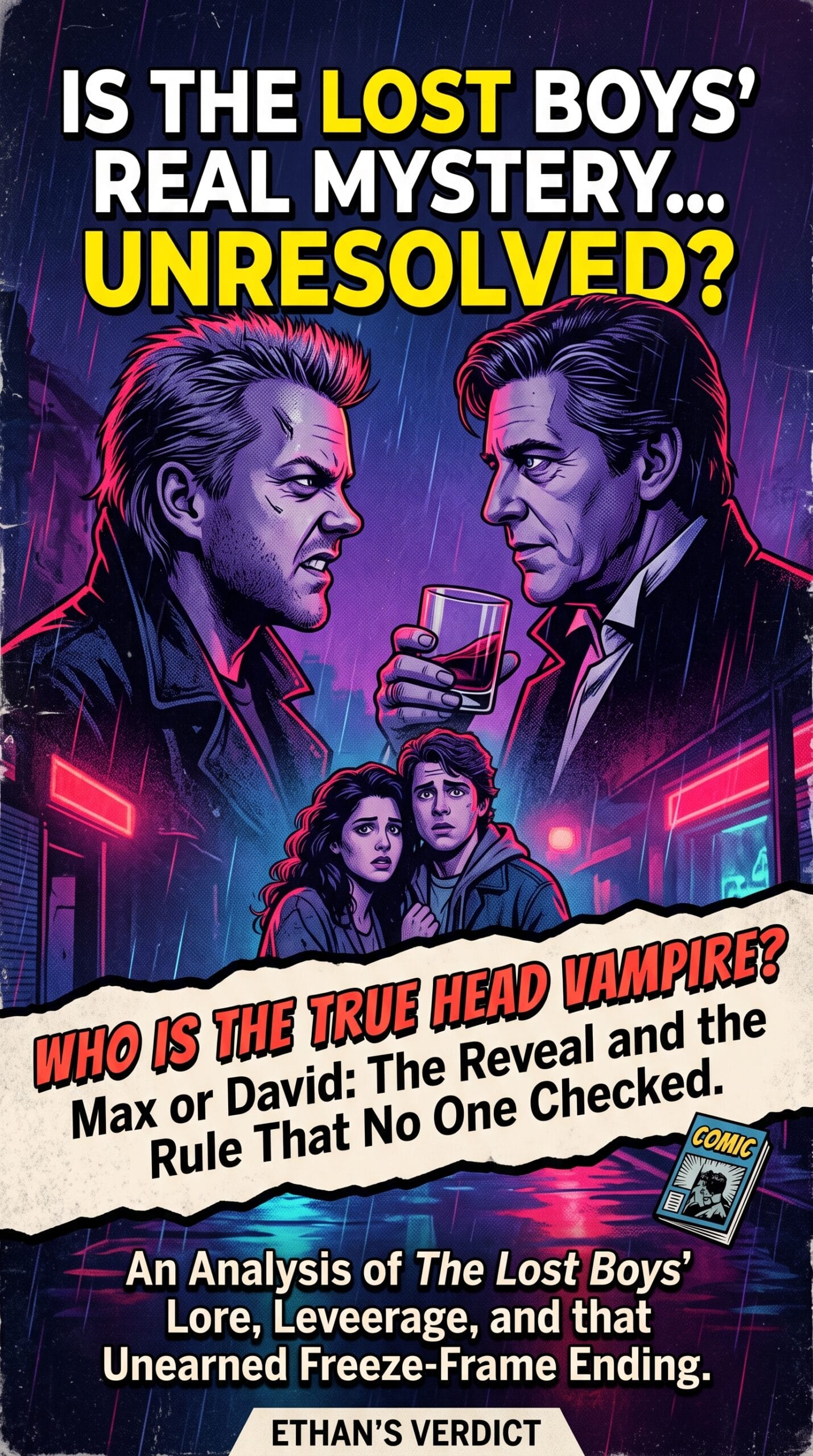
The Lost Boys, Joel Schumacher’s 1987 vampire film, runs on that same mechanism, gears exposed. If you came here wanting to know who is the head vampire in The Lost Boys, the short answer is Max, the mother’s boss at the video store, not David, the gang leader every instinct in the audience points toward first. The film’s own answer arrives late and lands strangely. The reveal itself is clean.What it exposes about the mystery leading up to it, and about the two characters left holding the film’s least-examined loose end, is the real story. I’ve already made
the case for why the craft around this movie still works even when its plot doesn’t, and for thirty-nine years the movie has gotten credit for a mystery it never actually plays fair.
The Rule Comes From a Comic Book, and the Movie Never Lets You Forget It
Here’s the premise everyone remembers: somewhere in Santa Carla there’s a head vampire, and if Michael and his friends can figure out who it is and kill him, every half-turned victim snaps back to human. Simple. Almost mathematical. The kind of rule a mystery needs if it wants the audience playing along instead of just watching. And the film does give you that rule, stated with total confidence, early enough that you’re meant to carry it through the whole back half like a flashlight.The Frog Brothers deliver this information the way they deliver everything, with the unearned authority of two kids who’ve mistaken a vampire-hunting comic book for a field manual. “Look, it says here that if you kill the head vampire, all half-vampires will return to normal.” That’s the entire evidentiary basis for the rule the movie’s third act runs on: a comic book, sold in a shop run by two boys who also, in the same scene, tell Sam his mother might be dating a monster with total sincerity, no sense that any of this should require corroboration.I don’t think this is a screenplay failure exactly, it’s a deliberate joke about how kids build entire belief systems out of pulp, and it mostly works as comedy. What I don’t think the film earns is spending its climax cashing a check written by that same unreliable source.
David Wasn’t the Head Vampire, and the Film Knew You’d Assume He Was
Watch what happens when the rule gets tested. Michael kills David in the house, and Edgar Frog, watching from the doorway, says the thing the whole movie has been building toward: “You destroyed the head vampire. It’s all over.” And then, immediately, brutally, the film takes it back. “Nothing’s changed,” Sam says. “I don’t feel any different,” says Michael. Two lines, maybe four seconds of screen time, and the entire mechanism the audience has been trusting for an hour collapses.David was muscle, a lieutenant, the most visually commanding member of the gang and therefore the character every viewer’s instincts pointed at, never actually the head vampire himself, and the film knew that and used it. I respect the mechanics of that misdirect even while I resent what it does to the rest of the mystery’s credibility. If the rule the Frog Brothers found in a comic book was wrong about who counted as the head vampire, on what basis does anyone, character or audience, trust it again thirty seconds later when Max turns out to be the real one?
Who Is the Head Vampire in The Lost Boys, Really?
The answer the film gives you is: don’t ask, just watch what happens next and accept that this time the rule holds. Sam unmasks Max through blunt accusation, more instinct than actual detective work, “you’re the secret that David was protecting,” and Max simply confirms it.“Mm-hm.” Grandpa’s earlier folklore, the one about never inviting a vampire into your house because it “renders you powerless,” turns out to matter only because someone, at some point off-screen, already extended Max an invitation he shouldn’t have gotten, which is how he’s sitting at the dinner table with enough power to threaten a family of four and nobody stops him.That’s a rule the audience never gets to see broken. It’s told to them after the fact, folded into the reveal, indistinguishable from it. A fair mystery gives you the pieces before it asks you to feel clever about assembling them. The Lost Boys gives you the pieces during the reveal and asks for the same satisfaction anyway. Most people grant it.The scene is genuinely well-staged, Herrmann plays the whole confrontation with the calm of a man who has already won, refilling a drink while a family realizes what he is, and by that point in the movie you want a villain more than you want a properly clued solution. Wanting something and being given something honestly aren’t the same transaction, and a movie built around a mystery ought to know the difference even when its audience is willing to forgive it for not knowing.
Max’s Real Plan Was Never About the Boys
What actually gets revealed in that scene is a motive, and it’s the most honest thing in the entire third act. Max turned Sam and Michael into half-vampires as leverage against their mother, the whole recruitment aimed at Lucy from the start rather than at building David a bigger gang. He tells Lucy directly, in front of everyone, without embarrassment, exactly how the plan worked: “I knew that if I could get Sam and Michael into the family, there’s no way you could say no.” The boys were always leverage, never the actual target.He built an entire courtship around the two people least equipped to see it coming, offered them belonging, danger, a version of masculinity their absent father hadn’t given them, and every bit of it was constructed backward from what he wanted from their mother. “It was all going to be so perfect, Lucy. Just like one big happy family.”I’ve heard that sentence’s shape before, dressed differently, aimed at me instead of at a fictional divorced mother in a beach town, and I recognize the specific coldness of someone explaining, almost proudly, exactly how they engineered your consent, the same rhetorical trick
another vampire in this cluster uses to frame control as choice.That’s engineering dressed as seduction, the kind that leaves you no real choice once you understand the blueprint, and you don’t usually get to see the blueprint while you’re still standing inside it.
The One Rule This Film Actually Earns
Set against that, it’s worth noticing what the film does get right about its own rules, because the contrast is what makes the cure’s absence so glaring later. Star tells Michael, in the cave, that neither of them counts as a full vampire yet, “you’re like Laddie and me,” still theoretically salvageable, still capable of walking it back. The threshold is explicit: “we’re not one of them, until you make your first kill.”What the film does with that threshold is genuinely sharp. Michael was supposed to be Star’s first kill, David’s idea of initiation as intimacy, and she couldn’t do it. “Why didn’t you kill me last night?” he asks her. “You were supposed to be my first,” she admits. “But I couldn’t.” When he pushes for a reason, she gives him one plainly, no metaphor standing in for it: “Because you care so much about me?” “Yes, I do.” That’s a clean setup, a clear test, and an answer the film actually lets its characters say out loud.Which only sharpens the question of why the cure, the rule the entire climax supposedly resolves, gets none of that same care.
Grandpa Knew All Along
Grandpa deserves a harder look here too, because his foreknowledge is its own quiet accountability gap. He delivers the invitation rule with the flat authority of someone who’s recited it before, “don’t ever invite a vampire into your house, you silly boy, it renders you powerless,” and closes the film with a line that only makes sense if he’s known about Santa Carla’s actual nature for longer than one panicked night, “the one thing about living in Santa Carla I never could stomach, all the damn vampires.”A man who’s lived with that knowledge long enough to be bored by it, who never once uses it to protect his own daughter or grandsons until the house is already under siege, functions as a second version of the same institutional failure the film keeps circling, dressed up as comic relief. The movie plays it for a laugh. I take it more seriously than that.
Star and Laddie Never Get Their Answer
Here’s where the film loses my patience completely, because after building an entire climax around a family being weaponized as bait, it doesn’t bother telling you what happens to the two members of that family who spent the whole movie as collateral. Star and Laddie aren’t background characters.Star is explicitly established, by her own dialogue, as occupying the exact same half-vampire status as Michael, and Laddie is a young child, eight or nine years old, dragged into this by adults who wanted a project, years away from the motorcycles and leather jackets that let David’s gang look like a lifestyle choice instead of a crime scene. His fear in the back half of the film, “they’ll be coming for Laddie and me, won’t they,” is one of the only moments where the stakes register as something other than stylish.It matters that Star isn’t the only character the film treats this way, either. Laddie never gets a single line of dialogue that isn’t fear or gratitude directed at an adult, no interiority beyond being frightened and then being saved, which is a reasonable thing to ask of a child character in a vampire movie and a genuinely thin one to ask of a film that otherwise spends real care sketching Edgar Frog’s overcompensation or David’s controlled menace. The imbalance is a function of whose psychology the story actually considers load-bearing, not an accident of runtime.Star herself gets even less room than the plot mechanics suggest she should. She exists in this story almost entirely in relation to men: bait David uses to lure Michael toward the gang in the first place, a warning system who tells Michael what not to do inside the cave, a hostage David dangles to keep Michael compliant once he starts pulling away.She gets exactly one moment where the film treats her interiority as worth a full breath, the confession that she and Laddie are trapped the same way Michael is, neither one a killer yet, both still hoping somebody gets to them in time. Then the plot moves on, and so does the film’s interest in her, because her function from that point forward is to be recovered rather than to act.A character built almost entirely out of what other people do to her is exactly the kind of character a story owes a real ending, not a reaction shot in a group hug.
What the Ending Actually Confirms, and What It Just Assumes
So Max dies. Grandpa’s jeep comes through the wall, the fence posts do their work, and the movie cuts to Michael calling their names into the dark, “Star! Star!” “Laddie.” They appear. They’re alive. Everyone hugs, everyone asks everyone else if they’re okay, and the answer is yes, apparently, across the board. What nobody in the scene ever says, what the film never bothers to have a single character confirm out loud, is that the cure actually worked.Nobody checks Star’s reflection in a mirror. Nobody asks Laddie if he still craves blood. The comic book said killing the head vampire would return the half-vampires to normal, and the film simply assumes you’ll extend it the same unearned trust the Frog Brothers extended it in the first place, this time with no test at all, not even the fake test David’s death gave you.I went looking for someone else who’d noticed this gap before writing that sentence, because I didn’t want to be the only person bothered by it, and the closest thing I found was a fan discussion thread where someone else had asked the same question and gotten the same silence in return. In nearly four decades of people picking this film apart line by line, nobody seems to have gotten a real answer, because the film never gave one.
The Freeze-Frame Is Doing the Movie’s Work For It
Look at what the camera actually does in that final scene, because the visual argument is doing work the dialogue refuses to do. Everyone gathers in one frame, arms around each other, lit warm after two hours of blue-and-neon dread, and the staging alone tells you the danger has passed. It’s the oldest trick in the genre: assemble the survivors, hold the shot a beat longer than necessary, let the audience’s own relief fill in whatever the script left unsaid. Composition is standing in for confirmation.A viewer walks away from that image with the same certainty they’d have gotten from a line of dialogue, because the grammar of a reunion shot has trained us to read it as resolution regardless of what it actually resolves. That’s a legitimate filmmaking tool, and I don’t fault Schumacher for reaching for it.I fault the reflex, mine included on every earlier viewing, to accept a warm image as a substitute for an actual answer, especially when the question involves whether a frightened child and a young woman who spent the whole film as someone else’s leverage got their bodies back.
So, Is the Ending a Cheat?
I don’t think this is incompetence. Boam and Schumacher were plenty capable of clean plot mechanics when a scene needed them: the invitation rule pays off exactly when the film needs it to, and the first-kill threshold gets stated and then meaningfully tested in the cave, with Star giving Michael a real answer for why she didn’t go through with it. Those rules get set up and respected.The cure doesn’t get the same treatment, and I think that’s because the film’s real interest was always getting to the fight, watching Grandpa’s line land, watching the family survive intact enough for a freeze-frame. The cure was just the rule that got everyone there.The trivia around this film’s unmade sequel supports the same read. Schumacher spent most of the next decade trying to get a follow-up made, built around the ambiguity of whether David actually survived, and the studio’s own appetite for a sequel confirms that nobody involved in making this story treated the cure as settled business either.The same imprecision that left David’s fate open on purpose is the imprecision that left Star and Laddie’s recovery unconfirmed by accident, and the fact that one serves the studio’s future plans while the other just serves the runtime arguably makes the second failure the more honest one, since nobody was even trying to be strategic about it.What galls me, watching it again with all of this laid out, is how little it would have cost the film to earn this properly. One line. “Are you human again?” “Yeah.” Four words either direction.The movie has that kind of economy everywhere else, Grandpa’s closing joke does more emotional work in one sentence than most horror endings manage in a full scene, and I don’t believe for one second that the same script that trusted an audience with that kind of compression suddenly couldn’t spare a breath for the two characters whose entire narrative function was needing to be saved. It could. It chose the freeze-frame instead.I keep coming back to the comic book, actually, more than the mirror rule or the invitation or any of the mechanics that get treated with more narrative respect. A comic book is where the entire cure mythology originates, an unreliable, half-joking, kid-logic source that the film asks you to trust completely by the third act, the same way I once trusted a version of love that had already decided, long before I found out, exactly how far it was willing to bend the truth to keep me inside it.You don’t usually get to see the architecture while you’re standing in it. The comic book is the one place in this film where you can, if you’re looking, and almost nobody looks, because the fence posts and the freeze-frame arrive fast enough to keep you from asking the question that actually matters: did this work, or did everyone just agree, together, that it must have.I know how that agreement gets made, because I made a version of it myself for longer than I want to put a number on, choosing the warmth of the story over the tedious work of checking its math.
Ethan’s Verdict: The film gets away with something it shouldn’t, and I’m not sure whether to be angrier at the screenplay for the shortcut or at four decades of audiences, myself included on every earlier watch, for never once asking Star if she still had a reflection. It would have taken four seconds and one line of dialogue. Instead it took me a genuinely bad breakup and a lot more rewatches than I’d like to admit to notice the shape of the silence where that answer should have been.
Frequently Asked Questions
Who is the head vampire in The Lost Boys?
Who is the head vampire in The Lost Boys? It’s Max, played by Edward Herrmann, not David. The film misdirects the audience toward David, the gang’s visible leader, then reveals after his death that nothing has changed. Max turns out to have been pursuing Lucy, the boys’ mother, the entire time, using her sons as leverage to get into the family.
Are Star and Laddie human again at the end of The Lost Boys?
The film implies it but never actually confirms it. Once Max, the true head vampire, is killed, the established rule says every half-vampire should return to normal. Star and Laddie appear alive and relieved in the final scene, but no character ever checks a reflection, asks how they feel, or says the word “cured” out loud.