Yes —
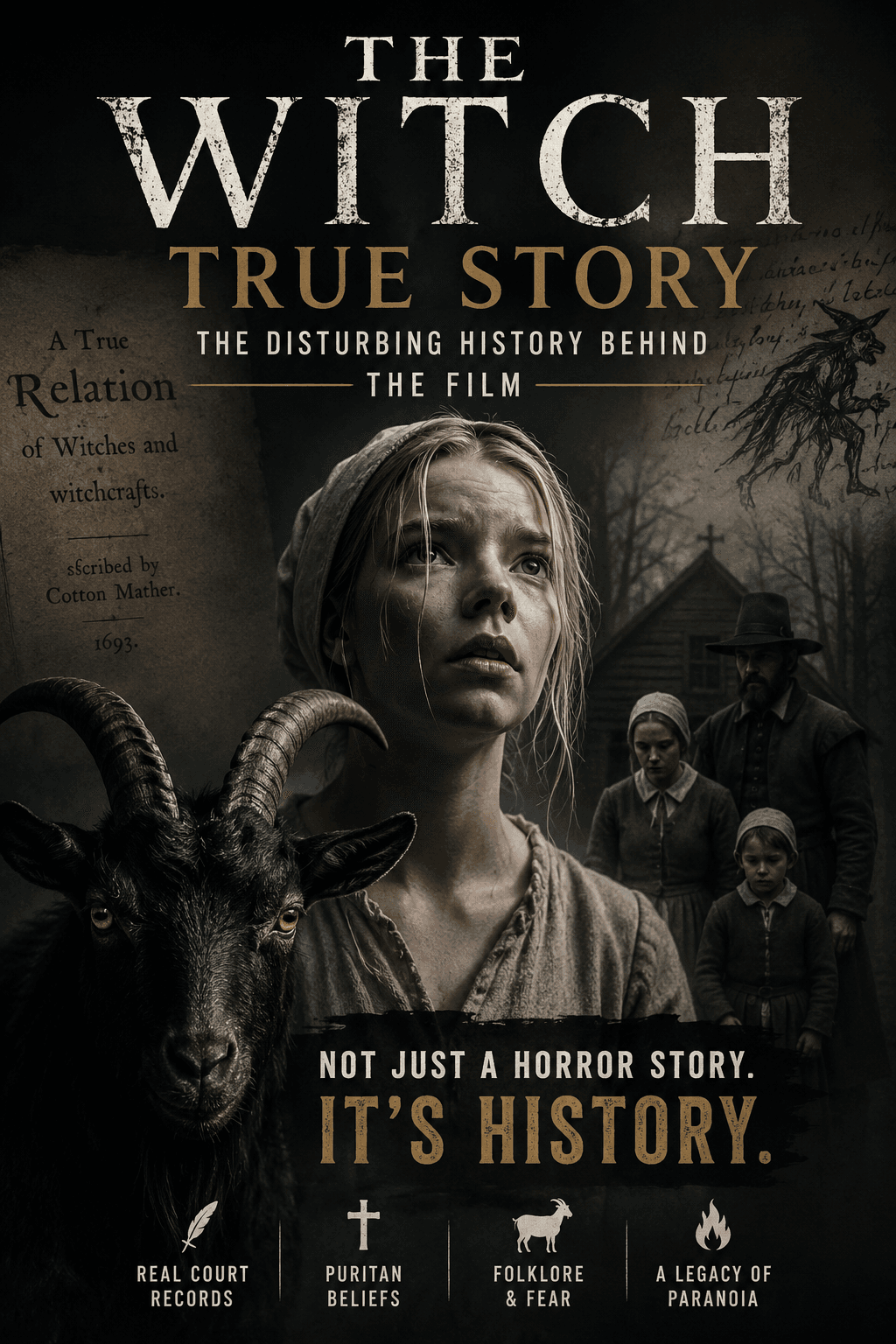
The Witch (2015), directed by Robert Eggers, pulls its most disturbing material directly from real Puritan court records, diaries, and witch pamphlets, exactly as its closing title card claims. That’s the short version of The Witch true story. The longer version is more precise: no single family lived exactly this, but the theological system that convicts Thomasin was real, documented, and used against actual women on evidence no stronger than what convicts her on screen.I was pulled over once on a Texas highway, at night, driving back from an out-of-town assignment. I hadn’t done anything wrong. The car was fine, I was fine, and none of that mattered, because the stop was checking something else entirely. License, registration, where are you coming from, where are you going — the full ritual, ten minutes, then released.What stayed with me wasn’t the officer, who was polite, the way I was polite, because politeness was the only tool either of us had. It was the logic underneath the ritual: that I had done nothing, and it hadn’t mattered, because the stop was never measuring what I’d done. It was measuring whether I would submit correctly to a process that had already decided what I was.That logic is the real engine of Eggers’ film. This exact family is invention. What convicts Thomasin — the theological machine behind her trial — is documented history, applied to real women on evidence no stronger than what convicts her here.
What Robert Eggers Actually Researched for The Witch True Story
Eggers didn’t start from a script. He started from a research process that ran for years before he wrote a line of dialogue meant to be spoken on camera. Working with museums and historians, his production team compiled primary materials — period fashion records, agricultural manuals, court documents, religious tracts, folklore collections — and Eggers made repeated visits to Plimoth Plantation, a fixation dating back to his childhood in New Hampshire. Director Alfonso Cuarón, who read an early draft of the screenplay in 2013, said it made him “more than anything, curious,” which is a strange compliment for a horror script and an accurate one. Curiosity is the operative feeling the film produces before it produces fear.The dialogue carries the clearest trace of how far that research went. Multiple accounts of the production describe Eggers pulling phrasing directly from period documents rather than writing an approximation of seventeenth-century English from scratch — down to some of what the possessed children say on screen, reported to echo language drawn from documented possession cases. I can’t verify every line against a specific archive, and neither can most people writing about this film. But the closing title card isn’t marketing copy. The claim that the material came “directly from period journals, diaries, and court records” is about as literal a statement of intent as this genre has produced in years.The physical world got the same treatment. Eggers wanted the family’s farm built with period-accurate construction, so he brought in a thatcher and a carpenter who’d actually worked in the building styles of the era. Costume designer Linda Muir consulted thirty-five books on the clothing of common people in Elizabethan and early Stuart England and made the family’s wardrobe out of wool, linen, and hemp — no synthetic shortcuts, no visual guesswork.And in a decision that tells you everything about how far Eggers went for authenticity over convenience, the crew filmed almost entirely on location using natural light, with candles as the only artificial source indoors. When a scene needed to look lit only by fire, it was lit only by fire.
The Real Witch Trials Behind the Puritan Family
Most people who know “witch trial” as a phrase know Salem — 1692, a wave of accusations, nineteen people hanged. What most people don’t know is how unusual that was. Historian Katherine Howe, who edited the Penguin Book of Witches, has called Salem “highly anomalous.” A typical witch trial in colonial New England involved one woman, occasionally two, usually someone who’d carried a bad reputation for years already.Conviction was, by Howe’s account, genuinely difficult to secure — excluding Salem and outright confessions, the conviction rate sat under one in five. And where Salem is remembered for the youth of its accusers, the more common pattern was the opposite: accusers were adult peers of the accused, often longtime neighbors, both parties frequently middle-aged. When children entered the picture at all, it was usually as the target of a witch’s supposed interest, not as her prosecutor.The gender pattern the film depicts, though, is accurate to the period, and the reasons behind it are worse than superstition alone. Puritans believed the Devil found it easier to access a woman’s body, which they held to be physically weaker. The deeper mechanism was social: women were assumed more sinful by nature, more susceptible to temptation, more in need of a governing authority — church, father, husband — to keep them inside the lines.Accusation tended to fall on women who’d failed some visible expectation of Puritan womanhood. Howe points specifically to childlessness as a marker: Katherine’s anxiety in the film is directed entirely at her daughter’s moral risk, never at her son’s, which is exactly the asymmetry the historical record shows.Add to that the real material conditions of the period — genuine scarcity, where spoiled food or a dead crop was a survival threat, not an inconvenience — and the wilderness pressing against a settlement that Cotton Mather, in his 1693 account of the Salem trials, described as land wrested from what were “once the Devil’s Territories.” That line is the actual worldview the family in the film operates inside: a hard border between godliness and the trees, with nothing in between.
What Eggers Confirmed Was Real — and What He Left Out
In an interview after the film’s release, Eggers walked through the historical basis for several of the film’s most extreme images, and the answers are more interesting than a simple “it’s all true.” Goats as a satanic image, he admitted, is a slightly imported idea — more common in continental European witch iconography, the work of artists like Hans Baldung and Francisco Goya, than in English witch narratives specifically.“I think that hardcore witch historians would say that I might be pushing it a little bit,” he said. He kept it anyway, because the family already had goats, and because the connection was too visually rich to leave alone. That’s a director being honest about where research ends and invention begins, which is rarer than it should be.Other details he traced to specific sources. The image of a witch poisoning a child with an apple, he found in a collection of Elizabethan witch pamphlets — a documented accusation that predates any written version of Snow White, which reframes the apple less as a fairy-tale borrowing and more as the fairy tale drawing from the same well the accusation did.Samuel’s death and disappearance draws on the period belief that a flying ointment required the rendered fat of an unbaptized infant, and the film stacks the Puritans’ own anxious theology of infant baptism on top of that lore to make Samuel specifically vulnerable.The blood-drinking, the goats lactating blood, the animals turned dry by a witch’s theft — all of it traces to real accounts of witches and their familiars, animal companions fed on the witch’s own blood, drawn from teats she was believed to grow for the purpose.Here’s the detail that matters most for separating the film from its research: some of what Eggers found didn’t make it to the screen at all. The lore held that a witch’s blood-teats could appear in unusual places on her body — a detail Eggers described in interview and then noted, in his own words, “didn’t quite make its way into the film.” The research pool was larger and stranger than the finished film. Eggers was already editing reality down before the camera ever ran, choosing what a period audience might have believed over what a modern one could stomach in a wide theatrical release.
The Court That Convicts Before It Meets You
Here is what the history doesn’t fully explain, and what the film understands better than the record does: Salem never has to happen to this family. William’s pride gets them banished from the plantation in the film’s opening minutes, before a single supernatural event has occurred, over a doctrinal dispute the film never bothers to spell out in detail, because the specifics don’t matter. What matters is that the machinery of judgment in this world doesn’t require a body of evidence. It requires only that someone in authority decide the verdict, and then a process runs to confirm what’s already been decided.That’s the same machine I felt idling on the shoulder of a Texas highway. The officer wasn’t checking whether I’d done anything. He was collecting proof that I’d perform submission on command, to an authority that had already decided what I was before I rolled down the window. Thomasin spends the entire film performing that same submission — answering every accusation with the correct tone, the correct posture, the correct display of faith — and it buys her nothing, because the court she’s appearing before isn’t weighing her answers. It’s weighing whether a seventeen-year-old girl, unmarried, first to find every body, first to be blamed for every loss, fits a shape the theology already has a slot for.Katherine Howe’s research confirms the shape existed and had a name before Thomasin was written: women who failed to fit, accused not because of what they did but because of what they’d failed to become. The film’s genius, and its cruelty, is refusing to tell you whether Thomasin was ever actually a witch before the ending. The machine already had its verdict ready before she said a single word in her own defense.
Black Phillip Was a Real, Furious Animal
For as much invented theology and folklore as the film metabolizes, its most infamous performer required no research into the seventeenth century at all — just a 210-pound billy goat named Charlie, sourced by trainer Anna Kilch, who reportedly had “the biggest horns” she’d ever seen on the species. Eggers deliberately instructed his editor to keep Black Phillip in the margins for most of the runtime, underplaying the goat so his eventual centrality would land as a surprise rather than an announcement.Charlie did not cooperate with the plan. Ralph Ineson, who dropped thirty pounds to play a starving Puritan patriarch, ended up outweighed by fifty pounds of uncooperative goat and came away from the production with a dislodged tendon after Charlie rammed him on the fourth day of shooting — Ineson spent the rest of the five-week shoot on painkillers. When a violent confrontation between William and the goat proved too dangerous to film safely, the production commissioned a stand-in puppet, then a second, larger one, and rejected both as unconvincing; the sequence that made it to screen used the real animal on a leash that was digitally erased in post.Eggers has said he wouldn’t work with Charlie again. The goat’s trainer, for her part, insists he was “the star of the show” and did his job perfectly. Both things can be true. That’s usually how it goes with anything genuinely dangerous that also happens to work.
The Witch True Story Ending: Nothing Was Softened for the Camera
One place the film and its script line up exactly is the ending, and it’s worth noting because so few horror productions leave their darkest material intact once test audiences and studio notes enter the process. Thomasin kills her mother in self-defense with a billhook. She goes to the goat house alone.Black Phillip speaks in a human voice, becomes a man, walks her through signing her name into his book while she stands naked in front of him, and leads her into the trees, where a coven of women — played, in the finished film, by a troupe of Butoh dancers who built their own choreography — levitates around a fire. Thomasin joins them, laughing, rising above the treeline as the film cuts to black.That’s the film. It’s also the script. Nothing about that sequence was walked back for a wider release, which is part of why the ending still unsettles people who’ve seen a hundred horror movies flinch at their own third acts.It’s tempting to read that ending as liberation, and plenty of people have — Thomasin escaping a family and a theology that offered her nothing but blame, choosing the coven over the farm. I understand the reading. I don’t fully trust it. Living deliciously, in this film’s terms, means signing a book while someone else guides your hand.It means finding out, at seventeen, that there was never a version of this world where you got to just be a person doing an ordinary amount of wrong. There was only ever a machine deciding, in advance, what you were, and a choice at the end between two different names for submission. Some highway stops end in ten minutes. This one just changed which authority Thomasin was going to answer to for the rest of her life.If
The Witch (2015) is on your list next to other folk-horror descents into ritual and submission, it sits naturally alongside
Midsommar’s ending and the question of
whether Pelle was ever really a villain — the same machinery of manipulation wearing different, equally convincing period clothing.
The Witch True Story — Frequently Asked Questions
The Witch True Story: Quick Answer
The Witch (2015) is not based on one documented case, but its dialogue, folklore, and Puritan theology come directly from real period journals, diaries, and court records, as the film’s own closing title card states. Director Robert Eggers spent years researching primary sources before writing the script.
What Historical Sources Did Robert Eggers Use?
Eggers researched period court records, personal diaries, Elizabethan witch pamphlets, and Puritan religious texts, working with museums and historians and making repeated visits to Plimoth Plantation. Much of the family’s dialogue and folklore imagery — including the apple, the flying ointment, and the witch’s familiars — traces to documented seventeenth-century sources.
Was Black Phillip a Real Goat?
Yes. Black Phillip was played by a real 210-pound billy goat named Charlie. No CGI was used for the animal’s physical performance; a stunt leash was digitally removed from one scene, and two attempted goat puppets were rejected as unconvincing during production.