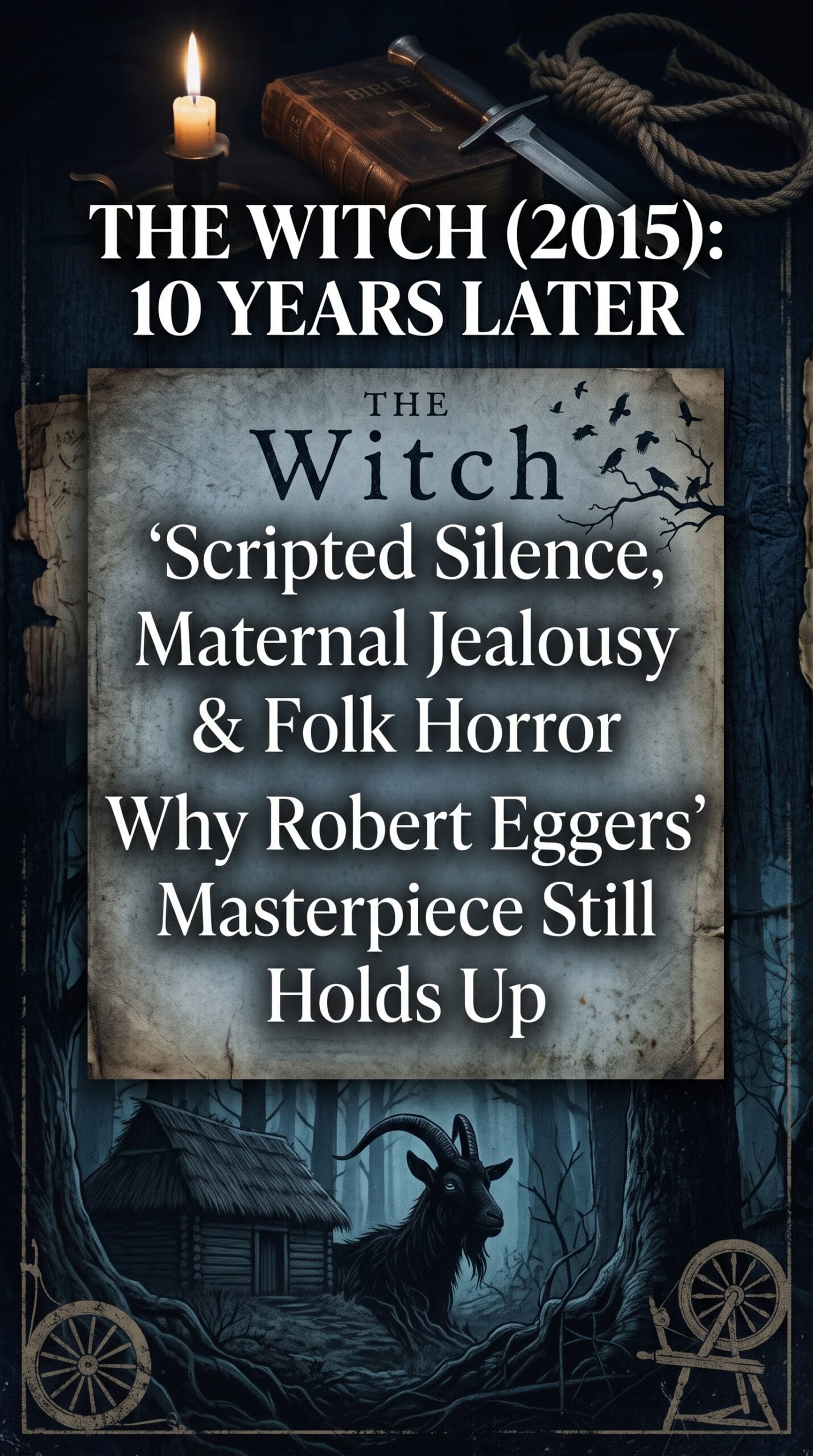
The Witch (2015) review that follows makes one argument the site hasn’t made yet: that Kate Dickie’s Katherine, sound designer Adam Stein’s scripted silence, and the film’s folk-horror lineage are the real reasons this Robert Eggers film still holds up a decade later.
The Witch (2015), directed by Robert Eggers, is a Puritan folk horror film that has spent a decade earning its reputation as one of the best horror films of its era. This review of The Witch (2015) makes the case for three reasons that reputation holds: Kate Dickie’s overlooked performance as Katherine, sound designer Adam Stein’s work building dread out of scripted silence, and a folk-horror lineage the film is only now getting full credit for.
The Witch has three names attached to it that this site has never once printed: Kate Dickie, Adam Stein, and the specific word “silence” as it appears, again and again, as its own paragraph in Robert Eggers’ original screenplay. Everything else about this film has been said here already — the cinematography, the score, the ending, the history. This review exists to say the rest.
Start with the sound, because the sound is where the argument actually lives. Pull up the shooting script and you will find “Silence.” sitting alone on the page, unattached to any character, functioning as its own command, repeated at five separate points across the story.
Eggers wrote the film’s quiet into the document before a single frame existed, alongside a catalog of specific, small sounds scripted to occupy that quiet: a baby gargling under the abductor’s cloak as Samuel is carried off into the wood at nightfall, the groan and creak of the tree trunks as William walks alone into the trees one early morning with Caleb watching from behind.
Footsteps and a wooden creak stop Thomasin cold inside the goat shed at night before Caleb stumbles into view, naked and freezing. The commitment to shooting things for real runs through the whole production: Eggers has said the raven that later perches at Katherine’s breast was an actual trained bird on set, lit with a flickering electric bulb because open flame would have spooked it, the same practical instinct that governs the sound design’s refusal to fake a mood with music it hasn’t earned.
Sound designer Adam Stein and sound editor Mark Gingras built the finished track around that scripted architecture, and their job is a genuinely different one from the job Mark Korven’s score is doing, already covered at length in the site’s Historical Accuracy piece. Korven’s Nyckelharpa-and-choir writing is expressive: it announces fear, colors a scene, tells the audience where to feel dread before they’ve consciously registered why.
Stein’s work withholds. It sits in the gap where music could go and refuses to fill it, for as long as a scene can stand the pressure, and the fear arrives precisely because nothing is announcing it.
Horror built this fully around scripted quiet is uncommon enough that The Witch belongs on a short list with Robert Wise’s The Haunting, a film built on the same premise: a held breath does more work than a sting.
The screenplay’s discipline about sound also explains why the family’s rare bursts of actual noise land so hard. After Caleb vanishes into the wood, William ties goat-bells to Jonas and Mercy so they can’t wander off while searching, and the script has the bells clanking as the twins call his name and the rain starts to plink against them — a small, practical, almost tender safety measure that the film will later make devastating, once the audience knows how little it ends up protecting anyone.
The opening banishment scene works the same way from the other direction: the fifty-person congregation is scripted to stand in “heavy silence” while William argues with the Governor and the Minister over his head, so that authority gets the noise and everyone powerless in the room gets the quiet — a hierarchy of sound the rest of the film keeps returning to every time the family faces a threat it cannot name.
Eggers treats sound as a budget the film spends carefully, and the repeated, isolated stage direction “Silence.” reads on the page like the ledger that budget was written against — evidence that the hush audiences feel in the theater was planned at the writing desk, months before Stein or Gingras or Korven ever touched the material.
Even the film’s stranger, more ambiguous threats get this treatment: late in the story, Jonas and Mercy hear an unidentified clicking sound moving closer through the trees around the goat house at night, then scratching on the shed wall, then something that sounds like digging, and the script uses it exactly once, unscored and unexplained, trusting the audience to keep carrying it long after the scene has moved on.
Kate Dickie’s Katherine Is the Performance This The Witch (2015) Review Exists to Fix
Kate Dickie’s Katherine has sat in plain sight through three previous pieces on this site without earning a headline of her own, and that gap has started to look like a real oversight in how the character usually gets discussed. The default reading files Katherine under grief, and grief is genuinely present in the performance — the accusation in her voice when her father’s silver cup goes missing from the farmhouse and Thomasin is the one she interrogates for it, the flat, exhausted stare she gives William across a home that used to hold five children and now holds fewer.
Dickie has described building the character from a sharper place than mourning alone: watching her oldest daughter arrive at precisely the age Katherine’s own fertility is departing, a dead infant still unaccounted for while a living one blooms in front of her. That detail recolors nearly every scene between mother and daughter. Katherine’s escalating accusations against Thomasin start to look like jealousy dressed in the language of scripture, a considerably uglier engine for a horror film’s adult female lead to run on than simple grief-stricken faith.
The subtitled dialogue backs this up in a confession the site’s other Witch pieces pass over quickly: Katherine tells William she once dreamed, when she was Thomasin’s own age, of lying with Christ, a devotional vision so overwhelming she calls it more than the affection of the kindest husband — and admits that since Samuel’s disappearance she can no longer feel anything close to it. It’s a woman naming her own lost desire out loud, at exactly the age her daughter is now living it.
That same wound resurfaces, curdled, when the missing cup finally cracks the household open and William confesses he sold it in secret, letting Thomasin take the blame for months — and Katherine is the one voice in the room still trying to force the collapse back into the shape of a prayer.
Dickie has also said, separately, that she came to believe the witch in the woods was simply real inside the world she was inhabiting — a fact of that world, played straight. That conviction shows on screen. Her Katherine plays a woman arriving, correctly and much too late, at a diagnosis nobody around her wants to hear.
Harvey Scrimshaw’s Caleb has been written about here before as a showcase of physical suffering, which it is, but the site’s existing coverage treats his death scene as a closed unit. Worth following, instead, is what it does to Katherine over the rest of the film. Caleb’s fever litany — the stammered inventory of animals, the writhing, a final monologue that borrows the vocabulary of religious rapture and points it somewhere closer to sexual arrival — happens in the one room Katherine has spent the whole film failing to keep safe, and it’s the loss she never recovers from.
By the night the twins vanish from the goat shed, Katherine has stopped being able to tell hallucination from memory: the script has her sit in the dark farmhouse breastfeeding what she believes is her lost baby Samuel, only for the image to resolve into a large black raven tearing at her chest, blood soaking through her shift.
It plays as a monstrous inversion of the comfort and nursing she spent the film’s opening scenes performing without a second thought, and it lands as hard as it does because Dickie has spent every prior scene building a woman who still, however futilely, believed her body could protect somebody.
Set that collapse next to Scrimshaw’s death scene and a throughline appears that neither performance fully carries alone — a mother whose body and instincts have been rendered useless by a world that already decided her family belonged to something else.
The moment where craft and Katherine’s characterization converge most precisely is a small folk-medicine ritual the script stages without a wasted word. With Caleb feverish and failing, Katherine takes a knife to a vein at his temple and lets his blood run into a bowl Thomasin is made to hold at his bedside, praying over him while William stands back near a beam, unable to do anything but watch.
It is bloodletting, a period-accurate remedy the production’s historical research would have made available to Eggers, and it is also, functionally, a ritual performed with a blade over a child’s body by the same woman who will spend the rest of the film insisting that ritual and blood belong exclusively to witches. The scene plays in near silence, the prayer itself the only sound, and it never announces its own irony. It simply lets Katherine’s hands do something that looks exactly like what she is afraid her daughter is doing, and trusts the audience to notice.
Why This Witch (2015) Review Calls It Folk Horror, Not “Elevated Horror”
All of this belongs to where the film actually lands in horror history, and the specific label matters more than the generic compliment “elevated horror” usually applied to it. The Witch is explicitly folk horror; Eggers subtitled it “A New-England Folktale” and has talked about approaching it as a genre exercise first, a personal project second, after his stranger, less commercial pitches kept failing to get financed.
That religious specificity put it in company with a small cluster of other films at the same Sundance, from a satire about a fraudulent biblical archaeologist to the true story of a gay-rights activist turned Christian pastor, all cited at the time as evidence that festival cinema was suddenly willing to take devotional material seriously on its own terms. It premiered at Sundance in January 2015, spent over a year waiting for A24’s wide release in February 2016, and eventually grossed roughly ten times its four-million-dollar budget, a trajectory that looks inevitable now and looked shaky at the time.
Opening-weekend audiences split hard enough that “why do horror fans hate The Witch” became its own small genre of think-piece, and one horror writer publicly complained on social media that ninety percent of the theater around him was too dense to understand what it had just watched.
The gap between that reaction and the trailer’s promise of a scarier, louder movie is the most commonly cited explanation for the divide, and it fits: the film in the theater was a slow, historically dense, theologically literate family tragedy, and a meaningful chunk of the opening-weekend crowd had shown up expecting jump scares.
Ann Hornaday’s review in the Washington Post got closest to naming what the film was actually doing to the genre around it, writing that it “comports itself less like an imitator of those classics than their progenitor” — placing it in direct lineage with The Exorcist, The Omen, and Rosemary’s Baby as an ancestor identified after the fact. A decade later, with the film turning up regularly on lists of the best horror of its decade and its century both, that assessment has aged considerably better than the opening-weekend backlash did.
The research underneath the film earns that seriousness. The production consulted period agricultural experts and worked with museum collections to get the family’s material world accurate down to the tools in the barn, and brought in a thatcher and a carpenter trained specifically in seventeenth-century building methods so the farmhouse itself would be constructed the way an actual Puritan homestead was, board by board.
That historical labor functions as motive: a family this materially isolated, this dependent on a harvest that has already failed once, has no slack left to absorb a demonic threat and no institution beyond a God they’re increasingly certain has stopped listening. The period accuracy is what makes the supernatural genuinely frightening; a family with more options would simply have a different, smaller story.
Where the film ultimately lands — Thomasin walking into the wood, rising off the ground, laughing in the firelight among the coven — has been read elsewhere on this site, in the piece on the folklore behind the film, as a story about institutional failure, and that reading holds up fine on its own terms. Watched through Katherine, though, the ending plays as an inheritance.
Thomasin doesn’t defeat the forces that destroyed her mother. She walks toward the only door in the entire story that was ever actually open to a woman like her, in a world where wanting anything — a lost son back, an honest husband, a daughter’s youth — got Katherine nothing but punishment and an early grave.
Thomasin, in the film’s last minutes, stops asking permission to want. Whether that reads as triumph or as the coldest available option is a question the film leaves open, a more folk-horror-appropriate note to close on than the marketing campaign, or the fan arguments that greeted the film in theaters, ever gave it credit for having.
The Witch was already a great film on its opening weekend in February 2016; it simply took the surrounding culture roughly ten years to catch up to a horror movie built on scripted silence, a repressed and jealous maternal lead, and a genuinely researched seventeenth century, delivered to an audience primed for something louder and simpler by the marketing around it. Its slow migration from divisive Sundance curiosity to fixture on best-of-the-decade and best-of-the-century lists is the clearest evidence that the film’s patience was correctly calibrated even when the room wasn’t ready for it yet.
Dickie’s Katherine, Stein’s negative-space soundtrack, and a screenplay that keeps interrupting itself to demand quiet are the reasons it rewards a second and third look at a rate louder films from the same year have not managed to match.
Is The Witch (2015) Worth Watching? Ethan’s Verdict
Yes, decisively. What this Witch (2015) review argues is that the site’s existing coverage needed a second entry point: the sound department, the actor who plays the film’s most quietly desperate character, and a genre label that finally names what the film was doing all along.
For readers chasing the film’s smaller craft trivia and background details, the site’s separate hidden details catalog covers that ground.
Ethan’s Score: 9/10
The Witch (2015) Review: Frequently Asked Questions
What Makes This The Witch (2015) Review Different From the Site’s Other Coverage?
This review focuses on three angles the site’s existing Witch coverage hadn’t used: Kate Dickie’s performance as Katherine, sound designer Adam Stein’s work building dread out of scripted silence, distinct from Mark Korven’s score, and the film’s specific place in folk-horror history. The site’s Historical Accuracy piece already covers the cinematography, score, and ending in depth.
Who Plays Katherine in The Witch (2015)?
Kate Dickie plays Katherine, the mother in the Puritan family at the center of the film. Dickie has said in interviews that she built the character partly around jealousy of her daughter Thomasin’s fertility, and that she personally believed the witch in the woods was simply real within the world of the story — a fact she played straight.
Is The Witch (2015) Based on a True Story?
Robert Eggers drew the screenplay from period folktales, fairytales, and historical records of witchcraft accusations and possessions in New England and Western Europe before the 1692 Salem outbreak, and much of the dialogue comes directly from those documented sources. The site’s own True Story piece covers those historical roots in full.
Who Composed the Score and Sound Design for The Witch (2015)?
Mark Korven composed the film’s score, built around Nyckelharpa strings and choral voices. Adam Stein served as sound designer and Mark Gingras as sound editor, building the finished soundtrack around the screenplay’s own repeated stage direction calling for silence at specific, deliberate points in the story.