
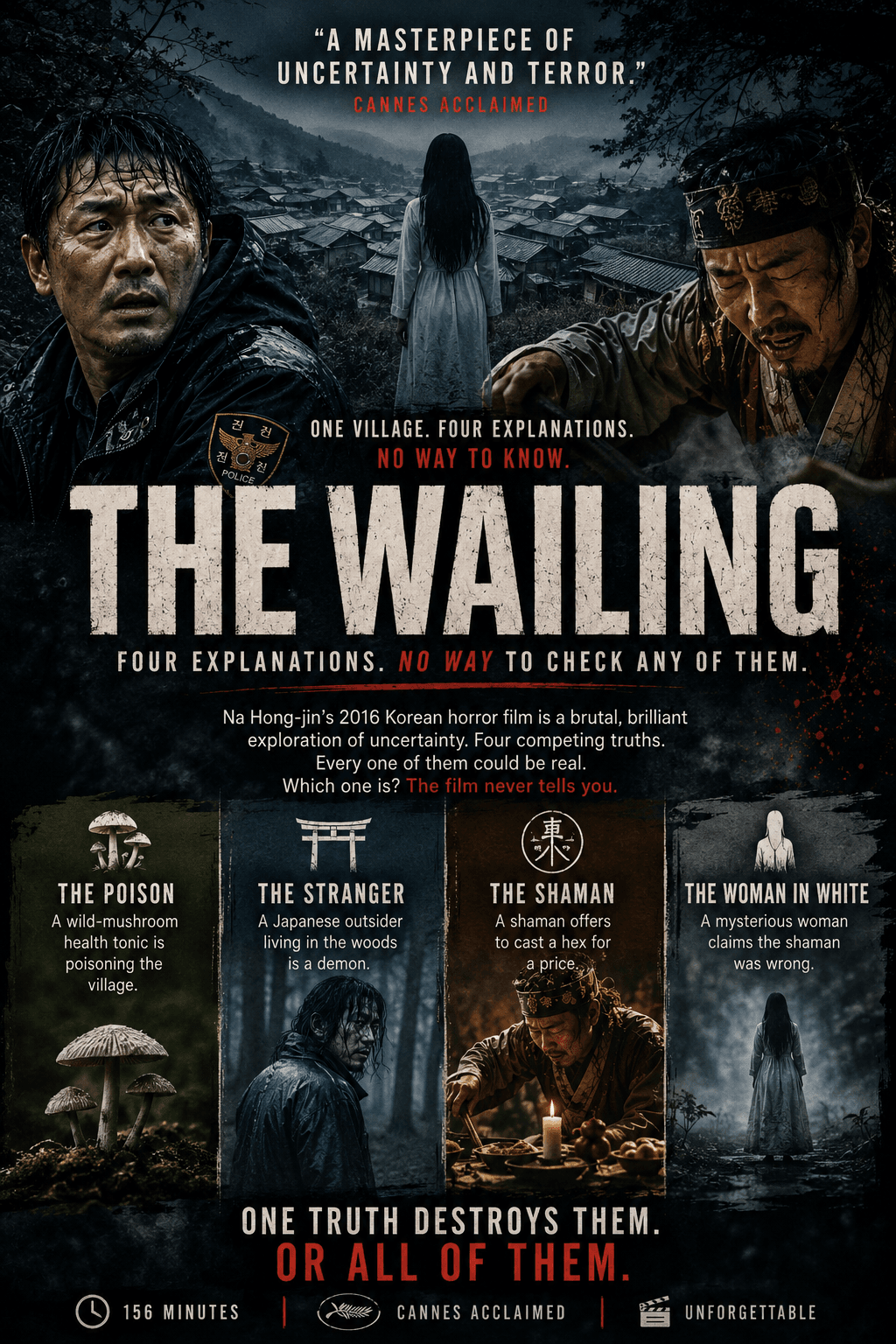
The Wailing review, in one sentence: Na Hong-jin’s 2016 Korean horror film gives you four separate, internally consistent explanations for a wave of family massacres in a rural village and then refuses, permanently, to confirm which one is true — and it deserves every bit of the acclaim it got at Cannes for doing exactly that. Directed and written by Na Hong-jin, starring Kwak Do-won, Hwang Jung-min, Jun Kunimura, Chun Woo-hee, and Kim Hwan-hee, it is 156 minutes long and it does not resolve.
Somewhere around the second hour, Sergeant Jong-goo watches a shaman perform a ritual to save his daughter’s life while, across town, a group of men beat a suspected demon half to death with sticks. The film cuts between the two scenes as though they were the same event happening in two places, because as far as the film is concerned, they might be.
Nobody involved — not the sergeant, not the shaman, not the audience two hours in — has any way of confirming which action is actually working, or whether either one is, or whether both are making things worse.
Na Hong-jin spent three years writing a script built entirely out of that specific impossibility, and I’ve spent longer than I’d like to admit being angry about it — not because the film fails but because it succeeds so completely at describing something true.
The Wailing Review: Four Explanations, No Way to Check Any of Them
I spent a decade as an investigative journalist, and the entire discipline runs on one assumption — that if you follow a claim back far enough, cross-reference enough sources, sit with enough documents, you eventually hit bedrock. Somewhere under the rumor is a fact.
The Wailing is a film about a rural village, Gokseong, where villagers are slaughtering their own families in fits of boil-covered, bloodshot-eyed psychosis. It hands its audience four competing explanations. A wild-mushroom health tonic is poisoning half the region. A nameless Japanese stranger living alone in the woods is a demon, on the strength of pure xenophobic momentum.
A shaman charges ten thousand dollars to cast a hex against that stranger. An unnamed woman in white shows up at every crime scene and eventually claims the shaman aimed at the wrong target entirely.
Every one of these four sources contradicts at least one of the others. The film never adjudicates between them. It ends with Jong-goo’s family destroyed and the audience holding four equally plausible, equally unconfirmed accounts of what killed them, with no fifth position from which to check.
That’s the most disciplined thing about the film, and it’s exactly the kind of disciplined that makes a journalist’s professional instincts useless. There is no source to follow further back. Every one of those competing accounts is internally consistent, dramatically staged, and performed with total sincerity by everyone involved. The film isn’t hiding an answer somewhere the audience failed to look for it. It has built a situation with no verifiable bottom at all, and it is demonstrating, coldly and at length, what that costs the people living inside it.
The Performances: Kwak Do-won, Hwang Jung-min, Jun Kunimura, Kim Hwan-hee
Kwak Do-won plays Jong-goo as a small-town cop who is, for the first forty minutes, close to comic relief — soft in the middle, scared of his own crime scenes, the kind of officer his colleagues rib for jumping at his own shadow.
Kwak doesn’t play the terror as a switch flipping. He plays it as sediment, one crime scene at a time, until the same nervous, slightly cowardly man who couldn’t hold his composure around a corpse in reel one is beating a suspect with a tire iron in reel four — the same frightened man with fewer walls left standing, not a different one.
By the time he’s on his knees promising a stranger he’ll believe anything if it saves his daughter, Kwak has built that collapse so gradually across two and a half hours that the scene reads as inevitable rather than dramatic, which is a much harder thing to act than either fear or grief individually. There’s a version of this role that plays Jong-goo’s arc as a man discovering courage. Kwak plays it instead as a man discovering how much of his earlier composure was just luck he’d never been tested.
Hwang Jung-min, as the shaman Il-gwang, gets the film’s most purely physical sequence — a ritual performed to save Hyo-jin, cross-cut against the mob assault on the stranger’s house, in which Hwang’s entire body works as an instrument, shaking, gagging, contorting hard enough that it stops registering as choreography at all.
The sequence works because Hwang plays Il-gwang as a professional the entire time — a man who does this for a living, who knows exactly what he’s charging and why, who never once breaks character to reassure the family that he’s certain of anything. His confidence is a service he’s selling.
Whether it’s also real is a question the performance refuses to answer, which turns out to be the correct choice, because the film needs the audience unsure of him right up until the moment it reveals they should have been.
Jun Kunimura, as the Japanese stranger, does the opposite kind of work — almost total stillness, long silences, a face that gives the audience nothing to read because the character has apparently decided giving nothing away is the only way to survive being hunted by an entire village.
Kunimura had already built a career playing men whose blankness could mean menace or could mean nothing — Tarantino cast him in Kill Bill on the strength of his work for Takashi Miike in Ichi the Killer, and before that he’d played the producer in Miike’s Audition. The Wailing uses that history the way a card sharp uses a familiar face: genre audiences half-recognize him, and that half-recognition does real work before he speaks a single line.
Kim Hwan-hee, as Hyo-jin, spends the film’s back half playing a child slowly overtaken by something that speaks through her in her father’s own daughter’s voice, cursing at him, laughing at him. Kim keeps the performance flat and unpolished the whole way through, so it plays like an actual child saying actual cruel things — a quieter and worse kind of horror than a demon voice ever manages.
Craft: Hong Kyung-pyo’s Camera and a Score That Disappears
Hong Kyung-pyo, who shot Snowpiercer the same year Bong Joon-ho was reinventing what a Korean genre film could look like internationally, frames Gokseong with the patience of someone documenting a real place rather than building a set — wide, damp, green, the kind of village where mist sits in the valley every morning whether or not anything supernatural is happening.
When the horror does arrive, it never has to announce itself with a lighting change. The ordinary weather is already doing the work. Jang Young-gyu and Dalpalan’s score mostly disappears for long stretches, which is its own kind of discipline; the ritual sequence is the one place the film lets sound become spectacle, and it earns that spectacle by having withheld it everywhere else.
Na Hong-jin didn’t arrive at this from nowhere. His debut, The Chaser (2008), was the third-highest-grossing Korean film of its year, a serial-killer procedural with almost no supernatural content at all. His second film, The Yellow Sea (2010), played Un Certain Regard at Cannes in 2011. Both are crime thrillers built around men chasing down truths that keep sliding out of reach.
The Wailing took that same procedural instinct and pointed it at a mystery with no solvable answer, which is either a logical next step or a small act of cruelty toward his own audience, depending on how charitable you’re feeling.
It premiered Out of Competition at Cannes in 2016, took the Best Director prize at the Blue Dragon Film Awards, and grossed $51.3 million worldwide against an $8 million budget. Audiences turned out for it the way they turn out for a blockbuster, which is worth sitting with given how little the film does to comfort anyone who watches it.
The Wailing Review: Why the Ending Refuses to Resolve
What actually produces the fury, more than the admiration, is the film’s use of Scripture. It opens on Luke 24, the resurrected Christ telling his frightened disciples to touch his hands and feet, because a ghost doesn’t have flesh and bones — a passage about doubt being answered, faith being rewarded with physical proof.
The film repeats that exact verse near its climax, and by then it has become impossible to tell whether it’s being spoken sincerely or worn as a disguise by something using scripture the way the shaman uses ritual and the mob uses rumor — a tool that works whether or not the person wielding it believes a word of it.
A priest character shows up mid-film and tells the family plainly that the Church has nothing to offer them, that they should trust their daughter to a hospital instead. On a first watch that sounds like institutional cowardice, a man declining to fight for a parishioner because the fight is inconvenient. On a second, it sounds like the one character in the entire village telling the truth about the actual limits of what he can verify.
I don’t think the film wants either reading to win permanently, and I’ve changed my own mind about which one is more honest at least three times while writing this.
That refusal is where the anger actually lives, and on reflection the anger has very little to do with Na Hong-jin. What it’s actually doing is holding up a mirror to something I recognize in my own life. My own faith has never been the kind that gets discussed at dinner parties or argued about online. It survives specifically because I’ve never needed it to produce a checkable answer to anything, and The Wailing forces the question of what that faith is actually worth in a scenario built to make sure it can never be checked at all.
It’s the same question we sat with in our Rosemary’s Baby breakdown: whether anyone inside the story could have proven what they believed, one way or the other.
Jong-goo is given a literal countdown — wait for the rooster to crow three times, a shaman’s instruction, an act of trust with a built-in verification mechanism that should have settled the entire question one way or the other — and he breaks on the third crow anyway, unable to hold the wait even when the proof was seconds from arriving.
Whether that broken patience is what dooms his family, or whether nothing he did would have mattered either way, is a question the film keeps in permanent suspension, and there’s something close to cruelty in how precisely it’s built to do that. Most horror cinema, even the good stuff, eventually tells you where the ground is. The Wailing spends three years of screenplay revisions making absolutely sure you never find it, and calls that mercy a village, a family, and a father’s whole remaining life.
Ethan’s Score: 9.5 / 10
The Wailing Review: Quick Answers
Is The Wailing review-worthy if you dislike unresolved endings?
Only if you can accept that the lack of resolution is the point rather than a flaw. The film gives four competing explanations for its events and never confirms which is true, by design.
Is The Wailing based on a true story?
No. It’s an original screenplay by Na Hong-jin, drawing on Korean shamanistic tradition and Christian imagery rather than a specific real case, written over roughly three years. The film’s central mechanism — a community testing a stranger for guilt it can’t actually detect — has a real historical parallel we cover in The Wailing true story piece.
Who is the real villain in The Wailing?
The film deliberately never confirms it. The Japanese stranger, the unnamed woman, and even the shaman all have moments that support and undercut their innocence, and no source in the story is ever fully verified. We break down exactly what the ending confirms and what it doesn’t in The Wailing Ending Explained.
What does the Luke 24 Bible verse at the start of The Wailing mean?
The verse is the resurrected Christ proving to doubtful disciples that he isn’t a ghost. The film repeats it near the climax in a context that makes it impossible to tell whether it’s being spoken sincerely or used as camouflage, mirroring the story’s larger refusal to confirm who deserves belief.