Every year someone asks Ruggero Deodato the same question about
Cannibal Holocaust, and every year the question is the wrong one. Is it real. Were the animals really killed, were the actors really hiding, did he really get arrested for murder. Those questions have answers, and the answers are mostly on file in an Italian courthouse.Short version, before any of the history: the cannibal holocaust 1980 true story runs mainly through Rome. Red Brigades terrorism was airing on Italian television every night while Ruggero Deodato raised a young son in that same city, inside a mondo-film tradition that had already taught Italian filmmakers how to fake atrocity footage for profit, years before he ever got on a plane to the Amazon.The question nobody usually asks is why an Italian horror director in 1979 decided the most frightening thing he could put on a screen was a television crew, filing a story for the evening broadcast.The answer is sitting in the same living rooms where Deodato’s own family watched the news.
Italy’s Years of Lead: The Real Violence Behind the Film
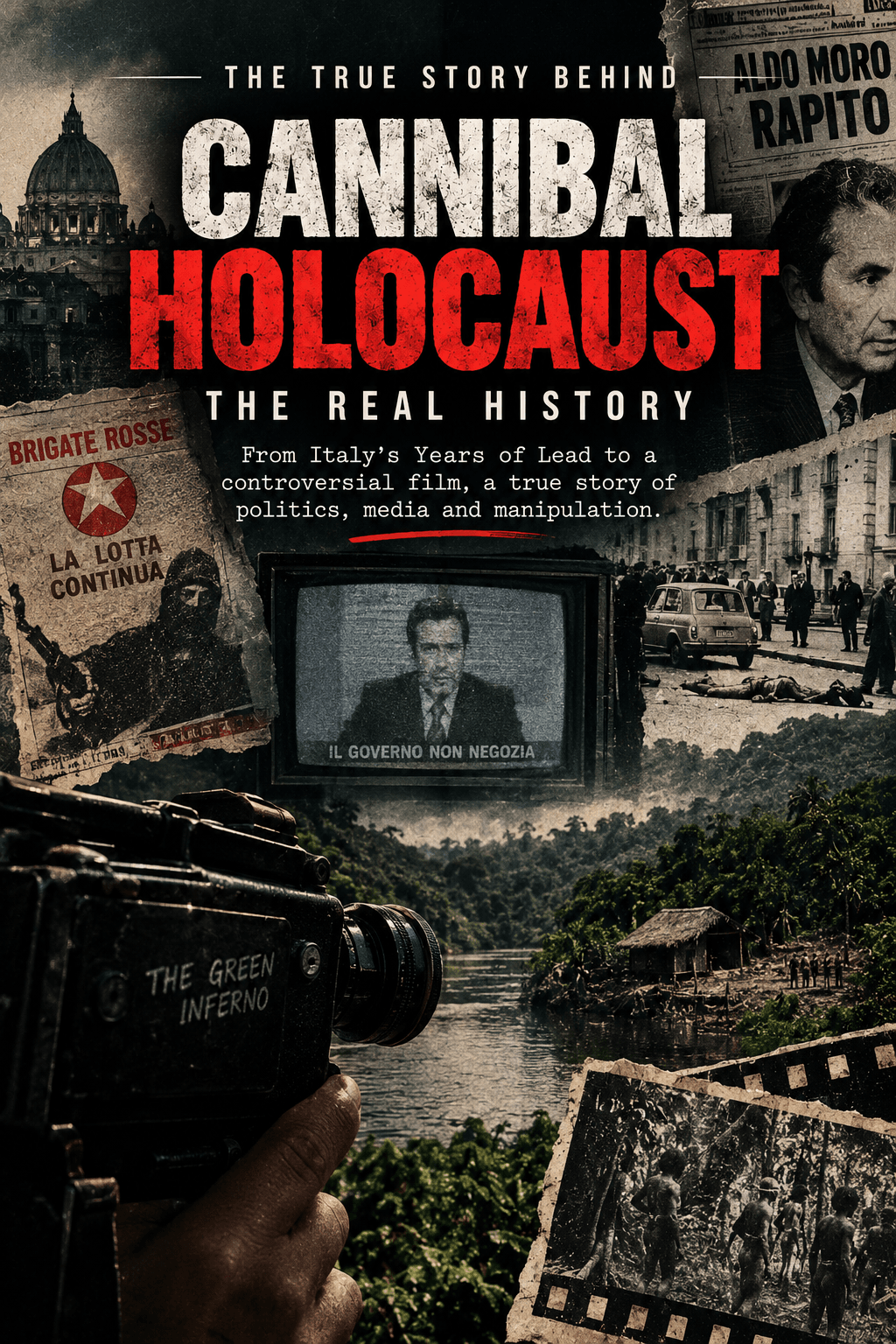
Italy in the late 1970s had a literal name for what was happening to it: Anni di piombo. The Years of Lead. For the better part of a decade, far-left and far-right paramilitary groups fought something close to an undeclared civil war in the streets of Rome, Milan, Turin — bombings, assassinations, kneecappings, kidnappings, a body count that depending on whose numbers you trust runs somewhere between fifty and seventy-five dead at the hands of the Red Brigades alone.The Brigate Rosse had become a standing feature of the evening broadcast by then, the way a weather report is a standing feature, except the forecast rarely changed.The event that defines the era, the one every Italian over fifty can still place themselves inside, is the kidnapping of Aldo Moro. On the morning of March 16, 1978, Red Brigades gunmen ambushed Moro’s car on a quiet Roman street, killed his five bodyguards in under a minute, and dragged the former prime minister into a waiting vehicle. He was held for fifty-four days. The Red Brigades ran what they called a people’s trial, issued communiqués, demanded a prisoner swap the government refused to make.Moro wrote eighty-six letters from captivity, most of them pleading with his own party to negotiate. None of it mattered. On May 9, he was shot inside the trunk of a red Renault 4 and left on a street roughly equidistant between the headquarters of the Christian Democrats and the Communists — a detail so on-the-nose it reads like staging, except nobody staged it. Ezio Mauro, who would later edit La Repubblica, called the whole affair Italy’s own September 11.That comparison is the kind of thing you say when you need an American audience to understand the scale of a wound, and it mostly works.Put a number on how bad it had gotten by the specific year that matters here. In 1969 there were two armed groups operating in Italy. By 1977 there were ninety-one. By 1979 — the year Deodato was in the Amazon shooting Cannibal Holocaust — there were two hundred and sixty-nine, responsible for six hundred and fifty-nine attacks in that single year alone, the worst twelve months of the entire two-decade period by that measure.One of the Red Brigades’ preferred warnings, short of killing someone outright, was gambizzazione — a bullet through the kneecap, a maiming punishment specific enough to earn its own word in the language. By the end of 1978 they’d done it to at least seventy-five people. Across the full stretch historians call the Years of Lead, from 1968 to 1988, the toll runs to roughly four hundred twenty-eight dead and close to two thousand wounded.Those numbers are the specific, countable backdrop of the specific year the man making this specific film was commuting between a film set and a television set.This is the television Deodato’s son was watching. By the director’s own account, the film’s premise came out of exactly that — nights in front of the news with a kid who kept asking him to change the channel, and a father who kept noticing something about the footage itself — the camera angles that seemed to anticipate the worst moment a half-second before it happened, the reaction shots that arrived too conveniently to be coincidence.Deodato has said, in interviews over the decades, that he came to suspect Italian television had started nudging the news into better composition, that crews were arranging reality on the way to recording it, because arranged reality drew better ratings than the real thing usually offers on its own. Whether every frame he was watching was actually staged is unknowable at four decades’ remove and was probably unknowable at the time. What matters for Cannibal Holocaust is that he believed it, and he built an entire film around the accusation.
Why an Eighteen-Plus Horror Film Got Less Censorship Than the News
There’s an irony here Deodato never had to go looking for, because the Italian ratings board handed it to him directly. Cannibal Holocaust was restricted to adult audiences on release — eighteen and up, the same age his son would need to be to legally watch his father’s fictional atrocities.The actual atrocities, the real ones — the kneecappings, the car bombs, a former prime minister’s body left on a street between two party headquarters — aired every night on the evening news at an hour any eight-year-old in the country could and did wander in front of, filed as ordinary current affairs and never once flagged the way the fictional version eventually would be. That’s the kind of detail a screenwriter would be accused of inventing for symmetry. It was already running in his own living room, every night, for free.That’s worth sitting with, because it reframes what the cannibal holocaust 1980 true story is actually about. Cannibal Holocaust gets filed, correctly, as a cannibal movie, a found-footage movie, a video nasty.It is less often filed as what it plainly is on a structural level: a piece of media criticism made by a man who thought the Italian press was lying to him nightly about the worst things happening in his own country, and who didn’t have a newspaper column to say so, so he built a fake documentary crew, sent them into the jungle, and let them commit every sin he suspected real journalists were already committing at home — then had the jungle kill them for it.Professor Monroe’s demand to burn the recovered footage has next to nothing to do with cannibal tribes — it reads like a man watching the evening news and wanting, for once, someone in the industry to have the decency not to air it.Shoot the film in 1979 — the year itself does some of the arguing for you. Guido Rossa, a trade unionist and factory worker, was murdered by the Red Brigades that January after reporting a BR propaganda courier to the police; his funeral drew the Italian president and marked, in hindsight, the beginning of the public turn against the group that eventually broke it. Deodato shot a film about staged atrocity and media appetite while the actual, unstaged version of both was still running on a loop on state television, with the Red Brigades nowhere near finished.He released it in Italian theaters on February 7, 1980, into a country that was still years away from being able to talk about the Years of Lead as something that had ended.None of this means Cannibal Holocaust is secretly a Red Brigades movie in disguise, and it would be a disservice to the film to pretend its politics are more coherent than they are — Deodato was a genre craftsman first, a polemicist second, and the finished film cares at least as much about outraging a ratings board as it does about indicting a newsroom.But the anger is real, and anger that specific has a traceable source: two years spent watching his country’s worst stretch on a nightly basis, and the particular, bitter conviction he walked away with — that the people filming the horror had started to enjoy filming it.
The Mondo Film Genre Deodato Inherited
That conviction had its own inheritance, too. Deodato picked up a genre already built on exactly that anxiety, and the trail worth tracing runs back further than 1979, through a filmmaker who got arrested for murder eighteen years before Deodato’s own cast and crew ever did.Gualtiero Jacopetti co-created the mondo film with Mondo Cane in 1962 — the shockumentary, the “world” picture, a genre built from the start on the promise that what you were watching was too strange and too real to have been scripted. It worked. It was nominated for a Palme d’Or, of all things, and it spawned a decade of imitators racing each other toward the next taboo. Jacopetti’s follow-up,
Africa Addio, pushed the formula into territory that stopped being a marketing problem and became a legal one.The film included footage of a Simba rebel being executed in the Congo, and the accusation that followed went past ordinary exploitation — mondo films were always exploitative, that was the pitch — straight into a staging charge: that Jacopetti’s crew had arranged or paid for a real human execution purely to get it on film. He was arrested in Italy and charged accordingly. He was eventually acquitted, after producing documentation that his crew had arrived at the scene moments before the killing happened on its own, independent of anyone’s camera. The footage, in other words, was real.If there was a crime here, it was being present with a camera already running.
Africa Addio and the Director Who Faced a Murder Charge First
The irony, which nobody in Italy seemed to appreciate at the time, is that the same production had come within a decision or two of supplying its own real atrocity footage in the opposite direction. The crew was detained and interrogated during filming in Zaire, and in Tanzania they were seized and came close enough to being executed themselves that, according to the account that’s survived, it took an army officer physically intervening and reportedly shouting, “Stop — they’re not whites, they’re Italians,” to call it off. A crew chasing footage of someone else’s death nearly became the footage.Jacopetti and Prosperi went home anyway, finished the film, and were put on trial over the one death in it they hadn’t caused.Jacopetti’s collaborator, Franco Prosperi, summed up their defense in four words that became close to a mission statement for the genre they’d created: slip in, ask, never pay, never reenact. It was a tidy sentence, built to settle the only question anyone was really asking — whether the filmmakers had caused what they filmed, or simply arrived in time to record it. What it actually did was hand every mondo director after them a script for the courtroom before they needed one of their own.When Deodato stood in front of an Italian judge in 1980 facing accusations that he’d murdered his own cast, his defense turned on the same premise: that filming something happening is not the same act as making it happen. He had to produce his actors in person to prove it, a harder bar than Jacopetti ever had to clear with paperwork alone. Deodato inherited more than a genre’s subject matter from Jacopetti. He inherited its legal alibi too.What makes this worth remembering has little to do with direct copying — there’s no evidence Deodato ever read a transcript of the Africa Addio case. An entire generation of Italian genre filmmakers, working inside the same loosely policed market, had already absorbed the same answer to the same question long before any single director had to stand in front of a judge and give it personally. Cannibal Holocaust needed no direct reference to Africa Addio for the connection to hold — the defense was already common knowledge inside the genre, available to anyone who needed it.
Faces of Death and the Appetite the Genre Was Already Feeding
By the time Deodato went into the jungle, the genre had escalated well past Jacopetti’s original shock value. Faces of Death hit American screens in November 1978, less than a year before Cannibal Holocaust began shooting, built almost entirely around the same unresolved question — a pathologist narrator presenting a parade of deaths that mixed genuine accident and disaster footage with scenes staged well enough to pass, at least on a drive-in screen, for the real thing. Audiences didn’t need to know which half was fake to buy a ticket. The ambiguity was the product.Deodato was entering a marketplace that had already trained viewers to enjoy not knowing whether what they were watching had actually killed someone, and he answered that marketplace with the most honest thing anyone in the genre had tried yet: a film that admitted, inside its own plot, that this was the exact transaction taking place, and made the audience complicit in it, without the comfortable distance most films in the genre still allowed.
The Cannibal Holocaust 1980 True Story: What It Actually Means
Here is the part of this that a true crime article isn’t equipped to sell you, because true crime wants a villain and a resolution, and Cannibal Holocaust’s real subject offers neither. The horror underneath this film lives somewhere past the tribe on screen, and past Deodato himself, in the fact that an entire national audience in 1980 had spent two years being fed real death as evening programming and had, by most measures, developed a genuine taste for it. Faces of Death made money.Mondo Cane, the film that started all of this, got a Palme d’Or nomination years before anyone in the genre it spawned got arrested over what a camera had or hadn’t caused. The nightly news covering the Years of Lead didn’t lose viewers as the body count climbed; if anything, a national crisis is reliable programming. Deodato looked at what his country had developed a taste for and built a fictional crew whose fate simply served that same appetite back to the people who’d been feeding it for years.None of this stayed in 1980, either, which is the part that makes the whole exercise feel less like history and more like a loop. The mondo lineage outlived Faces of Death by decades, migrating into the found-footage boom Cannibal Holocaust itself helped originate, and then into something closer to home: the first generation of viral execution videos and livestreamed violence, footage that arrives with the exact same unresolved question Jacopetti’s crew faced in the Congo — did the camera only record this, or did the camera make it worth doing.Every platform that has ever had to write a policy about graphic content has rediscovered, usually the hard way, the same appetite Deodato diagnosed in his own country’s living rooms in 1978. Nobody has solved it since, Deodato included. He just happened to be early enough, and angry enough, to put it inside a monster movie before anyone had a better word for it.I keep coming back to the detail that Deodato apparently needed his own son’s discomfort to notice what he was watching. Grown men in an Italian newsroom in 1978 looked at footage of the worst year in their country’s recent memory and found the angles acceptable. It took an eight-year-old asking to change the channel for someone in the room to flag that something about the presentation itself, beyond the content alone, had gone wrong. That’s not a flattering detail for the adults involved, Deodato included.His own recognition came late and slowly: a kid had been right the whole time about something every adult in the room had tuned out, and it took him two years and a trip to the Amazon to say so out loud, in a film strangers would have to sit through.The film’s closing line asks who the real cannibals are, and the honest answer to the cannibal holocaust 1980 true story was never hiding in the
jungle footage. It was sitting on a couch in Rome, in front of a television that had been quietly rewarding the worst behavior in Italian journalism for the better part of a decade, waiting for someone with a film budget to finally say so.
Frequently Asked Questions
Is the Cannibal Holocaust 1980 True Story Actually Based on Real Events?
The cannibal holocaust 1980 true story traces to real events, though not a literal cannibal tribe. Ruggero Deodato has said Italy’s Red Brigades terrorism directly shaped the premise, and the mondo film genre already had its own courtroom history over staged atrocity footage decades before Deodato faced a similar accusation in 1980.
What Is the Mondo Film Genre That Inspired Cannibal Holocaust?
Mondo films were Italian shockumentaries, starting with Mondo Cane in 1962, built on sensational and often staged footage presented as real. Gualtiero Jacopetti’s Africa Addio and the American hit Faces of Death pushed the formula further, training audiences to enjoy not knowing what was genuine before Deodato ever reached the Amazon.