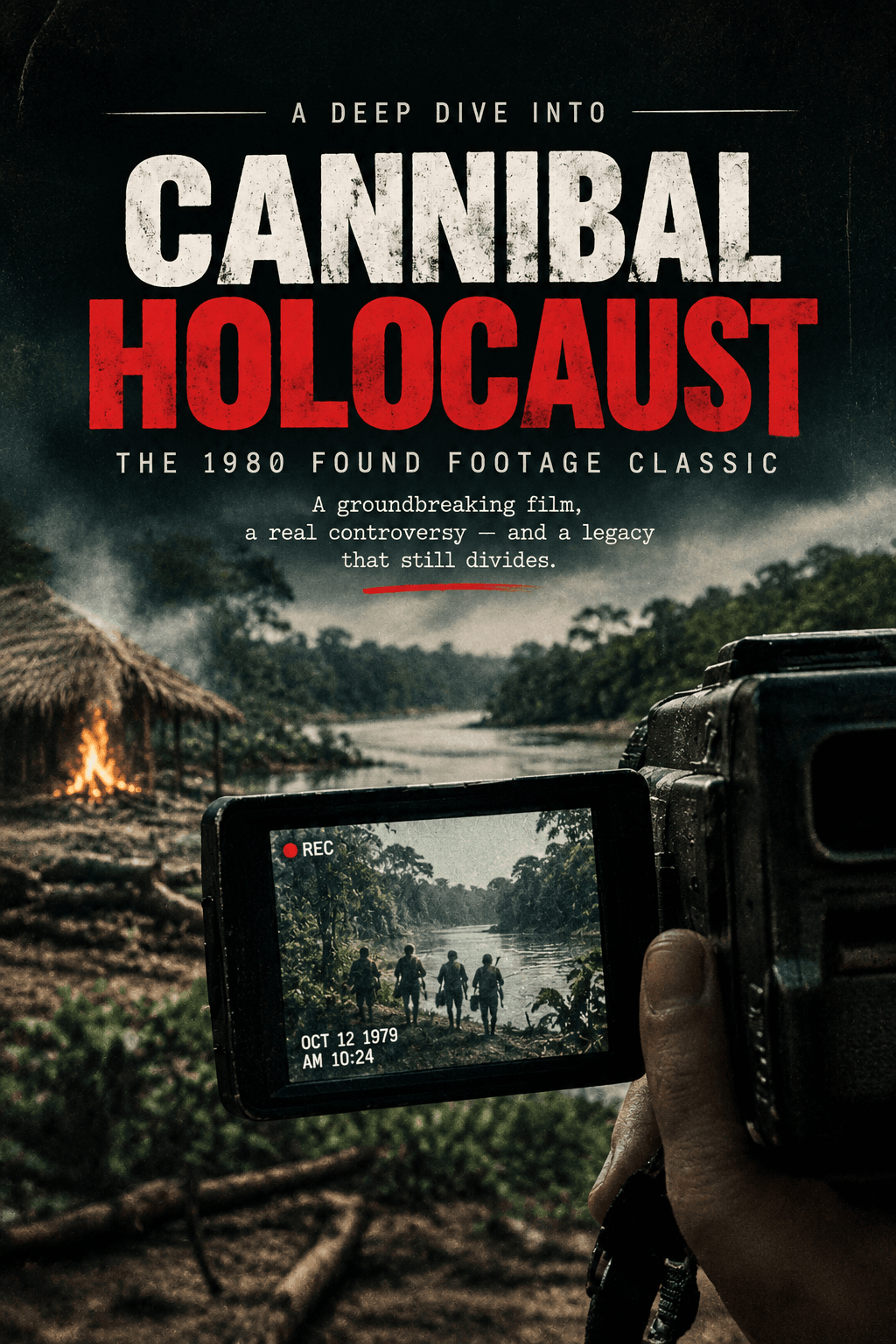
This Cannibal Holocaust 1980 review makes one argument above everything else: the film is both a genuinely significant piece of found-footage history and a film that doesn’t deserve a clean pass for how it got there. Cannibal Holocaust runs ninety-six minutes and spends roughly half of them pretending to be evidence.Ruggero Deodato built the structure out of a professor, a screening room, and a stack of recovered film reels, and the trick worked well enough in February 1980 that an Italian magistrate seized every print in the country and had the director arrested on the suspicion that four actors had actually been murdered on camera. Deodato had to produce them alive to make the charge go away. That’s not a marketing anecdote cooked up decades later for a Blu-ray insert.It’s a documented legal proceeding, and it says more about this film’s design than any amount of praise for its craft ever will: this is a horror movie that got mistaken for a crime scene by the people whose job was not to be fooled.The setup is NYU anthropologist Harold Monroe, played by Robert Kerman, flying into the Amazon to find out what happened to a four-person documentary crew that disappeared filming something called The Green Inferno. Monroe finds the guide’s skeleton, watches a tribal punishment killing he wasn’t supposed to see, and eventually trades a tape recorder’s worth of music to a Yanomamo village for the crew’s undeveloped reels. Back in New York, a television network wants to air the footage as a special. Monroe insists on screening it first.What’s on those reels is the real plot: the missing crew — director Alan Yates, his assistant Faye Daniels, cameramen Jack Anders and Mark Tomaso — staging the savagery they’d come to document, burning a native hut to fake a massacre for better footage, and eventually gang-raping and impaling a woman from the tribe they’re supposedly studying. The tribe wipes them out in return. The network executives watching alongside Monroe order the footage burned. He leaves asking who the real cannibals are, which is as close as this film gets to subtlety, and it isn’t very close.I’ll say the useful thing early, because a film with this reputation doesn’t earn the benefit of a slow approach:
Cannibal Holocaust is a genuinely significant piece of film history, dishonestly marketed, built partly out of real animal corpses, and still worth taking seriously as the first film to figure out that recovered footage is scarier than a ghost.All three of those things are true simultaneously, and nobody involved in flogging this thing as “the most controversial film ever banned in 50 countries” has ever shown much interest in holding more than one of them in their head at once.
The Animal Cruelty That Actually Got Cannibal Holocaust Banned
What actually got the film banned wasn’t the fiction. Seven animals died during production — a coatimundi the crew’s own script misidentifies as a muskrat, a large turtle, a tarantula, a snake, two spider monkeys (the scene was shot twice, so both died even though only one take made the cut), and a pig. Carl Gabriel Yorke, playing Alan Yates, refused to kill the pig on camera; Luca Barbareschi did it instead. Robert Kerman left the set, and by his own later account physically went after Deodato, when he realized the coatimundi’s death wasn’t a special effect.Kerman spent years afterward describing his director, on the record, as “remorseless” and “uncaring.” Deodato himself eventually admitted it plainly: “I was stupid to introduce animals.” He’s right, and the admission doesn’t undo a single one of the deaths. When the Italian courts finally banned the film, animal cruelty law was the actual legal hook. The film’s own defenders tend to blur that distinction, since the fictional violence against the human cast is the part they’d rather argue is clever.
The Obscenity Trial, the Murder Charge, and the Bicycle-Seat Defense
The human violence is where the obscenity case and the murder suspicion came from, and that part of the legend is funnier than it should be, in the specific way court transcripts are funny when nobody involved is laughing. The actors playing the missing crew had signed agreements to stay out of the press for a year after release, a contract Deodato wanted for the same reason he wanted everything else: it kept the illusion alive longer. A French magazine ran a story in early 1981 suggesting the deaths on screen might be real.Italian authorities, who had already pulled the film from theaters after a citizen complaint, took the suggestion seriously enough to add a murder investigation to the obscenity charge already in progress.Deodato’s fix was almost embarrassingly literal: he got the four actors in front of cameras together, alive, to settle the question, and had the actress behind the film’s most notorious image — a woman shown impaled on a wooden stake through her body — demonstrate the rig that made it work, a bicycle seat rigged to the iron pole so she could sit on it, with a length of balsa wood braced in her mouth. No proof of an actual snuff film has ever surfaced, because there wasn’t one.What the trial produced instead was six convictions for obscenity and violence — Deodato, two producers, the screenwriter, a production partner, and a distribution rep, each drawing a four-month suspended sentence — and an Italian ban over the animal footage that Deodato spent three more years fighting before a 1984 ruling let a cut version back into circulation.
The Craft: Sergio D’Offizi’s Cinematography and Riz Ortolani’s Score
None of that legal theater would have landed if the footage itself weren’t engineered to be believed, and the engineering is the part of this film that’s actually impressive, independent of whether you can stomach watching it. Cinematographer Sergio D’Offizi — who took over after the original director of photography quit partway through — shoots the film in two distinct registers. The New York framing scenes with Monroe sit in a conventional, hard-matted 1.85:1, clean and professionally lit, the visual language of a movie that knows it’s a movie.The recovered footage shot by the missing crew drops into full-frame handheld 16mm, degraded, overexposed in places, the camera catching the wrong thing half a second too late the way an actual amateur operator’s camera would. Deodato has cited his old mentor Roberto Rossellini’s sense of unpolished immediacy as the model, and it shows: the found-footage sections don’t look like a horror movie trying to look like a documentary. They look like someone forgot to clean the lens.Riz Ortolani’s score does something stranger than support that illusion — it actively works against it, and the friction is the point. His main theme, later repurposed as the pop hit “Ti guarderò nel cuore” and still getting new life four decades later on the Euphoria soundtrack, is gorgeous in a way nothing else in this film has earned.Ortolani described the cue written for the film’s most violent stretch, the tribal punishment of an adulteress, as “a religious adagio” that needed “the tone of a religious piece” while still sounding “modern and striking.” On screen, that means a Moog bass groaning under a man rowing a bound woman to shore, strings tightening into dissonance as the assault starts, and then — exactly when the images are at their ugliest — the harmony briefly resolves into something that sounds almost tender, perversely romantic even, before the tension clamps back down.It’s a scoring decision that refuses to let the audience settle into either revulsion or detachment, and it’s the single best piece of craft in a film that otherwise earns most of its reputation through what it’s willing to show, with the craft behind how carefully it’s actually made rarely getting equal credit.
Robert Kerman and Carl Gabriel Yorke: Performances Shaped by What Was Actually Happening to Them
Kerman and Yorke are doing two very different, equally unglamorous jobs as actors, and both performances are more interesting read against what was actually happening to the men delivering them than as pieces of composed screen acting. Kerman came into this with a decade of adult-film work behind him under the name R. Bolla — Debbie Does Dallas chief among the credits he’d later say he deeply regretted — and almost none of mainstream drama.What he brings to Monroe is the specific, unforced disgust of a man genuinely watching something he didn’t sign up to watch — by his own account, he wasn’t always acting that reaction; he was having it. Yorke, playing the crew’s director, was cast on the basis of two questions — was he willing to fly to South America for a month, and what size shoes did he wear — and arrived at a jungle airstrip without having read a script, because there wasn’t one to give him. His disorientation on screen isn’t a character choice.It’s closer to a documentary record of an actor who genuinely didn’t know what he’d agreed to, and it’s more convincing than most of what gets praised as “committed” acting in films where everyone involved understood the assignment. Perry Pirkanen and Luca Barbareschi round out the crew with less to work with dramatically, but Pirkanen’s one extended close-up — holding a dying turtle near his own face after killing it on camera — carries a flatness that reads less like performance than like a young Actors Studio student trying to get through a task he clearly didn’t want.
The Real Target of Cannibal Holocaust’s Media Satire
The thing nobody involved in this production ever says out loud, because it would sound like an excuse, is that the film’s actual target was never a fictional cannibal tribe. Deodato has said he built this partly out of frustration watching sensationalized Italian news coverage of Red Brigades political violence, the same instinct that had already produced the mondo-documentary genre this film is cannibalizing — a word chosen deliberately.The crew’s own fictional project, a fabricated atrocity reel called The Last Road to Hell, reportedly spliced in genuine Nigerian newsreel footage to pad out its horror, which means the film puts real death on screen early, inside a story about a crew willing to fake death for ratings, before a single frame of its own staged violence has started.That’s the actual argument buried under the gore: the “civilized” television executives screening this footage in a Manhattan conference room are the ones who decide what gets broadcast and what gets burned, and they make that decision purely on what will move units, which is the same decision the dead documentary crew made in the jungle. The film’s moral position — that an audience hungry for atrocity footage is doing the same math as the people producing it — would land harder if the film weren’t also, demonstrably, selling atrocity footage.Deodato wants credit for the critique and the shock value in the same ninety-six minutes, and he mostly gets away with it, because the craft is good enough to make you forget you’re watching someone have it both ways.
Box Office, Bans, and the Found Footage Lineage It Started
It made roughly two million dollars in Italy in the ten days before the seizure, then went on, improbably, to become the second-highest-grossing film in Japan that year behind E.T. Deodato’s own estimate of its worldwide lifetime gross — he’s claimed figures as high as two hundred million dollars through decades of reissues — is the kind of number that should be filed next to the “banned in over fifty countries” tagline: plausible in spirit, unconfirmable in the specifics, and repeated constantly because it’s good copy. What’s harder to dispute is the lineage.The recovered-footage structure this film built — someone else’s camera, someone else’s reels, a professional audience watching raw tape to reconstruct what happened to people who are already dead — resurfaces almost unchanged in The Last Broadcast and then in
The Blair Witch Project nineteen years later, close enough that Deodato has made no secret of his irritation at watching a 1999 film get credited with inventing a structure his own film had already walked through an obscenity trial defending. Paco Plaza has named this film directly as an influence on REC.Eli Roth built The Green Inferno in 2013 as a straight-faced homage, lifting its title from the fictional documentary inside this one. None of that lineage required the real animal deaths to work. The found-footage mechanism Deodato actually invented — recovered tape as the engine of dread — would have functioned exactly as well with a prop pig.
Cannibal Holocaust 1980 Review: Final Verdict
This Cannibal Holocaust 1980 review lands where the legend never does. Rate this one honestly and the number comes out lower than the legend wants it to. Cannibal Holocaust earns its place in any serious account of where found footage comes from, and the screening-room structure, the two-register cinematography, and Ortolani’s genuinely strange scoring choices are not the work of a hack cashing in on a trend.But a film doesn’t get to claim the moral high ground on media exploitation while actually killing a coatimundi for the shot, and I’m not interested in pretending those two facts cancel each other out just because one of them is good filmmaking. This is an important film. It is not, by any measure that accounts for what it actually did to make its point, a defensible one.
Ethan’s Score: 6 / 10Frequently Asked Questions
What does this Cannibal Holocaust 1980 review conclude about whether it’s worth watching?
This Cannibal Holocaust 1980 review’s verdict is that it’s historically essential and ethically indefensible at the same time. The found-footage structure, the two-register cinematography, and Riz Ortolani’s score are genuine craft achievements that predate Blair Witch by nineteen years. The real animal deaths used to make it mean it earns a 6 out of 10, not higher.
Were the deaths in Cannibal Holocaust real?
The human deaths are special effects — including the infamous impalement, staged with a bicycle seat rigged to an iron pole. The seven animal deaths, including a pig, a turtle, and two monkeys, were real, filmed on camera, and are the actual reason Italian courts banned the film.