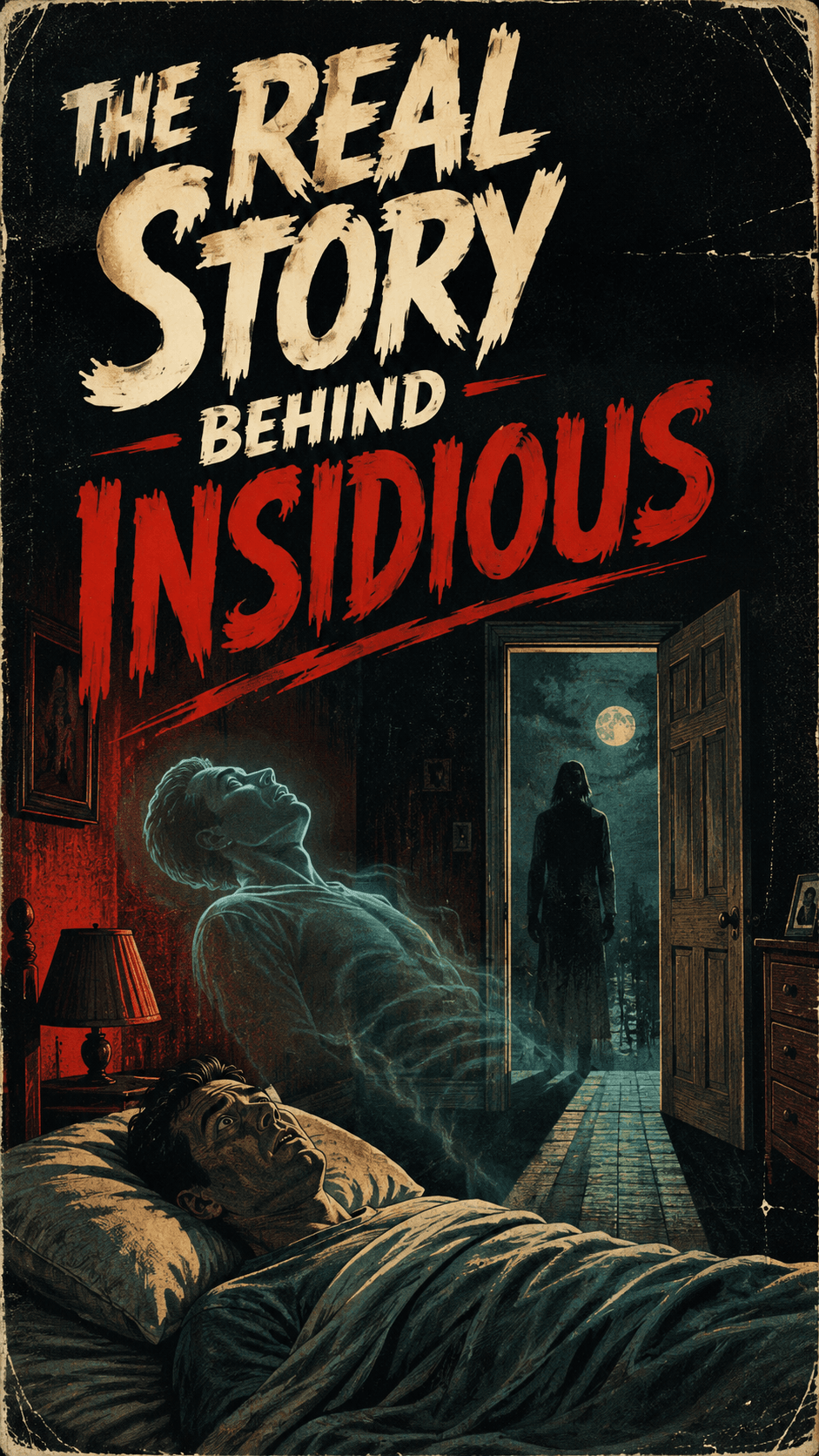
Astral projection has never been proven by mainstream science — neuroscience treats it as a dissociative hallucination, not a real journey out of the body. But the sleep paralysis history behind Insidious is real, documented, and older than the film by centuries.
Leigh Whannell didn’t invent the fear at the center of this movie. He described something he’d already lived through.
Before he wrote a word of the script with James Wan, Whannell had his own recurring bouts of sleep paralysis and a genuine, years-long curiosity about astral projection. The two of them realized, mid-conversation, that nobody had built a horror film around the idea. That gap became the movie.
I’ve written elsewhere on this site about what the film does with that premise once the cameras started rolling. This piece stays outside the theater. It’s about what’s actually documented — the research, the numbers, the four-hundred-year-old painting that beat modern medicine to the diagnosis. It’s a quieter, sadder story than the demon that made it to the poster.
The Sleep Paralysis History Behind Insidious’s Astral Projection
What Leigh Whannell Actually Lived Through
Whannell has talked about it plainly in interviews: recurring sleep paralysis, and a fascination with astral projection that predated any interest in turning it into a screenplay.
He wasn’t researching a monster movie. He was trying to name something that had already happened to him, more than once, in his own bed, with no one else in the room to confirm it.
That’s a different origin story than most possession films get. The Conjuring franchise built its mythology on the Warrens’ case files — secondhand testimony, curated and performed for cameras for forty years before Hollywood got to it.
Insidious started closer to the source. One of the two men who wrote it had felt the actual, physical helplessness the film later renders as a father crossing into a red-lit afterlife to save his son. The demon, the Further, the Lipstick-Face creature — all of that is elaboration. The paralysis itself wasn’t invented for the page.
What makes that detail worth sitting with is how ordinary Whannell’s version of it apparently was. No monster, no chase, no lore. Just a body that wouldn’t respond and a mind that was suddenly, unwillingly, wide awake inside it. Everything genre gets added on top of that afterward, for an audience. The experience itself came stripped of all of it.
The Old Hag: A Phenomenon Documented on Every Continent
Sleep paralysis happens when a person’s mind surfaces into consciousness before the body’s REM-sleep muscle shutdown finishes switching off.
During normal REM sleep, neurons in the brainstem release chemicals that directly shut down the spinal cord’s motor neurons — a built-in safety switch that stops a sleeping body from acting out its dreams. Sleep paralysis is what happens when consciousness reboots a few seconds before that switch flips back.
You’re awake. You can often see the room, hear it, sometimes feel a draft against your skin. You cannot move, and very often cannot speak, while the same dreaming brain that was just generating vivid, illogical scenes is still running — now layered directly onto a waking room it has no business being layered onto.
This isn’t rare. Population studies put the lifetime rate at roughly 7.6 percent of people overall, climbing to 28.3 percent among students and 31.9 percent among psychiatric patients — and the phenomenon isn’t distributed evenly. Reported rates run highest among people of African descent, at over 40 percent, and among Asian populations, at roughly 31 percent. Chest pressure specifically — the sensation of something sitting on you, restricting your breathing — shows up in more than half of all reported episodes.
Sleep researchers have identified three hallucination types that recur across cultures: a felt or seen presence in the room, known as “the intruder.” The crushing chest weight itself, the “incubus.” And a sensation of floating, falling, or being dragged.
The folklore built to explain those three symptoms exists almost everywhere, invented independently by cultures that never spoke to each other. In Newfoundland, it’s the Old Hag — a witch-like crone who sits on the sleeper’s chest. In Catalonia, it’s the Pesanta, a black dog or cat pressing down on a sleeping body.
In Nigeria, a demon-woman pounces mid-dream. In Japan, a vengeful spirit suffocates the sleeper. In Brazil, it’s the Pisadeira, a rooftop-dwelling crone who stamps on the chests of anyone who sleeps on their back with a full stomach.
China has its own name for it — guǐ yā shēn, “a ghost pressing on the body.” Korea calls it gawi nulim, being pinned down by something malicious inside the dream itself. Thailand attributes it to Phi Am, a spirit some sufferers blame for the bruises they wake up with.
In medieval Europe, the culprit was the mare — an Old English word for a demon believed to sit on a sleeper’s chest and cause bad dreams. That’s where the word “nightmare” comes from, four centuries before anyone had the vocabulary for REM-sleep atonia.
Every one of those cultures was describing the same nervous-system glitch, reaching independently for the only explanation available: something got in, and it wants something from you, at the one moment you’re least equipped to fight back.
The Painting That Beat Medicine to the Diagnosis by 150 Years
In 1781, decades before anyone could describe REM sleep, the Swiss-born painter Henry Fuseli exhibited a canvas called The Nightmare. A woman lies unconscious across a bed, one arm thrown below her, while a grinning, ape-like incubus crouches directly on her chest. A wild-eyed horse — the “night-mare” of the title — pushes its head through the curtains behind her, watching.
Fuseli had failed to make an impression at the Royal Academy for years. This painting, when it showed in 1782, made him famous overnight — audiences reacted with the specific horrified recognition of people looking at something they’d personally experienced and never had a picture for.
Art historians now read the painting as one of the earliest visual records of sleep paralysis anywhere in Western art — the chest weight, the total helplessness, the sense of being watched by something that shouldn’t be able to get in. Fuseli didn’t have a diagnosis. He had a Germanic folk tradition of bedroom demons and witches, and his own account of vivid, disturbing dreams, and he painted the sensation exactly, a century and a half before a sleep lab could tell you what REM atonia was.
The Men Who Tried to Prove Astral Projection Was Real
Insidious doesn’t stop at paralysis. It asks you to believe a person can leave their body entirely and travel somewhere else while it lies empty. That idea has its own history, and it’s stranger and more earnest than the film has time for.
The vocabulary starts earlier than most people assume. In 1875, Helena Blavatsky co-founded the Theosophical Society in New York, blending Hindu and Buddhist concepts with Western occultism at the height of a spiritualist craze that had Americans and Europeans flocking to mediums to reach dead relatives. Blavatsky’s writing popularized the term “astral body” itself — a separate, subtler double of the physical self, capable of traveling independently of it. Whatever else she was — and even sympathetic biographers use the word “fraud” somewhere in the sentence — she’s the reason the concept had a name at all by the time anyone tried to study it seriously.
Sylvan Muldoon started having what he called spontaneous projections as a child in Iowa, after attending a spiritualist gathering with his mother — waking, by his own account, to find himself looking down at his own sleeping body.
He spent the rest of his life documenting the experience with the seriousness of a man taking scientific notes on his own haunting. His 1929 book, co-written with psychical researcher Hereward Carrington, gave the phenomenon a vocabulary still used today: the cataleptic state at the moment of separation, the vibrations that precede it, and the silver cord — a luminous tether Muldoon claimed connected the traveling self to the sleeping body.
Robert Monroe picked up where Muldoon left off decades later and tried to make the experience repeatable. He built an entire research institute around inducing and studying out-of-body states in ordinary people, using audio technology of his own design. His 1971 book brought the idea to an audience that had never heard of Muldoon, let alone Blavatsky.
By his own account, and by the accounts of thousands of participants who passed through his institute over three decades, nobody who tried it ever reported the cord being severed, or the traveling self failing to find its way home.
I want to be honest about what that record proves, which is less than it sounds like. Mainstream neuroscience generally treats reported out-of-body experiences as a specific category of dissociative hallucination, often triggered by the same hypnagogic state that produces sleep paralysis in the first place.
The phenomenon itself remains unproven, across a century and a half and three very different men who each thought they’d finally pinned it down. The sincerity of the record is real regardless. Blavatsky, Muldoon, and Monroe spent their working lives trying to map a place most of us only visit involuntarily, for a few terrifying seconds, and rarely remember clearly enough to describe.
What Josh Lambert’s Inheritance Gets Right
The film frames astral travel as a family trait, passed down whether anyone wants it or not. There’s something true underneath that fictional framing even if the traveling itself isn’t literal.
Sleep paralysis has documented links to family history, sleep deprivation, irregular schedules, and anxiety disorders. It runs in patterns — the way a lot of things that scare a family quietly do, without ever getting named at the dinner table. It also runs harder through some populations than others, which is its own quietly uncomfortable fact sitting underneath the folklore: the people most likely to experience it are not evenly spread across the world that has to explain it.
I won’t re-walk the specifics of what happens to Josh here — I’ve already broken that down in full. What’s worth adding is this: people who experience recurring sleep paralysis often describe the same pattern the film gestures at. They mention it once, to a parent or partner, meet confusion instead of recognition, and stop.
Not because the fear passed. The telling simply stopped helping.
Every culture in this piece built a name for this thing — a hag, a dog, a demon-woman, a mare, a ghost pressing on the body — because a name makes an experience shareable. It proves to another person that what happened to you has happened to someone else too.
And still, across most households, most decades, most languages, a person who wakes up paralyzed and certain something is in the room learns fast that the telling gets a concerned look and little else. So the telling stops. The fear stays exactly where it was, quiet, the way Josh’s did for thirty years — the way most real accounts of this phenomenon do, long before any of them make it into a film with a score cue to announce when you’re supposed to be afraid.
Just a body that locks up in the dark on its own schedule, and a species that has quietly agreed, across five continents and roughly two hundred and fifty years since Fuseli picked up a paintbrush, to give the same nameless weight a dozen different names rather than sit with how alone it feels while it’s happening.
You can read more about how sleep researchers document the phenomenon today — the science has a name for it now. It just took longer to arrive than the fear did.
For the film itself — what it does with this premise, the performances, and how the ending actually plays out — my review and my ending breakdown cover that ground. And if you want to see how differently this site treats paranormal investigators who claim real cases, the Ed and Lorraine Warren piece is the other side of that coin.
Frequently Asked Questions
What is the sleep paralysis history behind Insidious?
Insidious grew out of screenwriter Leigh Whannell’s own recurring sleep paralysis and long-standing interest in astral projection. The film’s premise combines that real, documented phenomenon with astral projection research from figures like Helena Blavatsky, Sylvan Muldoon, and Robert Monroe, though the traveling itself has never been scientifically proven.
Is astral projection real?
Mainstream neuroscience has never proven astral projection as literal travel outside the body. Reported experiences are generally classified as dissociative hallucinations linked to the same hypnagogic state that causes sleep paralysis. Researchers like Robert Monroe documented thousands of accounts without scientific consensus ever confirming the phenomenon.
What is the Old Hag phenomenon?
The Old Hag is a folk name, originating in Newfoundland, for sleep paralysis accompanied by a felt presence and chest pressure. Nearly every culture has its own version — the Pesanta in Catalonia, the Pisadeira in Brazil, “ghost pressing on the body” in China, and the medieval European “mare,” the root of the word “nightmare.”
How common is sleep paralysis?
Roughly 7.6 percent of people experience sleep paralysis at least once in their lifetime, according to population studies, with rates climbing to nearly 30 percent among students and over 40 percent among people of African descent. Chest pressure occurs in more than half of reported episodes.
Did Leigh Whannell really experience sleep paralysis?
Yes. Whannell has said in interviews that he experienced recurring sleep paralysis and had a personal interest in astral projection before writing Insidious with James Wan, and that the film grew out of realizing no horror movie had explored the idea.