I watched The Shining alone in my college apartment in Austin, 2007, at two in the morning, on a cheap laptop with the sound too low and the room too dark. When it ended I left the light on. I never told anyone that. There wasn’t a reason to — nothing had happened, nobody had come for me, I’d just watched a very good movie about a man losing his mind in an empty building. But I remember lying there afterward listening to my own apartment the way you listen to a house you’ve suddenly stopped trusting, and I remember understanding, for the first time with any real clarity, that the thing horror does best has nothing to do with what’s on screen. It’s what it does to the fifteen minutes after the screen goes dark, when you’re alone with your own attention and you can’t quite get it back under control. That’s the exact fifteen minutes Insidious (2010) is built to occupy.
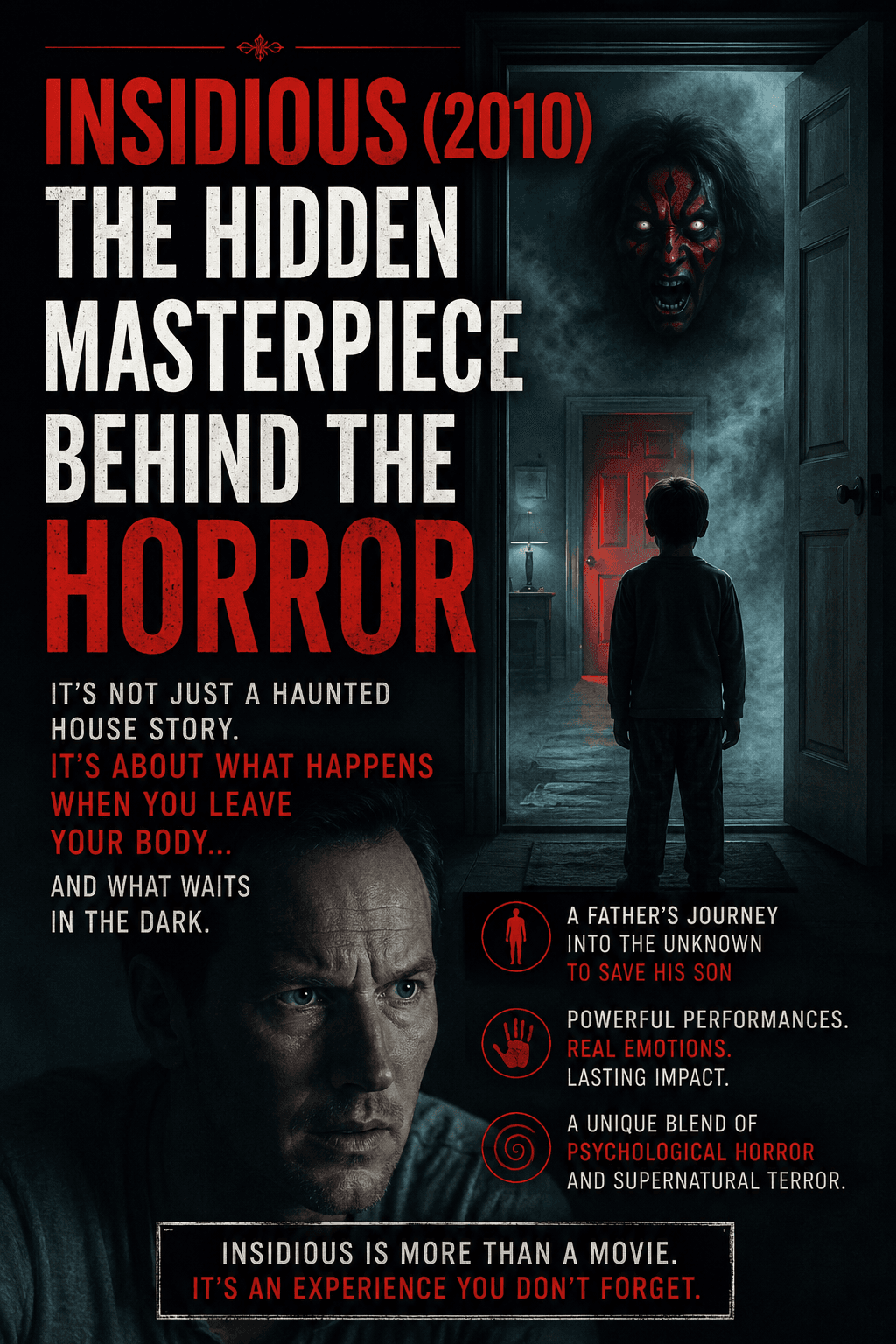
James Wan and Leigh Whannell made it in 2010, for around a million and a half dollars, about a family whose son falls into an unexplainable coma after a trip to the basement, and about the father who eventually has to leave his own body to go get him back. The premise is astral projection dressed as a haunted house movie, and the real subject, buried under the ectoplasm and the red-faced demon, is what happens in the gap where a person isn’t fully present in themselves. That gap is where Insidious lives. It’s the gap I fell into after watching Kubrick alone at two in the morning, except Wan and Whannell had the nerve to ask what’s actually waiting in it.
I’ve been public about this before and I’ll be public about it again: I think James Wan is a gifted technician who has, across most of his career, had remarkably little to say. The Conjuring universe he built afterward is the horror equivalent of a franchise restaurant — the lighting is confident, the jump scares are timed with genuine skill, and there is nothing underneath any of it that couldn’t be swapped out for a different demon and a different decade without losing anything essential. Insidious is the film that makes me hold that opinion with less certainty than I’d like. It’s the one Wan production where the craft is in service of an actual idea, made before the idea calcified into a formula he’d spend the next decade selling back to us with diminishing returns. Watching it again is watching a director who hadn’t yet figured out how to industrialize his own instincts, and Insidious is better for it in every way that matters.
What Insidious (2010) Is Really About
The astral projection mechanism does the thing good horror premises are supposed to do: it makes the metaphor and the plot mechanics the same object. Dalton’s possession is inheritance — a gift passed down from a father who spent thirty years pretending he didn’t have it, a debt collected three decades late. Josh Lambert was a traveler as a child, drawn out into the same nightmare realm his son now occupies, and his mother Lorraine suppressed the memory out of him so completely that he built an entire adult life — wife, kids, a teaching job, a house he can’t stop renovating — on top of a hole he didn’t know was there. The haunting was always coming for this family, passed down through the bloodline the way debt gets passed down, and Dalton is simply the generation it finally collects from.
The Performances That Make Insidious Work
Masculinity anxiety is one of horror’s most underused registers, and Insidious understands something about failed fathers that most possession films don’t bother with. Josh spends the first half of Insidious doing exactly what men in his position are trained to do: disbelieve his wife, retreat to the school where he’s competent, drink alone in a park rather than sit with what’s actually happening in his house. Patrick Wilson plays this without ever making Josh look weak in the conventional sense — he’s charming, funny with his kids, visibly loved. What he’s doing is worse than weakness. He’s performing competence over a hole he’s spent his whole adult life papering over, and Wilson finds the specific quality of a man who has gotten so good at managing his own denial that he no longer recognizes it as denial. When he finally goes under the metronome and crosses into the Further to get Dalton back, Wilson plays the fear as something closer to recognition than discovery — his face carries dread edged with something like relief, as if some part of him already expected this specific hallway to reopen. That’s a performance decision that goes well beyond anything the screenplay spells out, and it’s the reason the rescue sequence works as more than a special-effects set piece.
Lin Shaye does the other half of the film’s real acting. Elise Rainier could have been played as either mystic-shaman shorthand or comic relief propping up Specs and Tucker’s bumbling double act, and Shaye refuses both. She plays every supernatural claim with the flat, procedural confidence of someone reading a diagnosis off a chart, which is exactly the right choice — the film needs Elise’s authority to feel earned, and Shaye earns it by underplaying everything a lesser actor would have played for spectacle. Watch her in the scene where she tells the Lamberts that Dalton isn’t in a coma: she delivers the least believable information in the entire film in the same register she’d use to explain a mortgage rate, and that steadiness does more persuasive work than the sketchbook drawings or the tri-field meter readings combined. When the film later needs her dead — and it does, brutally, in an ending most possession movies wouldn’t have the nerve to commit to — it costs something, because Shaye spent ninety minutes making Elise feel like the only adult in the story who actually knew what she was doing.
Rose Byrne gets the least credit of the three, which is its own kind of tell. Renai is the character carrying the film’s other true subject — a woman who gave up a music career to raise three children in a house that keeps rearranging its own furniture, and who spends the first act being told, gently and repeatedly, that what she’s experiencing is exhaustion rather than evidence. Byrne plays that specific fatigue with a precision that never tips into hysteria, which the film needs, because Renai’s credibility is load-bearing for everything that happens once the ghost hunters arrive. Watch her at the piano, working on the one song she’s managed to salvage from a life that keeps interrupting itself, in the moment before the baby monitor starts whispering back at her — Byrne plays it as a woman stealing forty-five seconds of a self she used to have, and the film punishes her for it almost immediately. Every domestic detail Whannell’s script assigns to Renai — the wax fruit, the misplaced boxes, the sheet music nobody helps her look for — exists to establish a woman whose interior life had already been shrunk down to almost nothing before anything supernatural showed up to shrink it further.
The Craft Behind Insidious’s Scares
None of this works without the craft decisions sitting underneath it, and this is where Insidious earns the comparison to films with far bigger reputations. Cinematographers David M. Brewer and John R. Leonetti shoot the Lambert house the way a real estate photographer would shoot a house that’s already sold — static, evenly lit, patient wide shots that give the frame time to be searched. That patience is the entire strategy: reportedly, the production held to a rule against false scares — no cat jumping out of a closet, no sting that turns out to be nothing — and you can feel that discipline in how long the camera is willing to sit still before it gives you a reason to be afraid. The instant the family crosses into the Further, that patience gets weaponized. The palette drains to almost nothing but red and black, and Joseph Bishara’s score stops being score and starts being an assault — dense, scraping string clusters that owe an obvious debt to the Penderecki pieces Kubrick licensed for The Shining, built from dissonance rather than melody. It’s the kind of score that becomes dread rather than announcing it, and the fact that Bishara also physically played the Lipstick-Face Demon under all that red greasepaint is the sort of detail that would be too cute if the film weren’t already committed to the bit that its own composer is the thing coming for your son.
Kirk Morri’s editing, credited alongside Wan, is where the discipline actually gets executed rather than just claimed. Insidious cuts on stillness more often than it cuts on motion, holding a static frame a beat past where a lazier edit would move on, which is precisely the beat where your eye starts doing the work Insidious wants it to do. And then there’s Tiny Tim’s “Tiptoe Through the Tulips,” a genuinely sweet 1929 love song that the production repurposes as the demon’s calling card, and which has gone on to permanently ruin the song for a whole generation of people who’ve never seen the film. That’s the same instinct running through every other craft choice here — take something familiar and warm, and let the discomfort come from how wrong it feels rather than from anything the film has to manufacture from scratch.
How Insidious (2010) Was Received
Critics at the time landed somewhere between grudging and enthusiastic — Rotten Tomatoes settled around sixty-six percent off roughly a hundred and seventy-five reviews, with a consensus that called it a very scary, very fun haunted house ride undercut by a shaky final act, which is a fair description of a film that spends its first ninety minutes with more discipline than its own last fifteen. Peter Travers called it a better-than-average spook house movie precisely because it does its damage without spraying the audience in blood, and that’s the review I’d have written too, years before “elevated horror” became a marketing term critics could put on a poster to feel better about the genre they’d chosen to write about. Insidious sold to Sony Pictures Worldwide Acquisitions within hours of its midnight premiere at Toronto in September 2010, and it reached theaters through FilmDistrict the following April on the strength of a movie that cost roughly what a mid-budget studio film spends on catering. It went on to gross over a hundred million dollars worldwide.
Is Insidious (2010) Better Than The Conjuring?
I think about that math a lot, because it’s the same math that greenlit The Conjuring three years later, and The Conjuring is the film where I think Wan started trusting the formula more than the idea.
The Insidious (2010) Ending, Explained
The ending here still belongs to the idea. It’s a film about a father who finally goes looking for the part of himself he spent thirty years running from, and the ending refuses to let him win for it — the parasite that’s been hunting him since childhood gets him in the last scene, quietly, almost gently, snuffing a candle like she’s tucking someone in. Josh disappears into the dark, and Elise — the one person in the film who understood the rules well enough that it shouldn’t have happened to her — recognizes what’s wearing his face maybe a half-second before it kills her.
I think about the light I left on in 2007, and how nothing about that decision made rational sense, and how I’ve never once regretted it. Insidious ends on the exact opposite gesture — a woman blowing a candle out on purpose, taking the light away deliberately, because the dark holds nothing that can hurt her. She’s the thing waiting in it with Josh now. Somewhere in my apartment that night, seventeen years before I watched a fictional father get erased by something patient enough to wait thirty years for him, I understood that the safest thing you can do after a film like this is leave a small light burning somewhere you don’t have to look at directly. Insidious never lets its own family have that option. That’s the part of it I haven’t been able to put down since.
Ethan’s Score: 8.3/10