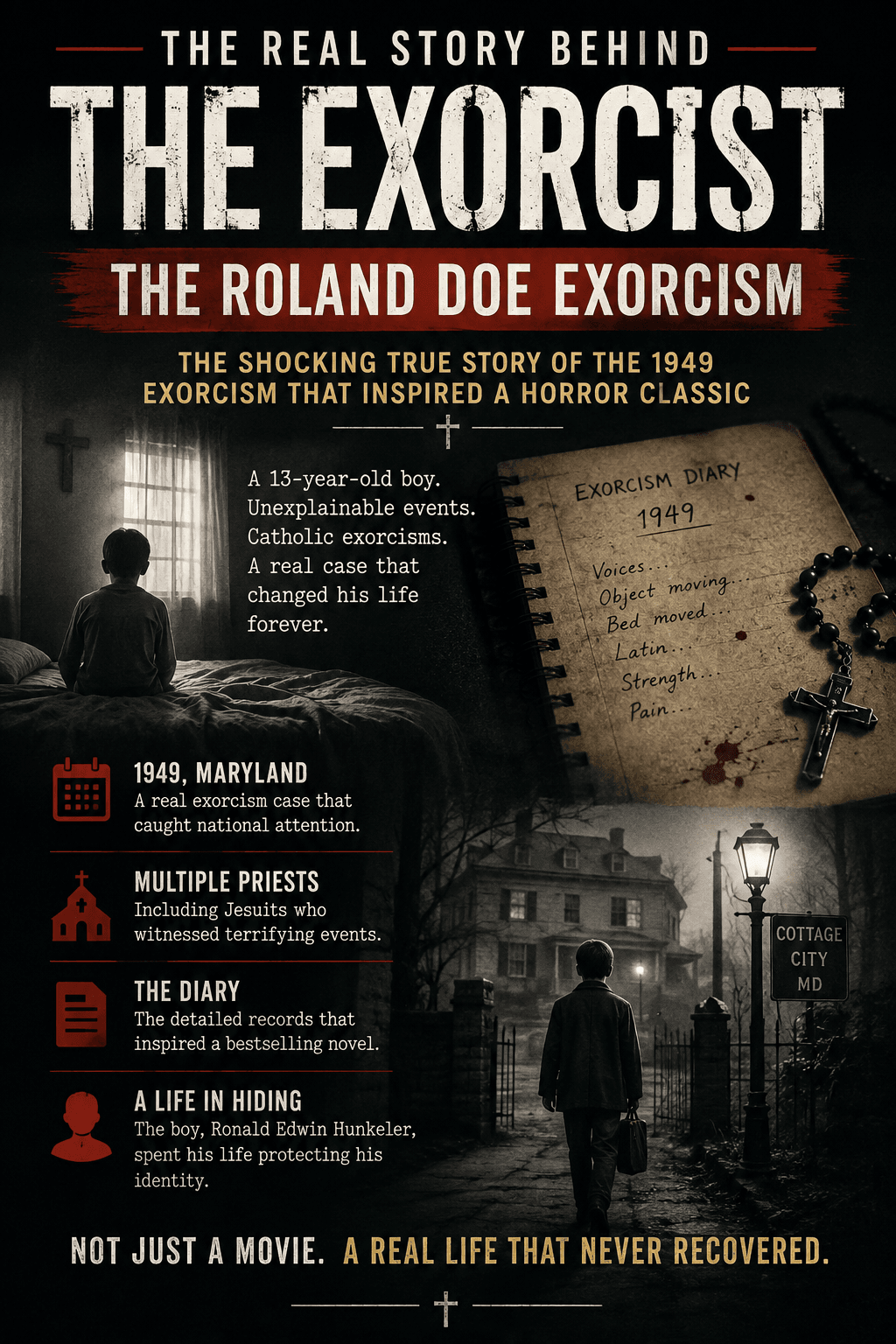
The Roland Doe exorcism true story is the real 1949 case behind William Friedkin’s 1973 film The Exorcist: a thirteen-year-old boy in Cottage City, Maryland, subjected to a series of Catholic exorcism rites after months of unexplained disturbances, later adapted by William Peter Blatty into his 1971 novel.
Yes, The Exorcist is based on a true story. But the boy at the center of it, later identified as Ronald Edwin Hunkeler, spent the rest of his life trying to outrun that fact, and got less than two years of peace after his own death before a magazine took even that away from him.
He went by “Roland Doe” in the case files and “Robbie Mannheim” in the books written about him. Almost nobody knew his real name for seventy-two years, because he spent his entire adult life making sure it stayed that way. He worked for NASA for forty years, retiring in 2001.
He helped patent heat-resistant panel technology tied to the Apollo program’s re-entry hardware. And according to his partner, he left his own house every Halloween, afraid that if the wrong person connected the right facts, his whole life would collapse into ten weeks from 1949 that he never chose and could never fully explain.
He died in May 2020, a month short of his eighty-sixth birthday, at home in Marriottsville, Maryland. A year and a half later, The Skeptical Inquirer printed his name. He wasn’t around to object.
That’s the part of the Roland Doe exorcism true story that doesn’t make it into the trailers.
What Actually Happened in 1949
Ronald grew up an only child in a German Lutheran household, close to his Aunt Harriet, a spiritualist who introduced him to a Ouija board when he was a kid curious about one. Harriet died. Not long after, the family started hearing things: scratching inside the walls, furniture that moved when nobody was near it, objects that seemed to travel across rooms on their own. They brought in their pastor, Luther Schulze, a man with a personal interest in parapsychology who spent a night directly observing the boy. Schulze’s advice was the one that mattered: go see a Catholic priest.
By mid-1949, newspapers were already printing anonymous reports of the case, most likely sourced through Schulze himself. One widely repeated account claims forty-eight people witnessed the climactic exorcism, nine of them Jesuits, though like much of this story, the number is difficult to verify against anything but hearsay.
What happened next depends on which version of the story is doing the telling. Multiple accounts describe an attempted rite at Georgetown University Hospital that ended when the boy allegedly tore a spring from his mattress and used it to cut a priest’s arm. It is one of the most-repeated details in the entire case. It is also one that a later, far more rigorous investigation couldn’t find any actual evidence for.
The better-documented parts: scratches appeared on the boy’s body spelling out “LOUIS,” which the family read as a sign to travel to relatives in St. Louis. Through a cousin connected to Saint Louis University, they reached Father Raymond Bishop and Father William Bowdern, who visited the boy directly, watched a bed move with no one touching it, and heard him speak in a voice that wasn’t his own.
Bowdern got the archbishop’s permission to proceed with a formal rite. It took place at Alexian Brothers Hospital in South St. Louis. Father Walter Halloran was called in partway through the ritual and had his nose broken by the boy mid-session. A third priest, William Van Roo, assisted throughout.
Bishop kept a diary of the sessions, and that diary is the closest thing this story has to a primary source, the document Blatty would later track down and study directly, years before he wrote a word of the novel. Even the priest who lived through it walked away with less certainty than the finished film ever allowed its audience.
Asked decades later, point-blank, to confirm the boy had genuinely been possessed, Halloran wouldn’t do it. “I never made an absolute statement about the things,” he said, “because I didn’t feel I was qualified.” That’s a Jesuit who was in the room, near the end of his own life, declining to close the case the way Hollywood already had. The priests’ own records never once describe the entity by the name most audiences now associate with the film.
The Diary, and the Story That Got Printed Instead
Here is where the Roland Doe exorcism true story stops being about demons and starts being about something else entirely: what happens to a real, documented event once enough people decide it’s more useful to them unverified.
In the 1990s, a writer named Mark Opsasnick went back and did the legwork almost nobody before him had bothered with. He tracked down neighbors, old classmates, property records. What he found didn’t match the story that had been circulating for forty years. The house wasn’t where most retellings placed it. The boy never lived in the town commonly cited. The Georgetown incident, the priest, the mattress spring, the injured arm, had no supporting evidence at all.
Opsasnick’s conclusion was blunter than any demon: a disturbed, attention-starved kid had thrown tantrums that snowballed, and every adult who touched the story afterward shaped it to fit whatever they already needed it to be. Psychiatrists saw mental illness because that’s what they were trained to see. Priests saw possession because that’s what they were trained to see. Writers and producers saw a story worth exploiting for profit, and mistook their own agenda for objectivity at every turn.
Skeptic Joe Nickell reached a similar place from a different angle, going after the physical “evidence” directly. The scratches, the words that appeared on the boy’s skin, the sudden displays of strength — Nickell called all of it well within what an agitated teenager could produce alone, without anything supernatural helping him along.
He noted that the marks never once appeared somewhere the boy couldn’t have reached with his own fingernails, and that on at least one occasion, people in the room reportedly watched him scratch the words himself. Not every academic who studied the case agreed with that framing; some, including psychology professor Terry Cooper and sociology professor Cindy Epperson, have argued the natural explanations don’t fully account for everything reported, and treated the case as a genuine test of where belief in the supernatural should sit against clinical skepticism.
Nobody fact-checked the version that spread, because nobody needed it checked. It was already selling.
A Journalist’s Take on a Story Built From Unchecked Details
I spent four days once, embedded with a state political campaign, watching a narrative get built in real time out of details nobody upstream had bothered to verify, because the narrative was already working without them. I came home and put on The Exorcist to decompress. I maintain, to this day, that it was the correct decision.
What I didn’t clock until much later, going back through Bishop’s diary and Opsasnick’s investigation side by side, is that I’d basically watched the same process twice: once with a campaign staffer, once with a thirteen-year-old, seventy years apart, with nobody in either room especially interested in slowing down to check.
The 1949 newspapers ran the story anonymously, sourced mostly through the family’s own pastor. Blatty picked it up years later as a Georgetown student sitting in a lecture on exorcism, chased down Bowdern directly, got access to the diary, and built a novel around it. Friedkin turned that novel into a film so effective that audiences have spent fifty years asking whether it’s “based on a true story,” as though the phrase settles anything, as though being true made any of it fair to the boy it happened to.
It didn’t. He had no vote in any of it.
Why Friedkin Turned a Boy Into a Girl
Not everyone involved in the adaptation was indifferent to that. In an interview years later with the Catholic broadcaster EWTN, Friedkin explained that he’d been in direct contact with the real boy’s aunt while making the film, and that the decision to make Regan a girl instead of a boy wasn’t a creative flourish.
It came from the Church itself, he said, which wanted to take pressure off the actual family while the details were still being pieced together into a script. “A lot of the details were the details from the actual case,” Friedkin said, while insisting he’d approached the material as a believer rather than as someone chasing shock value.
That’s a genuine attempt at protection, and it’s worth naming as one. It’s also worth noticing how little it ended up mattering. Changing a boy to a girl in the film didn’t stop the identity from leaking sideways for decades through documentaries, message boards, and increasingly confident magazine pieces. It just meant that when people finally did connect Ronald Hunkeler to the case, they were connecting him to a story that had already been reshaped several times by people who never had to live inside it.
Ronald Hunkeler’s Actual Life, Buried Under the Story
This is the part that makes the real ending worse than the film’s, not scarier, worse. Hunkeler grew up, went to work, and built a genuine career at NASA doing difficult, exacting engineering on the country’s biggest aerospace program, and he kept his mouth shut about 1949 for the rest of his life. He wasn’t performing recovery for anyone watching. He simply moved forward, the way people who’ve survived something tend to when nobody hands them a script for how to talk about it afterward.
The fear apparently never fully left. He avoided his own front porch on the one night of the year when the thing that happened to him as a child became, for everyone else, a costume. That’s a grown man rearranging his calendar every October around other people’s entertainment.
He died before anyone found out. The Skeptical Inquirer published his name in December 2021, using genealogical and documentary research to connect Ronald Hunkeler to the pseudonym that had shielded him for seven decades. It was careful, well-sourced work, the kind of journalism that actually checks what it prints before printing it. But it printed a name a man had spent sixty years protecting, in the one window of time he couldn’t push back.
The Profit Machine Never Stopped
The case behind the Roland Doe exorcism true story has been adapted, revisited, and re-monetized in some form more or less continuously since Blatty’s novel hit shelves in 1971. There’s Possessed, a 2000 film considered closer to Thomas B. Allen’s account than Friedkin’s version ever was. There’s In the Grip of Evil, a 1997 documentary reconstruction. There’s The Haunted Boy: The Secret Diary of the Exorcist, a 2010 film built around investigators tracking down Bowdern’s actual diary.
There’s a Shock Docs episode devoted entirely to the case. There’s a Ghost Adventures episode, sent to investigate a house that, per Opsasnick’s research, likely isn’t even the right house. Every one of these represents another turn of the same machine Opsasnick described in the 1990s: a real, disturbed child’s worst months turned into raw material, over and over, by people who never had to answer to him directly.
The boy wasn’t the only one who paid rent on this story for decades. Cottage City, the actual Maryland town where the family lived, spent close to fifty years fielding ghost hunters, reporters, and curiosity-seekers showing up at houses that, per Opsasnick’s own research, were often the wrong address entirely.
A 1999 piece in the Washington City Paper described a town finally exhaling once enough time had passed that people stopped knocking on doors looking for a demon that was never confirmed to have been there in the first place. That’s the actual footprint of this story: not just one life rearranged around other people’s entertainment, but an entire neighborhood conscripted into a haunted-house tour it never agreed to host.
What This Actually Is, Once You Strip the Demon Out
Friedkin and Blatty understood exactly how to stage dread — the cold room, the crucifix, the voice that shouldn’t be able to come out of a child’s throat. The film earned its reputation honestly, through real craft, and stands as one of the best-constructed horror movies ever made.
But somewhere underneath the film, the novel, the documentaries, the message-board archaeology, and the competing explainers all asking the same question, there was a real, disturbed teenager who never got a diagnosis anyone was fully confident in, who never consented to any of what came after, and who spent his entire adult life managing the fallout of a decision made for him while he was thirteen and in crisis. Priests wanted a case. Writers wanted a story. Audiences wanted to be frightened in a controlled, comfortable way, from the safety of a theater seat.
Everybody got what they came for. Ronald Hunkeler got forty years of NASA blueprints and a Halloween he had to spend somewhere else, every single year, for the rest of his life. He never gave an interview. He never wrote a rebuttal. He never got the chance to correct a single detail that fifty years of documentaries, message boards, and paperback reprints got wrong about him, because doing that would have required saying his own name out loud, and saying his own name out loud was the one thing he’d built his entire adult life around never doing.
That’s the true story behind The Exorcist. Not a demon. A boy nobody asked.
Is The Exorcist based on a true story?
Yes. William Peter Blatty’s 1971 novel, and William Friedkin’s 1973 film, both draw on a real 1949 case involving a boy known publicly for decades only as “Roland Doe,” later identified as Ronald Edwin Hunkeler. Many specific details, including the Ouija board, the family’s move to St. Louis, and the priests’ diary, come directly from the documented case.
Who was Roland Doe in real life?
Roland Doe was the pseudonym used to protect the identity of Ronald Edwin Hunkeler, a Maryland teenager who underwent a series of Catholic exorcism rites in 1949. His real name wasn’t confirmed publicly until December 2021, in The Skeptical Inquirer, a year and a half after his death.
What happened to the real Roland Doe after 1949?
Ronald Hunkeler lived a private, largely ordinary adult life. He built a forty-year career at NASA, retiring in 2001, and worked on heat-resistant hardware tied to the Apollo program. He guarded his connection to the case so closely that, according to his partner, he avoided his own home every Halloween. He died in May 2020 in Marriottsville, Maryland.
Is the Roland Doe exorcism true story fully confirmed as supernatural?
No. Investigators including Mark Opsasnick and skeptic Joe Nickell concluded the documented events were consistent with a disturbed teenager producing the effects himself, with no supernatural cause required. Even the priests directly involved, including Father Walter Halloran, declined to confirm genuine possession on the record.