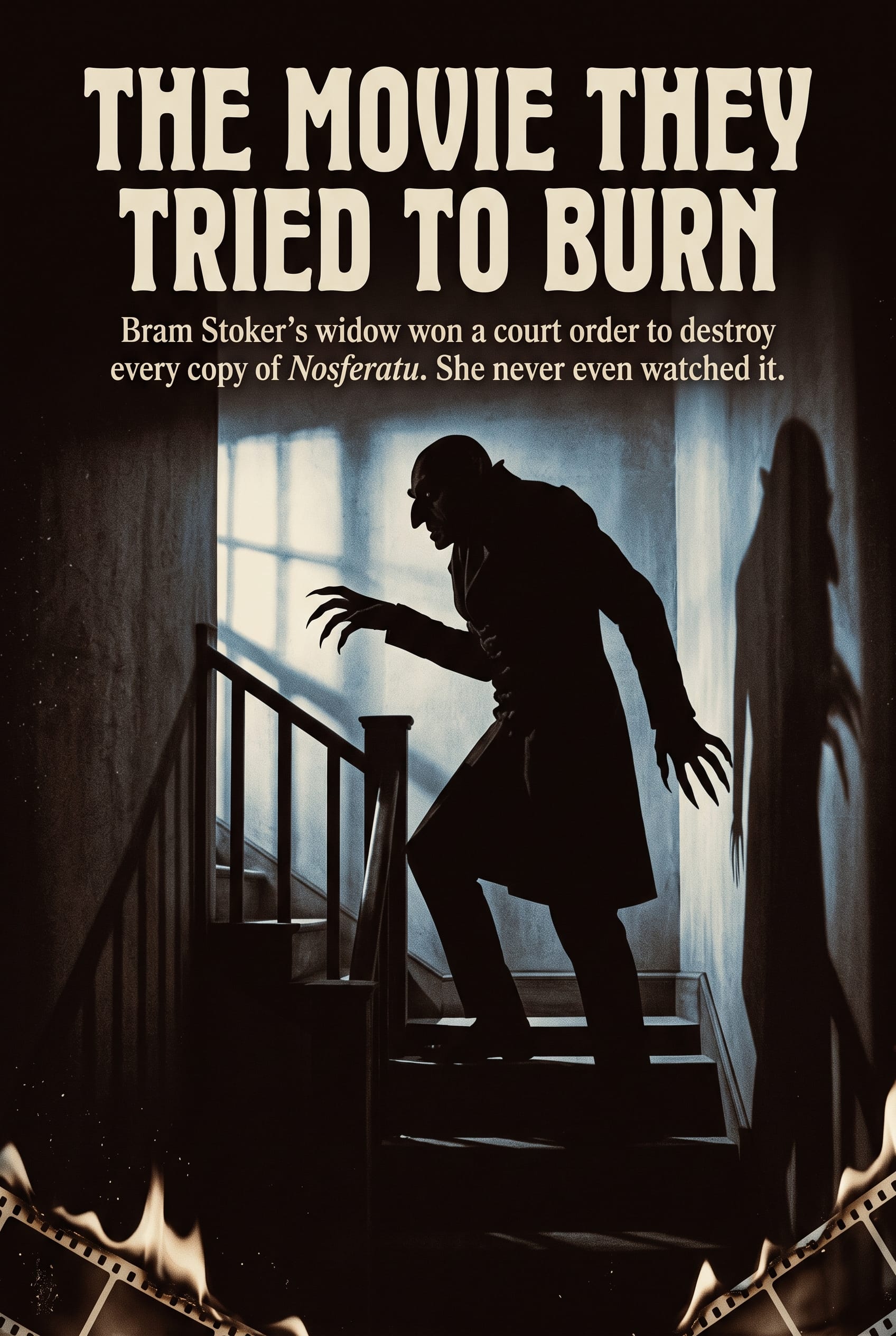
Nosferatu (1922), F.W. Murnau’s silent vampire classic, is a thinly disguised, unauthorized adaptation of Bram Stoker’s Dracula — the real Nosferatu 1922 true story sits in what happened after its release. Bram Stoker’s widow, Florence Stoker, sued the production into bankruptcy, won a German court order in 1925 demanding every surviving print be burned, and came within one lucky London screening of succeeding, all without ever watching the film she was trying to destroy.Here is the fact I keep coming back to, the one I genuinely think is one of the best-documented absurdities in horror history: in July 1925, a German court ordered every surviving copy of Nosferatu rounded up and burned, at the demand of a woman who never once watched it. Not a frame. She read a program, she read a lawyer’s summary, she read a judgment written in her favor, and she spent three years chasing a film into oblivion without ever pressing play on the thing she was trying to destroy.That’s the real story sitting underneath the one everyone already knows about Count Orlok’s shadow crawling up a staircase. The making of Nosferatu is a decent production anecdote. The attempt to erase it is a genuinely great one, and it deserves better than a footnote.
Albin Grau and the Real Vampire Story Behind Nosferatu
Start with the man who built the thing in the first place, because his fingerprints are all over what makes Orlok different from every vampire that came before him. Albin Grau was an occultist, a member of the German magical order Fraternitas Saturni under the working name Master Pacitius, and by the time he founded Prana Film in 1921 he’d already decided the company would specialize in movies about the supernatural — real supernatural, the kind he took seriously, not costume-party supernatural.Grau served on the Serbian front during the First World War, and he later claimed — in a 1921 article he published himself, in a magazine called Bühne und Film, well before Nosferatu existed as anything but an idea — that a Serbian farmer had once told him a story about his own dead father. The father had died without receiving the proper sacraments. A month later, people in the area started dying. Witnesses reported seeing the father walking around.When the villagers finally opened his coffin, it was empty; the next morning they found him again, healthy-looking, with teeth grown so long he couldn’t close his mouth around them, and they staked him and burned the body. Grau told that story as fact. I have no way to verify a word of it, and neither did anyone at the time — it reads at least partly like a producer building myth around his own project before a single frame had been shot, and I think that’s worth saying plainly rather than repeating it as gospel.But whether or not he believed it, or invented it, or half-remembered it from a soldier’s rumor, it’s the story he chose to build a company around. Prana Film ended up releasing exactly one movie before it collapsed into bankruptcy. That movie was Nosferatu, and Grau didn’t just produce it — he designed the sets, the costumes, the makeup, even the promotional art, and he built the whole visual language of the film out of his own occult training.The contract prop that passes between Knock and Orlok in the film’s opening act carries real hermetic and alchemical symbols, not prop-department gibberish. Orlok’s rat-faced, emaciated, plague-carrier design is Grau’s design, and it’s a direct rejection of the suave nobleman that Bram Stoker had written thirty years earlier. Grau wanted something that looked like it belonged in a crypt, not a drawing room.
How Nosferatu Copied Dracula, and Nearly Got Away With It
F.W. Murnau directed. Henrik Galeen wrote the screenplay. Fritz Arno Wagner shot it, with Günther Krampf working uncredited alongside him. Production started in July 1921, on location in Wismar and Lübeck and up into Slovakia, with interiors built in Berlin. None of that is in dispute. What’s also not in dispute, and what makes everything that follows almost too tidy to believe, is that Galeen’s script was a barely-disguised adaptation of Dracula — the opening move in what’s still
one of vampire cinema’s defining forks. Count Dracula became Count Orlok. Jonathan Harker became Thomas Hutter. Mina became Ellen.London became a fictional German harbor town called Wisburg. The filmmakers added a new plague-via-rats mechanism to the vampire’s arrival that isn’t in Stoker’s novel at all. And then, having made all those cosmetic swaps, the production put its own foot through the floor: the flyer for the film’s March 4, 1922 Berlin premiere described Nosferatu as “freely adapted from Bram Stoker’s Dracula.” In writing. In the marketing. They told on themselves before anyone had even asked.That premiere itself was held in the Marble Room of Berlin’s Zoological Garden, and guests were asked to arrive in nineteenth-century Biedermeier costume — a genuinely strange, elegant setting for the first public screening of a film whose central image is a plague-bearing corpse crossing an ocean in a coffin full of rats.
Florence Stoker Discovers the Unauthorized Nosferatu
Florence Stoker found out about it by accident, and the way she found out is its own small piece of theater. In April 1922, an unmarked envelope arrived at her home in England containing nothing but a program from the Berlin premiere — no note, no signature, no explanation of who’d sent it or why. Somebody wanted her to know. She never learned who. What she read on that program was the “freely adapted” line, sitting right there in black and white, unauthorized and unattributed and completely unmissable.
Nosferatu 1922 True Story: Florence Stoker’s Financial Motive
She was not in a position to shrug this off. Bram Stoker had died in 1912, business manager of Henry Irving’s Lyceum Theatre for twenty-seven years and author of a novel that, at the time of his death, was earning him a comfortable but unspectacular living. Florence inherited debt along with the estate.She had to auction his library and personal papers just to generate cash, and the sale brought in £400 total — a sum she described in a letter to a friend, with a candor I have real affection for, by noting that a quarter of it was “rubbish.” For the next twenty-four years, her entire income ran through Dracula’s backlist, and the backlist was not generous. Her 1920 French royalties came to 350 francs.So when a German production company built an unauthorized movie out of her husband’s most famous creation and didn’t so much as ask, what she was actually watching was someone else getting paid off the one asset standing between her and real poverty. That’s the register this whole fight belongs in — practical, financial, close to survival — and it’s a more interesting starting point than the version of this story where she’s simply defending her late husband’s honor.
The Lawsuit and the 1924 Judgment Nobody Could Collect
She took the case to G. Herbert Thring at the British Incorporated Society of Authors, and the Society engaged a German lawyer in the summer of 1922 with what the record makes clear was open reluctance. Thring wanted out more than once.The case was expensive, the outcome uncertain, and Prana Film was already a defunct entity by the time serious litigation got underway — the company had declared bankruptcy shortly after Nosferatu’s release and, by some accounts, sold the film off to a different distributor specifically to put distance between Grau and the coming lawsuit — which meant Florence spent years chasing a corpse through German civil courts, suing an entity that had every incentive to stay unreachable.The Society kept the case alive mostly because Florence had enough personal standing with its trustees to make abandoning her socially awkward — an unglamorous, entirely plausible mechanism that had nothing to do with grand principle and everything to do with institutional embarrassment.In the summer of 1924, she won. A German court awarded her £5,000 — something in the neighborhood of £323,000 in today’s money — plus the rights to the film itself. It should have been the end of the story. It wasn’t, because the receivership holding what remained of Prana’s assets, an entity called the Deutsch-Amerikanisch Film Union, simply refused to pay and appealed the judgment. Then appealed again.Florence had a piece of paper worth a small fortune and no functional way to collect on it, and that’s the moment where the story stops being about money and starts being about something closer to spite, or maybe closer to grief. She couldn’t get paid. So she stopped asking to be paid, and asked instead for the film to not exist.
The 1925 Court Order to Burn Every Copy of Nosferatu
That request finally landed in July 1925, after the Deutsch-Amerikanisch Film Union withdrew its last appeal. A German judge ordered every remaining negative and print of Nosferatu surrendered and destroyed, and the order wasn’t symbolic — government agents fanned out across Germany collecting prints, and reels of a film now considered one of the foundational texts of horror cinema were physically burned. This actually happened. There’s something almost unbelievably direct about it, a level of finality that modern intellectual property disputes never get anywhere near — no injunction, no takedown notice, an actual bonfire.And here’s the detail that makes the whole thing sing for me: by every account of the case I’ve found, Florence Stoker never watched Nosferatu at any point across the entire three-year fight, win included. She had no interest in seeing it. She knew what she needed to know — that it existed without her permission, that it was making money off her husband’s work, that a flyer had admitted as much in writing — and that was sufficient grounds to want it gone.She spent three years and a meaningful amount of the Society of Authors’ patience dismantling a movie she’d never once experienced as a movie. I don’t think that makes her a villain. I think it makes her one of the most purely motivated litigants in film history, someone whose objection was entirely about the principle of authorship and not even slightly about the content of the thing she was destroying.
How Nosferatu Survived Its Own Destruction
Except the destruction didn’t take, because vampires — real ones or the fictional kind — have a well-documented resistance to staying dead. By October 1925, barely three months after the burning order, word reached Florence that London’s Film Society was planning a screening of the film. A print had survived. She went straight after the man responsible, a Film Society organizer named Ivor Montagu, and demanded to know where he’d gotten it. Montagu never told her.Whoever had supplied the print disappeared from the record before anyone could trace it back further, and that thread simply ends — no name, no paper trail, nothing but a screening that shouldn’t have been possible happening anyway. Other prints had already left German jurisdiction before the order had any teeth beyond German borders, which is how Nosferatu ended up screening in American theaters by 1929, fully outside the reach of a lawsuit fought in Berlin courtrooms. Florence kept chasing European copies for the rest of her life.She died in May 1937, at seventy-eight, in London, having never fully won and never fully stopped trying.
Florence Stoker’s Other Dracula: The Authorized Universal Deal
What I find genuinely remarkable is that she was running two completely opposite campaigns about Dracula at the same time, and both of them were working. While she was hunting down and burning the unauthorized German adaptation, she was also actively building an authorized one. She granted stage rights to Hamilton Deane, whose Dracula play premiered in Derby in 1924 — the same year she won her first judgment against Nosferatu, which means for a stretch of months she was simultaneously suing one Dracula into ash and licensing another into a hit.In 1927, producer Horace Liveright bought the American dramatic rights and brought in playwright John L. Balderston to adapt Deane’s script for Broadway, where it became a genuine record-breaking success, even though Liveright never fully paid Florence what the contract owed her before he died. Then, in 1930, Universal Pictures bought the screen rights outright for $40,000 — something like $584,000 today — and for the first time since Bram’s death, Florence had real financial security.She personally endorsed the resulting film, the 1931 Dracula with Bela Lugosi, and there’s a specific kind of satisfaction in the idea that part of her motivation was hoping a fully sanctioned Dracula would finally bury the plagiarized one she’d spent the better part of a decade failing to erase.
What Nosferatu Accidentally Gave the Vampire Genre
The opposite happened, and this is the part of the story that turns a legal footnote into something closer to a horror film’s own internal logic. The changes Murnau and Galeen made to dodge copyright — the ones meant purely as legal camouflage — outlived the lawsuit that tried to kill the movie built around them.Stoker’s novel never once kills a vampire with direct sunlight; that detail is a Nosferatu invention, created almost certainly as one more way to make this vampire legally distinct from that vampire, and it became one of the single most durable rules in the genre, repeated in film after film for the century since. Grau’s occult-informed vision of the vampire as vermin and plague, a total departure from the seductive aristocrat Stoker had actually written, came directly out of a production Florence Stoker tried to have physically incinerated. None of that invented rule has anything to do with where the actual vampire panic started — Ethan traces that back to tuberculosis, misread decomposition, and grief in
The Real History of Vampires.It’s specific enough, and durable enough, that
Robert Eggers rebuilt his own 2024 Orlok around that same design instinct instead of the more polished, romantic vampire that dominated most of the genre’s twentieth century. A widow spent three years trying to erase this movie from the historical record, and it handed the genre several of the rules it still runs on regardless.
Restoring Nosferatu From Fragments
There’s a coda to the survival story that I think earns its own paragraph, because it explains why the version people watch today looks the way it does. No single complete print made it through the destruction order and the decades of poor circulation that followed — what exists now is a composite, spliced together out of multiple damaged and incomplete copies recovered from different countries, a restoration project that properly got underway in 1981 with a print held by MoMA and reached its current definitive form with a 2005 and 2006 restoration.Hans Erdmann’s original 1922 orchestral score was almost entirely lost in the same chaos that scattered the prints, with only a partial suite surviving; the modern standard version uses a reconstruction by Berndt Heller built from what could be recovered.
Nosferatu formally entered the public domain worldwide in 2019, which means the film Florence Stoker fought a seven-year war to erase is now, legally, everyone’s property and no one’s at all.
The Uncomfortable Side of the Nosferatu 1922 True Story
The film’s legacy isn’t uncomplicated, and I’d rather say that plainly than let the underdog-survival framing do all the work. Sweden banned Nosferatu outright as excessively horrific, and the ban held until 1972 — half a century of a country simply refusing to let its own citizens see the thing Florence Stoker couldn’t manage to burn.And Orlok’s design itself has drawn serious, sustained scholarly attention over the past century for imagery that multiple film historians have connected directly to antisemitic caricature circulating in Weimar-era Germany — the hooked features, the claw-like fingers, the framing of the vampire as a foreign contamination arriving by ship to poison a German town. That reading sits permanently alongside everything else this film is, the way real cultural artifacts tend to carry more than one true thing about themselves at the same time.
Why Florence Stoker’s War Against Nosferatu Still Matters
Dacre Stoker, Bram’s great-grandnephew, has said that “every author, artist and musician should thank Mrs. Stoker for the precedent she helped set,” and I don’t think that’s overstating it. The case genuinely mattered for how copyright law came to treat unauthorized adaptation, and Florence pursued it with a tenacity most estates managing a single valuable asset would recognize immediately. The legal precedent matters.What keeps pulling me back to this story, though, is its actual shape — a woman who never watched the film she destroyed, going up against a team who built that film out of an occultist’s genuine belief in the thing they were depicting, and losing anyway, decades after her own death, to a handful of surviving reels and one unnamed man in London who wouldn’t say where he got his copy. Nosferatu is a film about something that returns no matter how thoroughly you try to bury it.Its own production history got there first, and did it for real.
Nosferatu 1922 True Story — Frequently Asked Questions
Is the Nosferatu 1922 True Story Actually About a Real Vampire?
Nosferatu (1922) is a fictional, unauthorized adaptation of Bram Stoker’s Dracula. The real Nosferatu 1922 true story happened after release: Bram Stoker’s widow, Florence Stoker, sued the production and won a 1925 German court order demanding every surviving print be destroyed, a fight she pursued for years without ever watching the film herself.
Did Florence Stoker Really Never Watch Nosferatu?
By every documented account of the case, yes. Florence Stoker never watched Nosferatu at any point during her legal fight against it. She knew the film existed without her permission, and that was sufficient grounds to want it destroyed, regardless of what was actually on screen.