Public domain horror movies exist because copyright protection expires exactly 95 years after a work is published, and every January more childhood characters cross that line into fair legal game.
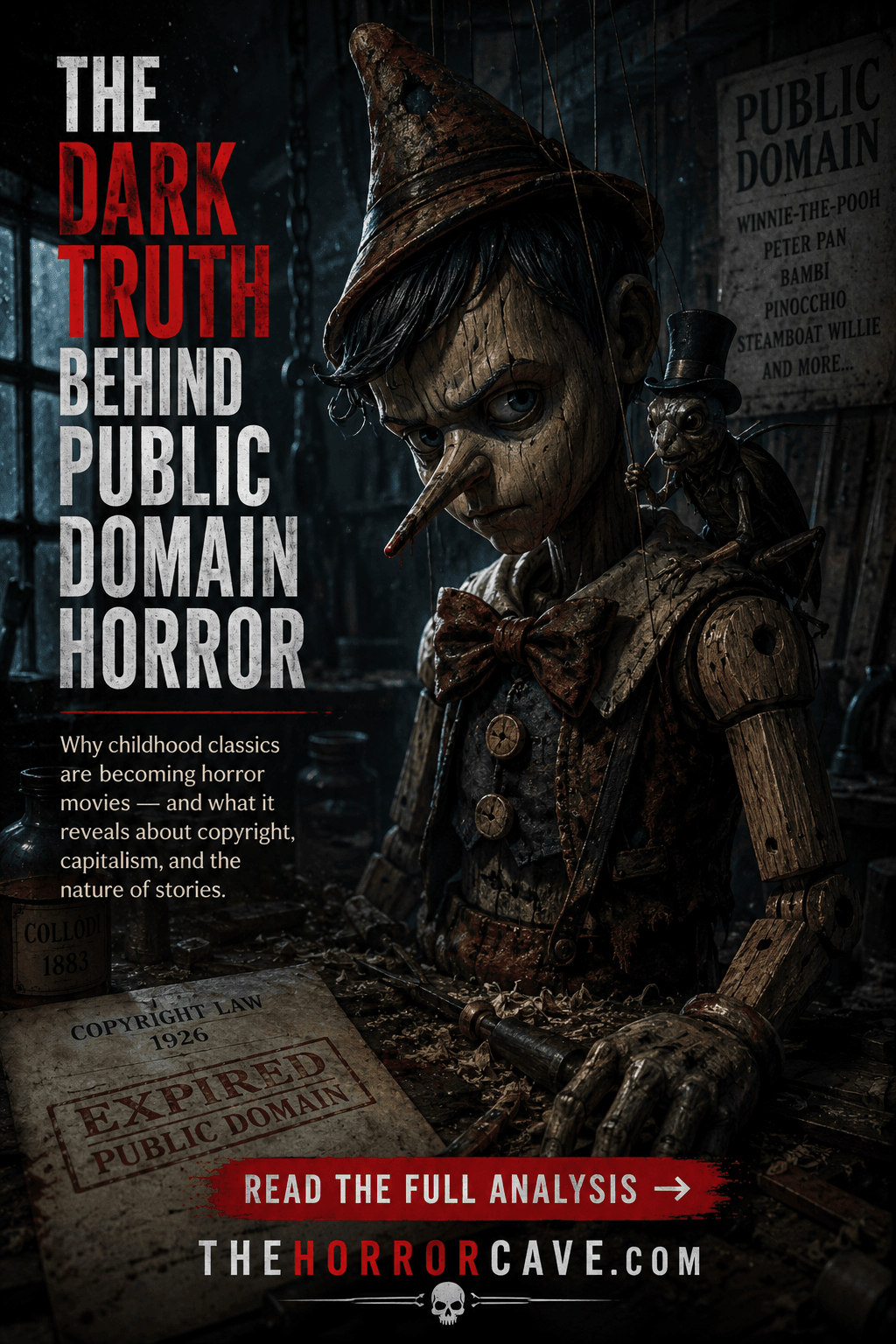
Pinocchio Unstrung (2026), directed by Rhys Frake-Waterfield, is the latest and strangest example: a slasher built from Carlo Collodi’s 1883 novel, opening in US theaters July 24, with Robert Englund — forty years removed from originating Freddy Krueger — voicing a sinister Cricket who steers a wooden boy toward murder.Somewhere in England, in late 2024, a crew spent weeks operating a practical animatronic puppet built by the man who made the 2019
Chucky. If you want to understand what’s happening to horror cinema in 2026, that single image is a reasonable place to start: Freddy Krueger’s voice coming out of Jiminy Cricket’s body, in a film that exists because a copyright expired.I’ve been thinking about this for a while now, and I keep arriving at the same place. The public domain horror wave — and it is a wave, with entries arriving monthly at this point — gets discussed almost exclusively as a novelty story or an outrage story. Killer Winnie the Pooh, can you believe it. Bambi with a body count. That framing misses what’s actually interesting, which is that we’re watching a controlled experiment on the question of what stories are when nobody owns them anymore. And Pinocchio Unstrung is the strangest data point in the whole experiment, because Pinocchio is the one case where the horror movie might be closer to the source material than the children’s classic it’s supposedly desecrating.
How the Public Domain Horror Movies Machine Actually Works
The mechanics are simple and worth stating plainly, because the entire phenomenon rests on them. Under current American copyright law, a published work is protected for 95 years. On the 96th year, it belongs to everyone. A. A. Milne’s
Winnie-the-Pooh, published in 1926, entered the public domain in 2022.
Steamboat Willie — the 1928 short that introduced Mickey Mouse — crossed over on January 1, 2024. J. M. Barrie’s
Peter Pan, Felix Salten’s
Bambi, and Carlo Collodi’s 1883 novel
The Adventures of Pinocchio have all made the crossing, some of them long ago.What crosses over is narrower than people assume. The original text crosses. The original characters cross, as they appear in that text. Everything a later corporation added stays protected. Winnie the Pooh’s red shirt is a Disney invention from the 1930s, so the killer Pooh of the horror films wears no shirt. Tigger didn’t appear until Milne’s 1928 sequel, so he was legally untouchable when the first Pooh horror film shot. Trademark law adds another layer that never expires, which is why none of these films can market themselves in ways that suggest Disney endorsement. The filmmakers are working inside a legal corridor with very specific walls, and part of the strange aesthetic of these public domain horror movies — the off-model designs, the careful title constructions — is the shape of that corridor made visible.Rhys Frake-Waterfield, a British filmmaker at a small production company called Jagged Edge, was the first person to fully weaponize this.
Winnie-the-Pooh: Blood and Honey cost roughly $100,000 and grossed $5.2 million worldwide in 2023. Read those numbers again. That’s a fifty-fold return, achieved almost entirely through the gravitational pull of a headline: someone made a Winnie the Pooh slasher. Media outlets that would never cover a $100,000 independent horror film covered this one breathlessly, because the concept was the story. The film itself — two large men in masks stalking college students around a cabin — was almost beside the point, and most critics said so. It didn’t matter. The awareness was free. The IP did the marketing that the budget couldn’t.What followed was inevitable in the way these things are always inevitable.
Blood and Honey got a sequel with actual prosthetics and a real budget. Jagged Edge announced an entire interconnected franchise — the Twisted Childhood Universe, which everyone just calls the Poohniverse — with
Peter Pan’s Neverland Nightmare,
Bambi: The Reckoning,
Pinocchio Unstrung, and a coming crossover film called
Poohniverse: Monsters Assemble, a title that tells you exactly how much irony is involved in the enterprise, which is to say an amount nobody can quite measure, possibly including the filmmakers.And around the flagship franchise, the imitators bloomed. When
Steamboat Willie entered the public domain, at least seven separate Mickey Mouse horror projects went into production almost immediately —
The Mouse Trap,
Screamboat,
Mouse of Horrors,
I Heart Willie, and others, including a film called
Mickey vs. Winnie in which one filmmaker’s public domain horror rips off another filmmaker’s public domain horror, an ouroboros of opportunism that would be funny if it weren’t so exhausting. There’s a Grinch slasher. There are two competing killer Cinderella films. There’s a Popeye slasher. Even Frake-Waterfield himself, the man who opened this door, has publicly warned other filmmakers away from the Mickey gold rush, predicting lawsuits and diminishing returns — the arsonist recommending fire safety.
The Numbers Tell a Sobering Story
Here’s what the outrage coverage never mentions: the business is already cooling.
Blood and Honey‘s $5.2 million looks like a lottery ticket in retrospect.
Peter Pan’s Neverland Nightmare, released in January 2025 on a budget around £250,000, grossed $1.6 million — profitable, respectable, and less than a third of the original’s haul.
Bambi: The Reckoning earned $534,030 theatrically. That film is instructive in another way, though: it holds a 63% score on Rotten Tomatoes, the best critical showing in the entire Twisted Childhood Universe, and it later found a genuine second life as a streaming hit on Peacock. The audience for these films exists. It’s just smaller in theaters than the initial headlines suggested, and it lives increasingly on streaming platforms, where curiosity clicks cost nothing.So
Pinocchio Unstrung arrives at a pivot point. The novelty that powered the first wave has been spent. The concept alone no longer sells tickets. Which is presumably why this entry looks so different from its siblings: it premiered at the Brussels International Fantastic Film Festival in April — an actual genre festival with an actual curatorial bar — and the production swung hard toward craft. The title character is a fully practical animatronic built by Todd Masters, the effects veteran behind the Chucky puppet in the 2019
Child’s Play remake. Frake-Waterfield has said he wanted Pinocchio to feel physically real on set, and early festival reactions have singled out the puppet as the film’s genuine achievement — audience response at BIFFF ran notably warmer than the franchise’s usual reception. Richard Brake, one of the most reliably unsettling presences in modern horror after
31 and
Barbarian, plays Geppetto. And Englund voices the Cricket.That casting is the tell. You don’t hire Robert Englund for a cash-grab. You hire Robert Englund because his voice carries forty years of horror history, and because you want the audience to understand that the film knows exactly what tradition it’s operating in. The early evidence suggests the Poohniverse is attempting something like legitimacy. Whether it gets there is a question for my review in a few weeks. What interests me today is the deeper irony underneath this whole corner of public domain horror movies.
Pinocchio Was Already a Horror Story
Because here’s the thing the outrage machine doesn’t know, and the thing that makes
Pinocchio Unstrung categorically different from a killer Pooh or a feral Bambi: Carlo Collodi’s original novel is genuinely, textually brutal. The horror adaptation isn’t a desecration of the source. In several important ways, it’s a return to it.Go read the actual text — it’s on
Project Gutenberg, free, because that’s what public domain means. In Chapter 4, the Talking Cricket, the character Disney would later transform into the beloved Jiminy, warns Pinocchio about his behavior. Pinocchio responds by throwing a hammer at him. The hammer connects. Collodi writes that with a last weak “cri-cri-cri,” the Cricket falls from the wall, dead. The moral conscience of the Disney film is, in the source text, a murder victim — killed by Pinocchio himself, in the fourth chapter, with a workshop tool.It gets darker. Pinocchio’s feet burn off while he sleeps. He’s nearly used as firewood. He’s caught in an iron trap. And in the story’s original published form — it ran as a serial in an Italian children’s magazine starting in 1881 — the tale ended at Chapter 15 with Pinocchio hanged from an oak tree by the Fox and the Cat, kicking as the life goes out of him while his murderers wait below for his last gasp. That was the ending. A children’s serial that concluded with its protagonist lynched for his disobedience. Collodi intended it as a cautionary tale in the old, punitive tradition: bad children come to bad ends. Only sustained reader demand and editorial pressure convinced him to resurrect the puppet, add the Fairy, and build the redemption arc that eventually became the version the world knows. The gentle Pinocchio is a revision. The dead one came first.Disney’s 1940 film — a genuine masterpiece, I want to be clear, and a foundational work of American animation — performed the great softening. The Cricket became a conscience instead of a casualty. The violence became peril. The punitive Italian morality tale became a warm story about wishes and honesty. And because Disney’s version conquered the global imagination so completely, the world forgot that it was an adaptation at all. We collectively misremembered the sanitized version as the original.So when a British slasher outfit picks up Collodi’s public domain text and finds a wooden child, a sinister cricket, dismemberment, and death by hanging already sitting in the material — the transgression is more complicated than the marketing suggests. Frake-Waterfield’s film inverts the source’s central violence in a way I find genuinely clever on paper: in Collodi, the puppet kills the Cricket; in
Unstrung, the Cricket corrupts the puppet, whispering him toward a crusade of carving himself a real body one piece at a time. The murdered conscience returns as the corrupting voice. Whether the film earns that inversion is a question I can’t answer before seeing it — but it’s an inversion of something real, drawn from a text the filmmakers clearly read, and that alone puts it in a different category from a shirtless Pooh with a mallet.
The Two-Track Gold Rush
Now widen the lens, because the Poohniverse is only the bottom shelf of a much larger phenomenon, and the top shelf is where this gets genuinely interesting.Consider what prestige cinema has been doing with the public domain over the exact same stretch of years. Robert Eggers’
Nosferatu — a remake of a film that was itself an unauthorized 1922 adaptation of
Dracula, the most famous copyright violation in cinema history — was a critical and commercial event in 2024, and Eggers has moved straight into
Werwulf. Guillermo del Toro spent decades of accumulated goodwill making
Frankenstein for Netflix, released last October to awards-season acclaim, adapting Mary Shelley’s 1818 novel with a fidelity to the book that deliberately stepped around Universal’s still-protected Karloff iconography. Maggie Gyllenhaal’s
The Bride! arrived this March, reimagining the Bride of Frankenstein as the subject of her own story rather than a five-minute plot function. Lee Cronin’s
The Mummy hit theaters in April. Every one of these is a public domain project, mining the same expired-copyright seam as Jagged Edge Productions. The only differences are budget, pedigree, and intent.This is the part I keep circling. We have, right now, two parallel industries extracting the same resource. One extracts fast and cheap, converting recognition directly into opening-weekend curiosity: killer Pooh, killer Peter Pan, killer puppet. The other extracts slow and expensive, converting recognition into prestige: del Toro’s creature, Eggers’ vampire, Gyllenhaal’s bride. Critics treat these as opposite phenomena — one a cynical degradation, the other a noble reclamation. I’m no longer sure the distinction is as clean as we’d like it to be. Both models depend entirely on the audience arriving with the story already installed in their heads. Both are answers to the same industrial problem: original stories are expensive to introduce and risky to market, while a name like Pinocchio or Frankenstein comes pre-sold, pre-loved, and — crucially, after the copyright lapses — free.And there’s a historical rhyme here that the outrage coverage never acknowledges. Building empires on
borrowed stories dressed up as something bigger is the oldest trick in the business. Disney’s animated canon is substantially a public domain operation:
Snow White,
Cinderella,
Sleeping Beauty,
The Little Mermaid, and yes,
Pinocchio, all lifted from Grimm and Andersen and Perrault and Collodi, all transformed, all then locked behind new copyrights and defended with legendary ferocity. The company lobbied hard for the 1998 Copyright Term Extension Act — nicknamed the Mickey Mouse Protection Act — precisely to delay the day its own foundational borrowings would become borrowable. When Frake-Waterfield takes Collodi’s puppet and makes him a slasher villain, he is doing, crudely, what Walt Disney did to the same puppet in 1940: taking a free story and bending it to the sensibility of his moment and his market. Disney’s moment wanted reassurance. The 2026 horror market wants transgression. The mechanism is identical.
What the Wave Actually Reveals
So what does it all mean, this strange year in which Freddy Krueger voices Jiminy Cricket while Oscar-season auteurs reanimate Mary Shelley? I’ve turned this over for weeks, and this is a phenomenon still in motion — anyone who tells you they know how it ends is guessing. But a few things seem true.The public domain functions as a mirror, and the reflection is unflattering to everyone. When a story loses its owner, what happens next tells you what the culture actually wants from it — with no brand manager standing guard over the answer. What the culture apparently wanted from Winnie the Pooh, at least for one opening weekend, was to watch him kill. That impulse deserves more thought than mockery. Adam Lowenstein, a film scholar at the University of Pittsburgh, has argued that childhood stories carry horror inside them natively, because childhood itself is a negotiation between comfort and fear. Public domain horror movies are a blunt, artless expression of something true: the stories we received as gentle were, in their oldest forms, frequently cruel. Collodi’s hanged puppet. The Grimms’ mutilated stepsisters. The softness was always a coat of paint, applied later, by companies with something to sell.The economics also guarantee this continues regardless of quality, and the calendar keeps being generous about it. The copyright horizon keeps delivering more of the twentieth century’s beloved figures every January, and each arrival will trigger the same cycle — the shocked headlines, the rushed productions, the diminishing returns, the occasional genuine film emerging from the churn. It’s worth being honest that the churn produces mostly garbage. It’s equally worth being honest that
Bambi: The Reckoning quietly earned decent reviews and found its audience on streaming, and that
Unstrung showing up at a real festival with a real animatronic suggests at least someone in the schlock economy is trying to climb. Low traditions occasionally produce the thing that outlasts them — the Universal monster cycle that prestige cinema now reveres was, in its own day, disreputable product cranked out fast.And underneath both tracks, the wave is quietly settling an old argument about what a story fundamentally is. The corporations spent a century arguing, through their lawyers, that a character is property — a fixed, ownable asset whose meaning they control. The public domain era is demonstrating the opposite. Pinocchio right now is simultaneously del Toro’s tender stop-motion child from 2022, Disney’s wishing-star icon, and — come July 24 — a murderous animatronic collecting body parts in a British slasher. All three are legitimate. None of them is final. The character survives every one of them intact. Stories, it turns out, were never really property. They were always folklore wearing a licensing agreement. The 95-year clock just makes it official.On July 24,
Pinocchio Unstrung opens wide, and I’ll be in a theater for it, partly for
the review and partly because I’m honestly curious whether the Todd Masters puppet delivers what the festival crowds say it delivers. The film will probably be rough. Most of its franchise siblings are. But somewhere inside it is a wooden boy who kills, steered by a talking insect — and a hundred and forty years ago, in the pages of an Italian children’s magazine, that’s more or less exactly what Carlo Collodi wrote. The strings were cut a long time ago. We’re only now noticing what the puppet does without them.
Frequently Asked Questions
What are public domain horror movies?
Public domain horror movies are films that reimagine characters or stories no longer under copyright — typically 95 years after original publication — as horror villains. Examples include
Winnie-the-Pooh: Blood and Honey,
Bambi: The Reckoning, and
Pinocchio Unstrung, all built from children’s characters whose original text now belongs to the public.
Why is Pinocchio Unstrung considered public domain horror?
Carlo Collodi’s 1883 novel
The Adventures of Pinocchio has been in the public domain for decades, meaning any filmmaker can legally adapt its characters and story without licensing rights.
Pinocchio Unstrung uses this freedom to retell Collodi’s original — genuinely violent — text as a slasher film.
When do characters enter the public domain?
Under current US copyright law, a published work enters the public domain 95 years after publication. Trademark protection on character names and logos, unlike copyright, never expires — which is why studios like Disney can still control merchandising even after a story’s copyright lapses.