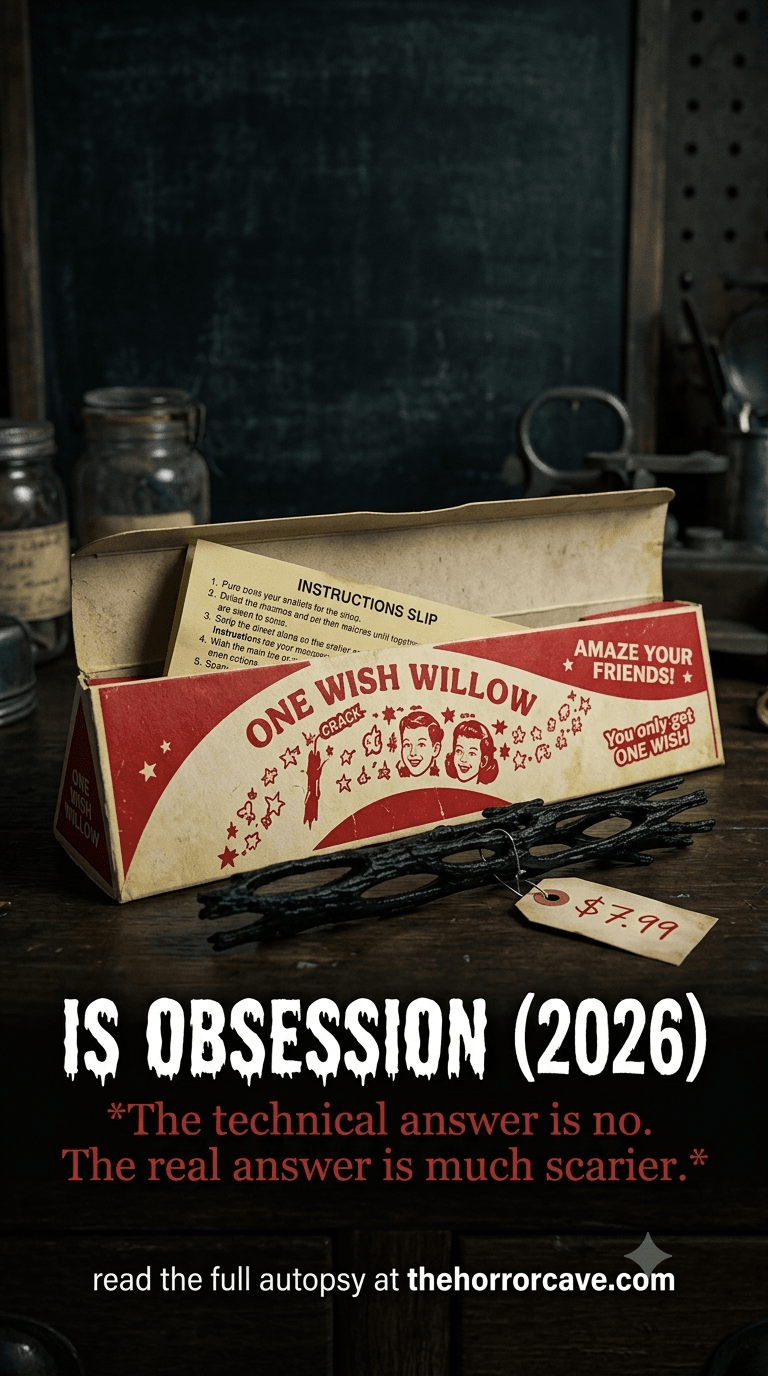
Let me answer the question in the title cleanly, because you searched for it and you deserve a straight answer before I start doing the thing I do. No — Obsession (2026) is not based on a true story. Nobody bought a haunted toy called the One Wish Willow at a crystal shop and wished a coworker into loving them. There is no police file. There is no Wikipedia section titled “Real Events.” Curry Barker, the twenty-six-year-old who wrote and directed it in Los Angeles for around three-quarters of a million dollars, has been almost aggressively transparent about where it came from, and it wasn’t a newspaper. It was a cartoon.
Specifically, it was The Simpsons — the “Treehouse of Horror II” segment where Bart gets a monkey’s paw and everything goes to hell — which itself was riffing on W. W. Jacobs’ 1902 short story “The Monkey’s Paw,” which was itself riffing on a folk anxiety older than any of us can trace. So there’s your fact-check. Zero documented events. You could close the tab.
But you’re not going to close the tab, and neither am I, because the reason people keep typing is Obsession 2026 based on a true story into search bars isn’t idle. There are Reddit threads right now arguing about whether the One Wish Willow is real, and the replies split roughly fifty-fifty, which tells you something.
People don’t run fact-checks on things that feel invented. They run fact-checks on things that feel true. And Obsession feels true — sickeningly, specifically true — in a way that has nothing to do with whether the toy itself is real and everything to do with what the movie is actually about. So let me put the real answer next to the technical one and let them stare at each other.
The Technical Answer, In Full
The monkey’s paw is one of the oldest engines in storytelling: you get exactly what you asked for, and the getting destroys you. Jordan Peele named his entire production company Monkeypaw after it. Barker didn’t stumble onto anything new, and he said so himself — he was twenty-six, wasn’t even alive when “Treehouse of Horror II” aired in 1991, and came at the premise with the specific confidence of a young man certain his version of an old idea was worth making. Which is usually insufferable. Here it isn’t, because he was right.
The film is fiction top to bottom. Bear — short for Baron, though everyone calls him Bear — is a music store clerk who’s been in love with his childhood friend and coworker Nikki since grade school and has never said a word. Instead of telling her, which might make things awkward, he buys a $7.99 novelty toy from a shop that also sells crystals and incense and wishes that she would love him “more than anyone in the fucking world.” And she does. Immediately. That’s the horror — not a jump scare, but a wish granted with the receipt still warm.
Everything after that is invented. The bludgeoning so graphic they had to cut it to dodge an NC-17. The customer-service line on the side of the box, where a bored employee informs you that wishes can’t be cancelled and the only cancellation is death, delivered in the tone of a man whose lunch you’ve interrupted. All fiction. Barker cited Japanese ghost stories and the French New Extremity movement for the visual grammar, shot the thing in a claustrophobic 1.50:1 aspect ratio drowning in brown murk, and cut it himself, like a YouTuber, because that’s what he is. None of it happened. That’s the last time I’ll say it, because it’s the least interesting true thing about this movie.
Now the Real Answer to “Is Obsession Based on a True Story”
Here’s what Obsession is actually about, stated plainly so nobody can pretend I hedged: it is about a man who decides that a woman’s autonomy is an obstacle between him and something he’s owed, and who removes that obstacle, and who spends the rest of the runtime insisting to himself that he’s the victim of the situation he engineered.
Barker made the coldly brilliant choice to tell the entire thing from his perspective — the perpetrator’s — so you’re locked inside the skull of the nice guy while he narrates his own decency over footage of the atrocity he’s committing. The wish doesn’t make Nikki love Bear. It hollows her out and installs a replica that performs love while the real person watches, trapped, a spectator in her own body.
Sit with that image, because it’s the one that matters. Not a demon. Not a curse in any register the genre usually trades in. A woman conscious inside a body that has been overwritten to adore the man who overwrote her. And he gets to tell himself it’s romance.
Critics reached, correctly, for a term that’s been calcifying online for a decade: incel horror. The saddest quadrants of the internet — the ones that metabolized Elliot Rodger into a folk hero, that gave us the Virgin-versus-Chad meme and the whole grim theology of “white knighting” — run on exactly Bear’s animating grievance. The belief that being a self-described nice guy is a currency women are contractually obligated to accept, and that their failure to do so is a theft requiring restitution.
Barker didn’t invent that either. He just aimed a camera at it and refused to blink. Obsession isn’t about a haunted toy. The toy is a delivery mechanism for a resentment that’s already loose in the world, walking around, holding down jobs, sending texts that start with “I just think it’s funny how.”
So when you ask is Obsession 2026 based on a true story, here’s my answer, and I want it on the record: yes. It is based on the truest story there is. Not a documented one — a structural one. If you have lived a certain number of years and loved a certain number of people, you have stood on one side or the other of the exact dynamic this movie dramatizes: the moment when someone decides that your interiority, your no, your separateness, is an inconvenience to be managed rather than a person to be respected.
Maybe you were Nikki. Statistically, some of you reading this were closer to Bear than you’ll ever admit. That’s the true story. It’s the oldest one we’ve got, older than the monkey’s paw, and every one of us gets a turn.
Why the “Nice Guy” Is the Scariest Monster in the Building
I want to be precise about why this specific villain lands harder than a masked man with a knife, because the precision is the whole point.
A slasher gives you a monster you will never be. That’s the comfort of the form — you watch Michael Myers from the safe side of the glass. Obsession denies you the glass. Bear isn’t a predator in a trench coat. He’s the guy who cries on his bed in the opening minutes — and here’s the detail that should make your skin crawl, because it made mine — not because his cat just died, but because Nikki doesn’t love him.
His pet is a corpse on the floor and his grief is entirely about his own romantic frustration. That’s minute five. Barker tells you exactly who this man is before the plot even starts, and he does it not with a monologue but with the direction of a single sob.
His yearning reads as relatable even as his mindset curdles into something pathetic, and Barker refuses to let you resolve the discomfort of holding both at once. Most of us know a Bear. Some of us have been a version of him on a smaller scale — the sulk when interest wasn’t returned, the private conviction that we were owed something for our restraint, the ugly little arithmetic of “I was so good to them.”
Obsession takes that arithmetic and follows it to its logical endpoint with no mercy and no exit. The terrifying question the film plants isn’t could I end up like Nikki. It’s could I, or someone I love, be tempted to do what Bear did — and it works because for a lot of the audience the honest answer is not a clean no.
That’s the fury underneath this whole piece, and I’ll own it. I’ve written about obsession and possession and the architecture of control in horror films for a long time now, and I don’t do it from a purely theoretical distance. I know what it looks like when someone decides your feeling for them is a lever they get to pull. It doesn’t require a supernatural toy. It requires only the conviction that your love obligates you and their autonomy is negotiable.
Barker built a $750,000 movie around that conviction and it grossed its way toward a quarter-billion dollars — which means a lot of people recognized something in the culture it was holding up. I’d like to believe they recognized it as horror. I’m not entirely convinced the culture didn’t also receive it as a mirror it enjoyed too much.
The Nikki Problem, Which Is Really the Us Problem
There’s a genuine fault line running through the film’s reception, and honesty requires me to stand on it rather than pretend it isn’t there.
Fifteen years ago, this movie gets made with Nikki as the villain. The unhinged girlfriend, the crazy-ex archetype, the woman whose excessive emotion is the threat the man must survive. The fact that Obsession inverts that — that it hands us a possessed, brutalizing, terrifying Nikki and still insists, structurally, that she is the victim — is the sliver of social progress that makes the film possible at all. Inde Navarrette’s performance is the load-bearing wall; she plays a woman being scary and being wronged in the same breath, and she never once collapses into the cartoon of “crazy” that a lesser actor would have reached for.
But the CBC panel that dug into this was right to worry. The film gives you almost nothing of Nikki as a person. She wants to quit her job. She wants to write. That’s the sum of what we know before Bear’s wish converts her into a vessel.
And a certain kind of viewer — the exact kind whose worldview the film is supposedly indicting — can walk out having watched a woman brutalize people for two hours and conclude that the movie confirmed what he already believed.
Barker toes a line and mostly holds it, but the line is thin, and whether an audience receives Obsession as a critique of Bear’s mindset or as a lurid entry in the “women be crazy” tradition depends on something the film cannot control: whether the person in the seat was willing to be implicated.
Some were. Some very much were not. That gap isn’t a flaw in the movie so much as a diagnosis of the rest of us.
So: Is Obsession 2026 Based on a True Story?
Let me close the loop for the person who came here for a yes or a no and stayed for the autopsy.
No, Obsession is not based on a true story. No real events, no case file. It’s a monkey’s-paw fable filtered through a Simpsons Halloween special, made by a former YouTube prankster who cut it himself in a brown murk on a microbudget, and every literal event in it is invented.
And also: it is the most based-on-a-true-story film I’ve seen in years, because the thing it dramatizes is not an event but a pattern, and the pattern is one you already know from the inside. The wish is fake. The willow is fake. The customer-service line and the cat and the bludgeoning are all fake. What’s real is the man deciding that his want outranks her personhood, and the story he tells himself afterward to keep sleeping. That happens every day, in kitchens and group chats and dating apps, minus the special effects. Barker just added the effects so you’d finally flinch at something you’d otherwise scroll past.
That’s why you searched the question. Not because the toy seemed plausible — because the feeling did. And the feeling is the true story, the one none of us fully escapes, whichever side of it we’ve stood on, at least once, in this life. If you haven’t decided whether the film itself is worth your two hours, that’s a separate question — this one’s already answered. The One Wish Willow costs $7.99. The thing it’s really selling has always been free, and we’ve all reached for it.
Frequently Asked Questions
Is Obsession 2026 based on a true story?
No. Obsession is entirely fictional. Director Curry Barker has confirmed it was inspired by The Simpsons‘ “Treehouse of Horror II” and W. W. Jacobs’ 1902 short story “The Monkey’s Paw,” not by any real-life events. There is no documented case behind the One Wish Willow or the film’s plot.
What is Obsession 2026 actually about?
On the surface, it’s about Bear, a music store clerk who uses a supernatural toy to make his crush Nikki fall in love with him. Underneath, it’s a critique of “nice guy” entitlement and what critics have called “incel horror” — a story about coercion, consent, and a man who mistakes his own desire for a woman’s obligation.
Who directed Obsession and what was the budget?
Curry Barker wrote, directed, and edited Obsession, his second feature after the YouTube-released Milk & Serial (2024). It was made for roughly $750,000, premiered at the 2025 Toronto International Film Festival, and was released theatrically by Focus Features on May 15, 2026, going on to become one of the year’s most profitable films.