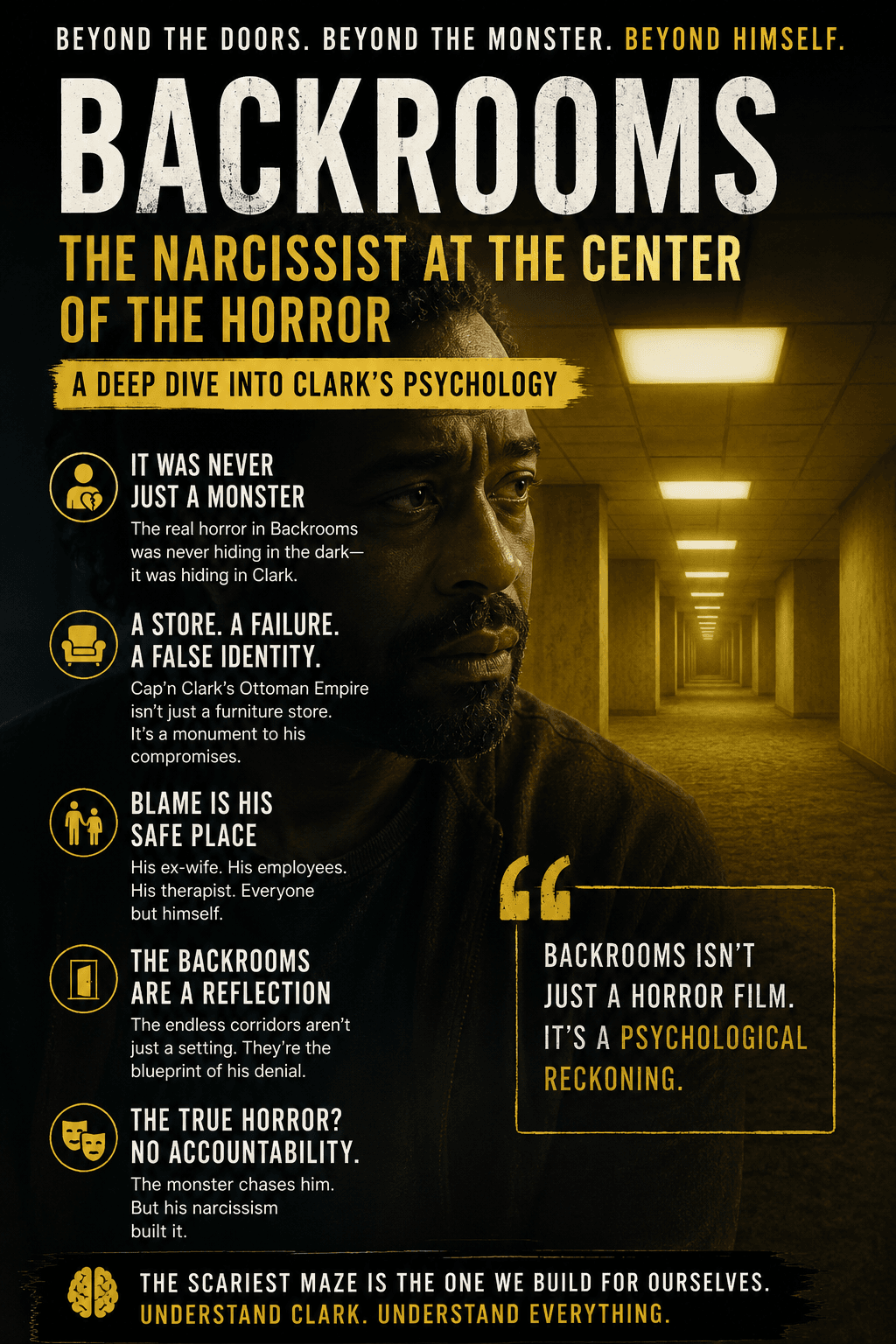
Clark’s narcissism in Backrooms runs under every scene from the opening shot, the engine driving the plot long before any door appears in his basement. Clark, the divorced furniture-store owner Chiwetel Ejiofor plays in Kane Parsons’ Backrooms (2026), spends the entire film blaming his ex-wife, his employees, and eventually a literal monster for failures that were always his own, and the film’s real achievement is refusing to let him, or the audience, off that hook.
Backrooms opens with a door in the basement of Clark’s furniture showroom and closes, roughly two hours later, with a woman discovering she may never have left. For most of its length, though, the film belongs to Clark, played by Ejiofor with a soulfulness that keeps threatening to tip into self-pity and stops short every time; only in its last stretch does the story quietly change hands.
That long middle stretch is worth taking apart slowly, because Clark is one of the more precisely diagnosed narcissists horror cinema has produced this decade, and precision is a word this film deserves more credit for than it’s gotten.
Parsons made his name online, under the handle Kane Pixels, with a YouTube found-footage series that turned the internet’s fascination with liminal spaces — empty malls, motel hallways, the uncanny non-places everyone half-recognizes from a dream — into a genuine subgenre. A24 signed him at twenty, its youngest director, and the pedigree shows in how confidently Backrooms translates an aesthetic built for a phone screen into 30,000 square feet of practical set across four stages.
What doesn’t get talked about enough is how well that translation serves the film’s actual subject. Liminal space, as internet horror understood it, was always about a feeling more than a location — the specific dread of being somewhere that used to serve a purpose and no longer quite does. Clark has been living in that feeling for years. The Backrooms just gave it a floor plan.
The film premiered wide on May 29, 2026, backed by a producing lineup unusual for something this strange — James Wan’s Atomic Monster, Shawn Levy’s 21 Laps, Osgood Perkins, and Chernin Entertainment all put weight behind a filmmaker with one produced feature to his name, and the $81.4 million opening weekend suggests the bet paid off commercially even where critics split. None of that context explains why the film works when it works. What explains it is Clark.
Clark owns a store called Cap’n Clark’s Ottoman Empire. He was supposed to be an architect. He is, instead, a man who sells furniture under his own name with a pirate mascot bolted to the sign, drinking through the gap between the life he designed on paper and the one he’s actually living. His wife, Barbara, left him. His therapist, Dr.
Mary Kline, played by Renate Reinsve, follows him into the Backrooms to bring him home. By the time the credits roll, the film has made a quiet, devastating argument: the monster chasing Clark through an infinite maze of yellowed corridors was never separate from him. It was assembled, piece by piece, out of everything he refused to say out loud about himself.
That’s the film’s real subject: the specific horror of watching a man’s denial take on mass and teeth, growing patiently in a basement he built for himself long before any doorway appeared there.
Cap’n Clark’s Ottoman Empire
Start with the store, because Clark built it and the film asks you to read it the way you’d read a confession he doesn’t know he’s given. A furniture showroom named after himself, mascoted by a cartoon pirate captain, selling ottomans and sectionals to a town that presumably has other options. An architect designs things that outlast him. A furniture salesman moves inventory that gets replaced in a decade. The gap between those two ambitions is the whole man, and he built a business that advertises the gap on its own sign without ever admitting that’s what the sign says.
Ejiofor plays this without a trace of cartoonish self-loathing, which is the correct choice and a hard one. Clark is proud of the store, in the specific defensive way people are proud of the compromises they’ve stopped calling compromises. In an interview tied to the film’s release, Ejiofor described tracking Clark’s “own psychological unsettled nature and just where he is in his life” — and that unsettledness reads, in the early scenes, as something closer to management than crisis. He has a system.
He has a routine. He has a version of the story where the store is a going concern and the drinking is proportionate and the divorce was a subtraction someone else performed on him. Cinematographer Jeremy Cox, throughout the film, resists doing anything flashy with that world.
He has spoken about wanting Backrooms to avoid feeling “cinematic,” to avoid feeling like “a fabrication of itself,” and that restraint is most legible in how he shoots the store and, later, the Backrooms themselves — held, static, patient, letting the architecture generate the dread instead of the camera performing it. The corridors, once Clark descends into them, have real weight. The carpet is a genuinely oppressive yellow, dense enough to become its own character by attrition.
No trick photography makes the maze feel infinite; the sameness itself is the horror, which is a very specific choice for a film about a man whose entire adult life has been one long exercise in sameness dressed up as forward motion.
What Barbara Actually Said
The marriage arrives mostly in fragments, reconstructed under duress, but the shape of it is legible early and confirmed late. Barbara was in law school. Clark was supposed to be an architect and instead sold furniture and drank. The divorce, in Clark’s telling, which is the only telling the film gives us for most of its runtime, because Clark is a man who has had years alone with the story and has sanded every rough edge off it, is something that happened to him.
Mary knows better, because that’s her job, and the film’s most excruciating scene is the one where Clark forces her to prove it. He ties her to a chair, deep in the maze, and makes her play Barbara — runs her through the same role-play exercise he apparently sat through in therapy without absorbing a single lesson from it, demanding she recite his version of the fight until she agrees it’s true.
Mary refuses. She stays in character just long enough to let him think he’s won, then breaks it entirely and tells him what he’s spent years not hearing: Barbara didn’t leave because of who he failed to become. She left because he wouldn’t stop complaining about it and wouldn’t take responsibility for a single piece of it.
There’s a cruelty embedded in the scene’s construction that the film never quite reckons with on its own terms — Clark is using Mary’s professional training as a weapon against her, forcing the exact tool meant to help him into an instrument of his own denial, and Reinsve plays the moment she abandons the clinical distance with a specificity that makes the film’s back half considerably stronger than its final act ultimately earns.
It’s a small sentence to build a climax on, and it works because everything before it has spent an hour building the architecture of a man who has never once blamed himself for anything. Clark’s tragedy is not simply that his life went wrong; plenty of lives go wrong without producing a man capable of what Clark becomes once nobody is left to perform normalcy for. It’s that he built an entire internal legal case — evidence gathered, testimony rehearsed, witnesses pre-selected — to ensure none of it was ever his fault, and the effort that took is, itself, the thing that curdled into a monster.
The People Clark Used as Company
Bobby and Kat — his employees, a couple, dragged into the Backrooms because Clark offered them extra pay for after-hours work without telling them what “after-hours” actually meant that day — are where the film’s argument about Clark stops being abstract and starts drawing blood. Bobby is lowered by rope down a sloped corridor to investigate a noise. Something wearing a pirate hat pulls the rope. Bobby dies in front of both of them, and Clark’s response is grief that curdles almost immediately into self-preservation, the same reflex he’s shown his whole adult life, just faster now, because the stakes are faster.
Kat’s fate is left more ambiguous. The film never confirms on screen what happens to her, only that her head is later found separated from the rest of her, a detail several outlets independently reported and the film itself declines to resolve. Fan theories have filled the gap with everything from a second attack by the pirate-hatted entity to something considerably darker involving Clark himself; none of it is confirmed by the text, and the ambiguity reads as a choice rather than an oversight.
What is confirmed is Clark’s account afterward: he “tried to help her,” delivered in the same practiced, self-exculpating cadence he’s used on every failure up to that point. He is a man who was never trained to say I did this without immediately reaching for a qualifier.
In every scene the film gives him room to say so, Clark calls Bobby and Kat family — the way small business owners often do when the word costs nothing and the health insurance isn’t offered. It’s a small verbal tic and the film doesn’t underline it, but it’s consistent with everything else about him: language as a substitute for structure, warmth deployed in place of the responsibility warmth is supposed to accompany.
He got them into that basement with the promise of extra pay and a version of camaraderie that dissolved the instant camaraderie required him to say something true out loud — that he didn’t know what was down there, that he was asking them to risk something he couldn’t name. A man who confuses being liked for being trusted will always eventually ask people to follow him somewhere he has no right to lead them.
This is where Ejiofor’s performance earns the film’s better reviews. He plays Clark as someone whose worst instincts were always there, low-grade, survivable in a normal life with normal stakes — the kind of casual accountability-dodging that makes a person exhausting to be married to but not obviously dangerous. The Backrooms strip away every social consequence that used to keep those instincts contained, and what’s left, once containment is gone, gets people killed.
Captain Clark: What the Monster Reveals About Clark’s Narcissism in Backrooms
The monster, when it finally arrives in full, is a towering, mutated version of the store’s pirate mascot — Clark’s own branding, his own name, given teeth. Multiple outlets covering the film’s mythology describe it in almost identical language: his rage made physical, his denial given a body, the parts of himself he spent the whole film refusing to look at directly, now large enough that looking away stops being an option.
It kills him the way it kills everyone, with a kind of appetite that reads less like predation and more like collection of something it believes it’s owed. It’s the same trick Hereditary pulls with Paimon — the demon is incidental, the family damage was always there — except Backrooms only needs one man to generate the whole haunting.
There’s a reading of this that’s almost too tidy — Clark’s rage literalized, case closed — and the film risks leaning on it too hard in its back half, which is where some of its harsher reviews land fairly; Variety called the whole enterprise a “YouTube-gone-A24 head trip,” admiring but skeptical, and more than one critic has argued the mythology gets over-explained right around the time the monster gets a name.
There’s something to that complaint. But the tidiness is doing work those reviews undersell: it’s naming a shape of masculine collapse horror rarely names this directly. The genre’s laziest shorthand for male failure is the useless husband, the cowardly partner, ineffectual by default. Clark is neither. He mistook the performance of control for the real thing his whole life, and he built, without ever consciously choosing to, something that finally makes that mistake visible from the outside — not unlike Obsession’s Bear, another recent horror villain the genre refuses to let off the hook by making him a stranger.
The monster wears Clark’s own hat and moves in his own store’s colors — an extension of the man himself, built exactly to specifications he never consciously drafted.
It’s worth setting Clark briefly against Jack Torrance, horror’s other great study of a failed writer-turned-something-else undone by the gap between ambition and reality. Torrance has intelligence and, for a while, real charisma — the disintegration is legible as a loss of something that was genuinely there. Clark never had the equivalent height to fall from. His collapse is smaller, meaner, more recognizable to anyone who has watched an ordinary man spend a decade explaining away his own ordinary failures, and the film’s insistence on housing that smallness inside a genuinely massive practical creature is its most interesting formal choice, whether or not the back half fully earns it.
Torrance frightens because you can see the talent curdling in real time. Clark frightens because there was so little to curdle in the first place, and the film asks you to sit with that smallness for two hours instead of looking away from it, which is a harder thing to ask of an audience than a jump scare and considerably harder to forgive a film for attempting badly.
Psychology Today ran an unusually engaged piece reading the film through Lacan’s idea of “subjective destitution,” the collapse that happens when a person is finally confronted with everything their unconscious has spent a lifetime hiding from them. The framework is worth taking seriously. It also risks turning Clark into a case study rather than a man, and the film, to its credit and Ejiofor’s, never quite lets that happen.
Institutions have a habit of converting a specific, culpable failure into a diagnosis with no author. Clark authored this one; the maze only found what was already there and gave it room to grow, aided by a score — composed by Parsons himself with Edo Van Breemen, with Jeffrey Innes contributing additional piano — that works almost entirely below conscious notice, ambient tones thickening under scenes until the dread feels environmental rather than scored, present in the building rather than piped into it.
What Mary Carries Out, and What Doesn’t
Mary escapes — for a value of “escapes” the film keeps carefully unresolved — using a piece of cement she’s carried from her own childhood home, a private totem of trauma she’s never fully processed, deployed here as a weapon against the physical evidence of someone else’s. It’s a good detail, quietly devastating in a film that doesn’t always trust its quiet ones: everyone in this story is carrying a piece of a house they can’t put down.
Some critics have argued that Mary is underwritten as a character in her own right, asked late to carry a film she spent most of its runtime supporting, and that complaint has real substance — her interiority mostly arrives through what Clark makes her do rather than what she wants, and Reinsve is doing more with the part than the script gives her room for.
Async deserves its own scrutiny, because the film clearly wants it to unsettle you the way Clark does, and for different reasons it succeeds. A company that spent decades building MRI machines and then found something more lucrative than diagnosing the human body is, first and foremost, a business that found a better margin. Phil is polite. Phil seems, in his handful of scenes, to actually like Mary, or at least to prefer that she not suffer more than the job requires.
None of that softens what the institution is doing, which is treating a woman who just survived her patient’s death as a data point in a research program she never consented to join. Async’s danger is patience, adequate funding, and a total lack of interest in what happens to Mary once the data has been collected.
Horror has spent decades imagining monstrous institutions as bureaucracies that fail the people they’re supposed to protect — hospitals, churches, police departments that show up too late or not at all. The Warren case is the true-crime version of that same complacency. Async is a colder variation: an institution that succeeds completely, at exactly the thing it wants, which has nothing to do with helping anyone who walks through its doors. Clark’s collapse is personal and specific.
Async’s is structural and will presumably keep happening to whoever gets pulled through that basement door next, long after this particular story has ended.
She’s picked up afterward by Phil, Mark Duplass playing the researcher with the same careful courtesy he brings to the rest of the film, and told the Backrooms may function as a kind of echo chamber for memory. He does not tell her when, or whether, she’ll be allowed to leave. The film’s final image is a distorted, multiplied version of Mary’s own face, and it declines, on principle, to clarify whether she made it out or whether the version of her that walked into that debriefing room was already something else’s copy.
It’s a bleaker ending than Clark’s death alone would have provided, and a smarter one, because it refuses the comfort of believing accountability, once spoken aloud, actually saves anyone. Mary told Clark the truth. She was right to. It didn’t stop the monster from killing him, and it may not stop whatever Async’s version of help turns out to be from doing something worse to her.
A story about a man who spent his whole life refusing to be accountable to anyone doesn’t get to close on the idea that telling the truth, once, fixes anything. The maze only rearranges who’s trapped inside it and asks nothing about who deserves to leave.
There’s a version of this film that ends on Clark’s death and calls it justice, and a lesser version that ends on Mary’s escape and calls it survival. Backrooms declines both endings, and the decision to decline them is the most mature thing about it. Clark spent a lifetime building a case for his own innocence, and the film lets that case collapse without pretending collapse is the same thing as redemption.
He is eaten, in the end, by the very thing his refusal to learn anything built — a colder and more accurate ending than the genre usually allows itself, and one this decade’s horror cinema — increasingly comfortable handing its damaged men a last-minute epiphany — could stand to sit with a little longer.
Clark built a room he could never leave long before there was a door in his basement. The Backrooms just gave it walls.
Is Clark a Narcissist in Backrooms?
Yes. Clark, played by Chiwetel Ejiofor, spends Backrooms (2026) blaming his divorce, his employees’ deaths, and eventually a literal monster on everyone but himself. His therapist, Dr. Mary Kline, names the pattern directly during the film’s climax, and the monster that kills him is built from the same denial the film has been tracking since its first scene.
What Does Clark’s Narcissism in Backrooms Actually Cost Him?
Clark’s narcissism in Backrooms costs him his marriage, his employees Bobby and Kat, and eventually his life. The monster that kills him, nicknamed Captain Clark by fans, is depicted as a physical manifestation of the rage and denial he refused to examine, making his death less a punishment from outside than a consequence of who he already was.