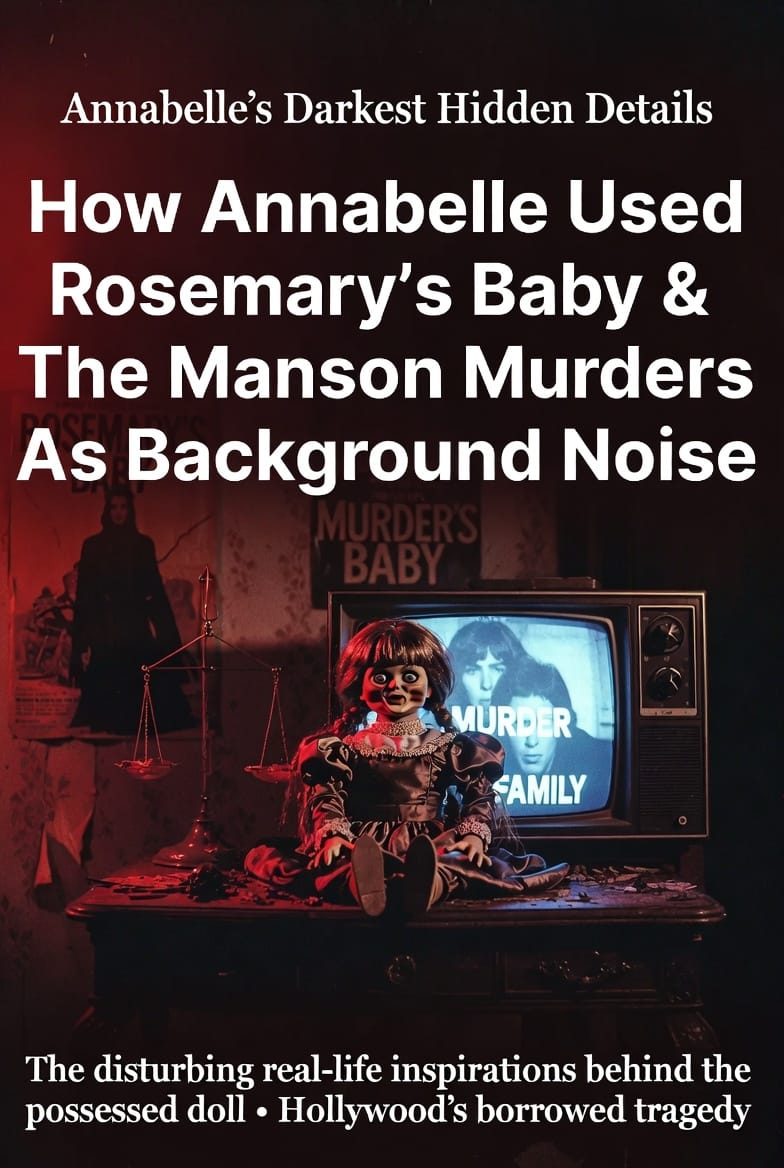
You’ve seen the names a hundred times without registering them. Mia. John. A young married couple, a pregnancy, a gift that turns out to be a curse. The film never announces the connection, and most of the audience that made
Annabelle a hit in October 2014 never made it either, because why would you go looking for Roman Polanski in a James Wan spinoff about a porcelain doll. I didn’t make the connection myself the first time I saw it. But the names aren’t a coincidence, and the Annabelle hidden details behind this production make the film considerably more interesting than the movie itself ever bothers to be.Mia Form and John Form share their first names with Mia Farrow and John Cassavetes, the married leads of
Rosemary’s Baby. Gary Dauberman’s screenplay borrows the shape of that film almost wholesale: a young pregnant wife, an ambitious husband more invested in his career than her fear, an apartment building full of neighbors who are not what they claim, a conspiracy targeting the child before it’s born. The noise from the Higgins’ apartment next door, loud enough to disturb the Forms on the worst night of their lives, is a direct nod to the thin walls and intrusive neighbors of the Bramford in Polanski’s film. IMDb’s trivia page for Annabelle confirms the naming choice explicitly, and once you know to look, the parallel structure runs through nearly every act of the film.I want to sit with that borrowing for a moment, because it’s the first sign of what actually bothers me about this movie, and it isn’t the jump scares.
The Night Charles Manson Walked Into a Spinoff
Annabelle opens in 1967 and stages its inciting murder in a way that removes any ambiguity about its source material. The Forms are watching a television news report about the Tate and LaBianca murders and the arrest of the Manson Family when their neighbors are attacked in the apartment next door. The killers are identified afterward as a young woman estranged from her family and her boyfriend, both members of a cult devoted to summoning something with blood. The murdered wife next door is named Sharon Higgins.The murders happened in August 1969: Sharon Tate, eight months pregnant, and four others killed at the Cielo Drive house she shared with Roman Polanski; the LaBiancas killed the following night in a separate, related attack. Manson wasn’t at either scene. He was convicted on a theory of vicarious liability, for directing followers who did the killing in his name. Annabelle times its own fictional murder to land in that same news cycle, while the real case was still being litigated.I don’t know whether that specific first name was a deliberate choice by anyone in the writers’ room, and I’m not going to pretend I do. What I can tell you, because it’s documented rather than inferred, is that screenwriter Gary Dauberman returned to this exact material a second time. He wrote Wolves at the Door, a film built directly around the Tate murders, released in the years between Annabelle and its own sequel Annabelle: Creation. Once as background noise for a haunted-doll movie. Once as the entire subject.A film is allowed to be inspired by real horror. Horror as a genre has always metabolized real atrocity into fiction; that’s a long, legitimate tradition going back further than this franchise. What bothers me here is the register. Rosemary’s Baby, the film Annabelle is quoting by name, was made by a director who would lose his own pregnant wife to a cult murder the following year, a fact that turned the film into something closer to prophecy than most horror movies ever manage to be by accident. Annabelle borrows that gravity as costume. It puts real murdered women on the evening news, gives its own fictional victim a common American first name, and then spends ninety minutes on a doll’s shadow moving across a nursery wall. The tragedy is furniture here. It sets a mood and gets out of the way.
The Composer Who Plays the Demon
Joseph Bishara scored Annabelle, and on this one he also has an acting credit: he plays the demonic figure that stalks Mia through the apartment. It’s part of a pattern specific to him. Bishara played the Lipstick-Face Demon across the Insidious trilogy, took the role of Bathsheba in The Conjuring, and appeared again as the entity credited simply as “Demon” in The Conjuring 2. It’s a strange, almost architectural kind of authorship, a composer who writes the dread and then wears it. Across three different franchises tied to the same producing team, Bishara has built a career out of literally embodying the thing his own score is telling the audience to fear, which is either a very specific kind of actor’s ego or the most efficient hiring decision in modern horror: why pay two people when one person already understands exactly how the monster is supposed to sound arriving in a room.John R. Leonetti, directing his first Conjuring Universe entry here, had already shot
The Conjuring as its cinematographer the year before, which makes him one of the rare people on this production who understood the franchise’s visual grammar before he was ever asked to direct within it. He didn’t operate the camera himself this time; that job belonged to cinematographer James Kniest, working from Leonetti’s sense of what this world was supposed to look like. Between them, and editor Tom Elkins cutting the result, you can feel a version of the same commitment to practical shadow that made the first film work: the instinct to let a hallway go dark rather than light it for safety, to hold a static frame long enough that stillness itself starts to feel like a threat. It’s the most credible piece of craft in a film that critics, at the time, were otherwise entirely right to call cut-rate. Variety’s Scott Foundas described it as a film that “makes up in crude shock effects what it lacks in craft, atmosphere, and just about every other department,” and on the writing and performance level, I don’t disagree with a word of it. The visual department is the one place where somebody who understood the house was actually driving, even if Leonetti himself had traded the camera for a monitor.
The Best Scene the Script Doesn’t Earn
Alfre Woodard’s Evelyn gets one monologue in this film, late, describing the car accident that killed her daughter Ruby years earlier: the drive back from her parents’, the fatigue she shouldn’t have been driving through, looking over at Ruby asleep in the passenger seat, waking up three weeks later to learn her daughter never did. Critics who otherwise dismissed the film’s writing single out this scene specifically, and the reason is simple to name once you’ve watched Woodard work through it. The rest of Annabelle gives its actors lines that exist to move plot forward. This scene gives Woodard grief that has nowhere to go, guilt with no object to attach to except herself, and she plays it without asking the camera for sympathy. It’s a genuinely well-built piece of acting sitting inside a screenplay that otherwise has no idea what to do with the adults it’s populated with, and it’s the clearest evidence in the whole film that the difference between a competent horror movie and a forgettable one is rarely the monster. It’s whether anyone in the cast gets material worth taking seriously, and here, for about ninety seconds, one actor does. Woodard was an Academy Award nominee and multiple Emmy winner by the time this film cast her, and it shows in exactly the moment the script finally gives her something to work with instead of exposition.
The Music Box That Remembers
The baby mobile hanging over Leah’s crib plays the same melody as the music box that opens The Conjuring and sits, ominously inert, in the Warrens’ occult museum by the end of that film. It’s a small audio cue, easy to miss entirely if you’re not listening for it, and it does something the rest of the movie’s homages don’t: it ties this film’s mythology to the previous one through sound rather than through a name-check or a news broadcast. You don’t need to know Rosemary’s Baby to feel it. You just need to have watched the first film with the volume up.
Where the Doll Actually Goes
The film’s final scene shows a mother buying the porcelain Annabelle doll from an antique shop as a gift for her daughter, a nursing student named Debbie. That detail isn’t decoration. The Conjuring opens with two nursing students recounting the doll’s behavior to Ed and Lorraine Warren, the scene that gives the whole franchise its first case file. Annabelle exists specifically to walk backward from that opening scene to an explanation for how the doll got there in the first place, and the final shot is the film closing that loop in front of you, the same nursing-student framing device now doing double duty as a prequel’s answer key.There’s a real design choice buried in this handoff worth naming directly: the doll in Annabelle is porcelain, ceramic-faced and glassy-eyed, built specifically to read as more unsettling on camera than the real object it’s based on. The
actual doll housed in the Warrens’ occult museum is a Raggedy Ann, cloth-bodied and cartoonish, nowhere near as photogenic a monster. The production made that substitution deliberately, and it’s the single biggest fictional liberty the franchise takes with its own source material before The Nun would go on to invent an entire country’s worth of new mythology a few years later. Every subsequent film in the doll’s corner of the franchise inherits that same substitution without ever revisiting it: Annabelle: Creation and Annabelle Comes Home both use the porcelain version exclusively, meaning the actual documented object at the center of one of the Warrens’ most famous cases has, at this point, appeared on screen less often than the version invented to look better in a trailer.
The Annabelle Hidden Details Nobody Talks About
One of the quieter details in Annabelle never gets mentioned in the franchise’s Easter egg round-ups, probably because it isn’t a demon name spelled out in a windowsill. When the Forms move into their new apartment, the building’s children slip crude drawings under the door, the kind of thing meant to read as a neighborly welcome. Mia looks at them and starts to laugh it off before John examines them more closely and stops. The proportions are wrong in a way that unsettles him specifically, not obviously monstrous, just off, the kind of children’s drawing that reads completely normal until an adult stares at it a beat too long and can’t say exactly why they don’t like it. The film never resolves what the drawings mean or whether the children who made them saw something, understood something, or were simply children drawing badly the way children do. It’s the one moment in the movie that trusts ambiguity instead of explaining itself, and it’s telling that it’s also the one moment nobody bothers cataloguing when they list what’s scary about this film.
The Haunted Set Press Tour
In the promotional run before release, Leonetti and producer Peter Safran both told reporters that they believed the Annabelle set had genuine supernatural activity during filming. The Hollywood Reporter ran the story under the header “Annabelle Director John Leonetti Talks About Shooting on a Haunted Set.” I want to be direct about what this is: it’s the exact same promotional move Corin Hardy would make four years later for The Nun, and the same one attached to nearly every entry in this franchise going back to the original Conjuring’s press cycle. A haunted set makes good copy. It costs nothing to claim and it primes an audience already inclined to believe the marketing that the film is “inspired by true events” to extend that credulity to the production itself. Sets are unsettling places to work at odd hours, regardless of what’s actually haunting them, and I believe these directors felt something real. What I’m tracking here is the pattern. Leonetti and Safran made the claim for this film. Corin Hardy made a version of it for The Nun. During Annabelle Comes Home in 2019, star Mckenna Grace told reporters her nose started bleeding unexpectedly during rehearsals and stopped every time she stepped off the soundstage. Three productions, three sets of unverifiable anecdotes, all surfacing on cue during the same promotional window. That consistency is either a genuinely haunted studio lot or a genuinely reliable marketing beat, and only one of those explanations has ever shown up in a quarterly earnings call.
Why the Homages Bother Me
None of this makes Annabelle a well-made film. I already said as much in the review, and rewatching it for this piece didn’t change my mind. What these Annabelle hidden details actually reveal is more specific than “the movie is bad.” They reveal a production that had real material sitting in front of it, a genuinely great film’s cast names, a genuinely horrifying double murder from three years before the story’s setting, and chose to use both as texture rather than subject. Rosemary’s Baby is about a woman not being believed by every institution meant to protect her. The Manson murders are about the specific horror of ordinary domestic space being invaded by ideology dressed as spirituality. Annabelle has access to both of those ideas through its own homages and never once asks what either of them means. It just borrows the names and the newsreel and moves on to the next jump scare, confident the association will do the emotional work the screenplay itself declines to do.That’s a real sin, and this film is far from the only one committing it. It’s the founding logic of an entire spinoff strategy: take something that already means something to an audience, attach it to a new product with the smallest possible amount of original thought, and let the borrowed weight carry the box office. Annabelle grossed over 257 million dollars against a budget of 6.5 million, a return that made the studio’s spinoff calculus look less like a gamble and more like a formula worth repeating immediately. Whatever else this film failed to do, it proved the strategy works, and every subsequent Conjuring Universe entry has followed the same math since: identify a genuinely resonant piece of American fear, real or fictional, attach a demon to it, and let the resonance do the labor the script won’t.That’s the part that actually earns the cold fury here, more than any single jump scare or any one borrowed name taken on its own. The homages in Annabelle aren’t accidents of an underfunded production reaching for shortcuts under deadline pressure. They’re the business model, running exactly as designed, on the back of somebody else’s tragedy. Rosemary’s Baby took a director working at the edge of his own life to earn the dread it produces. Annabelle borrowed its names in an afternoon and its newsreel in an editing bay, and it made ten times its budget back before its second weekend was over. The only honest word for how that makes me feel is furious, and the doll has almost nothing to do with it.
Frequently Asked Questions
Are Mia and John from Annabelle named after Rosemary’s Baby?
Yes. According to IMDb’s trivia entry for the film, the character names Mia and John directly reference Mia Farrow and John Cassavetes, the leads of Rosemary’s Baby (1968). Both films center on a young pregnant wife, a husband focused on his career, and neighbors involved in a plot against mother and child, and the noisy apartment neighbors in Annabelle echo the same device from Polanski’s film.
Does Annabelle (2014) reference the Manson murders?
Yes, directly. The film opens with a television news broadcast about the Tate and LaBianca murders and the Manson Family, immediately before the Forms’ neighbors are killed by a cult couple in a home invasion staged to evoke the same crime. Screenwriter Gary Dauberman later wrote Wolves at the Door, a film centered specifically on the Tate murders.
Who composed Annabelle’s score, and does he appear in the film?
Joseph Bishara composed the score and also holds an on-screen acting credit as the demonic figure that stalks Mia. He has taken similar dual composer-actor roles elsewhere in horror, including the Lipstick-Face Demon across the Insidious films and Bathsheba in The Conjuring.
How does Annabelle (2014) connect to The Conjuring (2013)?
Annabelle ends with the doll being purchased for a nursing student named Debbie, directly setting up the nursing students who first bring the doll’s story to Ed and Lorraine Warren at the start of The Conjuring. A shared musical cue between Annabelle’s baby mobile and The Conjuring’s music box reinforces the connection.
Is the real Annabelle doll the same as the one shown in the film?
No. The real doll kept in the Warrens’ occult museum is a cloth Raggedy Ann. The production designed a porcelain, glass-eyed doll for the film specifically because it reads as more unsettling on camera than the actual object.
Was Annabelle (2014) a box office success despite bad reviews?
Yes, dramatically so. Against critic scores in the 20-to-30 percent range on Rotten Tomatoes, Annabelle earned roughly 257 million dollars worldwide on a 6.5 million dollar budget, one of the highest returns-on-investment in modern horror. It posted the biggest opening weekend for a horror film in 2014 domestically and set opening or overall box-office horror records in several countries, including Mexico and the Philippines.
Did critics single out any performances in Annabelle as genuinely good?
Alfre Woodard’s Evelyn drew consistent praise even from reviews that otherwise dismissed the film, particularly a late monologue about the car accident that killed her daughter years earlier. Critics generally attributed the film’s weaker moments to the screenplay rather than the cast, noting that strong actors were given underwritten material to work with throughout.