Most “hidden details” pieces are treasure hunts for things you can see — a name on a gravestone, a shape in the wallpaper, a frame where the monster is already standing behind someone before the score tells you to be afraid. Robert Eggers’ Nosferatu (2024) has a few of those, tucked into the set dressing. But its real texture lives in what gets said, and said fast — Latin, old angelology, a word Bram Stoker himself once wrote down and then, for whatever reason, decided not to use.
You can watch the film twice and miss all of it, because it never asks you to notice. It just assumes you already know, the way a period piece assumes you already know what a telegram is.
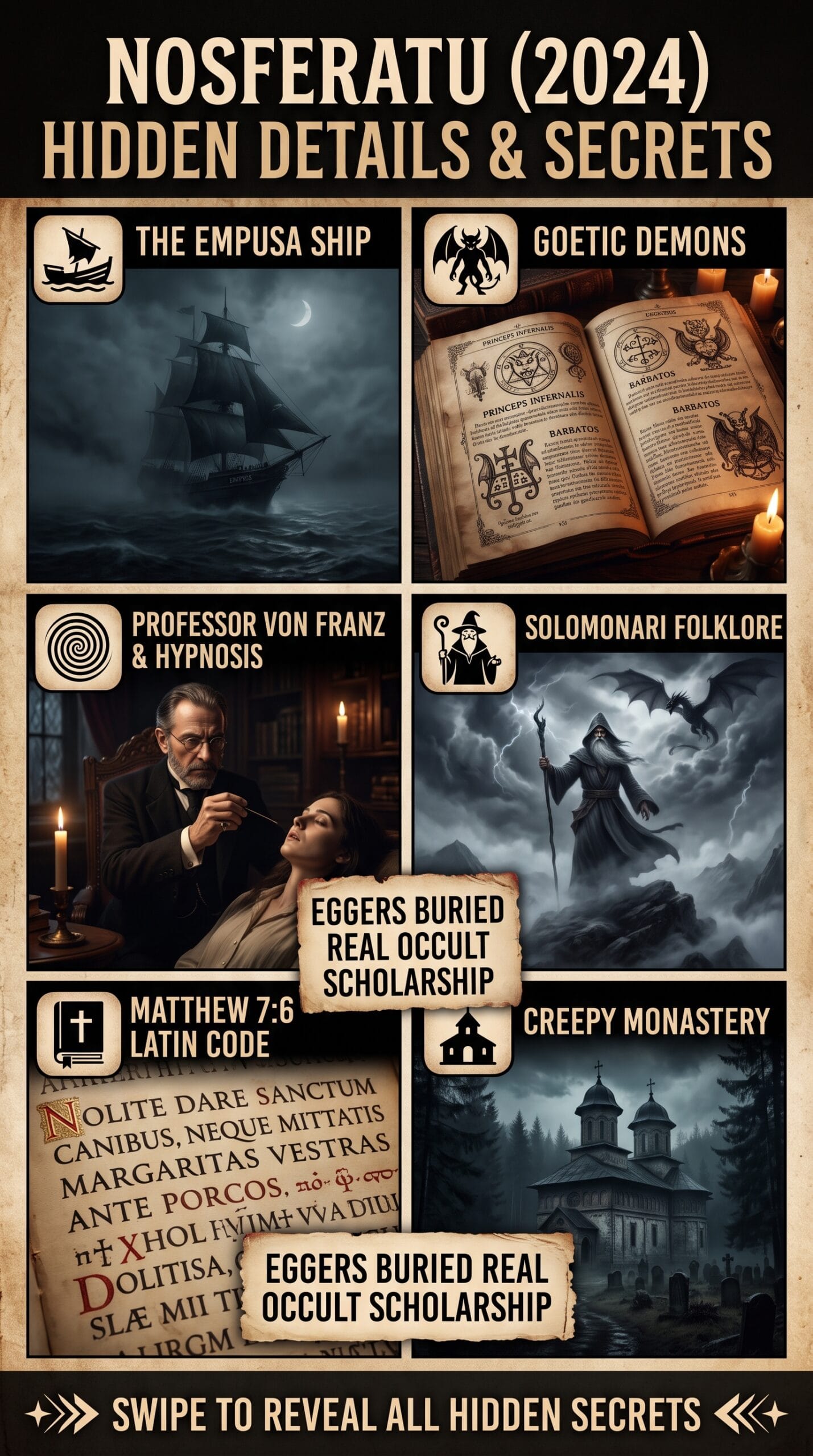
This roundup of Nosferatu 2024 hidden details focuses on what the film says rather than what it shows: real Goetic demon names inside Von Franz’s ritual, a Latin joke lifted straight from Matthew 7:6, a ship named after a Greek myth, and the real Romanian word — Solomonari — that the film uses for what Count Orlok actually is.
That’s the thing to sit with here, before any of the specific references. Eggers didn’t build this film to reward the pause button. He built it to reward the person who goes home and looks something up — the exact instinct the film’s own occult scholar models for two and a half hours. Von Franz spends the movie insisting that real knowledge requires digging past what’s comfortable. The film is quietly daring you to do the same thing to it.
The Hypnosis Scene Nosferatu 2024 Never Fully Explains
Start with the scene most people remember as “the hypnosis scene” and mentally file away as one plot beat among many. Von Franz sits Ellen down, asks her to tell her story from the beginning, and she does — and what she describes turns out to be about her own childhood and her own family, with Orlok barely entering into it directly. She says she always knew things. She knew when her mother would die.
Her father used to find her out in the fields, in the forest, “as if I was his little changeling girl,” and as she got older it worsened. He grew ashamed of her. She was alone, and she wished for comfort, and then — a presence. Nightmares. Epilepsies. And then the detail nobody quotes in the recap videos: her father once found her lying unclothed, and the scene is staged so that everyone in the room goes quiet with embarrassment except Von Franz, who keeps writing. She remembers being told it was sin. That she’d be sent away.
And then, plainly, almost as an aside: “It all ended when first I met my Thomas. From our love, I became as normal.”
Sit with what that scene is actually doing. It plays like a testimony about a childhood that adults around her treated as shameful and never properly explained, delivered under hypnosis to a man taking clinical notes while her in-laws sit close enough to hear all of it. Whatever Orlok literally is — and the film is careful never to let you find him boring — Ellen’s account of her own life is the account of a girl whose family responded to something happening to her with silence, disgust, and the word “sin.”
Thomas is described, by Ellen herself, as the thing that made her “normal” — which means someone else’s presence is what had made her not-normal in the first place, long before any of them had heard the name Orlok. The film gives you a full clinical interview establishing this and trusts you to sit with the discomfort of it rather than resolve it into a clean metaphor.
The Real History Behind Von Franz’s Diagnosis
The instruments Von Franz uses to get there deserve a second look too, because they’re staged the way real nineteenth-century diagnostic theater actually worked. Before the invocation, he tests Ellen with a long needle through the flesh of her wrist while she registers nothing, then holds a candle to her open eyes and announces, through a quizzing-glass, that her pupil “does not contract naturally to light.”
Physicians of the era practiced exactly this kind of theater — Jean-Martin Charcot’s demonstrations at the Salpêtrière hospital in Paris are the best-known example — genuinely staging needle-prick tests on hysteria patients to show that they could be pierced without apparent pain, part of an elaborate, half-theatrical diagnostic showmanship that drew audiences and blurred clinical observation into performance.
Von Franz is practicing that same real, deeply flawed nineteenth-century medicine, the kind that treated a suffering woman’s body as a stage for other men’s expertise — which makes it stranger that he turns out to be the one person in the film who’s actually right about what’s happening to her.
That same theory of susceptibility gets one more application, and the film makes the connection explicit even if it never spells it out for you. Von Franz tells Harding that “daemonic spirits more easily obsess those whose lower animal functions dominate” — his list of the vulnerable is “hysterics, children, lunatics.” Set that list next to Knock, locked in an asylum cell, eating live insects and biting the heads off birds while insisting he serves “His Lordship.”
Von Franz’s diagnostic framework quietly makes Ellen and Knock the same kind of case, sorted only by circumstance and class — one treated as a delicate patient to be hypnotized in a parlor, the other as a dangerous lunatic to be restrained in a hospital chair — even though the film treats them as opposites in every other way. And Knock gets his own small, exact literary echo.
When he kills the orderly and drinks his blood, he says, twice, “The blood is the life!” — the same phrase, almost word for word, that Renfield repeats in Stoker’s original 1897 novel after lapping blood from Dr. Seward’s cut wrist, obsessively quoting a line of Deuteronomy to justify what his own master has made him crave. Knock is Eggers’ Renfield down to the sentence. The film never explains the reference. It just assumes the audience that cares will recognize its own grandfather.
The Real Occult Names in Von Franz’s Ritual
Von Franz’s method for extracting the rest of Ellen’s testimony is itself worth a closer look, because when he presses his ring to her forehead and commands her to speak, the names he invokes are drawn from real, identifiable sources: “By the protection of Chamuel, Haniel, and Zadkiel, in the name of Eligos, Orabas, and Asmoday, impart your speech unto me.” The first three are angels drawn from genuine Renaissance angelology — the kind catalogued in Heinrich Cornelius Agrippa’s Three Books of Occult Philosophy, correlated to planetary spheres.
The second three are demons, and specifically Goetic demons, pulled from the same family of grimoires that produced the Ars Goetia: Eligos appears as a knight and is said to know the past, the future, and the movements of soldiers; Orobas takes the form of a small horse and speaks to matters of time; Asmoday — Asmodeus — appears as a three-headed monster who, of all things, teaches mathematics. None of that trivia makes it into the film’s dialogue.
It’s simply true of the names Eggers chose, and a viewer who bothers to check will find the invocation assembled from a specific, identifiable corner of real Western occult literature, angels and demons yoked together in the same breath the way real grimoire practitioners sometimes did when they wanted both protection and information at once.
Whether that specificity is meaningful or just atmospheric is an open question, and answering it too neatly would be a mistake. It’s entirely possible nobody involved intended Eligos’ military knowledge or Asmoday’s mathematics to mean anything for this scene in particular — that the names were chosen simply for the way they sound out loud, for the texture of unfamiliar syllables in a nineteenth-century parlor. But the fact that the choice could have been arbitrary and still happens to be historically real is itself the more interesting fact. Somebody did the reading.
The film doesn’t need you to know that Orobas manifests as a horse. It just quietly rewards you if you go find out.
What Von Franz’s Latin and Scripture Reveal About Him
The same instinct shows up a few scenes later, in a much smaller, easier-to-miss moment: Sievers finally locates Von Franz, half out of his mind in a rented attic, and snaps him back to lucidity with a single line of Latin — “Nolite dare sanctum canibus.” Von Franz answers in kind: “Neque mittatis margaritas vestra ante porcos.” Do not give what is holy to dogs. Do not cast your pearls before swine.
It’s one verse, split in half — Matthew 7:6 — used the way old friends sometimes use a private joke or a childhood password: not because either man doubts the other believes in it, but because saying half a sentence and getting the other half back is proof that the person answering is still, underneath the squalor and the muttering about alchemy, the same rigorous colleague he used to be. It’s a test built entirely out of scripture, disguised as a test of sanity, and it passes without either character explaining what just happened.
If you don’t know your Matthew, it reads as two old academics being cryptic at each other. If you do, it’s a small, exact piece of characterization — evidence that under everything, Von Franz’s mind still works.
Von Franz gets one more speech that rewards close attention, delivered to Harding, who wants none of this: “We have not become so much enlightened as we have been blinded by the gaseous light of science. I have wrestled with the Devil as Jacob wrestled the angel in Peniel.” That’s Genesis 32 — the story of Jacob spending a night physically grappling with a divine being at a river crossing, refusing to let go until he receives a blessing, and coming away from it changed, limping, renamed.
Von Franz is reaching for something far more specific than a vaguely biblical-sounding metaphor — he’s comparing his own occult research directly to a story about wrestling something holy and dangerous at close range and refusing to release it until it gives something up. It’s a strange thing for a script to be that precise about, for a line most audiences will let wash past them as period flavor. But it tells you exactly how Von Franz understands what he’s doing: as a physical contest he’s willing to be hurt by.
Nosferatu 2024 Hidden Details: The Real Word for What Orlok Is
Then there’s the word the film actually uses for what Orlok is, and this is where the details stop being isolated trivia and start connecting to each other. Deep in the Orthodox monastery, an old Schema Abbess hears Thomas say Orlok’s name and reacts with real terror. Translated, she calls him a “Şolomanari” — in the film’s own subtitles, rendered simply as Solomonari. That’s not an invented word for the occasion.
Solomonari are a genuine figure in Romanian folklore: wandering wizard-priests, trained at a legendary “Scholomance” — a school run by the Devil himself, deep in the mountains, where ten students study together and the Devil claims the tenth as payment. Solomonari were said to ride dragons, control storms and hail, and carry books of forbidden wisdom. And in at least one serious nineteenth-century folklore study — the ethnographer S. F. Marian’s work on Romanian peasant belief — Solomonari are explicitly classified as a type of strigoi, the Romanian term for a revenant or vampire.
The word the film chooses for Orlok already means, in the folklore it’s drawn from, something dangerously close to vampire.
It gets better, or worse, depending on your taste for this kind of thing. The Scholomance has a literary pedigree of its own. Bram Stoker himself wrote about it. In his working notes for the original Dracula, Stoker records that the Draculas “had dealings with the Evil One” and “learned his secrets in the Scholomance, amongst the mountains over Lake Hermanstadt, where the devil claims the tenth scholar as his due” — material he lifted from Emily Gerard’s 1885 essay on Transylvanian superstition. Stoker knew this legend. It’s exactly the kind of folklore rabbit hole covered at length in the real history of vampires.
He built it into his understanding of where his vampire’s power came from, even if the finished novel only hints at it. Folklorists tracing the story back further connect the Scholomance to much older, pre-Christian belief about Zalmoxis, a god-figure associated with an underground teaching chamber in ancient Dacian religion — the same Dacian world the film’s Wisburg physicians dismiss as extinct superstition.
So when Eggers has an Orthodox nun name Orlok using a word from real Romanian folk belief, one already linked by actual folklorists to vampirism, one that traces backward through Stoker’s own research notes to a pre-Christian priesthood — that’s not decoration. That’s the film reaching past its own invented plot and grabbing something that was already there, waiting, in the historical record Stoker himself once touched and then left on the cutting-room floor of his imagination.
The Ship’s Name Is Its Own Hidden Detail
The ship gets the same treatment, and it’s easy to miss entirely because nobody ever says its name out loud — it exists only as lettering on the hull, a piece of background production design. The vessel carrying Orlok’s coffin toward Wisburg is the Empusa. In Greek mythology, Empusa is a shapeshifting night-demon in the retinue of Hecate, goddess of crossroads and the underworld.
She hunts travelers on lonely roads, sometimes by frightening them into fleeing, sometimes — more relevantly here — by taking the form of a beautiful young woman, seducing a man, and then feeding on his flesh and drinking his blood once his guard is down. A demon who looks safe, who looks desirable, until the moment she doesn’t, and by then it’s too late to leave.
Naming the ship after her turns out to be the film quietly restating its own premise on the side of a boat: something is crossing the water disguised as cargo, and it will use exactly the same mechanism — attraction that curdles into consumption — that the rest of the story keeps circling back to, just with the genders reversed. Orlok seduces Ellen the way Empusa seduces her victims. He’s sailing to Wisburg on a ship named after the thing he’s about to do to her.
The Three-Night Countdown Hidden in Plain Dialogue
One structural detail buried in plain dialogue is easy to register once and then forget, and it reframes how deliberately paced the film’s back half actually is. After Ellen’s first refusal, Orlok doesn’t simply escalate — he sets a clock. “I will leave you three nights,” he tells her, and the film keeps count out loud: after Anna is attacked, his voice returns, flat and almost bureaucratic, with “Two more nights.” And near the climax, a line surfaces that functions as a direct callback to that very first ultimatum: “Behold, the third night.”
What plays, on a first watch, as mounting dread is also — underneath — a countdown the film has been running since well before the halfway mark, announced once and then paid off precisely on schedule. It’s the kind of structural discipline that’s easy to feel without ever consciously tracking it, which might be exactly the point: horror that works on a clock rarely announces the clock.
That same scene holds one more detail worth noting, mostly because of who says it and who he’s saying it to. Orlok is alone with Knock in the ruin of Grünewald Manor when Knock, eager to prove his usefulness, offers to simply murder Thomas and be done with it. Orlok refuses: “I have use in him.” Then, almost as an aside, he states a rule of his own compact out loud: “The compact commands she must willingly repledge her vow. She cannot be stolen.”
It’s a strange, almost bureaucratic thing for a predator to volunteer to his own devoted servant, in a scene most of the audience has already half-forgotten by the time the ending arrives — Orlok holding himself to a procedure, turning down a shortcut Knock is handing him for free. Even his hunger, it turns out, has rules attached.
The Prologue Line Nosferatu 2024 Quietly Answers at the End
One last echo is easy to miss simply because of where it sits. In the film’s opening minutes — the prologue, before the story proper even starts — a voice tells a young Ellen, “You are not for human kind.” It’s easy to let that line slide past as mood-setting, a single ominous sentence meant to color everything that follows. But the line returns.
It’s the same claim Orlok makes to her adult self at the window, decades later, in almost the same words: that whatever she is, she was never meant to belong to Thomas, to Wisburg, to any of it. The film tells you the ending of that argument before it tells you the story.
By the time Orlok repeats himself at the climax, he’s finishing a sentence that started in the first scene, which makes the film’s structure a kind of closed loop — the claim made once in childhood, denied for two hours by a marriage and a household and a city full of people who’d rather call it hysteria, and then simply restated, unchanged, when it matters.
None of this changes what happens on screen. Ellen still opens the window. Orlok still dies with the light. The plot doesn’t move an inch differently whether or not you know that Asmoday teaches mathematics in the Ars Goetia or that a nineteenth-century folklorist once filed Solomonari under vampire.
But knowing it changes what the film feels like it’s made of — something closer to what Von Franz claims to be doing across the whole runtime: actual research, assembled by people willing to go find the real word, the real verse, the real folklore classification, and use it exactly once, without underlining it, trusting that most of the audience would never need to know and a handful would go looking anyway.
Maybe that’s the real hidden detail — not any single reference, but the posture behind all of them. A film about a scholar who insists that real knowledge requires digging past what’s comfortable, made by people who apparently agreed with him enough to bury actual scholarship in the corners of their own movie and never once point at it. You can watch Nosferatu and never learn any of this and the film will still work on you exactly as intended.
You can also go looking, the way Von Franz keeps telling everyone around him to do, and find out that the ground under this particular haunted house goes down a lot further than the set decoration.
Nosferatu 2024 Hidden Details: Frequently Asked Questions
What Are the Best Nosferatu 2024 Hidden Details?
The strongest Nosferatu 2024 hidden details are verbal, not visual: Von Franz invokes real Goetic demons during Ellen’s hypnosis, quotes Matthew 7:6 in Latin as a private sanity test, and an Orthodox nun names Orlok using Şolomanari, a genuine Romanian folklore term one 19th-century ethnographer classified as a type of vampire.
Is the Ship in Nosferatu 2024 Really Called the Empusa?
Yes. The vessel carrying Orlok’s coffin to Wisburg is named the Empusa, after a shapeshifting demon in Greek mythology who serves Hecate and seduces travelers before feeding on them — a detail visible only on the hull, never spoken in dialogue.