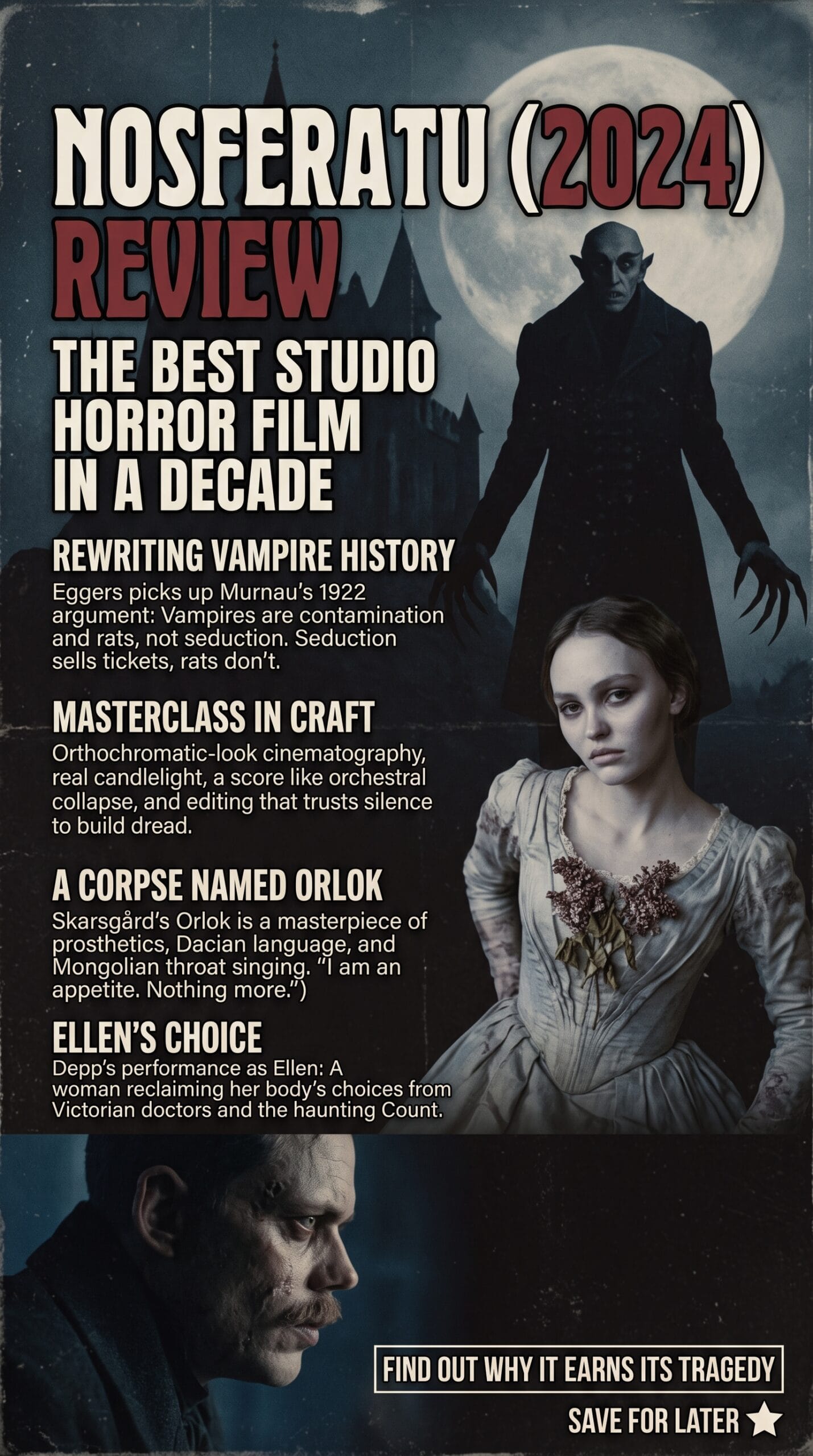
Nosferatu (2024), directed by Robert Eggers and starring Bill Skarsgård and Lily-Rose Depp, is the best studio horror film in a decade — this Nosferatu 2024 review makes that case in full, department by department, starting with why the ending still hasn’t let me go.
I watched Robert Eggers’ Nosferatu three times before writing a word of this, and each time the ending did the same thing to my chest. That almost never happens anymore. A remake of a hundred-and-two-year-old public domain film, one everybody already knows the shape of, made me sit in the dark after the credits and just breathe for a minute.
This is the best studio horror film in a decade, and that claim is the whole foundation for what follows — I need you to sit with the stakes before I start picking the thing apart scene by scene, craft choice by craft choice, and I have a lot to say.
Here’s my position, stated plainly and early: Eggers picked up an argument Murnau started in 1922, one that Bela Lugosi’s Dracula interrupted nine years later, and finished it. Murnau built a vampire as vermin — rat-toothed, plague-bearing, arriving on a ship full of corpses. Browning’s Dracula, made in 1931, replaced that with a charming nobleman in a cape, and every vampire film for the next ninety years inherited the seduction reading, and the contamination reading went dormant for decades, because seduction sells tickets and rats don’t. Eggers went back for the rats — the same vermin design Albin Grau built for the 1922 original, made under legal siege from Bram Stoker’s widow.
Count Orlok in this film is a corpse in every sense that matters — rotting, mustached, obscene — and the film’s entire design philosophy commits to that choice with a rigor I haven’t seen from a horror production in years. It’s the same argument that anchors our guide to the best vampire movies, and this film is the clearest recent proof of it.
The Cinematography, Score, and Production Design Behind Nosferatu’s Look
Jarin Blaschke’s cinematography is the reason this film feels like nothing else currently playing in a multiplex, and the proof is in what the camera is actually doing scene by scene. Blaschke shot the moonlight sequences through a filter that strips out red, orange, and most of the yellow light, leaving something close to true monochrome even in color footage — an orthochromatic look borrowed from the actual film stock of the 1920s, when blue-sensitive emulsion rendered skin pale and blood black.
He shot every candlelit interior with real candles, no simulated firelight, which means every flicker on Ellen’s face or Orlok’s crooked hand is real light behaving the way real light actually behaves. The 1.66:1 aspect ratio is tighter and taller than the widescreen modern horror defaults to, which makes every hallway and every castle corridor feel like a coffin standing on end.
All of it serves the same design logic — a director and a cinematographer building a world where color itself has been drained out by whatever Orlok is, so that by the time dawn finally breaks gold across Wisburg in the film’s last shot, the relief is almost physical — you’ve been starved of warm light for two hours and the movie knows it.
Robin Carolan’s score earns a mention specifically for its patience. Long tones sit under scenes like weather, occasionally erupting into something closer to orchestral collapse in the plague-ship and possession sequences, but mostly content to just make a room feel wrong before anything visible happens. Production design and costuming are doing quieter, equally important work. Craig Lathrop’s Wisburg looks like an actual nineteenth-century Baltic port choking on its own commerce — cattle in the streets, canals thick with cargo.
Linda Muir dresses Ellen in a wedding gown she’s still wearing dried lilacs in when Orlok finally comes for her, and it reads as a burial shroud from the moment you see it, long before the film confirms that’s exactly what it is. Louise Ford’s editing trusts silence to do what music usually does — entire sequences play out with almost no cutting, because Eggers and Ford understand that dread needs time to accumulate.
Bill Skarsgård’s Count Orlok Performance, Explained
Bill Skarsgård’s Orlok is the performance everyone’s going to talk about, and it earns every bit of the conversation, though for reasons most trailers undersold. The dread here is cumulative, built performance choice by performance choice.
Skarsgård needed a team of six just to apply the prosthetics that leave almost nothing of his own face visible, and he built the voice from scratch with Icelandic opera singer Ásgerður Júníusdóttir, twenty minutes of vocal warm-up before every day’s filming, and Mongolian throat-singing exercises between takes, rejecting the studio’s original plan to digitally modulate his voice — low enough that it registers less as speech than as something moving through your chest cavity.
Orlok speaks reconstructed Dacian in the film, a language that had gone silent for roughly a millennium and a half, because Eggers wanted a vampire that predates seduction as a concept entirely, something that was already ancient and already wrong before human language had the vocabulary to describe it. It works. Every line Orlok speaks lands like weather arriving, and the film is smart enough to give him almost nothing to say. “I am an appetite. Nothing more.” That’s the whole thesis statement, six words, and Skarsgård makes you believe it’s the most honest sentence in the movie.
Lily-Rose Depp’s Ellen and the Film’s Real Subject
Lily-Rose Depp is doing the harder job, though, and I think history is going to be kinder to this performance than this year’s reviews were.
Ellen’s possession sequences are almost entirely practical — Depp working with a movement coach to contort her own body into positions that read as inhuman without a single visual effect doing the work for her — and what struck me watching it three times is how much of the performance lives in small transitional beats: the seconds where Ellen catches herself mid-spiral, where shame flickers back into her eyes before the next wave of whatever Orlok is doing to her takes over. Those beats are the hardest acting in the film and the least discussed.
Depp plays a woman who has spent her entire life being told her own body is a problem to be medicated, corseted, bled, and tied to a bed — the film’s Victorian doctors debate her “congestion of blood” and recommend a corset to calm her womb with a straight face that’s somehow more disturbing than anything Orlok does — and by the time she chooses her own ending, deliberately, with full knowledge of what it costs her, the film has spent two hours making the argument that this is the first real choice anyone in Wisburg has ever let her make.
Willem Dafoe’s Von Franz Twist, and Why It Works
That’s the part of this film I didn’t expect, and it’s the part that’s kept me turning it over for days: Von Franz. Willem Dafoe plays him as the film’s ostensible hero, the eccentric Swiss philosopher and occultist, an expert in alchemy and mysticism who alone understands what’s actually hunting Wisburg, and for two acts he plays exactly that part — brilliant, a little unhinged, the only adult in the room.
Then the film reveals, in its last twenty minutes, that Von Franz has known the whole time that the only way to end the plague is Ellen’s death, and he has manipulated everyone — including Ellen herself, who goes along with it fully aware of what she’s choosing — into a position where that death becomes inevitable, dressing the whole thing up as destiny and redemption while Thomas Hutter screams that it isn’t moral. Von Franz’s answer is the most chilling line in the film: God is beyond our morals.
Willem Dafoe delivers it laughing, joyfully, which is somehow the detail that makes the line land hardest. I’ve sat with a lot of horror villains this year, and none of them unsettled me as much as watching a supposedly benevolent mentor figure calmly engineer a woman’s death and call it salvation.
It’s a genuinely upsetting addition to the mythology, and it reframes everything that came before it — every scene where a doctor dismissed Ellen, every scene where Thomas told her to keep her visions quiet, suddenly reads as a smaller version of the same instinct Von Franz enacts at full scale: take the choice away from her and call it protection.
Nicholas Hoult’s Thomas and the Film’s Mirror Structure
Nicholas Hoult’s Thomas doesn’t get talked about nearly enough in the conversation around this film, and he should, because the screenplay is doing something quietly brutal with his character that most reviews skip past. Thomas comes back from Castle Orlok marked the same way Ellen is — he’s carrying his own bite, hidden under his shirt, which he only reveals late in the film in a moment of near-hysterical confession to Harding.
The film is built on a mirror: both husband and wife are violated by the same creature, in the same period of time, and the household around them responds to each violation in exactly opposite ways. Thomas’s wound becomes proof, evidence taken seriously by every man in the room the moment he bares it. Ellen’s identical affliction gets read as nerves, hysteria, congestion of the blood — something to be corseted, bled, and quieted.
Hoult plays that asymmetry without ever grandstanding about it — his Thomas is gentle, well-meaning, and completely incapable of seeing that the credibility being extended to him and withheld from his own wife is the actual horror the film is diagnosing, running underneath the vampire plot the whole time.
What This Nosferatu 2024 Review Gets Critical About
I want to push back on myself here for a second, because a review that’s pure enthusiasm reads like a press release, and I don’t think Eggers gets away completely clean. The film’s middle stretch, particularly the scenes bouncing between Harding’s collapsing household and Von Franz’s increasingly theatrical lectures on demonology, runs a little long, and there are two or three exchanges — Von Franz explaining, at length, what the audience has already understood from the imagery — that feel like the film doesn’t trust its own visual language as much as it should.
Simon McBurney’s Knock is tremendous in small doses and slightly overused in the back half, a comic-grotesque note that occasionally undercuts the film’s otherwise total commitment to dread. These are minor complaints against a film this ambitious, but they’re real ones, and I’d rather flag them than pretend the two and a half hours never sag.
Box Office, Oscar Nominations, and Why This Film Matters
Zoom out and this film’s existence at all is a small miracle worth naming. Focus Features spent fifty million dollars on an R-rated period horror film with subtitled Dacian dialogue, a two-and-a-half-hour runtime, and an ending that refuses to comfort anyone, and the film earned that bet back more than three and a half times over worldwide.
The Academy noticed too, with nominations across cinematography, costume design, production design, and makeup and hairstyling — the craft categories, which is exactly where this film’s actual argument lives — its entire case for taking the vampire myth seriously again is made through texture and light, patient enough that it never needs a twist or a jump scare to land. I’ve written on this site before about horror’s fight for respect as a serious genre, and Nosferatu is the strongest recent evidence I’ve got that the fight is winnable when a studio actually backs the vision all the way through. It’s the same case Ethan made for Let the Right One In (2008), a colder, meaner arthouse vampire film that got there first.
The Ending, and Why It Earns Its Tragedy
What the film gets exactly right, though, is the ending, and I’ll say this much without spoiling the specific mechanics of it: Eggers resists every impulse a modern studio horror film has to soften a sacrifice into a rescue. Nosferatu earns its tragedy honestly, commits to it fully, and doesn’t flinch away from what that commitment costs its characters. The final shot, Wisburg’s plague finally lifting into pure gold morning light after two hours of near-monochrome dread, works precisely because the film has made you feel the absence of warmth for the entire runtime before it.
It’s the rare ending that argues its case as thoroughly with pure craft as it does with plot. Ethan breaks down exactly what that sacrifice costs, and whether Ellen ever really had a choice, in Nosferatu 2024 Ending Explained.
Final Verdict
Call this one a correction — the shortest way I can put the argument I’ve spent this whole review making. Eggers, Blaschke, Carolan, Lathrop, Muir, Ford, Skarsgård, and Depp built it together, every department pulling in the same direction. I watch a lot of horror for a living, and most of it I forget within a week. I still think about the sound Skarsgård’s Orlok makes in that last scene, and I suspect I will for a long time.
That’s the whole argument of this Nosferatu 2024 review, distilled into one image: a starving thing, finally fed, and a genre finally taken seriously enough to let it happen.
Ethan’s Score: 9/10
Frequently Asked Questions About Nosferatu (2024)
Is Nosferatu 2024 Worth Watching?
Yes — Robert Eggers’ Nosferatu earned 85% from critics on Rotten Tomatoes, four Oscar nominations for its craft work, and a box office return of more than three and a half times its fifty-million-dollar budget. It commits fully to Count Orlok as rot and contamination, the reading Murnau built and Hollywood buried for decades, and the payoff is worth the two-and-a-half-hour runtime.
What’s the Verdict of This Nosferatu 2024 Review?
Ethan’s score is 9 out of 10. Nosferatu (2024) is the best studio horror film of the decade so far — a patient, craft-driven remake anchored by Bill Skarsgård’s transformative performance as Count Orlok and Lily-Rose Depp’s committed, physical work as Ellen. Minor pacing issues in the middle stretch keep it from a perfect score.