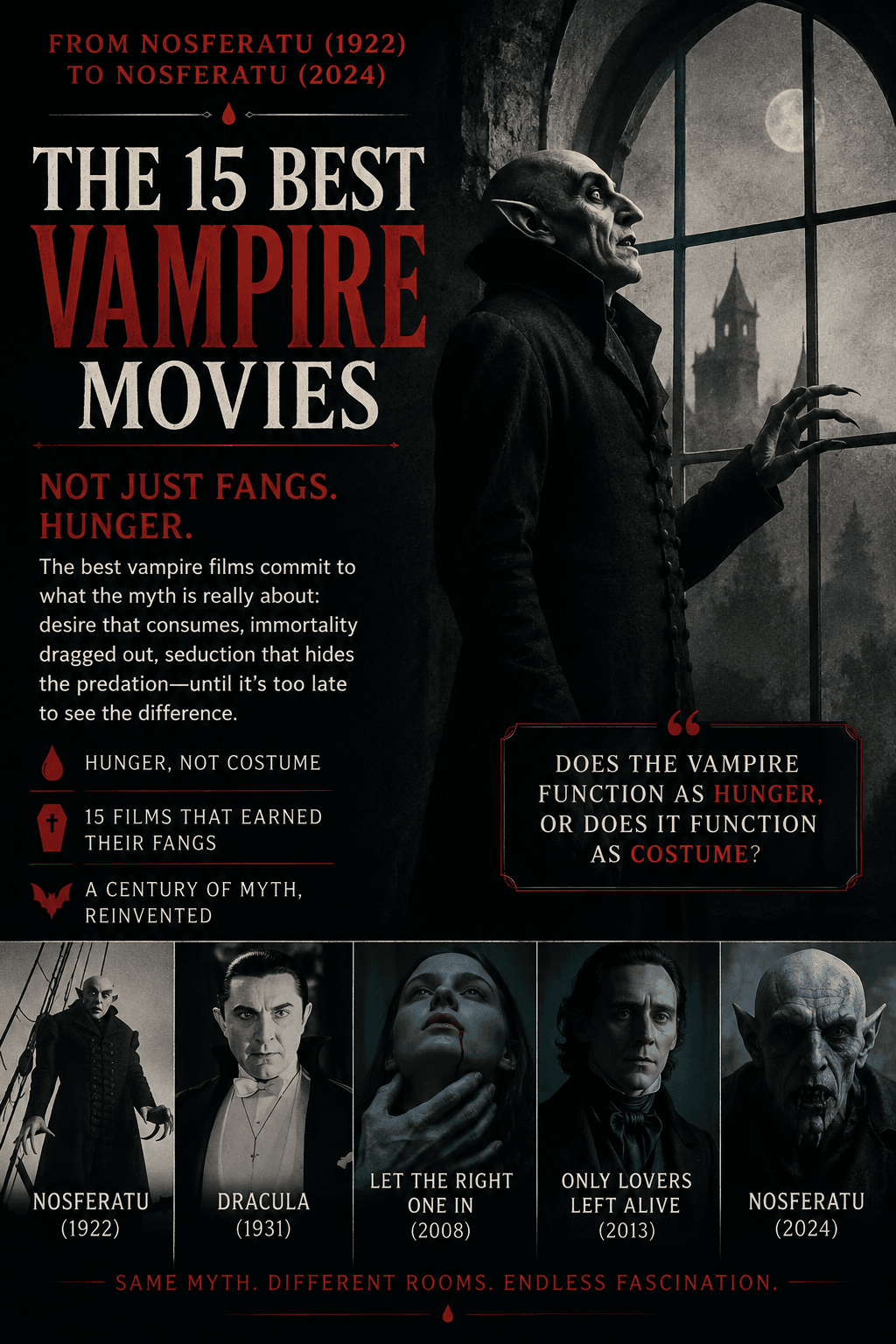
The best vampire movies commit to the vampire as hunger — desire that consumes the thing it wants, immortality dragged out to the length of an actual sentence being served, seduction indistinguishable from predation until it’s too late to tell the difference. Fifteen films earn that description below, running from Murnau’s 1922 original through Robert Eggers’ 2024 remake, and most vampire movies never even attempt it.
Most vampire movies are bad, and the ones that aren’t bad are usually bad in a more interesting direction. That’s a plain observation, and also an unpopular one to say out loud, because vampire cinema has spent a century running on the same four props — cape, fangs, castle, mirror that shows nothing — and audiences keep showing up anyway, the way you keep ordering the same mediocre dish at a restaurant because the good version exists somewhere and you’re hoping tonight is the night.
Every few years somebody remembers that the vampire is supposed to mean something and makes a film that actually earns its fangs. Most years, nobody remembers.
Here’s the test Ethan applies, and it’s a short one: does the vampire function as hunger, or does it function as costume. Hunger means the film has committed to what the myth is actually about — desire that consumes the thing it wants, immortality dragged out to the length of an actual sentence being served, seduction that’s indistinguishable from predation until it’s too late to tell the difference.
Costume means the film wants the cheekbones and the coat and none of the metaphor underneath, which is how you end up with ninety minutes of a good-looking person hissing at sunlight and nothing else happening. The films below split cleanly on that line, and the split explains almost everything about which ones people still watch and which ones got buried the year they came out.
Treat this as a map of the best vampire movies more than a countdown — fifteen films answering the same question, each in a different room, none of them actually competing with the others for a single top slot. Some of these will get the full treatment on this site eventually, scene by scene, ending explained, the details a first watch misses. This is the map before those pieces exist: which films earned their place in the genre’s spine, which ones got unfairly buried by timing or marketing, and which ones everyone remembers for the wrong reasons entirely.
The Best Vampire Movies Start With a Fork in the Road
Start at the fork in the road, because there’s a real one, and it happened almost simultaneously. F. W. Murnau’s Nosferatu premiered in Germany in March 1922 with Max Schreck as Count Orlok, and the production didn’t have the rights to Dracula — Bram Stoker’s widow Florence sued, won, and a court ordered every print destroyed. Several survived anyway, which is the only reason this conversation is possible. What matters more than the lawsuit is what Murnau actually built: a vampire as vermin, rat-toothed and rigid, arriving with plague literalized as his traveling companion.
Orlok functions as pure contamination, moving at the speed of a disease vector, which is exactly what he’s supposed to be. Murnau shot most of it as pure German Expressionist shadow-play — Orlok’s silhouette climbing a staircase became the single most reused image in horror history precisely because the shape alone carries the entire threat — Schreck’s actual face barely matters next to what his shadow does on that wall.
Then, nine years later, Tod Browning’s Dracula opened at Universal in February 1931 with Bela Lugosi in the role that ruined his career by perfecting it, and the fork opened. Browning — or really cinematographer Karl Freund, who functioned as the film’s uncredited director through most of a notoriously disorganized shoot — built the opposite vampire entirely: the charming nobleman, the cape reframed as pure seduction, the invitation into the bedroom standing in for the plague-ship pulling into the harbor. The seduction won first.
Lugosi’s $3,500 paycheck for seven weeks of work bought Universal the archetype every subsequent vampire film has been arguing with ever since, whether the filmmakers know it or not. Every vampire movie made after 1931 is downstream of one of these two films, and most of them don’t seem to know that’s true.
Two Directors Who Knew Exactly Which Side They Were On
Robert Eggers knew it, which is the whole reason his 2024 Nosferatu works as well as it does. He didn’t remake Browning’s seduction; he went back to Murnau’s plague and pushed it further than Murnau’s technology in 1922 could manage. Bill Skarsgård spent up to six hours a day in prosthetics and trained with an opera singer to build a voice using throat-singing technique, speaking reconstructed Dacian, a dead language, because Eggers wanted Orlok to sound like something that predates language itself — older than persuasion, older than any word doing seductive work. Ethan’s full review of Nosferatu (2024) walks through how far that commitment goes.
Lily-Rose Depp’s Ellen Hutter spends the film as something already claimed, closer to Murnau’s plague logic than to Browning’s bedroom-invitation logic, and the film’s 85% critical score and $182 million worldwide gross on a $50 million budget suggest audiences noticed the difference even if they couldn’t name it.
Francis Ford Coppola went the other direction entirely in 1992, and Bram Stoker’s Dracula is the fullest, most extravagant version of the seduction reading anyone has ever attempted. Gary Oldman’s Dracula is Vlad the Impaler reincarnated by grief, chasing Winona Ryder’s Mina across four centuries because he’s convinced she’s his dead wife reborn. It’s tragic romance grafted directly onto the predator, love story wearing the horror film like a disguise.
Coppola refused computer effects entirely, using rear projection, forced perspective, and matte paintings supervised by his son Roman to build every transformation in-camera, which gives the film a texture no CGI vampire movie since has matched. It made $215.9 million worldwide and won three Oscars, including Eiko Ishioka’s costume design, which did more world-building in fabric than most scripts manage in dialogue — Dracula’s blood-red armor reads as a wound wearing a man before he ever speaks a line.
The shadow that moves independently of Oldman’s body, detaching from him to strangle Keanu Reeves’ Jonathan Harker in his own castle, was built with a projector behind Oldman and a trained dancer standing off-camera, mirroring his movements in real time to cast the shadow itself. That’s how cinematographer Michael Ballhaus described the shot to American Cinematographer — achieved entirely in-camera, no postproduction compositing required.
Whether the tragic-romance reading is a legitimate interpretation of Stoker’s novel or a complete betrayal of it is a real argument, and Ethan comes down on the side of betrayal — the book’s Dracula is a predator, full stop, no dead wife required — but the film is gorgeous enough that he’ll have the argument anyway, gladly, every time someone brings it up.
The 1980s Answer the Question Three Different Ways
The mid-1980s gave the genre three vampire films in three years, and the way they got remembered has almost nothing to do with which one was actually better. The Lost Boys opened in July 1987 on the strength of Joel Schumacher’s decision to make vampirism look like a lifestyle brand — leather, motorcycles, a boardwalk full of teenagers who’d clearly rather be undead than bored — and it made $32.5 million against an $8.5 million budget despite Roger Ebert calling it “a triumph of style over substance,” which, correctly read, is what the film was going for.
Two months later, Kathryn Bigelow’s Near Dark opened on a fraction of the screens — 262 to 429 theaters against The Lost Boys’ 1,542 — and made $3.4 million against a $5 million budget, a genuine flop, buried by a studio-backed competitor that Bigelow later described as leaving her film “just this little whisper out there.” Near Dark is the better movie.
It’s a vampire film wearing a Western’s clothes, with a family of nomadic vampires who function like an outlaw gang, saddlebags and a stolen truck standing in for a castle, and Bill Paxton’s performance as the unhinged Severen does more genuine menace in individual scenes than anything in The Lost Boys attempts.
It sat at a financial loss for years before anyone caught up to it; it now holds an 81% approval rating, twenty years and a full critical rehabilitation later, which is the usual timeline for a film that was right the first time and unlucky about when it opened.
Tom Holland’s Fright Night, sandwiched between the two that August of 1985, went a third direction that neither of the others bothered with: a teenager who realizes his neighbor is a vampire and can’t get a single adult to believe him, which turns the vampire story into a story about the specific horror of being correct and powerless at the same time.
Chris Sarandon’s Jerry Dandridge is genuinely unsettling in a way “family vampire” movies rarely bother to be, and Roddy McDowall’s washed-up horror-host-turned-reluctant-vampire-hunter Peter Vincent gives the film its funniest and most self-aware element a full decade before self-awareness became the genre’s default setting. It made $24.9 million, became the second-highest-grossing horror film of that year, and holds up better than either of its more famous siblings, mostly because it never once tries to be cool about what it is.
The production couldn’t afford to be cool even if it wanted to — Sarandon’s transformation makeup took up to eight hours a session, and the era’s contact lens technology was hard plastic and hand-painted, capping wear time at twenty minutes before the discomfort became unusable. The film’s low-budget scrappiness ended up matching its premise: a teenager nobody believes, made by a crew working with almost nothing, and somehow it’s enough.
The Studio Vampire Learns to Suffer
Neil Jordan adapted Anne Rice’s novel in 1994 with Tom Cruise as Lestat and Brad Pitt as Louis, and the casting controversy — Rice herself publicly doubted Cruise before the film opened, then reversed course after seeing it — obscured what the film actually does well, which is treat immortality as depression with fangs. Louis spends the entire runtime narrating his own life as a burden he can’t put down. Cruise, playing against type, makes eternal life look like a curse he’s still enjoying.
Roger Ebert’s observation that the movie “never makes vampirism look like anything but an endless sadness” is the correct read on why the film still works at $224 million worldwide against a $60 million budget: it’s the studio version of the same argument Murnau made with a plague rat, stretched from one voyage to the length of a life.
The Best Vampire Movies Made Outside Hollywood
The strongest ground the genre has covered in the last two decades came from outside the American studio system entirely, and it’s not close. Tomas Alfredson’s Let the Right One In, adapted by John Ajvide Lindqvist from his own novel, sets a vampire story in a frozen Swedish suburb between a bullied twelve-year-old and the centuries-old child who moves in next door, and refuses every single opportunity to make that relationship comfortable or safe. Ethan’s full review of the film makes the colder case for why that restraint works better than its gentle reputation suggests.
Roger Ebert called it “the best modern vampire movie,” which undersells it — it’s one of the best modern horror films of any subgenre, earning its 98% Rotten Tomatoes score honestly, built on a fixed, patient camera that Alfredson uses to make stillness itself feel like a threat.
Park Chan-wook’s Thirst, released the following year, takes a Catholic priest, turns him into a vampire through a failed medical experiment, and grafts the whole story onto Zola’s Thérèse Raquin — guilt, desire, and murder braided so tightly you can’t isolate the horror element from the moral one, which won it the Jury Prize at Cannes and remains the most purely adult treatment of vampirism as appetite this list contains. It makes its vampire funny and repulsive and genuinely tragic inside the same scene, sometimes the same shot.
That jury was rewarding a director, Park Chan-wook, willing to trust an audience with three contradictory reactions running at once.
Ana Lily Amirpour’s A Girl Walks Home Alone at Night takes the same idea somewhere neither of those two goes. It’s a black-and-white, Farsi-language “Iranian vampire Western,” shot on a $56,903 Indiegogo budget in Taft, California, and its vampire functions as the film’s instrument of justice, stalking a fictional Iranian oil town’s predatory men with the unhurried patience of someone who has all the time in the world and intends to use it. None of these three films needed American vampire cinema’s usual toolkit — the aristocrat, the cape, the seduction — to make the hunger land.
They just needed a filmmaker willing to point it somewhere specific.
When the Vampire Loses Its Humanity on Purpose
David Slade’s 30 Days of Night, adapted from Steve Niles’ comic, tried something the rest of this list mostly avoids: vampires with no interiority at all, an invading horde that descends on an Alaskan town during its month of total winter darkness and behaves the way a natural disaster behaves — indifferent, total, without a face worth remembering. A month of night is a long time to be hunted.
It’s the most purely predatory film here, deliberately stripped of the seduction Browning invented and the tragedy Coppola built on top of it, and its 50% critical score reflects a real trade-off — you lose the metaphor’s depth when you remove the vampire’s humanity entirely, but you gain something closer to a pure creature feature, which is its own legitimate thing to be even when it isn’t the more ambitious choice.
What Immortality Costs When the Adventure Runs Out
At the opposite end sit two films where immortality has curdled into exhaustion. Jim Jarmusch’s Only Lovers Left Alive follows Tilda Swinton and Tom Hiddleston as centuries-old lovers so thoroughly bored by immortality that the film’s real subject is connoisseurship — music, books, blood sourced ethically through a hospital contact and sipped from crystal glasses. Its 86% critical score comes from viewers willing to accept a vampire film with almost no violence in it at all.
Neil Jordan returned to the genre in 2012 with Byzantium, splitting a mother-daughter vampire pair across two centuries of survival on the margins of respectable society. Its 65% score reflects a film whose atmosphere outpaces its plot, but Saoirse Ronan and Gemma Arterton still land the hunger question this list keeps returning to: what two hundred years of surviving as a woman with no legal standing actually costs, even when you can’t die from the toll. Moira Buffini’s screenplay, adapted from her own stage play “A Vampire Story,” builds an entire secret fraternity that reserves vampiric transformation for men only.
Arterton’s Clara took the gift by force, from a man it was meant for, then later turned her own dying daughter to save her, doubling the violation. Two centuries spent running from a brotherhood whose entire objection is that she wasn’t supposed to have this power in the first place.
The Comedy That Finally Understands the Assignment
Jemaine Clement and Taika Waititi’s What We Do in the Shadows closes this list because it’s the rare comedy that earns the right to mock everything above it — a mockumentary about vampire roommates in Wellington that only works because its writers clearly understand every convention this list has spent several thousand words taking seriously. It’s funny because it’s accurate.
Filmed on a $1.6 million budget partly raised through Kickstarter, it made back barely four times that at the box office and became something far more durable than a box-office hit: the funniest possible argument that the genre’s tropes have calcified enough to be worth laughing at, which is itself a kind of tribute. You can’t parody a myth this precisely without having understood, first, exactly what the myth was for.
What Separates the Best Vampire Movies From the Rest
Run the hunger-or-costume test back across all fifteen and the pattern holds almost everywhere: the best vampire movies on this list all committed hard to one specific idea of what the vampire means, and every film remembered mainly as a punchline picked the coat first and figured out the metaphor never. Even 30 Days of Night, the one real outlier, earns its place by refusing the metaphor on purpose, stripping the vampire down to pure appetite as a deliberate choice — a trade worth making, and a legitimate one.
That’s true of the studio-backed disappointments that never made this list as much as it’s true of the ones that did — the direct-to-streaming glut of the last fifteen years, the CGI-heavy franchise entries built entirely around a brand, the ones where you can tell from the trailer alone that nobody in the production ever once asked what the fangs were supposed to mean. None of those get named here individually, because naming them would be generous — they’re costume, and costume doesn’t reward close reading.
There are real, deliberate absences here — Twilight, whatever else it did, changed the commercial shape of the genre for a decade and deserves its own full reckoning somewhere else on this site; Blade turned the vampire into an action-franchise premise and is a different conversation about a different genre wearing vampire teeth. Both get their due elsewhere.
What’s here is the spine: the fork Murnau and Browning built without knowing they were building it, and every serious attempt since to answer the question they left open — whether the thing that wants you is a disease, a lover, a soldier, or a joke, and whether the film has the nerve to pick one and mean it. That disease reading isn’t only a metaphor — the real tuberculosis panics and misread decomposition science behind it get their own full accounting in The Real History of Vampires.
Most of the bad vampire movies never picked. They wanted the cape and the cheekbones and the box office that comes with both, and they got exactly what that costs: something that looks like hunger from a distance and turns out, on any real inspection, to be nothing.
Frequently Asked Questions About the Best Vampire Movies
What Are the Best Vampire Movies of All Time?
By that standard, the best vampire movies of all time include F.W. Murnau’s Nosferatu (1922), Tomas Alfredson’s Let the Right One In (2008), Francis Ford Coppola’s Bram Stoker’s Dracula (1992), and Robert Eggers’ 2024 Nosferatu remake — each commits fully to hunger as the vampire’s defining trait, with nothing left over for costume.
What Makes a Vampire Movie Actually Good?
The test is whether the vampire functions as hunger or as costume. Hunger means the film commits to desire that consumes, immortality dragged out to an unbearable length, seduction indistinguishable from predation. Costume means a good-looking actor in a cape, hissing at sunlight, with none of that metaphor underneath.