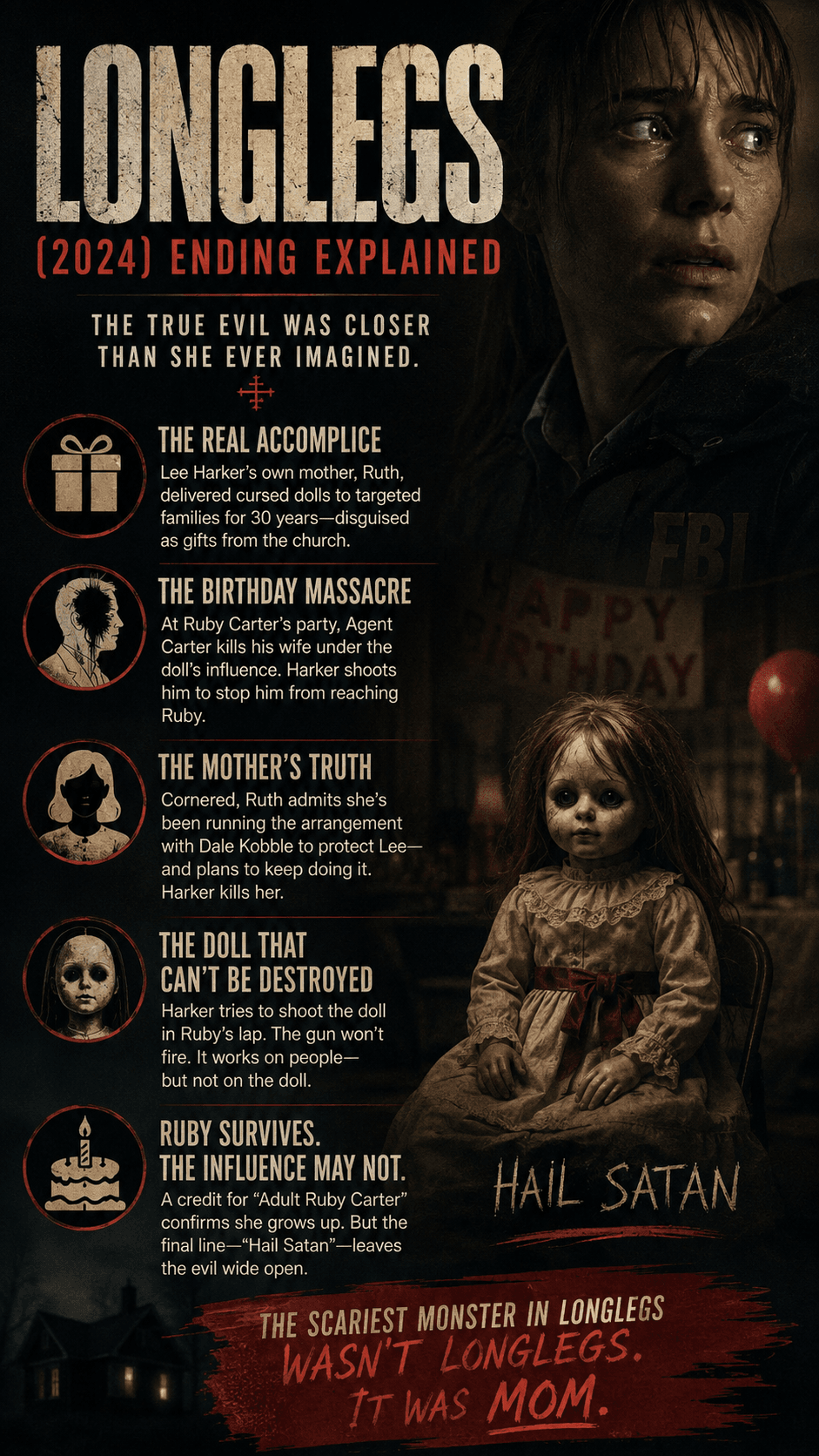
Longlegs (2024) ending explained in short: FBI Agent Lee Harker discovers that her own mother, Ruth Harker, has spent three decades as the real accomplice to serial killer Dale Kobble, delivering his cursed dolls to targeted families disguised as gifts from the church. At Ruby Carter’s birthday party, Agent Carter kills his wife Anna while under a doll’s influence. Harker shoots Carter, then shoots her mother, then tries and fails to destroy the doll sitting in Ruby’s lap — the gun simply will not fire on it. Ruby survives. Whether the doll’s influence does too is the question the film leaves open.
Dale Ferdinand Kobble smashes his own face into an interrogation table until he stops breathing, roughly two-thirds into the film, and it changes nothing that follows. The man with the pale doll-maker’s hands and the strange, flattened voice on the tape was a courier who got caught. Agent William Carter says as much out loud, standing in a hallway feeling good about himself: “He did it alone, with no accomplices! No black magic, no voodoo, no nothing!” He says this roughly forty minutes of screen time before it kills his wife.
The real ending of Osgood Perkins’ film happens at a nine-year-old’s birthday party, in a kitchen, arranged by a woman who has spent three decades being underestimated for precisely the reasons that let her keep doing it.
Longlegs (2024) Ending Explained: What Actually Happens
Harker shows up late to Ruby Carter’s birthday party and recognizes her own mother, Ruth, standing in the room as an invited guest. Ruth has delivered one of Kobble’s handmade dolls to the house — the same “gift from the church” routine she has run for every family on the killer’s list since 1974. In the kitchen, Agent Carter, compelled by the doll the same way every father before him was compelled, kills his wife Anna.
Harker shoots Carter to stop him from reaching Ruby. Her mother, cornered, tells her the truth in full: she has been running this arrangement the entire time, feeding it new families to protect Lee, and she intends to keep doing it. Harker kills her.
Then she turns the gun on the doll sitting in Ruby’s lap and pulls the trigger. Nothing happens. The gun works on Carter. It works on Ruth. It only refuses to fire on the doll. Ruby survives the day — a closing credit for “Adult Ruby Carter” confirms she grows up — but the film’s last line, spoken into the wreckage of that kitchen, is “Hail Satan,” and nobody on screen contradicts it.
The mother is the twist the film has been building toward since its first ten minutes, and the tragedy is how long she got to keep doing it. Nobody in an FBI field office runs a background check on a churchgoing widow who bakes and worries and asks her daughter if she’s still saying her prayers.
Ruth Harker’s Deal, Told as a Bedtime Story
Perkins hands you Ruth’s arrangement with Kobble as a storybook narration, spoken in a fairy-tale cadence over images: “Once upon a time, there was a girl named Lee. She lived in a little house with her mother, and no one ever came to visit them. No family. No big, bad wolves. No anyone.” Then a man arrives — “a doll maker” — with an early birthday gift. “The doll maker started his work, his terrible magic. The work of the Devil, with a little bit of him in every one. The doll made the little girl forget, and told her where to look, and what not to see.”
The Devil wanted the girl. Her mother could not let that happen. “So her mother begged for the little girl’s life to be spared. In exchange, she would have to help him.” A former nurse, repurposed: “Now her work would be murdering families.” Knock-knock-knock on the farmhouse door. A nice lady with a Bible. Congratulations, you’ve won a gift from the church. All she had to do was get it inside the house. All she had to do was watch.
This retroactively reorganizes everything the film showed in its first act. The 1974 police report Ruth filed about a “tall and pale” trespasser, one day before Lee’s ninth birthday, was a mother staging the one piece of paper that would let her daughter grow up still convinced her childhood home had been safe. Ruth Harker negotiated a deal with Longlegs that day rather than surviving an encounter with him, and she has been fulfilling her half of the contract on a schedule ever since — dressed as a nun, walking up driveways with a doll under her arm and a line about church raffles rehearsed to the point of boredom.
Lee spends most of the film treating that 1974 report as a loose thread worth tugging, the way any competent investigator would. She has no idea she is investigating her own house. When her boss finally asks her, gently, when she last spoke to her mother, the question plays like routine background-checking. It’s actually the film’s cruelest piece of dramatic irony: the answer to the entire case has been calling Lee on the telephone every few days, asking if she’s eating enough and still saying her prayers.
Why Dale Kobble’s Arrest Wasn’t the Ending
Long before the birthday party, the film tells you exactly what kind of story it is through a very small scene: Lee’s own psychological evaluation, an FBI Rorschach exercise where a recorded voice asks her to say the first word that comes to mind for a series of images — camera, table, legs, tiger, door, mother, father, piano — then to guess numbers between zero and a hundred. She beats the machine eight times and misses it eight times. “Half-psychic is better than not psychic at all,” her supervisor says, and treats her gift as a useful tool rather than a wound.
Nobody in that scene asks where the gift came from. That question doesn’t get answered until the very end, when the film reveals that Lee had one of Kobble’s dolls too, as a child, and that whatever it did to her is the actual source of the intuition the Bureau finds so convenient.
Perkins has said he modeled Kobble’s reveal on Kevin Spacey’s John Doe in Se7en — present for almost none of the runtime, the confrontation deliberately anticlimactic instead of cathartic. It works on Kobble twice over, because the film hands you a second, worse version of the same trick: even after he confesses on camera and identifies himself by his real name, catching him solves almost nothing.
According to reporting on the film, Kobble dies in custody shortly after that confession, by repeatedly smashing his own face into the interrogation table until his body gives out — a single detail I could only confirm through one outlet, so treat the specific method as reported rather than airtight. What’s confirmed directly in the film is simpler and worse: “So far, there’s no physical evidence that Kobble has ever killed anyone,” a senior agent admits, and he’s right. Kobble was never in any of those houses. He built the instrument and let each family’s own father swing it.
The last thing Kobble tells Harker through the interrogation glass is that he won’t only be in the room: “I’ll be a little bit of everywhere. Waiting, in the wings. In the father’s wings.” Carter treats the case as closed the moment the letters match Kobble’s handwriting. He is a competent, decent investigator, and he is catastrophically wrong, because the film has already given you Harker’s own profile of the real killer, spoken out loud and shrugged off in the same scene: someone “the families felt comfortable letting into their house. Someone they know, or have met before.” Nobody in the room stops to consider that this could describe a woman old enough to be somebody’s mother — not even the daughter sitting across the table from her boss.
It’s the same blind spot that runs through Get Out’s hidden details about the family that raised Chris’s captors: horror keeps discovering that the threat lived inside the house the whole time, on a first-name basis with everyone in it.
There is a second survivor buried in the middle of the film who makes the same point from a different angle: Carrie Anne Camera, the lone child who lived through an earlier Longlegs murder in the 1970s, found catatonic in a state hospital for eight years until Ruth pays her a visit. Carrie Anne wakes up talking in riddles about “the Man Down The Stairs” and dies jumping from the hospital roof the same day Ruth sees her. The FBI treats her as a lead. She was actually a loose end, and Ruth tied it off in an afternoon, in a public institution, without anyone clocking her as a threat. It is the birthday party in miniature, rehearsed weeks early on a much smaller stage, with a hospital orderly instead of an FBI task force standing a few feet away and noticing exactly as little.
Where the Dolls Came From
Perkins has said the dolls were inspired by a detail from the JonBenét Ramsey case he’d carried around for years: a life-sized replica doll of the murdered girl, dressed in one of her pageant outfits, found in a box in the basement fifteen feet from where she was killed. “There was something so insane about that,” he said, “I’d cataloged it away.” He paired that image with the logic of sympathetic magic — the old idea, straight out of Frazer’s The Golden Bough, that a likeness carries a hold over the person it resembles — and built Kobble into a craftsman who hand-sews porcelain-headed effigies of the daughters he targets, stuffed with cotton and human hair.
Inside the skull of each one sits a hollow metal orb that Perkins has described as producing a strange sonic frequency. The film’s own forensics examiner holds one up to his ear during autopsy, calling it “the brain” out of nowhere, admitting there’s nothing inside it he can explain. The dolls function less like pin-and-poppet voodoo props and more like delivery mechanisms — built to look like a compliment, a gift, a kindness done to a nine-year-old on the week of her birthday. The film reveals, almost as an aside, that Lee had one too, as a child, and that the hole in her memory of 1974 is shaped exactly like whatever that doll made her forget.
Nicolas Cage has described his own role in the film as playing a kind of possessed Geppetto — a craftsman whose devotion to his work has curdled into something that makes things instead of people. It’s the right frame for the performance, which spends most of its screen time as voice and silhouette rather than face, present in the film mostly as an absence with a return address. Kobble is the character everyone remembers walking out of the theater. He is also, by the film’s own accounting, the least dangerous person in it — a man who never crossed a single victim’s threshold in his life.
The Soundtrack Was Warning You
Three T. Rex songs run through the film, and none of them are there for retro texture. “Get It On (Bang a Gong)” opens the movie against a wash of red and returns over the end credits — a song about a monster, a hydra, dressed up as glam-rock horniness, sitting right next to the film’s Revelation passage about a beast with seven heads. “Jewel” plays immediately after the title card. “Planet Queen,” full of lyrics about abduction, plays in Kobble’s car on a supply run for sewing thread, while he’s actively en route to build another doll. Perkins has described the effect as “a weird synergetic thing” — glam rock and demonic poetry sharing the same chord.
None of that music belongs to Ruth. It belongs to Kobble, a failed musician turned devil-worshipping craftsman, and its glamour is the point: the film gives its literal villain a killer soundtrack and its actual villain a church bake sale. One of them gets a rock song. The other gets a casserole dish and an alibi nobody thinks to check.
The Gun That Won’t Fire
This is the detail every recap fixates on, and it earns it. Harker’s revolver kills her mother without hesitation. It kills Carter without hesitation. She points it at the doll sitting in a nine-year-old’s lap — the one object in the film confirmed to be actively working, right now, on a living child — and the gun clicks on a chamber that was not empty a minute earlier.
Perkins has been direct about what he intended this to mean: “The last shot that she fires is the worst thing that can happen to her.” Maika Monroe has put it even more plainly: “Evil isn’t going anywhere. That’s just the reality. There really is no end.” Read that against the film’s own numerology, and the moment gets bleaker rather than more mystical — Perkins has also waved off the triangles and birthdate patterns as plot mechanics more than sacred geometry, which means the gun jamming works simply as the film declining, at the exact moment the audience is braced for a clean exorcism, to hand one over. Ruby gets pulled out of that kitchen alive. Nothing in the film promises the doll in her lap stopped working on the drive home.
What Happens to Ruby
The closing credits list an actress under “Adult Ruby Carter,” which is the closest thing this Longlegs (2024) ending explained can offer to good news: whatever happened after the last scene, Ruby lives long enough to become a woman with her own credited role in someone’s memory of that day. It’s a small mercy, handed out sideways, in a font, after the lights should already be up — the kind of detail a viewer has to go looking for, buried past the point where most people have already stood up to leave the theater. Nothing on screen confirms the doll in her lap ever stopped humming.
The Real Horror Was Never Satanic
The Devil barely bothers to show up in his own movie. He amounts to a voice on a tape, a handwriting sample, a passage from Revelation about a beast with seven heads and ten horns that an FBI agent mangles into “Revelations” and gets corrected on the spot. Every bit of that theology is décor. What actually earns the cold fury is that an entire investigative machinery — FBI agents, a trained profiler, forensic examiners, a daughter who is herself a federal investigator — spent decades looking directly at Ruth Harker and saw a woman who bakes, who prays, who calls to ask if her daughter is still saying her prayers.
“Our prayers protect us from the Devil,” she tells Lee on the phone, early, when the line still plays as harmless superstition. By the film’s last act it plays as a confession delivered in the one register this genre almost never bothers to interrogate: maternal concern. I’ll admit the reading tempts you to over-explain the film’s every symbol as deliberate design — Perkins himself has pushed back on that impulse, insisting some of the number patterns are closer to plot scaffolding than scripture. But the maternal-concern reading is the plainest one available for a woman who spends the entire runtime being visibly, boringly harmless.
Ruth is dangerous with nothing but a kitchen and a captive audience. She stands there and explains, with total sincerity, that murdering three people in front of her daughter was an act of love. “I’m doing this for you,” she tells Lee, “just like I’ve always done.” Every parent who has ever done something unforgivable and called it protection has already rehearsed a version of that sentence. Ruth Harker just happens to be the one who means it literally, and who has the body count to prove it.
Kobble at least advertised what he was. He signed his letters. He called himself a name meant to be found and feared. Ruth spent thirty years making sure nobody had a reason to look at her twice, which took more discipline than anything Kobble ever managed from inside a farmhouse basement. It’s the same trick Guy Woodhouse pulls off in Rosemary’s Baby — the film’s real accomplishment is making you sit with how completely that discipline resembles an ordinary devoted mother, right up until the moment the resemblance stops holding.
The Devil in this film was never especially interested in ruling the world. He only ever wanted one house at a time — one bright, white, immaculate house, and a woman standing in the doorway with a Bible, telling a family congratulations, you’ve won.
Frequently Asked Questions
Longlegs (2024) Ending Explained: Does Lee Stop the Killings for Good?
No. That’s the core of any honest Longlegs (2024) ending explained: Lee kills both her mother and Agent Carter, but her gun fails specifically when she aims it at the doll still in Ruby’s lap. Director Oz Perkins and star Maika Monroe have both described the ending as deliberately unresolved rather than a clean victory over the doll’s influence.
Who is the real villain in Longlegs?
Dale Kobble builds the cursed dolls and writes the letters, but he never enters any of the houses where the murders happen. The film’s actual antagonist is Ruth Harker, Lee’s mother, who has delivered the dolls to targeted families for three decades in exchange for her own daughter’s life being spared.
What happens to Ruby Carter at the end of Longlegs?
Ruby survives the birthday party where her mother is killed by her own father under the doll’s influence. The closing credits list an actress as “Adult Ruby Carter,” confirming she grows up, though the film never confirms whether the doll’s influence over her was actually broken.
Why doesn’t Lee’s gun fire at the doll?
Lee’s revolver works normally when she shoots Carter and her mother, then jams the instant she aims it at the doll in Ruby’s lap. Perkins has described this as intentional — the film’s way of denying the audience a clean resolution rather than a literal prop malfunction.
Full cast, crew, and production details for the film are on Longlegs’ IMDb page.