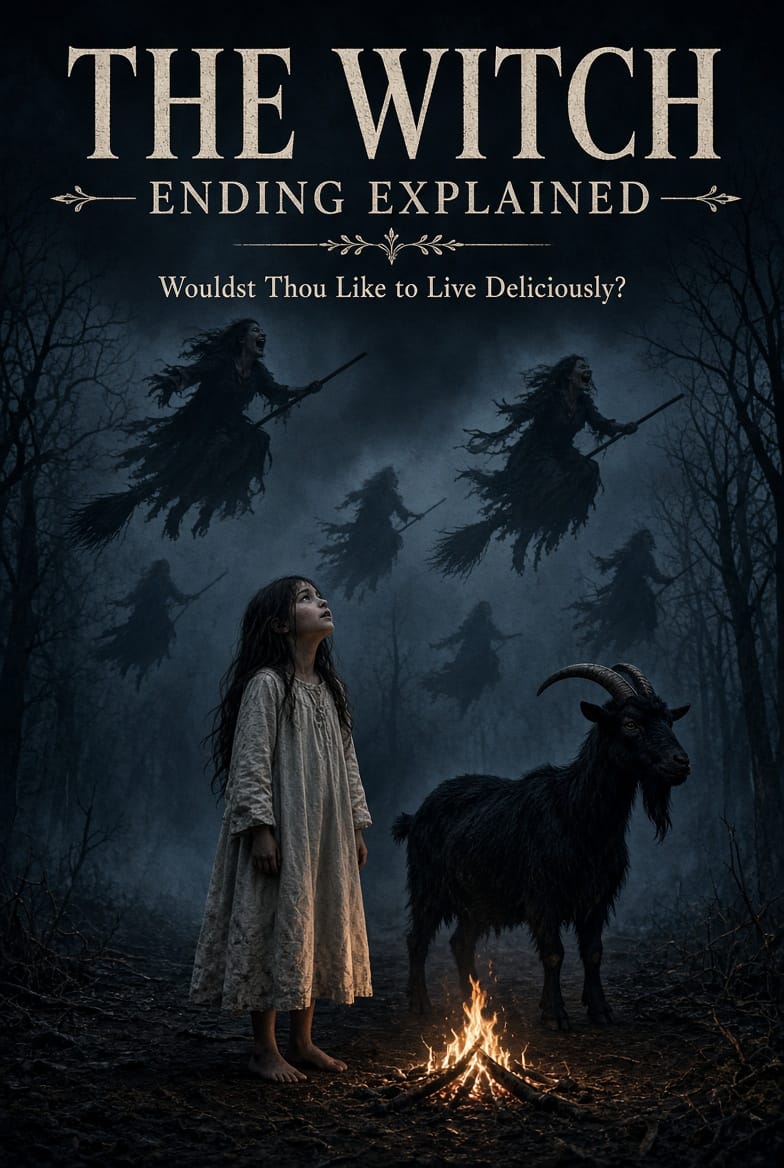
The Witch (2015) ending explained starts with two deaths in a single night: William killed by Black Phillip, and Katherine killed by Thomasin’s own hand, leaving her alone to decide what happens next.
The Witch (2015), directed by Robert Eggers, ends with Thomasin killing her mother in self-defense, signing her name in Black Phillip’s book after the Devil offers her butter, a dress, and the chance to “live deliciously,” then walking naked into the wood to join a coven of witches who rise into the air laughing.
This Witch (2015) ending explained walks through why every step of that sequence is more deliberate, and more historically grounded, than it looks on a first watch.
There is a moment near the very end of the film where Thomasin, alone in a farmhouse with two corpses she cannot look at, walks out into the dark and asks a goat a question. Not screams at it, not curses it the way her mother did in the film’s last coherent sentence to her. Asks it. “I conjure thee to speak,” she says, and then waits, and gets nothing, and asks again. It is the first time in the entire film that anyone actually invites the thing they’ve spent ninety minutes fearing to come closer.
What Kills William at the End of The Witch (2015)
Start with what kills William, because it’s easy to remember it wrong. He does not go looking for a fight with evil in the abstract. He goes looking for two missing children, finds the goat shed torn open and the nanny goats dead, and picks up an axe with the specific, human intention of killing the one animal on the property that’s been acting strangely.
He chases Black Phillip, misses him once, gets knocked down, gets up, and manages to slice the goat’s shoulder before Black Phillip rams him backward into his own woodpile hard enough that the horns go through his stomach and out his back, and the logs finish the job by burying him.
It plays as an accident born of rage as much as a supernatural execution — a man swinging an axe at a farm animal in the dark, missing his footing, and dying under his own firewood. The film never clarifies which reading is correct, and it’s worth sitting with the fact that it doesn’t need to.
William dies, in the end, at the hands of the one creature on the farm he never once suspected — a man who spent the whole film watching his family for signs of witchcraft in his daughter, killed by his own son’s favorite goat while chasing it with an axe he grabbed in a panic.
There’s a kind of grim symmetry in that: the accusations in this house were always aimed downward, at the children, at the women, never at the quiet, patient animal the twins had been talking to the entire time. William’s death is the film’s one moment of dramatic irony delivered without a hint of satisfaction — nobody watching is meant to feel vindicated that he finally guessed wrong about where the danger was.
Why Katherine Turns on Thomasin
Thomasin finds him and kneels beside him, and this is where Katherine arrives — the film’s actual climax begins here, in the argument that follows, long before the levitation everyone remembers. Katherine has, by this point, lost Samuel, Caleb, Jonas, and Mercy, and now finds her husband dead with her surviving daughter crouched over the body covered in blood that isn’t entirely hers. What she says next is a woman assembling the only story that lets four disappearances and a death make sense at once, evidence be damned, and Thomasin happens to be standing in the middle of it.
“You have their blood upon thy hands,” Katherine tells her, and then, escalating without pause, accuses her of bewitching Caleb, of seducing him with “sluttish looks,” of taking everyone. It’s the sound of a woman’s grief converting itself into the only vocabulary her world has given her for catastrophe this size, and the vocabulary happens to be witchcraft.
The Sin Every Family Member Was Hiding
It’s worth pausing on how carefully the film built toward this exact accusation landing on Thomasin specifically, because the pattern underneath it is easy to miss on a single watch. Every member of this family spends the story privately guilty of something and publicly convinced the sin belongs to someone else. Katherine watches her daughter’s body bloom into womanhood with something closer to envy than concern. William trades away his wife’s inherited cup in secret and lets Thomasin absorb the blame for months rather than confess.
Caleb, in his own quiet and unexamined way, looks at his sister’s changing body with an attention that unsettles even him. The twins, indulged and unsupervised, spend their idle hours inventing cruelty and calling it play.
Thomasin is the one member of this family introduced in the film’s opening minutes on her knees, begging forgiveness for a faith she fears is wavering — the only person in the household who ever examines her own conduct at all. She becomes the witch because she is the only one left standing once everyone else has finished laundering their own guilt through her — the family’s most examined conscience, punished as though she were its least.
The fight that follows is close and ugly and entirely physical, two exhausted, starving people who have not eaten properly in weeks, fought hand to hand with nothing supernatural in the room but the accusation itself. Katherine slaps her, pins her against the house, and starts to strangle her.
Thomasin’s hand finds a rusty billhook by instinct rather than intention. She hacks at her mother twice, in what the screenplay stages as something closer to a survival reflex than an act of will, and then sits with the body until it stops being warm.
The quiet mournful sound she makes afterward, and the way she holds her mother’s corpse before letting it go, is the last entirely human moment left in the film. Everything past this point moves at a different speed, in a different register, as though the story itself has decided the ordinary rules no longer apply now that there’s no family left to enforce them.
She sleeps. That’s easy to skip past, but it matters: whatever happens next doesn’t happen in a fever, in shock, in the same breathless minutes as the killing. She wakes hours later, alone in a dark house, watches a door swing open and shut in the wind until it seems to be asking her something, and walks out to the goat shed with a lit taper, barefoot, in only her shift.
Nothing forces this. Nobody is chasing her. She goes because she has decided to go, and the film is careful to give her that agency rather than stage it as a trance or a possession she stumbles into.
What Black Phillip Offers Her: “Wouldst Thou Like to Live Deliciously”
The conversation with Black Phillip is the strangest scene in the film precisely because of how ordinary it sounds. He doesn’t announce himself, doesn’t perform menace.
He asks her, in a voice the camera never lets us attach to a face, what she wants — and then offers her, one at a time, the taste of butter, a pretty dress, the chance to live deliciously, the chance to see the world.
Robert Eggers has said in interviews that this list wasn’t invented for shock value; it’s built from things people who actually confessed to witchcraft in the historical record said they’d wished for — small physical pleasures and freedoms of movement that a household run on Puritan denial had made unavailable to a teenage girl with no dowry and no path forward.
“Wouldst thou like to live deliciously” reads as an offer of food, clothing, and the ability to leave a specific starving farm, dressed in the language of temptation and made to someone who has just buried what’s left of her family with her own hands.
Eggers has said the temptation list wasn’t the film’s first draft. Early test audiences found it arbitrary, and he went back to the historical record to replace it with things the Devil was actually recorded offering people. In a 2019 conversation with the historian David D. Hall published alongside the film’s screenplay, Eggers pointed to a boy during the Salem trials who said Satan had offered him a pair of shoes, and to a servant named Elizabeth Knapp who claimed the Devil had offered to do one of her chores.
Butter and a pretty dress sit in exactly that register: specific, humiliatingly small comforts a poor teenage girl in this world would have actually wanted and never been allowed to ask for out loud, closer to the scale of an actual documented confession than to grand cosmic bribery.
The Historical Roots of the Devil’s Book — and Black Phillip’s Name
The book itself, and the demand that she sign it, is also drawn from documented history rather than invented for the film. The “Devil’s Book” is one of the most consistent details across surviving seventeenth-century witchcraft confessions on both sides of the Atlantic — a physical register the Devil supposedly carried from village to village, collecting signatures the way any earthly contract collects them, and the detail recurs so often across independent trial records that historians treat it as one of the folklore’s stable, load-bearing images rather than a regional variation.
Even Black Phillip’s name fits into that same documented pattern: goats and other animal familiars appear constantly in the confessions and accusations that survive from this period, described by the accused themselves as the shape the Devil chose to wear when he came to talk business. Eggers didn’t need to invent any of this. He needed to select it.
She says yes to all of it, and then admits she can’t write her name — she’s illiterate, like most teenage girls in her position would have been — and Black Phillip answers “I will guide thy hand,” which is either the most tender line in the entire film or the most sinister, depending on how much weight a viewer wants to put on the word guide. It’s worth noticing that even her surrender isn’t fully her own hand on the page.
Something else moves through her one more time before the choice is complete, the same way something has arguably been moving through this family’s decisions since the opening banishment. The screen goes black on that line.
What happens in the dark is never shown, and the choice not to show it is doing real work: everything up to this point in the film has been staged in unglamorous, unromantic physical terms — blood, mud, dead animals, exhausted bodies — and the one moment the film chooses not to picture is the moment of the actual bargain. It’s the one ellipsis in a film otherwise committed to showing everything plainly.
The Coven and the Levitation, Explained
What comes after the cut is the image most people remember: Thomasin, naked, riding Black Phillip — a goat again, not the man his voice implied — into the wood at night, broomsticks clicking through the branches overhead. She arrives at a clearing where a coven of women, young and old, filthy and half-clothed, dance around a fire in a state the screenplay describes bluntly as depraved and bestial.
They see her arrive and welcome her on sight, with no ritual demanded and nothing she has to prove, and she joins the circle already laughing. As the laughter builds, the witches begin to rise off the ground on their poles and brooms, and then Thomasin rises with them, higher and higher, crying while she laughs, in what the script calls, without qualification, pure ecstasy. That’s the image the film ends on. No dialogue after it. No return to the farmhouse. Just a girl ascending, laughing, and the screen going black on her mid-air.
Is the Ending Real, or All in Thomasin’s Head?
The film is unusually literal about what happened, more literal than most horror endings ever bother to be, which makes the honest open question a different one: whether any of it was ever meant to be read as metaphor. On that point Eggers has been fairly direct. He’s said that in the world he built the film around, “the real world and the fairytale world were the same thing,” and that treating the witchcraft as anything other than a literal, physically real threat would have been a betrayal of the seventeenth-century worldview he spent years researching.
That’s consistent with the note that opens his own screenplay, which states outright that the family’s folkloric and religious beliefs are meant to be true within the story. Thomasin isn’t hallucinating a levitation brought on by trauma and starvation. Within the rules this film has set for itself, she’s actually flying.
The psychological reading survives that anyway, just as an answer to a different question than the one the film is actually asking. A person can accept that the coven and the levitation are meant to be literal and still notice that everything about how Thomasin arrives there is explicable in entirely human terms: a girl who has been slapped, blamed, undressed by implication, controlled, and finally orphaned by her own hand, walking toward the one place left that offers her food, clothing, movement, and an audience that welcomes her.
The film treats “this is supernatural” and “this is what unbearable grief and hunger do to a seventeen-year-old with nowhere left to go” as compatible readings rather than competing ones. Whatever the coven actually is, it is also, unmistakably, the first group of people in the entire film who look at Thomasin like she belongs somewhere.
There’s a version of this ending that plays as straightforward horror — girl loses everyone, sells her soul, dances with monsters — and there’s a version that plays as something closer to release, and the film’s most uncomfortable achievement is refusing to fully commit to either one. Eggers has talked about the witch archetype as a projection of men’s fear of female power in the historical record, and, just as pointedly, of women’s fear of their own bodies and futures inside a world that offered them almost no room to want anything for themselves.
Thomasin spends the entire film being accused of wanting things — attention, freedom, her brother’s affection, her own body — long before she does anything to earn the accusation. By the time she actually says yes to Black Phillip, the film has spent ninety minutes building the case that there was never really another direction for that yes to come from. Whether her final laughter is a girl finally getting what was taken from her, or a girl too destroyed to recognize what she’s traded it for, is a question the film asks and then declines to answer for you.
Who — or What — Is Black Phillip, Really?
Black Phillip himself gets the same treatment. He is never called the Devil onscreen. Nothing in the dialogue confirms it outright. But the shape he takes in the dark — gauntlets, spurs, sable hair, a gentleman’s silhouette glimpsed rather than shown — draws directly on centuries of folklore about the “Man in Black” who meets witches at the edge of the wood, and Eggers has said plainly that he wanted goats specifically because of how thoroughly they’re embedded in witch mythology.
They were useful animals 17th-century colonists actually needed and, conveniently, an animal already coded as demonic long before this film cast one. Whatever he is, he was always more patient than anyone in the family. He waited through an entire ruined harvest, four disappearances, and two deaths before he ever had to say a word.
It’s worth noticing what Black Phillip does and doesn’t do across the whole film, because the pattern only becomes visible in hindsight. He never directly harms anyone with his own body until the very end, when he kills William. Every death and disappearance before that is committed at a remove — a hag in the wood, a raven, an unseen hand in a cradle — while Black Phillip himself spends the film simply present, watching, occasionally whispered to by the twins in scenes the adults dismiss as childish invention.
The patience reads differently once the ending recontextualizes it. He spends the film waiting for an invitation, the same patience he shows in the goat shed, where he waits for Thomasin’s actual spoken words rather than simply appearing to claim her. Consent, or the appearance of it, seems to matter to whatever he is, which makes the family’s slow self-destruction less like a siege and more like a long, unbearably patient courtship.
The Witch (2015) Ending Explained: What It All Means
What lingers longest, oddly, is a small human detail underneath the levitation: a girl who can’t write her own name, agreeing to something she doesn’t fully understand, guided by a hand that isn’t hers. That detail belongs to the signature in the book, and it arguably belongs to almost every major decision this family makes across the whole film — decisions made under duress, under starvation, under a theology that left almost no room for a person to simply want something without it being evidence of sin.
This is a family that spent two hours accusing its most devout member of a crime everyone else in the house was quietly guilty of, and the ending simply completes the sentence they’d already written for her. Audiences and critics have never fully settled on which of those readings the film wants. Some have written about the final image as a genuine liberation, a girl finally handed the freedom and appetite her family spent the whole story punishing her for wanting.
Others describe the same image as the saddest thing in the film, a teenager so thoroughly failed by every person meant to protect her that damnation reads as the only door anyone ever actually held open for her. Both readings are usually argued with real conviction, and both are drawing on exactly the same forty seconds of footage. That split reading is the most honest thing about the ending — a film built entirely around a family’s inability to agree on what anything meant closes, fittingly, on an image nobody watching it can fully agree on either.
Becoming the thing you were falsely accused of being is its own particular kind of ending — something closer to a debt finally called in than to any clean triumph. Thomasin ascends laughing and free in a way nobody in this story has been allowed to look for nearly two hours. Whether that reads as an ending or as a different, better-lit kind of guidance is the part the film leaves for the ride home.
For the craft decisions and historical research behind the rest of the film, the site’s Historical Accuracy piece and Review cover that ground; for the smaller Easter eggs, the hidden details catalog is the place to look.
The Witch (2015) Ending Explained: Frequently Asked Questions
The Witch (2015) Ending Explained in One Paragraph
After William is killed by Black Phillip and Katherine dies in a struggle with Thomasin, Thomasin is left alone. She conjures Black Phillip, who offers her butter, a dress, and the chance to “live deliciously.” She agrees, signs his book with his guidance, and joins a coven of witches in the wood, rising into the air with them as she laughs.
Is Black Phillip the Devil in The Witch (2015)?
The film never states this outright in dialogue, but the figure Black Phillip becomes in the dark — described in gauntlets, spurs, and a gentleman’s silhouette — draws directly on historical “Man in Black” folklore about how the Devil appeared to accused witches, and goats themselves recur constantly as demonic familiars in surviving trial records.
Why Does Thomasin Kill Her Mother in The Witch (2015)?
Katherine attacks and tries to strangle Thomasin after finding William dead and blaming her daughter for the family’s disappearances. Thomasin grabs a billhook by instinct while trying to free herself, and the screenplay stages the killing as a survival reflex rather than a deliberate act.
Is the Devil’s Book in The Witch (2015) Based on Real History?
Yes. The “Devil’s Book,” a register supposedly used to collect witches’ signatures, is one of the most consistent details across surviving seventeenth-century witchcraft confessions, and Robert Eggers has said the specific temptations Black Phillip offers were drawn from documented cases, including a Salem-era boy who said Satan offered him shoes.