This is a Talk to Me (2023) hidden details catalog, and it starts with an ice cream truck instead of the film. Bear with it.
When I was eight, there was an ice cream truck that came down my street in Ohio every afternoon, same bell, same rhythm — three rings, a pause, three rings again. Kids came running from every yard within earshot. Nobody thought about it as a summons. It felt like our idea, every single time, the exact second we heard it.
It took me another three decades to work out what should have been obvious at the time: that man knew exactly which streets had traffic and which didn’t, which mothers let their kids out with change in their pockets and which didn’t, what time each of us would be within running distance of a truck we couldn’t see yet.
He had a map of that street more detailed than any of us could have drawn ourselves, and none of us ever clocked that the choice to run for the curb had already been made for us before we heard the first ring.
Talk to Me runs the same trick, except the map isn’t drawn from a season of watching kids play outside. It’s drawn from grief, and it’s redrawn instantly, for whoever’s holding the hand.
Most of the coverage on this film has already done the job of explaining what happens to Mia and why the ending lands as inevitable rather than as a twist. That ground is covered.
What’s less covered — what actually rewards a second and third pass, pausing and re-running scenes most people watch once at normal speed — is the machinery underneath it: what the Philippou brothers built into the opening oner that almost nobody catches on a first watch, the sequence they shot and then buried on purpose, the pattern the entities repeat every single time they get inside someone, and the small continuity choices that only mean something once you already know how the film ends.
Consider this the spoiler line: if you haven’t seen the film, everything past this paragraph gives it away completely.
Talk to Me Hidden Details: The Opening Oner Has the Entire Main Cast Hiding in It
The film’s cold open — Duckett mid-breakdown at a party, his brother Cole trying to talk him down before the stabbing — plays as a single unbroken shot, and it’s the sequence directors Danny and Michael Philippou have specifically pointed people back toward when asked what they’d hidden in the finished film. Michael Philippou confirmed in a 2023 interview with Collider that he personally appears in that opening sequence, positioned near the doorway just before the camera pushes inside the house. He isn’t the only one.
Danny Philippou went further: every principal cast member is somewhere in that opening scene, and all of them are dressed as different characters than the ones they play for the rest of the film. It’s a deliberate bit of misdirection built for repeat viewing — the entire ensemble hiding in plain sight, in a party scene that exists specifically to establish a stranger nobody in the story will meet again, so that almost nobody watching once has any reason to go looking for familiar faces in a crowd that’s supposed to be full of strangers.
It’s a small thing, and the Philippous clearly built it to be found rather than simply discovered by accident — Joe Bird, who plays Riley, posted a photo on Instagram that same year confirming the cast’s disguised looks from the scene. But it’s also a quiet thesis statement for the whole film before the plot has technically started: everyone here is already present, already implicated, before the story admits it needs them.
The Kangaroo Is the Whole Film, Twenty Minutes Early
The detail that actually stopped me, on a rewatch, sits in the drive home before any of the party scenes even start.
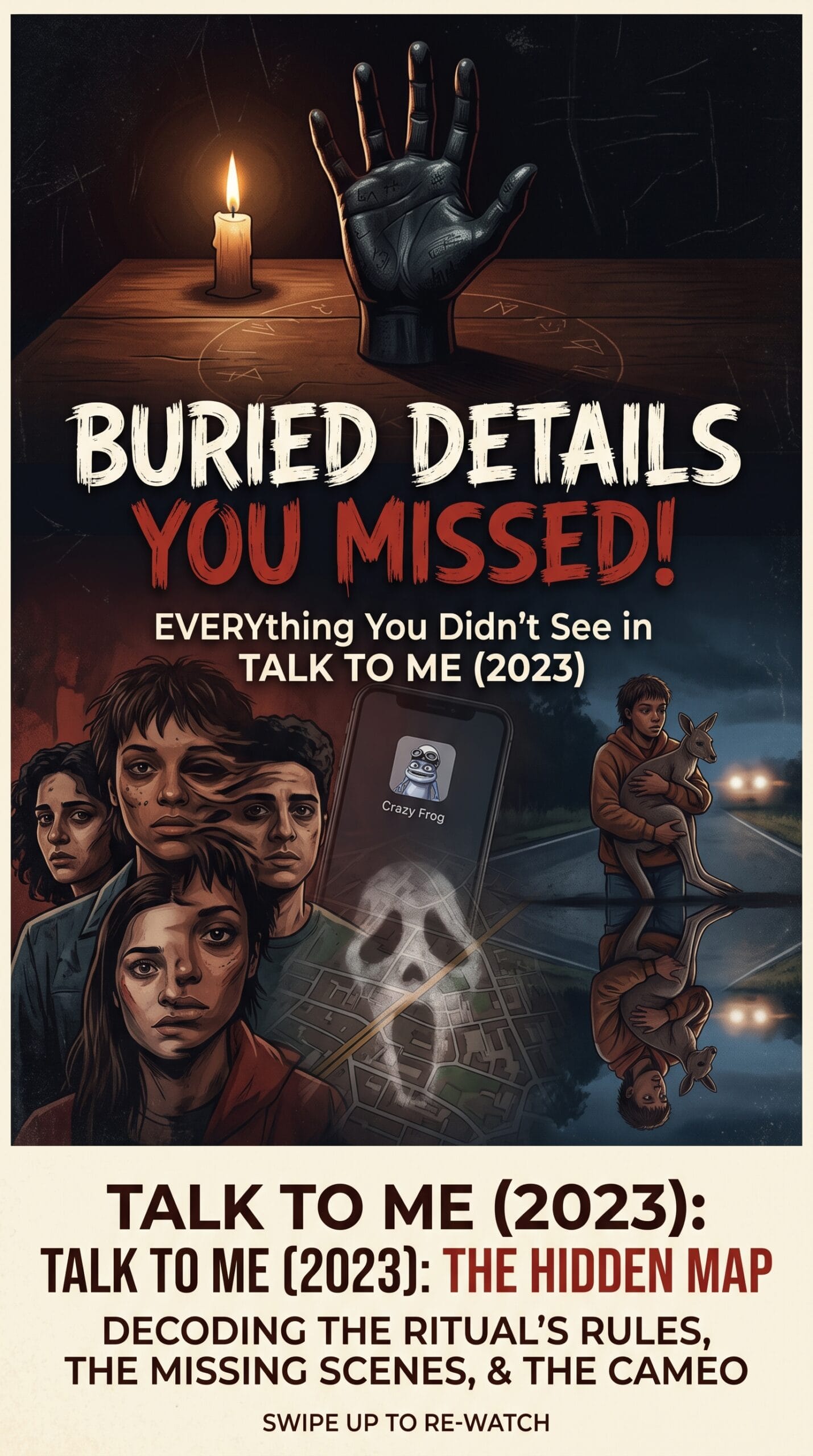
Mia and Riley find a kangaroo dying on the side of the road — hit by a car, still alive, in visible pain. Riley asks the obvious question: what do we do? Mia’s answer isn’t sentimental. “That’s not gonna help, Riley. I mean, look at it.” Riley pushes: “We can’t just leave it like that.” He asks her, directly, to put it out of its misery. She does. The car does the rest, off-screen, tires screeching, and the two of them drive away having made a decision neither one talks about again for the rest of the film.
That scene functions as the film’s climax, rehearsed in miniature, with the roles reversed. By the end, it’s Mia standing over someone she loves who is suffering beyond any rule the group understands how to fix, being told — this time by a voice wearing her dead mother’s affect — that the only mercy left is to end it herself. “You have to put him out of his misery,” the entity tells her, about Riley, in language close enough to Riley’s own words about the kangaroo that it can’t be coincidence.
Nobody in either published piece on this site has connected those two scenes, and the film never underlines the parallel either — no cutback, no dialogue callback, nothing that tells you to notice. It’s simply sitting there, twenty minutes apart, asking the same question of two different people, and answered the same way both times: yes, this is mercy, right up until the audience realizes mercy was never actually the operating logic in either scene.
The kangaroo really was suffering; Riley is a fourteen-year-old boy on the other end of a manipulation dressed up as that same mercy. The film lets you feel the wrongness of applying the first frame to the second without ever spelling it out.
Every Spirit in This Film Wears a Face Somebody Already Trusts
Here’s the pattern that runs under nearly every possession in Talk to Me, and it’s the one the film plants earliest and cashes in latest.
The cold open gives it away first, if you’re watching for it after the fact. Duckett, mid-possession, tells Cole: “Pop said you’re gonna hurt a lot of people.” Cole’s answer is immediate and exhausted: “Pop’s dead, Duckett. You’re not him.” That’s the entire mechanism of this film, delivered in the first ninety seconds, before the title card, before anyone’s explained what the hand even is. Whatever gets into these people arrives already wearing the specific dead person each victim is least equipped to say no to — never a generic monster, always somebody’s actual grief.
It happens again with Daniel, alone with an entity wearing Mia’s face and voice well enough that he doesn’t question it until he’s already been violated by it — “she was sucking your foot,” Mia tells him afterward, horrified, and Daniel’s own confusion (“I woke up and Mia was… sucking my feet”) only makes sense once you clock that the thing wearing Mia’s face knew exactly which version of Mia would get past Daniel’s guard.
It happens a third time, more devastatingly, when the group tries to reach Riley and instead gets something speaking as Mia’s mother, warm and convincing right up until it breaks into that stuttering “got, got, got, got” loop — a detail worth sitting with on its own, because that glitch always shows up at the exact moment the entity is closest to being caught.
It happens a fourth time at the very end, when Mia’s own father is banging on a door and the voice beside her, still wearing her mother’s warmth, tells her calmly: “That’s not your dad. They’re imitating him.”
The line “didn’t Duckett say they could imitate people?” gets a single mention late in the film, almost thrown away in a group conversation processing what happened to Riley. That’s the cold open’s entire content, restated as dialogue two acts later for anyone who missed it the first time — right before the film uses that exact rule to strip Mia of the one person who might have pulled her back.
What none of these possessions ever do is show up as something unfamiliar. Every single one of them arrives already fluent in exactly who you’d let past your own defenses, which means the ritual was measuring something else entirely: who each person already couldn’t say no to, an answer it already had before the candle was ever lit.
The Ritual Gets More Theatrical Every Time It’s Performed
Watch the three major uses of the hand back to back — Mia’s, Daniel’s, Riley’s — and the staging changes each time in a way that has nothing to do with the entity and everything to do with the audience in the room.
Mia’s first attempt plays almost quiet and small — a handful of teenagers, someone half-joking about how “lame” it probably is, Mia herself shrugging off what happened the first try. It’s only when she insists something was actually there that the room turns into an audience, chanting “Do it. Do it. Do it.” until she picks the hand back up and does it again, for real this time.
By Daniel’s turn, the room doesn’t need to chant anymore — it already has a format: lights cut deliberately, someone assigned to film, someone else assigned to time it, run like a routine that’s been done before because, by then, it has.
By Riley’s turn, the language has curdled further: “You better not cry after 20 seconds,” Joss tells a fourteen-year-old, treating the hand exactly like a stunt with a reputation to protect rather than the thing that already put one boy in the ground.
Each successive ritual gets a deliberately bigger production built around it — more people assigned specific jobs, more performance layered into a process that was ostensibly about contacting the dead in front of an audience.
What’s worth adding here is that the audience itself visibly professionalizes across only three uses of the hand — from a private dare to a produced event with a timer, a cameraman, and a house style — which means the escalation that eventually kills Riley traces back to a room that had already been quietly rehearsing bigger versions of this exact moment ever since the first one went well enough to post — not only to the four seconds Mia held on too long.
What the Directors Cut, and What They Buried Instead of Cutting
Some of the most interesting hidden material in Talk to Me exists only in what the directors have said about it since — the footage that got removed before release, according to the people who removed it.
Danny and Michael Philippou told Collider in 2023 that the sequence showing Mia’s trip into the spirit world originally went much further than what made the final cut. Michael Philippou described the excised material bluntly: “It was just showing a lot more of hell.” Danny Philippou called it “the depravity of hell… a really intense, brutally messed-up sequence,” and said their own producer warned them the scene as shot would draw an NC-17 rating.
They cut it down to the glimpse that made the film — but they didn’t cut all of it. Frames of the more extreme version are reportedly still spliced into the sequence at normal speed, invisible unless you slow the footage down. “If you go through there slowly, you will see some pretty intense imagery,” Danny Philippou said, which is as close to an open invitation as a director gets.
A second scene got the opposite treatment — cut for pacing reasons rather than for censors. The directors have said the film’s very first possession, in its original form, went so far that it undercut the premise: it made the hand look bad enough that no rational teenager would ever want to touch it again, which is a problem when the rest of the film depends on these kids wanting to.
Danny Philippou has declined to specify exactly what that original version showed, calling himself “that embarrassed” by it and floating the idea of saving the material for a different project entirely.
And then there’s the hand itself — not to be confused with the real, centuries-old embalmed hand behind Hand of Glory folklore, already covered elsewhere on this site. The ceramic shell is covered in carved markings that go unexplained in the dialogue and mostly unnoticed at theatrical viewing speed. According to Danny Philippou, that wasn’t an oversight — the symbols are meant to be decoded, deliberately, by whoever’s patient enough to pause on them. “The answers are there,” he told Collider. “I can’t wait. We’re very excited” for someone to work it out.
None of that is background trivia for its own sake. It’s a director duo who spent years running a YouTube channel built entirely on the audience noticing things frame by frame, making a film whose actual thesis is about what happens when an audience is watching — and then hiding real content inside the film for that exact kind of viewer to find. The hidden frames work as the same logic the film spends its runtime making an argument about, turned back on the people doing the watching.
The Rule Nobody in This Film Ever Actually Tests
Cole gives the group what sounds like the film’s clearest piece of usable information, late, after Riley’s already hospitalized: “His body should kick ’em out. They get weaker the longer they’re in.” It’s delivered like a rule that’s been tested and confirmed — Cole watched it happen, or claims to have. Jade’s response is immediate: “It hasn’t.” Cole’s answer to that — “give it time” — is the last anyone in the film says about it.
The rule is never actually confirmed or disproven on screen. The film shows Riley cycling between silence and violence with no visible trend in either direction, all the way up to the moment the plot needs him to disappear from a locked hospital room. The characters treat Cole’s rule as established fact because he’s the only person in the film who’s watched someone die from this, which lends him an authority nobody questions.
But watching one case doesn’t make a rule, and the film seems to know that even if nobody inside it does — every piece of hand-lore in this story arrives the same way, from someone who heard it from someone else, at a party, treated as gospel because the alternative is admitting nobody actually knows anything about the thing they keep sticking their hands into.
That’s the quieter cruelty sitting underneath the louder one. These teenagers aren’t just breaking rules they understood and chose to ignore. Several of the rules they’re breaking were never real rules to begin with — just the closest thing to structure a group of scared people could assemble out of secondhand stories, applied with the same confidence you’d apply an actual fact.
A Small, Deliberate Piece of Continuity: The Ringtone
It’s minor, and it’s exactly the kind of detail that only means anything on a second viewing. Jade’s ringtone — the “Crazy Frog” tune — plays twice within the same early scene at her house, both times when Daniel calls, both times treated as an ordinary, almost comic beat. It’s a joke about a fifteen-year-old’s phone settings, nothing more, on a first watch.
It’s also one of the only pieces of pure, undisturbed normalcy the film establishes before anything goes wrong, and it never comes back. Once the ritual starts claiming people, nobody’s phone plays a joke ringtone again — every phone in the second half of the film exists to film something, call an ambulance, or receive news nobody wants.
The Crazy Frog gag works as a small marker of the version of these characters’ lives that existed before the hand — planted early and small enough that you don’t register its absence later unless you’re specifically looking for what got quietly erased along with everything else.
Talk to Me (2023) Hidden Details — Frequently Asked Questions
Is there a real Michael Philippou cameo in Talk to Me?
Yes. Director Michael Philippou confirmed in a 2023 Collider interview that he appears in the film’s opening party sequence, near the doorway just before the camera moves inside. Co-director Danny Philippou has also said the entire main cast appears somewhere in that same scene, each dressed as a different character.
What did the directors cut from Talk to Me?
Two sequences were significantly altered before release. The spirit-world sequence Mia experiences originally showed much more graphic imagery — described by the directors as “the depravity of hell” — and was trimmed after producers warned it would draw an NC-17 rating, though some of the cut frames reportedly remain spliced into the final sequence at normal playback speed. A separate early version of the film’s first possession scene was also cut for going further than the directors felt the story could support this early on.
Does the carving on the ceramic hand in Talk to Me mean anything?
According to director Danny Philippou, yes — the markings carved into the hand are intentional and decodable, though the film never explains them in dialogue. The directors have said they built the symbols specifically for audiences to research and interpret on their own.
What’s the earliest sign in Talk to Me that the entities can imitate people?
It happens in the film’s opening scene, before the title card. A possessed Duckett tells his brother Cole that their dead grandfather, “Pop,” warned him about hurting people — Cole corrects him immediately: “Pop’s dead, Duckett. You’re not him.” That single exchange establishes the imitation mechanic the film’s climax later depends on.
I still hear that bell sometimes, in the specific way you hear things that stopped being about sound a long time ago. Three rings, a pause, three rings. I know now what I didn’t know at eight — that the running wasn’t a decision so much as the last step in a plan that had already been made about me, by someone who’d been paying closer attention to my street than I ever paid to my own choices.
Talk to Me isn’t interested in whether you’d have the nerve to hold the hand. It already knows you would, the same way that truck already knew which kids would come running before it turned onto the block. The nerve was never the test. The map was already drawn. All the ritual needed from any of them — Duckett, Daniel, Riley, Mia — was for someone to mistake the sound of the bell for their own idea.