Sister Irene seals a demon back into a Romanian abbey using a flaming key and a vow of chastity she took roughly ten minutes earlier, Frenchie gets mauled half to death and revived with a kiss, and the whole thing wraps up with a lecture scene that exists to remind you a better movie is coming later in the franchise. That’s the Nun (2018) ending explained without the detour: the ending Corin Hardy actually shot for
The Nun (2018).I’ve also read the screenplay Gary Dauberman wrote for it, and the ending on the page is meaningfully nastier than the one in theaters — a corpse in a rocking chair, a man vomiting a snake into another man’s mouth, a shotgun murder-suicide in Massachusetts. Practically none of it survived the cut. I want to walk through both versions, because the gap between them tells you something about what this franchise is actually optimized to deliver, and it isn’t horror.
What Actually Happens at the End of The Nun (2018)
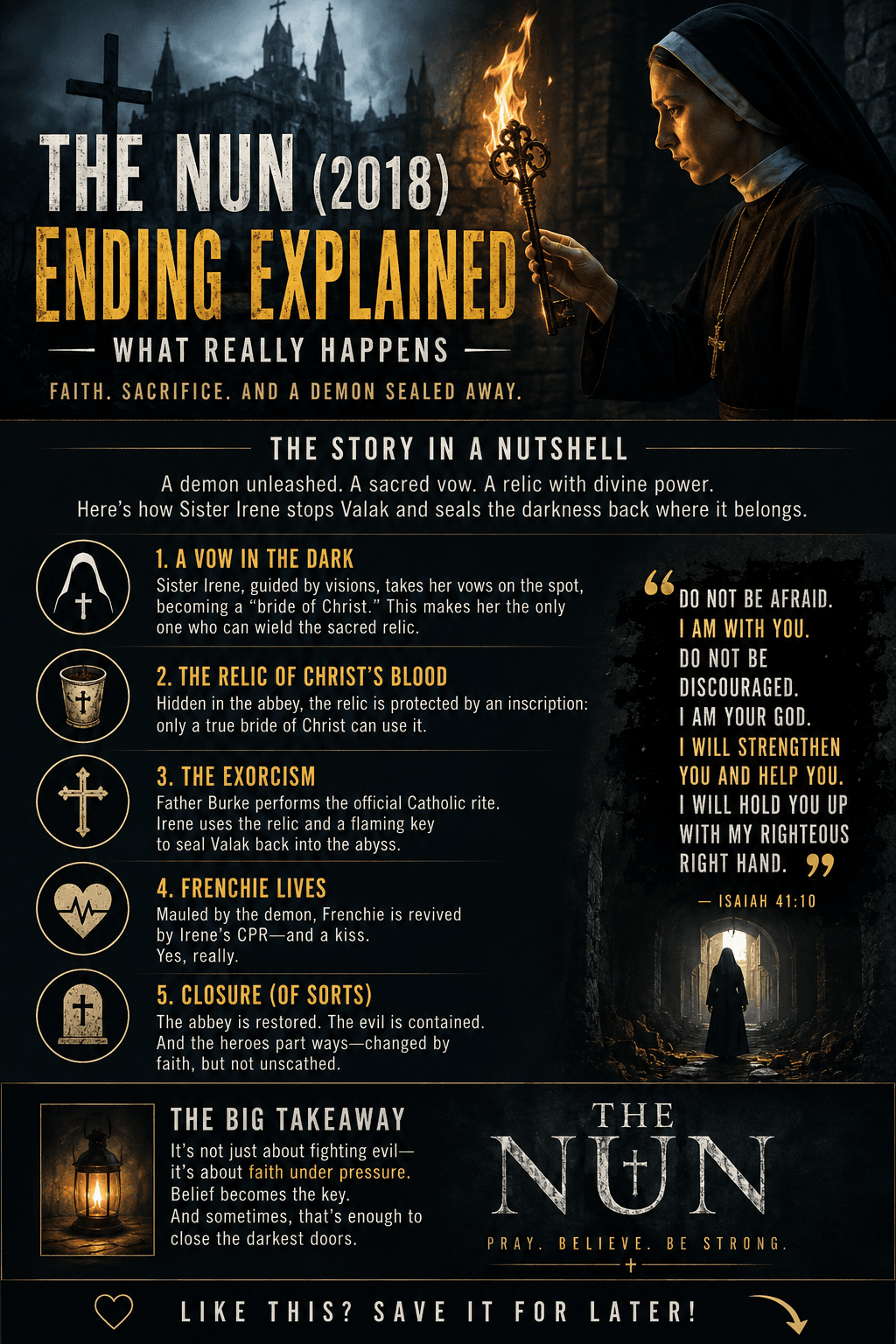
By the film’s final act, Sister Irene and Father Burke have pieced together the Abbey of St. Carta’s history: a medieval duke opened a doorway to Hell through witchcraft, the Church sealed it behind a relic containing the blood of Christ, and a perpetual vigil of praying nuns has kept the seal intact for centuries — until a World War II bombing cracked it and let something out. The Abbess is dead. The convent’s nuns are dead or gone. Whatever occupies the building now wants a body to wear off the grounds.Before Irene, Burke, and Frenchie go looking for the tunnel to the catacombs, Irene stops and tells Burke she wants to take her vows. Not later. Now, standing in a corridor with a demon actively hunting them. Burke asks if she’s certain.She tells him her visions have convinced her they’re a gift from God rather than a symptom of something wrong with her, and Burke performs an abbreviated version of the ceremony on the spot — no procession, no ritual trappings, just the two of them and a prayer that unites her, in his words, “with the sacrifice of the Eucharist.” She’s now a bride of Christ in the technical, canonical sense, which turns out to matter about ninety seconds of screen time later: the relic they’re hunting for is guarded by an inscription stating that only a true bride of Christ can wield it.Sister Irene finding religious conviction under maximum duress functions less like earned storytelling patience and more like a lock the plot needed a specific key for, manufactured in real time to fit the exact hand that would need to turn it.The relic itself sits behind a small piece of theater the film clearly enjoys staging: Burke assumes there’s “nothing here,” Irene notices what he doesn’t, and a hidden compartment opens on a container holding what the film calls, without much ceremony, the blood of Christ. Frenchie’s contribution to the moment is “holy shit,” delivered completely straight, which is as close as this movie gets to acknowledging out loud how strange its own set dressing is. Burke wants to skip straight to using it. Frenchie, of all people, is the one who suggests maybe they should pray first. Nobody does.They find the portal. Burke starts reciting a formal rite of exorcism — the actual Catholic prayer, more or less verbatim, the kind of thing that reads as respectful research when a film bothers to use the real text instead of inventing spookier-sounding Latin.And then the sequence gets away from the film a little: Frenchie, alone in the dark, gets cornered by whatever’s down there and taunted directly — called “Frenchman,” corrects it to “French-Canadian” even while something is actively trying to kill him, which is either the best character beat in the movie or proof that Jonas Bloquet was contractually owed one laugh line regardless of the stakes. He goes down.Burke prays over the portal — “I bind all evil spirits to this fire, protect us from evil with your holy light” — and somewhere in the chaos, Irene gets the door shut and the key turned, and the light does what holy light does in this franchise, which is win.Worth pausing on what “wins” actually means here, mechanically. Nothing about the exorcism rite Burke recites is specific to
Valak. It’s the generic Catholic rite, the version you’d use on any possession, applied to a named seventeenth-century grimoire spirit without a single line of dialogue acknowledging the mismatch. A demon the film spent an hour insisting was uniquely, specifically dangerous gets sent home by the same prayer that would work on a routine haunting. The theology is coherent. The dramaturgy is a shrug.Then the film shifts registers entirely. Irene finds Frenchie’s body and performs CPR — “the kiss of life,” he calls it once he’s conscious again, immediately undercutting the moment because that’s apparently who Frenchie is even freshly resurrected — and in the middle of resuscitating a man she asks him his real name. Frenchie. Maurice. Thank you for saving my life, Maurice. You’re welcome. It’s a genuinely strange note to hit thirty seconds after a demon exorcism: two people flirting, gently, over a body that was nearly a corpse. Burke delivers a funeral rite for the dead nuns of St. Carta. Maurice muses about giving up world travel for tomato farming, like his father. Everyone survives who’s supposed to survive.The actual last scene isn’t set in Romania at all. It cuts to a lecture hall, Father Burke narrating a case study about a French-Canadian farmer named Maurice Theriault — friends called him Frenchie — who, after a botched exorcism, started speaking fluent Latin he’d never learned and grew an upside-down cross out of his own chest. It’s the three stages of demonic activity: infestation, oppression, possession, delivered as academic framework rather than lived horror.This scene exists to connect directly to the opening minutes of The Conjuring (2013), where Ed Warren tells a nearly identical story about the exact same man to a room of skeptical students. The Nun doesn’t end so much as it hands you off to a franchise timeline you may or may not already know the rest of.
Sister Irene Stays. That’s the Whole Ending for Her.
Once Burke leaves for Bucharest, Irene chooses to remain at the Abbey and help rebuild it, which the film frames as a quiet, deliberate act of faith rather than a consolation prize. Burke offers to send help. She tells him this is where her path has led her, and that’s the end of the conversation — no extended debate, no dramatic reversal, just a decision that was apparently already made somewhere the film didn’t show us and only needed a moment to be spoken aloud.She’s given a black habit — implied to have belonged to one of the dead nuns — puts it on, looks back at the world outside one more time, and shuts the door on it herself. It’s a clean, small image, and it’s doing more emotional work than almost anything else in the last twenty minutes: a woman who spent the entire film being told her visions made her unreliable chooses, at the end, to build a life around trusting them anyway. The film doesn’t dwell on it. It cuts away almost immediately to the lecture hall.That’s a genuine miscalculation — Irene’s ending earns about four seconds of screen time before the franchise machinery reasserts itself, and it’s the closest thing this movie has to a real emotional conclusion, delivered and abandoned in the same breath.
The Ending Gary Dauberman’s Script Actually Wrote — and Cut
Here’s where the screenplay and the finished film stop agreeing with each other, and it’s worth being precise about how much changed, because it’s not a scene here or there. It’s the entire back third of the climax.In the draft I read, before the portal sequence, Irene and Burke discover that Sister Miranda — the nun they’ve been talking to throughout the film, rocking calmly in a chair, occasionally offering cryptic guidance — has been dead for months. What they’ve been interacting with the whole time was never Miranda. The corpse gets pulled off the chair, reanimates, and stabs Father Burke in the side with his own crucifix before he manages to pin it down and improvise a blessing over a cup of water to slow it down.This entire subplot — the corpse, the stabbing, the improvised holy water — does not appear anywhere in the finished film’s dialogue. Sister Miranda’s name never comes up once in the actual movie.The undercroft sequence is where the script gets genuinely feral, and the mechanism of Frenchie’s attack changes completely from what made the screen. On the page, a small winged boy grabs him — the
Ars Goetia’s actual described form for Valak, notably, rather than the nun costume the franchise made famous — and vomits a live serpent directly into Frenchie’s open mouth. That’s the moment the film’s own reference material would have justified visually and never used: the finished movie keeps Valak in the marketable habit throughout, even in scenes where the script had already written a truer, stranger design.Frenchie’s neck snaps around on the page, upside-down crosses erupt through his skin, and for a stretch of pages he functions as a second demon-possessed antagonist, pinning Irene down and nearly smothering the sacred light she’s carrying before Burke tackles him off her. Irene herself gets pulled toward the open portal and is nearly dragged through it by the demon before Burke’s exorcism prayer — which does explicitly name Valak on the page, unlike the more generic banishing rite that made the final cut — breaks its grip long enough for her to slam the door and lock it.Frenchie’s status once the dust settles is left genuinely ambiguous on the page — consumed, carried off, unaccounted for, the kind of open thread a franchise leaves dangling on purpose. The CPR scene, the real-name reveal, the gentle almost-romance that closes the theatrical cut all belong entirely to the rewrite; the version of Frenchie who survives to flirt with a freshly-ordained nun over his own resuscitated body exists only in the finished film.And then the script’s epilogue is where the divergence becomes almost comedic in how much darker it is. Instead of a lecture hall, it cuts to Massachusetts, years later, where Maurice — the man we now know is Frenchie’s real self — shoots his wife dead in their bedroom, upside-down crosses visibly pushing out through his own chest, and turns the shotgun on himself. It misfires.Ed and Lorraine Warren burst through the front door with a priest a beat too late to stop the murder, and as Lorraine looks toward a mirror across the room, it isn’t Maurice’s reflection staring back. It’s Valak. The mirror shatters. Cut to black.That is a genuinely unhinged way to end a PG-13 studio horror film, and I mean that with something close to respect. It’s also completely, deliberately absent from what audiences actually saw. What replaced it is Father Burke, in a classroom, delivering the same information as exposition instead of violence — literally describing the events the script wanted to show you, secondhand, at a lectern, days or weeks removed from any danger.Call it what it actually is: a wholesale swap, a different ending entirely, standing in for a summary of events that happened somewhere off-page, narrated well after the fact by a man in a cardigan.
The Corpse in the Rocking Chair Nobody Talks About
The Sister Miranda material is the strangest cut of all, because unlike the Frenchie survival question, it isn’t obviously about franchise math. In the draft, Miranda has been sitting in a rocking chair for most of the film’s back half, offering guidance, occasionally cryptic, treated by Irene and the audience alike as a living nun with information worth trusting.The reveal that she’s been a corpse the whole time — animated, or impersonated, or simply misperceived, the script is cheerfully vague about the mechanism — recontextualizes every prior scene she appeared in as something closer to a haunting than a conversation.That’s a legitimately strong idea on the page, and I think it got cut for a reason that has nothing to do with gore or runtime. The finished film already spends its entire second act training the audience to distrust what Irene sees — her visions of Mary, her visions of guidance, the possibility that everything pointing her toward the relic is itself a trap. Adding a second “the person you trusted wasn’t real” reveal, stacked on top of the one the film is already building toward, risks diluting both rather than compounding them.Cutting Miranda’s corpse protects the one piece of ambiguity the film actually wanted to keep, conserving it instead of spending the same trick twice in one runtime.There’s a character-mechanics reason too. Burke getting stabbed by reanimated-Miranda, on the page, happens shortly before he needs to lead an exorcism rite with total authority and composure. A visibly wounded, bleeding priest reciting Latin over a portal to Hell is a harder image to sell as commanding than an unwounded one. The finished film keeps Burke’s body intact right up until the confrontation that actually matters, which reads like a deliberate choice about where to spend the film’s one serious injury, not an accident of the edit.
Why the Softer Ending Won
None of this is really a mystery once you think about what the finished sequence needed to accomplish that the script’s version couldn’t. The Conjuring Universe runs on connective tissue — Frenchie has to survive long enough to become Maurice Theriault, the man from Ed Warren’s lecture, the bridge back to the 2013 film that started this whole thing. A version of the ending where Frenchie dies in Romania in 1952 works fine as a self-contained horror climax and works terribly as franchise plumbing, because it forecloses the exact connective scene the marketing wanted to build toward.Keeping him alive, giving him a “kiss of life” and a real name and a small joke about tomato farming, reads far more like an inventory decision than a softer creative one — the math of not killing off a character your cinematic universe needs intact for a scene you’re already planning to shoot as a coda.The Massachusetts epilogue tells a similar story from the other direction. It’s a genuinely disturbing piece of writing — a murder-suicide, a mirror reveal, Ed and Lorraine arriving one beat too late to matter — and it’s also completely redundant once you remember
The Conjuring (2013) already opens with almost this exact story, told as testimony rather than dramatized as an in-universe cold open. Filming the Massachusetts scene would have meant re-staging, in full, the thing the franchise’s very first film already established as backstory.The lecture-hall version does the same connective work in ninety seconds of dialogue instead of a full additional sequence, without requiring the studio to explain why its PG-13 prequel suddenly needed a bedroom shotgun killing on screen.I don’t think either change was made because someone got squeamish. I think both were made because a tidier ending is a more efficient piece of franchise infrastructure, and infrastructure is what this particular machine is actually built to produce. The version in the script is scarier, stranger, and considerably more committed to its own mythology. The version on screen is more useful to whatever gets released two years later.
The Nun (2018) Ending Explained: What the Ending Is Actually Arguing
Strip away the franchise bookkeeping and there’s a real thesis buried in the theatrical ending, even if the film doesn’t linger on it long enough to make its case. Irene’s vow-taking under active threat, immediately validated by the plot as literally the correct key to the correct lock, argues that conviction chosen at the worst possible moment counts for more than conviction inherited quietly at a better one. It’s a decent idea. Robert Eggers would have given it a whole third act. Corin Hardy gives it one scene and a load-bearing relic, then cuts to a lecture.Whether that’s a failure of nerve or just an accurate read of what a $22 million Conjuring Universe installment is actually allowed to be about, I’d rather let the two endings answer for themselves. One of them ends with a nun choosing her own life. The other ends with a mirror. Only one of those made it to a theater, and it wasn’t the one that trusted the audience to sit with the version where nobody gets a tidy classroom recap to wrap it up for them.I keep coming back to the shotgun that misfires in the unused epilogue. Even the script seems to know it needs a second chance to reach the ending the franchise actually requires — Maurice has to survive that moment too, one way or another, so Ed and Lorraine can eventually meet him, so The Conjuring can eventually open on his exorcism. Both versions of this story, the one that got filmed and the one that got shelved, are pointed at the exact same downstream obligation.They just take wildly different routes to get a French-Canadian farmer to the finish line alive enough to become somebody else’s opening scene.
The Nun (2018) Ending Explained: Quick Answers
What Is the Nun (2018) Ending Explained in One Sentence?
Sister Irene takes her vows, uses a relic to access a sealed portal, and helps Father Burke banish the demon Valak back through it before locking it with a blessed key. Frenchie survives after nearly dying in the confrontation, and the film closes on Burke lecturing a class about the case, directly setting up
The Conjuring (2013).
Does Frenchie Die in The Nun?
No, not in the finished film. He’s badly hurt and revived by Sister Irene, and the two share a quiet moment where he reveals his real name is Maurice. In an earlier version of the screenplay, Frenchie’s fate was far darker and his survival was never guaranteed — that ending didn’t make the final cut.