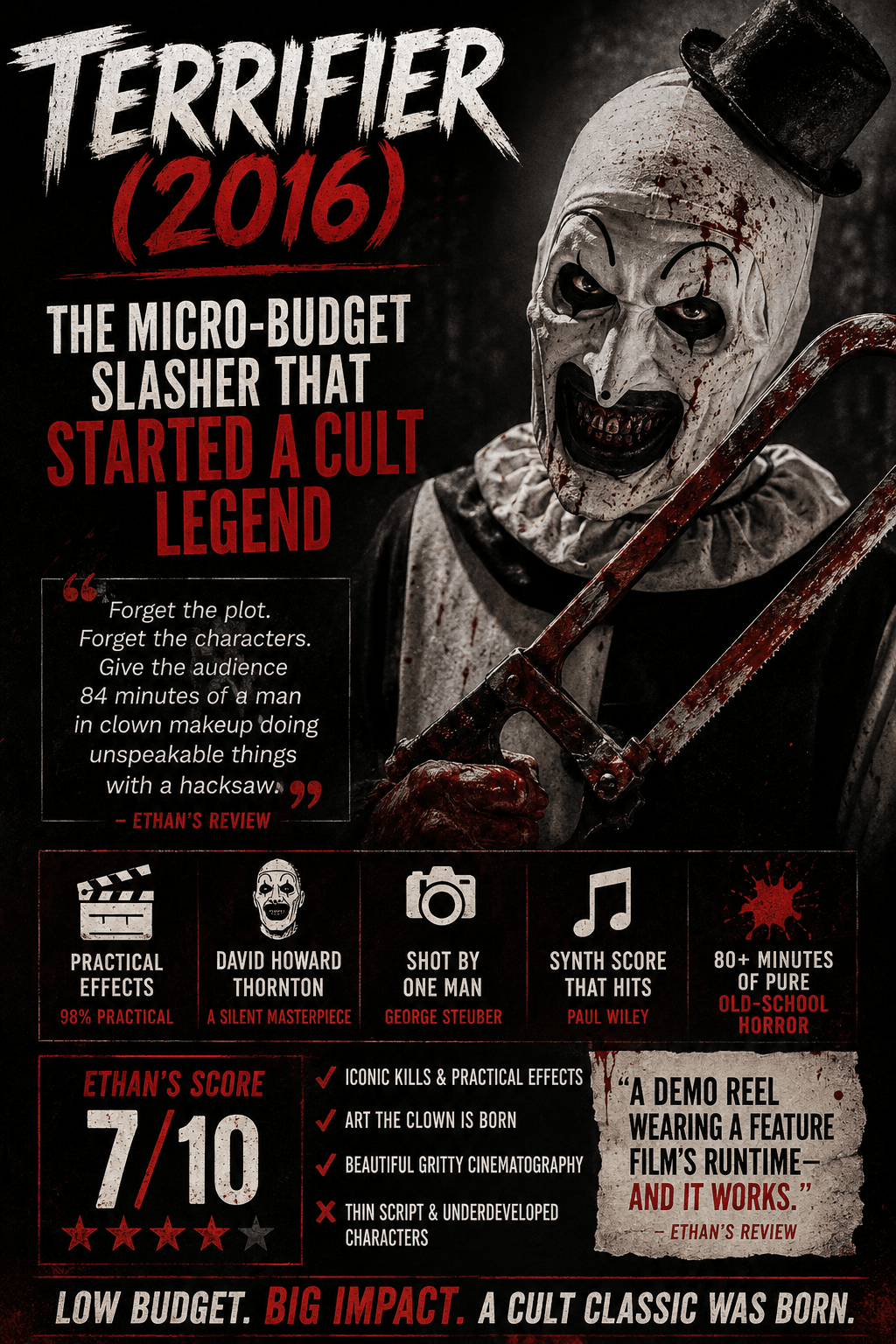
Short version of this Terrifier (2016) review: the practical effects and David Howard Thornton’s performance are worth the eighty-four minutes. The screenplay is not, and Damien Leone has never pretended otherwise. The film premiered at the Telluride Horror Show in October 2016, took until March 2018 to get a limited theatrical release, and made $421,798 against a budget that depends on which day you ask Leone — somewhere between $35,000 and $55,000, most of it patched together after his Indiegogo campaign fell short and producer Phil Falcone stepped in for a credit.
None of that sounds like the origin story of a franchise that would eventually put its killer clown in a Fortnite skin and, allegedly, on someone’s Christmas sweater. And yet here we are, because Terrifier is the rare micro-budget slasher that actually understood the assignment: forget the plot, forget the characters, give the audience eighty-four minutes of a man in clown makeup doing unspeakable things with a hacksaw, and let everyone else spend the next decade arguing about what it means.
It spent the better part of two years doing exactly that on the festival circuit before Epic Pictures gave it an actual theatrical release, which is a long time for a movie this small to survive on nothing but word of mouth and a growing pile of Fangoria Chainsaw Award nominations. Most micro-budget slashers don’t get that runway. This one earned it the hard way, one festival screening at a time, from Telluride in 2016 to FrightFest in London a year later, before anyone with real distribution money agreed to bet on a clown.
A Terrifier (2016) Review Has to Start With the Screenplay Problem
I want to be clear about something before I say anything nice: the screenplay, such as it is, was not a priority, and Leone will tell you this himself without much prompting. His stated biggest regret is not fleshing out Samantha Scaffidi’s character, Victoria Heyes — the sister who survives everything and gets to spend the sequel explaining what it’s like to have your face eaten on Halloween.
Tara Heyes, played by Jenna Kanell, gets marginally more screen time and considerably less characterization; she’s “scrappy,” per Kanell’s own description in interviews, which is a generous way of saying the script gave her nothing beyond a pulse and a flashlight. Dawn Emerson, Catherine Corcoran’s character, exists mostly to be drunk, mouthy, and then very famously bisected. This is not an ensemble. It’s a body count with good posture.
Credit where it’s due: the film knows exactly what register it’s operating in even when the writing doesn’t. Art gets thrown out of a pizzeria early on for smearing his own feces across the bathroom walls, and the owner’s response — screaming for a mop and bleach rather than calling the police — is funnier than anything in most horror-comedies that are actually trying to be funny.
Later, an exterminator cheerfully warns Tara that the building she’s about to use as a bathroom has a rat problem, “not roaches,” delivered with the bored professionalism of a man who has clearly had this exact conversation before. Terrifier has jokes. It just refuses to signal that they’re jokes, which is a better strategy than it sounds like on paper — nothing kills a scare faster than a film winking at its own punchline.
None of that is a revelation, and it wouldn’t be worth mentioning at all if the film’s smartest idea weren’t buried inside its laziest structural choice. Terrifier opens and closes on a talk show — Victoria, a year later, disfigured, sitting across from a host who spends the segment fishing for trauma on camera and then, off air, mocks the woman’s face while gossiping with her boyfriend about ratings.
She’s murdered for it almost immediately, which is the closest this movie comes to a moral position, and it’s a genuinely good one: the machine that turns survivors into content gets punished before the actual killer even shows up.
Then the movie drops that idea completely for eighty minutes so it can follow two women out of a bar. Somewhere in the writers’ room — a room that in this case was one man with a laptop and a deadline — that thread just got left on the floor. Anton Bitel called the whole thing a “subtext-free thrill-and-kill ride,” and I’d only push back on the word “subtext-free,” because there’s clearly one good idea in here. It just never gets invited back after the opening credits.
The Craft: Steuber’s Camera, Wiley’s Score, and Leone’s Own Cut
What I can review without reservation is whether the chainsaw is sharp, and here Terrifier earns every dollar of its shoestring budget. George Steuber shot the film entirely by himself — camera, focus pulling, lighting, media management, the whole department folded into one guy who also produced — and the desaturated, near-monochrome look he found for it does more storytelling than the script ever attempts. It’s a smart cheat: color costs money and continuity, and a world drained down to grays with one recurring smear of red doesn’t need either.
Paul Wiley’s score leans into the same instinct, synth work that evokes Carpenter and Goblin without embarrassing itself, content to sit under a scene instead of shouting at you about how to feel. Leone edited his own film too, and the pacing shows the instincts of someone who knows exactly how long an audience will sit with dread before it curdles into impatience. The kills breathe. They’re not rushed, and they’re not padded either — a rare needle to thread on a shoot this small, and one plenty of studio slashers with a hundred times the budget still can’t manage.
David Howard Thornton’s Performance Is the Actual Reason for This Review
David Howard Thornton is doing the actual heavy lifting here, and it’s worth saying plainly: this is a genuinely excellent physical performance wearing the costume of a footnote. Thornton had exactly one audition tool available to him — mime — and used it to invent an entire vocabulary of malice without a single line of dialogue.
Watch what he does with his hands when he’s deciding whether to kill someone quickly or slowly. Watch him perform actual delight at the precise moments the film wants you least comfortable, the way he mugs at a camera that technically isn’t supposed to know he’s there.
That’s a cheap gimmick on paper, and Thornton sells it anyway, committing to the bit with the seriousness of a man who’s figured out that comedy and horror run on the exact same muscle, just flexed in opposite directions.
Leone built Art as the deliberate photo negative of Pennywise — black and white instead of primary colors, silent instead of chatty — and the whole gambit only works because Thornton refuses to let silent mean blank. We’ve gone deeper into that design philosophy, and into what Art became after this film — for now, the point is narrower: the performance carries scenes the script has no interest in earning.
There’s a stranger scene buried in the middle of the film that I keep coming back to, involving a squatter Tara meets while looking for a bathroom — a woman credited as the Cat Lady, played by Pooya Mohseni, who’s convinced the doll she carries is her living infant.
It has nothing to do with the plot, resolves nothing, and is the one moment where the movie risks something genuinely unsettling underneath all the graphic thoroughness. It’s also the moment critics tend to skip past fastest, probably because it doesn’t fit the “gory slasher throwback” elevator pitch, which tells you something about how narrow the frame around this film usually is.
Kanell, Corcoran, and What Actually Happened Making the Hacksaw Scene
Kanell and Corcoran are working with less than Thornton, and it shows in the way it always shows when a script hasn’t done its job: both actors are visibly better than their characters deserve. Kanell brings a specific, believable panic to Tara that never tips into the shrieking-victim register the genre defaults to when nobody’s paying attention to something more textured.
Corcoran, for her part, filmed the film’s signature set piece — Dawn strung up and sawed in half — hung upside down and shackled by the ankles with no rig, in forty-second increments, a crew member sliding a platform underneath her between takes so she wouldn’t drop. For years that circulated as a fun piece of scrappy-indie-horror trivia, the kind of story that gets a laugh at a convention panel. I’d be lying if I said it still lands that way for me.
In October 2025, Corcoran filed a federal lawsuit against Leone and Falcone. She alleges she was shortchanged on the profit percentage she’d agreed to in exchange for that low per diem rate, and, separately, that she was photographed nude without her consent during an incorrectly performed molding process for the role. Leone and Falcone deny the claims.
I don’t have a verdict to hand you, because there isn’t one yet — the suit is active, the allegations are allegations, and I’m not going to pretend otherwise in either direction. What I can tell you is that the next time somebody brings up the hacksaw scene as a fun bit of low-budget grit, there’s now a federal complaint attached to how it actually got made, and that context doesn’t disappear just because the scene still works.
Where Terrifier (2016) Actually Sits in Slasher History
That context sits uneasily next to the thing Terrifier is otherwise selling, which is a very specific, very old-fashioned pleasure: watching a crew solve problems with ingenuity instead of money. Ninety-eight percent of the effects in this film are practical, per Leone, with digital work reserved for the unglamorous job of erasing a blood tube or deepening a wound that didn’t read deep enough on camera. That ratio matters more than any single gag.
It’s the difference between a film that looks expensive because it had money and one that looks credible because someone who knew what they were doing built the illusion by hand, on a budget that wouldn’t cover craft services on most studio sets. Leone has said he wanted to fuse familiar American slasher elements — he’s cited Jason, Michael Myers, Freddy Krueger as direct influences — with the “graphic violence and atmosphere of Giallo films,” and it’s a more honest description of the movie than anything written about it since.
Terrifier restages the slasher formula rather than reinventing it, with better makeup and a meaner sense of humor about its own body count than most of the genre bothers with, and academics have noticed: one thesis points out that Dawn’s hacksaw death is doing a direct, deliberate echo of Nancy Thompson’s bathtub scene in A Nightmare on Elm Street, just with the mercy removed.
The morgue scene that closes the film out earns its own mention, if only because it’s the moment Terrifier seems to understand it might get a second chance. A coroner pulls back the sheet on Art’s body, deadpans “I hope your fifteen minutes of fame was worth it, you sick son of a bitch,” moments before Art reanimates and attacks the man examining him.
It’s a cheap sequel tease, the kind that usually reads as desperate on a film this small, but the movie has already spent eighty minutes proving it knows how to earn a laugh at the worst possible moment, so a dead clown climbing back off the table lands as just one more punchline hitting exactly on the beat.
Terrifier 2016 Review Verdict
Where does that leave the movie itself? Somewhere between the two extremes that have followed it since 2016 — Cody Hamman calling it “a thrilling, brutal, gory ’80s throwback” worth an 8 out of 10, and Felix Vasquez Jr. dismissing it as “a very disposable party favor you’ll have forgotten once the credits roll.”
Both of them are describing the same eighty-four minutes accurately, which tells you this is a film built to be graded on a curve depending entirely on what you walked in wanting. Critics landed in roughly the same place on average — Terrifier sits at 63% on Rotten Tomatoes, a 6.0 average across 27 reviews, which is about as split a verdict as this genre produces.
That split is the honest shape of any Terrifier 2016 review: it’s a demo reel wearing a feature film’s runtime, a proof of concept for a character its own director would clearly rather spend the next decade sequelizing than build a real ensemble around this once. Four years and two sequels later, that’s the plan working exactly as intended. Judge it as a slasher movie with things to say about grief or identity or the corruption of the self, and it collapses in about nine minutes.
Judge it as proof that practical effects and one genuinely committed performance can outrun a nonexistent script for eighty-four minutes, and it’s one of the more honest movies I’ve watched all year, in the sense that it never once pretends to be something it isn’t. Terrifier clears that low bar by doing the one thing it promised, extremely well, and I’d rather sit through that than one more self-serious “elevated” horror film that’s confused restraint for meaning.
Ethan’s Score: 7 / 10
Frequently Asked Questions
Is Terrifier (2016) worth watching?
Yes, mainly for David Howard Thornton’s silent physical performance as Art the Clown and George Steuber’s near-monochrome cinematography. The screenplay is thin by design — Leone has said he prioritized showcasing the character and the practical effects over the two lead women’s characterization.
What is Ethan’s Terrifier 2016 review score?
Ethan’s Score is 7 out of 10. The film earns strong marks for its practical effects, cinematography, and Thornton’s performance, but loses points for underwritten characters and a structural idea — the talk-show framing device — that the script abandons almost immediately.
Is Terrifier (2016) based on a true story?
No. Art the Clown is a fictional character created by Damien Leone, first introduced in his 2008 short film The 9th Circle. Leone has cited slasher icons like Jason Voorhees, Michael Myers, and Freddy Krueger as influences, not any real killer.
What is the lawsuit against the Terrifier filmmakers about?
In October 2025, actress Catherine Corcoran filed a federal lawsuit against director Damien Leone and producer Phil Falcone, alleging shortchanged profit payments and nonconsensual nude photography during production of her hacksaw death scene. Leone and Falcone deny the allegations; the case remains active.
For a full breakdown of what happens after the credits start rolling — including the scene most first-time viewers misread as the finale — read our Terrifier (2016) ending explained.