
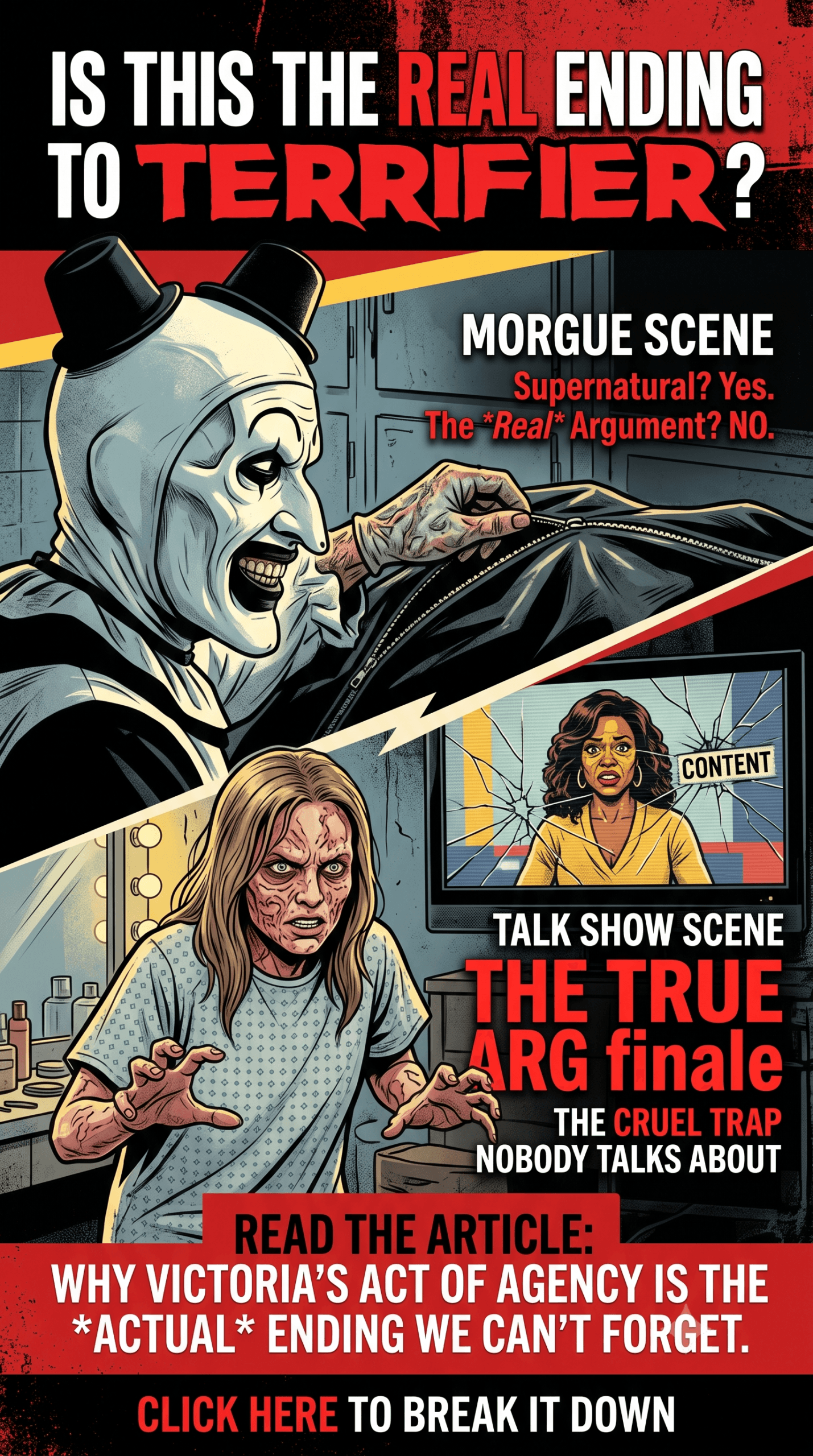
This Terrifier 2016 ending explained breaks down two closing beats, and only one of them usually gets talked about. Art the Clown reanimates in the morgue and kills the coroner examining his body, which is the moment most recaps call the finale. It isn’t. The film’s actual final scene brings Victoria — the disfigured survivor interviewed at the very start of the movie — back to the talk-show studio where that interview happened, where she overhears host Monica Brown mocking her backstage and gouges out Monica’s eyes.
The morgue scene confirms Art is supernatural and unkillable. The Monica Brown scene is where Terrifier’s real argument lives, and Damien Leone built the entire film, structurally, to walk you back to it. Everything else in the final ten minutes — the coroner’s office, the hospital discharge, the doctor’s throwaway line about tomorrow’s interview — exists to get you there without your noticing you’re being led.
The Coroner’s Office Joke Nobody Talks About
Ninety seconds before Art sits up in that body bag, two coroner’s office attendants are eating breakfast next to a table of corpses. One of them recaps the night’s violence like he’s reading box scores: police found the guy eating some girl’s face off after running her over with a truck, and he blew his brains out before they could bring him in. “Halloween never disappoints, does it?” his coworker says. “Looks like it’s just getting started.” Then they argue about whether a greasy croissant is an appropriate breakfast to eat while cutting up bodies.
That exchange is the whole ending of Terrifier in miniature, and it’s easy to miss, because it happens right before Art reanimates and everyone’s attention correctly goes there instead. But the joke is doing real work. It’s showing you, in the driest possible register, exactly what the film is going to do to you again in a few minutes with a bigger microphone and a worse person holding it.
What Actually Happens at the End of Terrifier (2016)
Tara Heyes gets shot and killed partway through the film, well before the ending — a beat Leone plays almost as a punchline, a slasher subverting its own toolkit by handing the killer a gun nobody expected him to carry. Dawn, the friend Tara and Victoria spent the night with, doesn’t make it past the midpoint either, in the scene most people actually remember this movie for.
Victoria, who’d come to pick Tara up, finds Art instead. Police respond. Art runs Victoria down with a truck, eats part of her face, and — as the coroners later summarize it over coffee — blows his own brains out before he can be taken into custody.
His body goes to the morgue. A coroner with twenty-two years on the job jokes that nothing shocks him anymore, not after “an eight month old microwaved to death.” He unzips the bag anyway, deadpans “let’s have a look at the man of the hour,” and gets one more line in — “I hope your 15 minutes of fame was worth it, you sick son of a bitch” — before Art’s hand closes around his throat.
Cut to a hospital room. Victoria, apparently months into recovery, is being wheeled out by staff who talk about her the way you’d talk about a difficult patient who’s finally being discharged: “so cooperative,” “still a wise ass,” good spirits all around. The doctor tells her he’ll see her in a couple of months. Then the last line of dialogue in the entire film arrives, almost thrown away: “Oh, and good luck with your interview tomorrow.”
That single sentence is the hinge the whole movie swings on.
Victoria Was Never Supposed to Be the Final Girl
Leone has said Tara was built deliberately as a false protagonist — the character with all the final-girl instincts, quick, strategic, handy with a two-by-four, the one the film spends its first half training you to root for — specifically so he could kill her off partway through and hand the ending to someone the audience hasn’t been coached to expect.
Victoria is introduced, instead, as a favor — a ride home for a sister who never needed picking up — and she spends her own chase sequence wandering dim corridors calling out a name nobody answers. That’s Leone’s design working exactly as intended: he wanted an ending where survival reads as leftover luck rather than a reward for competence, just what’s left over after everyone more capable has already died.
That’s why the ending can’t hand Victoria a triumphant final confrontation. The film already spent an hour establishing that competence doesn’t save you in this story — Tara proved that with a two-by-four in her hand. So when Victoria’s actual moment of agency finally arrives, months later, in a dressing room, it lands as violent, sudden, and aimed at the smallest available target instead of the one who actually did this to her.
That’s a more honest ending than a rewritten final-girl showdown would have been, and it’s also a considerably crueler one, because it means the film’s one act of reclaimed power lands on a talk-show host instead of a clown.
Terrifier 2016 Ending Explained: Why the Talk Show Is the Real Finale
Terrifier opens on a talk show. Host Monica Brown — played by Katie Maguire in a small role that still manages to be one of the most quietly hateful things in the film — is interviewing the sole survivor of what the show’s producers have branded, with the kind of tidy specificity only a news package can manufacture, the “Miles County Massacre.” One year later, live, in front of an audience. Brown asks the disfigured woman what it felt like to wake up from a coma and see her own face for the first time.
The woman answers honestly: “I wished I was dead.” Asked if she still feels that way, she doesn’t retreat into television-ready optimism: “People are frightened by the way that I look, especially children,” she says, “and it’s really difficult for me to deal with that, so isolation is ideal.” That’s a woman describing a life she’s already begun organizing around other people’s fear of her, a year before Monica Brown gets anywhere near the room.
Brown keeps going anyway, raising, unprompted, the “controversy” over whether the killer might still be alive, since his body vanished from the coroner’s office overnight — a detail she’s using because it’s better television, not because the woman asked to discuss it. Our review of this film already flagged the talk-show frame as the one genuinely smart structural idea Terrifier has and then abandons for most of its runtime. This is the movie finally going back and cashing that idea in.
Most recaps of this ending will tell you the interview segment gets revisited at the very end, that Monica mocks the survivor backstage and gets her eyes gouged out for it, full circle, roll credits. That’s accurate. What gets flattened in the retelling is the shape of the loop. Read it as a trap rather than a twist: something built brick by brick out of every scene of institutional and media condescension the film stages along the way, sprung the moment the person being condescended to has nothing left to lose.
Monica is doing, on camera and with worse manners, exactly what every other institution in this film has already done to Victoria in smaller, more survivable doses: turning her trauma into content. She’s just the first one to get caught alone with the consequences.
The “Massacre” Was Always Going to Get a Brand
Notice the name: the “Miles County Massacre.” Nobody inside this film’s universe stumbled into that phrase by accident. It’s the kind of tight, brandable label a news desk workshops in a pitch meeting, the sort of name built to fit in a chyron and get repeated on anniversary segments for years.
By the time Monica Brown sits down across from Victoria, the event has already been packaged, titled, and scheduled for a one-year retrospective slot, which means Victoria isn’t being interviewed so much as asked to perform a role inside a story the network wrote before she agreed to show up.
That’s the detail that makes Monica’s “controversy” question so specifically ugly. An unresolved threat is simply better television than a closed case, and Victoria’s certainty — he’s dead, she saw it happen — is inconvenient to the segment’s shape regardless of what Monica actually believes about Art. The film shows you a woman with a script and a runtime, more invested in keeping the story open than in the fact that the story is a person sitting three feet away from her.
None of this is subtle, and it isn’t trying to be. Terrifier wants you to notice that every character with institutional authority in this film — the coroners, the hospital staff, Monica Brown — processes Victoria’s survival as material first and a life a distant second. The clown is the one who takes her face. Everyone else just takes turns deciding what her face is worth to them.
The Coroners Already Told You How This Ends
Go back to that breakfast conversation. Two men who spend their careers processing the aftermath of violence have found the only sustainable posture available to them: detachment dressed as professionalism, tragedy converted into shop talk. It’s coping more than cruelty. But it’s the identical move Monica Brown makes on television, minus the ratings incentive — reducing a specific person’s worst night into a story with a shape, a punchline, a “can you believe this town” shrug before moving on to the next body.
Terrifier stages this dynamic twice, once small and once large, because Leone wants the pattern noticed before the film asks you to be horrified by its biggest version. The coroners get to be sympathetic despite doing it, because their detachment reads as survival mechanism rather than cruelty. Monica does the same thing with an audience and a paycheck riding on it, and the film withholds that same grace from her. The film is direct about which one it thinks is worse. It puts a woman’s fingers through the second one’s eye sockets.
What the Ending Actually Cost Victoria
Here’s where the anger sets in, because the math on this ending doesn’t work in Victoria’s favor no matter which direction you look at it. She survives a night that kills her sister and half a dozen strangers. She loses part of her face to a man who was already, by every account in this film, unkillable.
She spends what’s implied to be an extended stretch of hospitalization — “I’ll see you in a couple of months,” said like this is routine — being managed by a medical system that describes her recovery in terms of how easy she is to be around. Then, the very next scripted beat in her life, she’s shipped off to a television studio to relitigate the worst nine minutes of her life for a stranger who’s already decided the “controversial” angle is more valuable than the true one.
The hospital room never raises the question of whether she’s ready for the interview, or whether she should have to do it at all. The doctor treats “good luck with your interview tomorrow” as a throwaway pleasantry, the horror-movie equivalent of “drive safe” — because to him, and to the machinery he represents, it is exactly that mundane. That’s the cruelty Terrifier is actually interested in by its final ten minutes — bigger than the truck, bigger than the face. Surviving Art the Clown doesn’t buy Victoria the right to stop being useful to other people’s narratives.
Leone’s Regret Doesn’t Fix What’s on Screen
Damien Leone has said on record that Victoria’s thin characterization is his biggest regret about this film — a regret we cover in more detail in our full review of Terrifier (2016) — and he’s been honest that the reason was mundane: directing and doing the practical effects himself, on almost no budget, meant something had to give, and what gave was the interior life of the two women this film puts through the most.
I believe him. I don’t think Leone set out to make a film where the sole surviving woman gets her face eaten, gets institutionalized, gets wheeled into a talk-show ambush, and then gets defined for the next two films almost entirely by what was done to her body rather than who she is underneath it. I think that’s what happens when a filmmaker is running practical-effects makeup sessions on almost no budget and simply runs out of hours in the day to write a second interior life alongside the first.
Intent and outcome aren’t the same ledger, though, and the outcome here is a woman whose entire function, for the length of this film, is to be acted upon — first by Art, then by a hospital system, then by a media apparatus that exists inside the story specifically to demonstrate how little has changed since Art put his hands on her.
A Reflection, Not a Redemption
There’s a reading of this ending, one that shows up in a fair amount of the writing around Victoria’s arc, that frames her transformation as a kind of dark inheritance. One analysis describes her as “not a heroine but a dark reflection of the atrocities Art the Clown committed.” That’s basically correct, and it’s also the film’s sharpest and least examined idea.
Every institution Victoria encountered after Art treated her exactly the way he did — as a body to be processed, managed, and eventually put on display — and that accumulation, not anything supernatural, is what turns her monstrous by the time she’s alone with Monica.
Victoria is a woman the movie handed a script that told her, over and over, that her suffering existed to be looked at — no demon required. By the time she’s alone in a dressing room with the one person who said that plan out loud, she finally gets to act on it instead of just enduring it.
One more useful read on this comes from Collider’s coverage of the character: Art “essentially steals the film back from her” by leaving her face unrecognizable before the morgue scene reclaims the spotlight, denying her the chance to become “an oppositional face or force to his story.” I’d go further.
The film steals the ending back from her too, structurally — her act of violence against Monica plays flat and unscored, cutting to black without a final shot to soften it into catharsis. Just the confirmation that the loop closed the way the coroners’ breakfast conversation always said it would: with somebody else’s tragedy becoming somebody’s punchline, and the person it happened to finally deciding she’d rather be the one holding the knife than the one being talked about.
What This Sets Up for Terrifier 2 and 3
This ending does two jobs for the franchise, and only one of them is about Art. The first is obvious: reanimating him in the morgue tells you, unambiguously, that whatever Art the Clown is, gunshots and vehicular manslaughter aren’t going to be the thing that ends him. That’s the setup every future film cashes in on. The second job is Victoria’s, and it’s the one this film shows the least interest in following through on itself.
Her disfigurement, her institutionalization, and her assault on Monica Brown are the first three dominoes in an arc that Terrifier 2 and Terrifier 3 will spend years actually paying off, turning her from Art’s collateral damage into something closer to his co-author. None of that is visible yet at the end of this film.
What’s visible is a woman who has just learned, in the space of one dressing room, that the only power available to her runs through violence — which is a bleak lesson for a franchise to teach its own survivor, and an even bleaker one for it to spend two more movies proving correct.
Samantha Scaffidi, who has played Victoria across all three films, has described the arc in blunt terms: “this kind of final girl — or heroine — but descending into madness.” That’s exactly the shape this ending sets in motion, one hospital-room platitude and one dressing-room ambush at a time. That transformation deserves its own article. This one is about the version of Victoria the first film leaves you with: alive, disfigured, unheard, and finally out of patience with everyone who kept asking her to perform her own survival for an audience.
That’s the Terrifier 2016 ending explained the way the film actually earns it: the woman standing over a talk-show host, having finally figured out that the only way to stop being someone else’s content was to make sure nobody walked away from the interview to tell the story. The reanimated clown just clears his throat first.
Frequently Asked Questions
What’s the Terrifier 2016 ending explained in one sentence?
The film’s true final scene is Victoria — the disfigured survivor from the opening interview — confronting talk-show host Monica Brown backstage and gouging out her eyes after overhearing Monica mock her, rather than the morgue reanimation most recaps focus on. The morgue scene confirms Art is unkillable; the Monica Brown scene is the story’s actual conclusion.
Does Monica Brown die at the end of Terrifier?
No. Victoria gouges out Monica’s eyes, but Monica survives the attack. Katie Maguire returns as Monica Brown in Terrifier 2, confirming the character lives past the first film’s ending.
What happens to Victoria after Terrifier (2016)?
Victoria is institutionalized following the events of the first film. She returns in Terrifier 2’s post-credits scene, now possessed and giving birth to Art’s severed head, and becomes a central antagonist alongside Art in Terrifier 3.
Why does Art the Clown come back to life in the morgue?
The film never fully explains it in the first movie, but the reanimation establishes Art as something beyond a conventional human killer — a detail the sequels expand into a supernatural mythology involving entities like the Little Pale Girl.