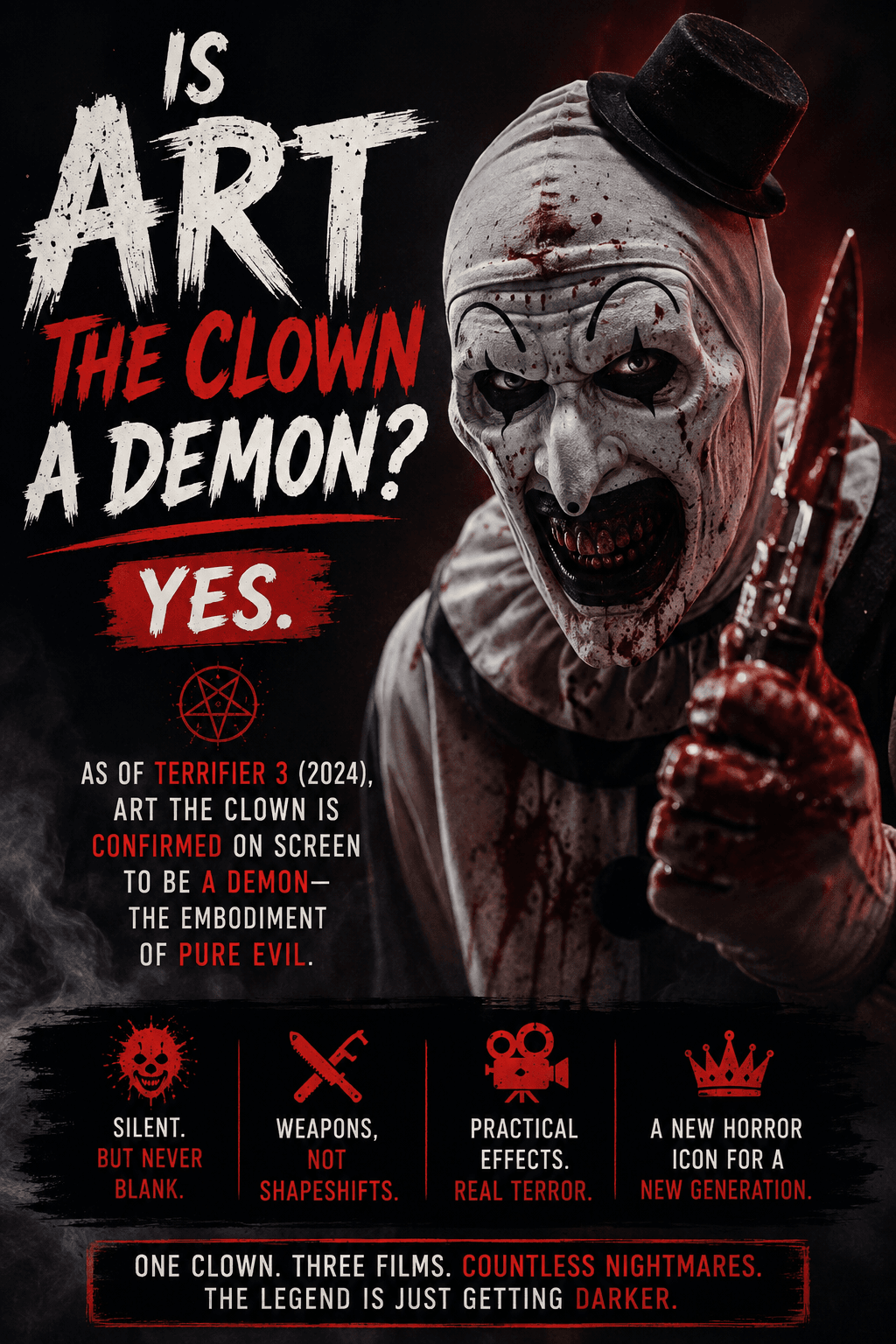
Is Art the Clown a demon? Yes. As of Terrifier 3 (2024), Art the Clown is confirmed, on screen, to be a demon — or more precisely, a dead serial killer resurrected and inhabited by a demonic entity that Damien Leone’s own story treats as the embodiment of evil itself. That single confirmed fact answers the internet’s favorite Art the Clown question. It doesn’t come close to answering the more interesting one: how did a mute, bug-eyed clown with a trash bag full of tools become, in less than a decade, horror’s fastest-rising icon since Ghostface?
A Background Character Who Wouldn’t Leave
Art wasn’t built to be a franchise. Damien Leone put him into his 2008 short film The 9th Circle as one ingredient in a pile of horror concepts he was testing — clowns, witches, demons, monsters, everything up against the wall hoping something would stick, in Leone’s own words. Art was a background player in a satanic-cult abduction story. Audiences latched onto him anyway, hard enough that Leone brought him back for a second short in 2011, then folded both shorts into the 2013 anthology All Hallows’ Eve, which gave Art his first real feature-length appearance.
The character audiences met in those early shorts wasn’t played by David Howard Thornton, the actor most now associate with the role. It was Mike Giannelli, a friend of Leone’s who wore the makeup through All Hallows’ Eve before retiring from acting.
When Leone decided the 2010s needed an original horror icon — something that wasn’t another masked slasher, wasn’t another Pennywise knockoff — he rebuilt the casting from scratch. Thornton found the role through a casting listing for a tall, skinny, comedic actor with clowning experience, already knew the character from All Hallows’ Eve, and improvised a kill scene during his audition. He got the part on the spot.
Leone’s own description of the difference is the whole thesis of why this recasting mattered: Mike may as well have been a guy dressed as a clown, whereas David is a clown. If you know him in person, he is a walking cartoon — Roger Rabbit in real life — and you’d never believe that he’s Art the Clown, but he knows how to flip the switch and bring it to a dark place.
All Hallows’ Eve itself was a low-budget anthology, structured as a VHS tape of short horror stories a babysitter finds herself watching, with Art functioning as the connective tissue linking one story to the next rather than the film’s single headline villain. That’s easy to forget now that his name sells tickets on its own, but it’s the reason the character had years to accumulate a small, dedicated following well before Terrifier gave him a story built entirely around him.
The Opposite of Pennywise, on Purpose
Leone has been explicit that Art was engineered as Pennywise’s photo negative. Bald instead of red-haired. Bone-white and colorless instead of gaudy. Silent instead of chatty. Weapons instead of shapeshifting monster reveals. But the choice that actually separates Art from the rest of the silent-killer lineup — Michael Myers, Jason Voorhees, Leatherface — is that he’s never blank. Those three are, by design, forces of nature: masks with no interior weather, built to feel less like people than like weather systems that happen to carry weapons.
Art mugs. He winks at a camera he isn’t supposed to know is there. He takes a selfie with a body he’s just sawed in half. He poses a corpse beneath a sign that reads blessed like he’s the one telling the joke, not the audience. This is exactly the performance Leone hired Thornton to deliver: keep the horror grindhouse-grade while making it funny enough that you’re laughing before you’ve registered what you’re laughing at.
One Man, Every Job
Part of why Art looks the way he does is that Leone isn’t primarily a director who hired someone else to handle the gore. He started as a self-taught special-effects makeup artist, building homemade prosthetics and blood rigs before he ever ran a film set, and that background is exactly why Terrifier’s kills read as tactile rather than digital.
Leone has stayed remarkably hands-on across four features and two shorts, frequently serving as writer, director, editor, and effects artist on the same production, favoring practical prosthetics and minimal CGI even as budgets grew. That control is also why the character has stayed so consistent tonally across three feature films, eight years, and a growing string of distributors — one person has kept a hand on almost every frame Art has ever appeared in.
It also puts Art on the right side of a real shift in how horror fans talk about craft. A run of high-profile 2020s horror films leaned hard into practical prosthetics and in-camera gags specifically as a selling point, after years of digital blood being treated as a shortcut audiences had grown tired of.
Leone was doing that work out of necessity long before it became a marketing angle, funding early effects out of pocket because there was no visual-effects budget to lean on instead. Art’s gore reads as handmade because it is, and that’s become as much a part of the character’s identity as the silence or the mask.
Three Films, One Escalating Curse
Is Art the Clown a demon? The question only makes sense once you know what actually happens to Art across the trilogy, because the films answer it in pieces, on a delay, almost daring the audience to keep up.
Terrifier (2016) ends with Art cornered by police while mid-attack on survivor Victoria Heyes. Rather than get arrested, he puts a gun in his own mouth and pulls the trigger. His body goes to the morgue — and is resurrected there by an unnamed evil force before the film is even over. That force turns out to matter more than the character himself.
Terrifier 2 (2022) spends its runtime revealing what that force can do. It heals Art’s ruined body over the following year. It can shapeshift, appearing to Art disguised as his own first victim, a ten-year-old girl, with yellow eyes as the only tell that it isn’t what it looks like. It targets siblings Sienna and Jonathan Shaw, whose late father had visions of Art’s rampage before he died and left Sienna a sword, insisting she’d need it.
She does: the film’s climax is a duel at an abandoned amusement park attraction called, pointedly, the Terrifier, where Art impales Sienna with that same sword. Her brother’s screams pull her back from the edge of death, the sword itself seals her wound, and she rises to behead Art with it. The entity simply collects his severed head and vanishes. In the mid-credits scene, hospitalized survivor Victoria Heyes gives birth to that head from her own body and begins eating Art’s face — her eyes now the same yellow as the entity’s.
Terrifier 3 (2024) is where the story finally puts a name to what’s been driving all of it: an entity called the Little Pale Girl, described in the film as evil itself, wearing the shape of Art’s earliest victim and using Art’s resurrected body as her instrument. That’s the confirmation the internet keeps searching for.
Art the Clown, mechanically, is a dead man’s body being piloted by something that was never human to begin with, brought back specifically to keep killing. The film’s final minutes even let the joke close its own loop: Art escapes onto a public bus and honks his horn at a woman quietly reading a paperback titled The 9th Circle — the same name as the short film that started all of this in 2008.
No, He Wasn’t Based on John Wayne Gacy
Here’s the myth worth killing before it spreads any further: Art the Clown is not a John Wayne Gacy analog. It’s a comparison that follows every killer-clown character into every review, common enough that A&E has published a direct rebuttal specifically because the assumption keeps circulating. Leone has never named any real-world killer as inspiration, and by his own account, Art’s origin has nothing to do with true crime.
The actual seed was smaller and stranger: Leone imagined a woman riding a city bus home alone at night, and a clown getting on, sitting across from her, and just staring. It’s awkward and uncomfortable, and maybe even funny, Leone has said of the idea, but then it gets progressively more intimidating and aggressive. From there, the influences he’s cited are Charlie Chaplin and Bugs Bunny — silent-era physical comedy and cartoon anarchy, not case files. Art’s DNA is grindhouse exploitation cinema colliding with slapstick, not a biography of a real killer wearing a costume.
The confusion probably survives because Gacy really did perform as a clown in real life, under the name Pogo, at children’s parties and charity events in the 1970s, years before his crimes were discovered.
That coincidence — a real killer with a genuine clown alter ego — is powerful enough that pop culture keeps reaching for it whenever a fictional killer clown shows up, regardless of what that character’s creator actually says about where the idea came from. Art getting swept into that same shorthand says more about how deep the Gacy association runs in the culture than it does about Leone’s actual writing process.
Critics haven’t always been kind to the trilogy’s plotting — reviews across genre outlets routinely flag Terrifier 2 in particular for stretching a simple slasher premise well past two hours — but the same reviews tend to praise the practical gore work almost in spite of themselves, treating the films as unapologetic throwbacks to grindhouse splatter at a moment when most studio horror had moved toward jump scares and CGI. That split reaction, love the craft and forgive the runtime, is part of why word of mouth kept building instead of fading after opening weekend.
Sienna Shaw: The Reason Art Has an Equal
Part of what makes the trilogy work is that Art eventually meets an opponent built to match him. Critics have compared Sienna Shaw to Ash Williams more than to the traditional final girl — a survivor who fights back with a literal enchanted weapon rather than wit and a lucky break, closer to a mythic hero than a victim who got out alive.
One writer at Collider went as far as calling her horror’s version of Wonder Woman. That framing matters for Art’s icon status too: a slasher is only as compelling as the person trying to stop him, and Sienna is the first opponent in the franchise who genuinely raises the stakes of whether he wins.
Most classic slasher franchises never bother giving their killer a worthy adversary — Laurie Strode spends most of the Halloween series running rather than matching Michael blow for blow, and it takes decades of sequels before Jason Voorhees meets anyone remotely his equal.
Sienna gets there by her second appearance, armed with a weapon tied to actual family mythology rather than whatever object happens to be nearby. It’s a big part of why Terrifier 3 had somewhere to go: the franchise built a rivalry, not just a body count, and rivalries are what keep audiences invested past a single scary premise.
How a Trash-Bag Slasher Became the Horror Icon of the 2020s
Every slasher icon before Art earned his cultural foothold by answering a specific decade’s anxiety. Michael Myers rattled suburban babysitters. Jason punished camp counselors for sneaking off to have sex. Ghostface made you suspicious of the horror-obsessed friend in your own group chat. Art didn’t get twenty years to build that kind of mythology.
Terrifier 2 did most of the work in a single theatrical run, when reports surfaced of moviegoers fainting and vomiting during screenings, with paramedics reportedly on standby at some showings. Attending Terrifier 2 in a theater briefly became its own badge of honor — the kind of shared, escalating dare that hadn’t attached itself to a horror release since found-footage films made audiences swear the footage was real.
That’s the internet-native version of an icon: not built over two decades of sequels, but detonated into cultural relevance inside a single viral news cycle, and then kept alive by exactly the kind of cross-platform saturation that only happens to characters an audience has decided it wants more of. Art has turned up as a hallucinated cameo in Pete Davidson’s comedy series Bupkis, on ugly Christmas sweaters, as a Fortnite skin, and inside Call of Duty’s Warzone and Modern Warfare III seasonal events.
As of a confirmed November 2026 chapter announcement, he’s headed into Dead by Daylight as a licensed killer — reprised by David Howard Thornton himself — with Sienna Shaw joining as his opposing survivor. Musician Ghostemane has cited him as a direct influence on an entire album. None of that happens to a character who’s merely effective inside his own franchise. It happens to a character audiences have adopted as their own.
Part of the timing is generational. Art’s breakout arrived after two decades of studio horror had swung between the nihilistic extremity of torture-porn franchises and glossy legacy-sequel nostalgia, right as meme culture had trained an entire audience to treat horror imagery as shareable content first and nightmare fuel second.
Art fits both currents at once — gore explicit enough to make headlines, delivered by a performer clearly enjoying himself enough to make the whole thing screenshot-friendly. Older icons were built for a theatrical run and a VHS shelf. Art was built, whether Leone intended it or not, for a clip to travel further than the film ever could on its own.
What the Bali Monkey Taught Me About Art the Clown
I rented a motorcycle in Bali once because it seemed like the right way to see the island, and in the afternoon I stopped at a temple where the monkeys move through tourists like they own the place, because they do. I was taking a photo when one of them — medium-sized, in absolutely no hurry — reached over, unclipped my motorcycle key from its keychain, examined it with what looked like genuine scientific curiosity, and vanished into the trees with it.
I spent the rest of the afternoon trying to negotiate, trying food, trying to identify that one monkey among dozens who looked exactly like him and could not have cared less about my situation. Eventually I just called the rental place and waited.
What stayed with me was the specific texture of that monkey’s indifference. He caused total chaos with something close to delight, entirely unbothered by the wreck he’d left behind, because consequences were never part of his calculation to begin with. Art the Clown operates on that exact frequency, and it’s why he plays so differently from every silent killer before him. Michael Myers is dread. Jason is punishment. Art is a creature who finds you funny, dismantles your night for his own amusement, and never once considers that you might have had plans.
Eight Years, Three Films, One Genuine Icon
Not every slasher survives contact with a sequel, let alone three of them and a fourth already announced, with Leone confirmed to be continuing the story rather than rebooting it. Art the Clown has already outpaced plenty of horror villains with decades-long head starts, and he did it without a single line of dialogue.
He’s a demon now, canonically. He’s also, somehow, the closest thing horror has produced to a new Freddy or Jason in a generation — proof the genre hadn’t run out of room for an icon, it just needed one silent enough to let the audience do all the talking for him.
It’s the same kind of confirmed-canon reveal we’ve traced before on this site with Pazuzu and Valak — a piece of horror mythology finally catching up, on screen, to what audiences had suspected about the character for years.
This is the first piece in our coverage of the Terrifier franchise, and it starts with the character on purpose. Understanding the mythology Leone actually built — a demon-possessed corpse invented from grindhouse instinct and silent-film slapstick, years before any studio thought a mute clown could carry a franchise — is the groundwork for evaluating whether the film that introduced him still holds up on its own terms. That review is next.
Frequently Asked Questions
Is Art the Clown a demon?
Yes. Terrifier 3 confirms that Art is a resurrected human serial killer possessed and driven by an entity called the Little Pale Girl, described in the film as the embodiment of evil itself.
Is Art the Clown immortal?
He’s effectively immortal within the franchise’s internal logic. He’s died on screen more than once — shooting himself in Terrifier, beheaded in Terrifier 2 — but has been resurrected or healed each time through the entity’s intervention.
Who plays Art the Clown?
David Howard Thornton has played Art since Terrifier (2016), continuing through Terrifier 2, Terrifier 3, and his crossover appearances. Mike Giannelli originated the role in the 2008 and 2011 short films and 2013’s All Hallows’ Eve before retiring from acting.
Is Art the Clown based on John Wayne Gacy?
No. Creator Damien Leone has never cited Gacy or any real killer as inspiration. He’s described Art’s origin as an imagined scene of a clown menacing a woman on a night bus, with Charlie Chaplin and Bugs Bunny cited as his actual creative influences.
What order should I watch the Terrifier films in?
Release order works fine: the shorts The 9th Circle (2008) and Terrifier (2011), followed by All Hallows’ Eve (2013), then Terrifier (2016), Terrifier 2 (2022), and Terrifier 3 (2024). The three numbered features form a direct continuing story and should be watched in that sequence; the earlier shorts and All Hallows’ Eve are optional background rather than required viewing.