
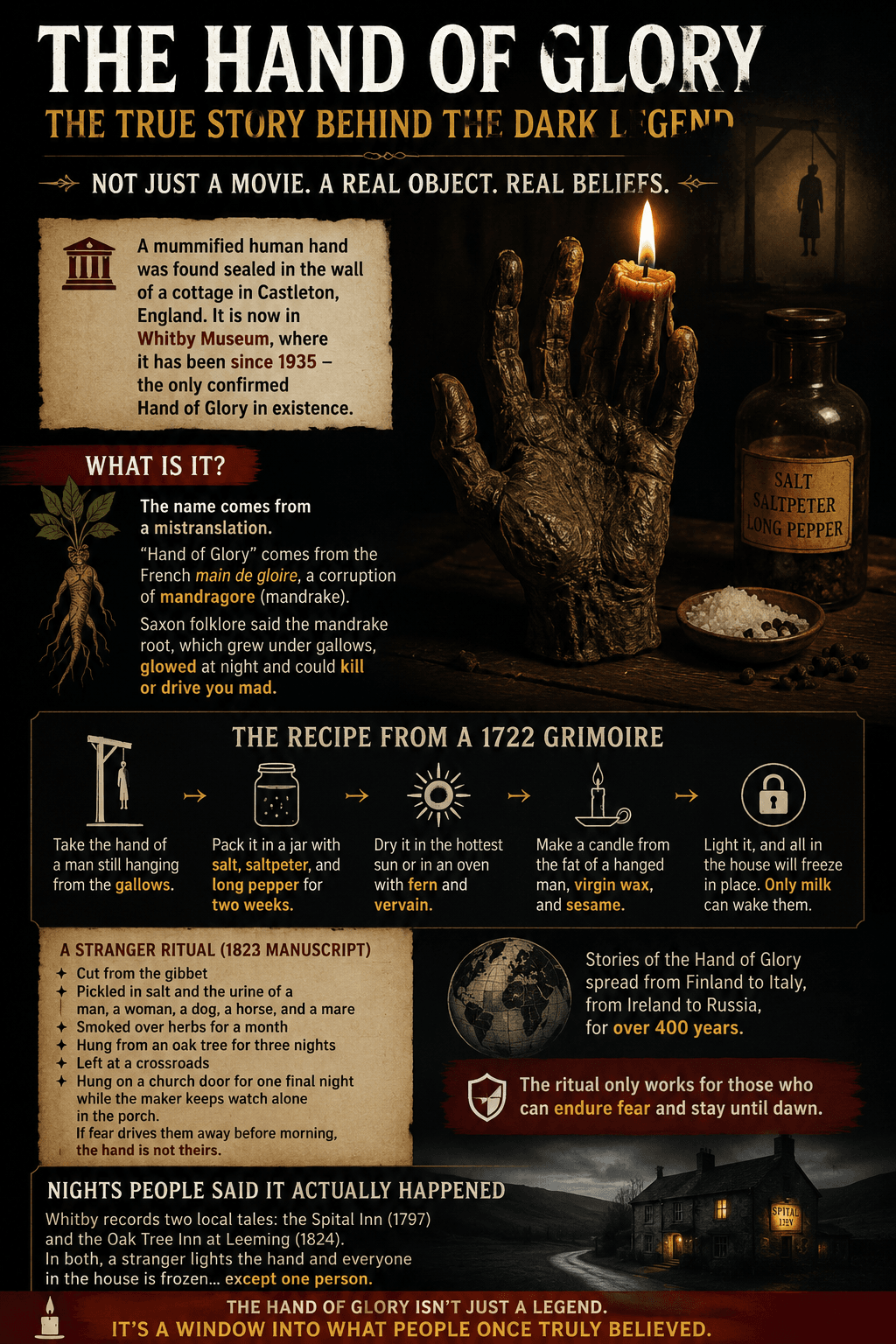
The Hand of Glory true story starts with an actual object: a mummified human hand, sealed for decades inside the wall of a thatched cottage in Castleton, England, until someone found it in the early twentieth century and had no idea what they were looking at. An antiquarian recognized it immediately from old stories and passed it to a local historian named Joseph Ford before it could be lost or thrown out. It went to Whitby Museum in 1935, where it still sits today, the only object of its kind confirmed to survive.
Museum records don’t note who the man was, what he did to end up hanging outside a village, or how long the hand had been sealed inside that wall before anyone found it. That absence of a name is its own kind of detail. Talk to Me gives its characters a different hand entirely, cast and wired and allegedly made from an embalmed medium, and tells them that if they light a candle, hold it, and say the words, something on the other side will answer. The film invented that hand. It did not invent the idea behind it.
What People Actually Believed a Dead Hand Could Do
The name itself is a mistranslation that stuck. “Hand of Glory” descends from the French main de gloire, itself a corruption of mandragore, meaning mandrake. Saxon folklore held that the mandrake root, said to sprout from the ground beneath a gallows, glowed faintly at night, and that glow migrated into the legend of the hand until the two ideas fused into one object.
The mandrake was already its own object of dread long before anyone attached a hand to it: root systems that vaguely resemble a human torso and limbs, said to scream when pulled from the ground, said to kill or drive mad anyone who heard that scream unprotected. None of that is metaphorical exaggeration on my part; those are the literal, sincerely recorded beliefs of the people writing these texts. A society that already accepted a screaming, glowing plant root as plausible had very little trouble accepting that a dead man’s hand, prepared correctly, might do something similar.
The recipe survives, and it’s the part that stays with you longest, because of how procedural it is. The 1722 grimoire Petit Albert lays it out like a set of cooking instructions: take the hand of a man still hanging from the gallows, wrap it in a piece of the cloth used to cover his coffin, and press the blood out of it.
Pack it into an earthenware jar with salt, saltpeter, and long pepper, and leave it sealed for two weeks. Dry it in direct sunlight through the hottest days of summer, or in an oven with fern and vervain if the sun won’t cooperate. Then make a candle from the fat of a hanged man, virgin wax, and sesame, and set it into the hand like a candlestick.
Light it, the text promises, and everyone in the house you enter freezes in place. They will not wake. The flame can’t be put out with water. Only milk works.
A separate account, tied directly to the Whitby hand and recorded in an 1823 manuscript, describes something stranger still. Cut from the gibbet. Pickled in salt and the urine of a man, a woman, a dog, a horse, and a mare. Smoked over herbs for a month.
Hung from an oak tree for three nights. Left at a crossroads. Then hung on a church door for one final night while the maker stood watch alone in the porch. If fear never drove the maker out of that porch before morning, the hand was theirs to keep. If it did, it wasn’t.
Versions of this belief traveled an enormous distance without much modern communication technology to spread them. Folklorists have traced Hand of Glory stories from Finland to Italy, from western Ireland to Russia, repeating across roughly four hundred years with only minor regional variation in the recipe. A belief doesn’t cross that much geography and that much time by accident. It crosses because it’s answering something people across very different cultures needed answered: what would it take to get past a locked door, a sleeping household, a world of rules built specifically to keep you out.
That detail is doing real work. The ritual is built to insist that the object only functions for someone who has already proven they can sit through a night alone with the thing that’s supposed to frighten them. Talk to Me tells its teenagers a version of the same promise: that whatever comes through the ceramic hand is only dangerous for people who aren’t brave enough, or reckless enough, to keep holding on.
The Nights People Said It Actually Happened
Whitby’s own museum records list two local tales of a Hand of Glory being used exactly as the recipe claimed it would work. One is tied to the Spital Inn, on the moors at Stainmore, in 1797. The other belongs to the Oak Tree Inn at Leeming, supposedly in 1824. In the Spital Inn version, a servant named Bella was told by the innkeeper, a man named Anderson, to keep watch over a beggar who’d been given a night’s shelter by the kitchen fire.
The general version of the story, retold across Northumberland for generations, follows the same shape almost every time. A stranger arrives at a remote inn on a bad night and asks for shelter. He’s given a spot by the fire and waits until the house goes quiet. Then he pulls a shriveled hand from his coat, sets it upright, and lights it, and it does exactly what it’s supposed to do. Everyone in the house goes still. Everyone except whoever was left awake to watch.
That person is almost always a servant, alone in the kitchen, watching through a crack in a door. She sees the fingers catch flame one at a time, sees the man start filling a sack with whatever he can carry, and runs to wake the house. Nobody stirs. It isn’t sleep, and shaking someone doesn’t reach whatever state the hand has put them into.
She tries water on the candle first. It burns brighter. She tries the last of a beer jug. Same result. It’s only milk, in every surviving version of the tale, that finally puts the flame out, wakes the house, and gets the thief caught before he can leave with what wasn’t his.
Nobody telling these stories seems especially interested in whether the hand actually worked. That was never the question that mattered around the fire. What mattered was what a person will do once they’re handed something that promises to erase every rule protecting a house full of sleeping strangers, and whether anyone in the room is willing to stay awake long enough to stop them.
Reading Talk to Me Through an Older Ritual
Talk to Me builds its own version of the porch test. The rule its characters invent is ninety seconds: hold the hand, let something in, and you have a minute and a half before you have to let go or risk it staying.
It’s an arbitrary number that functions exactly like the Petit Albert’s fortnight in salt and saltpeter, or the Whitby manuscript’s three nights on an oak tree. The specifics don’t matter. What matters is that a ritual with steps feels safer than a door with no steps at all, even when nothing about the steps actually controls what comes through.
Mia’s arc across the film is the burglar’s arc, run in reverse. The old stories are told from the household’s side, about resisting a stranger who wants access to something that isn’t his. Talk to Me tells its version from the stranger’s side, following someone who wants access badly enough to keep pushing past every rule she and her friends invented for their own protection. She isn’t trying to take something out of a house. She’s trying to bring someone back into her life who the actual rules of the world have already declared unreachable.
The hand offers her a version of the same lie every Hand of Glory story tells its readers: that there’s a technique, a correct sequence, a right way to hold the thing, that gets you past a boundary that was never actually built to be gotten past. Every servant girl standing watch in every old telling of this story eventually reaches for milk, because the tale needs someone who resists long enough to break the spell. Talk to Me is more honest about how rare that person actually is in a room full of teenagers convinced they’re the exception.
The Other Hands That Kept Turning Up
Whitby’s is the one with the clearest paper trail, but it was never the only object people claimed as one. A four-hundred-year-old mummified arm still hangs from the ceiling of the Church of St. James the Greater in Prague, tied to a folk legend about a thief who reached for jewels on a statue of the Virgin Mary and found the statue’s grip closing around his arm and refusing to let go. Parishioners could only free him by amputating the arm.
It’s hung there ever since, less a Hand of Glory in the classical recipe sense than a warning displayed exactly the same way one would have been: in plain sight, meant to be looked at. Nobody pickled it in saltpeter or hung it from an oak tree for three nights. It ended up displayed the same way anyway, because the impulse behind both traditions is identical: take the part of the transgressor that reached for something forbidden, and put it somewhere everyone afterward has to walk past.
An English pub in Wiltshire displayed one for most of the twentieth century, discovered during renovations in 1911 and said to belong to a gambler caught cheating at cards, his hand severed by a butcher and thrown into a fireplace as punishment. The pub kept it behind glass alongside an original deck of eighteenth-century playing cards. It was stolen in 2010 and has never resurfaced.
A limestone-preserved hand in North Rhine-Westphalia, Germany, known locally as the “perjury-hand,” sat in a wooden box at a Catholic church from 1907 onward, until the town finally raised enough money to send it to Düsseldorf University for proper forensic dating. It was stolen in 2012, just before the testing could happen, and it was never recovered either.
Objects built specifically to warn people away from exactly this kind of theft kept getting stolen anyway. That’s the same pattern, repeating at a different scale. The legend was never really about a magic hand. It was about how thin the line is between being warned off something and being drawn toward it. The Wiltshire hand sat behind glass for nearly a century before anyone touched it.
The German hand waited even longer, sitting quietly in its wooden box through two world wars and a church renovation, only to disappear in the handful of months before it could finally be tested and understood. Both thefts remain unsolved. Whoever took them didn’t leave a note explaining why, which means the only honest answer left is the same one the old stories kept circling: something about a preserved dead hand still makes people want to possess it, use it, or simply own the fact of having taken it, more than they want to leave it alone.
What’s Actually Preserved, Versus What People Needed to Be True
The Whitby hand is real, and its documented history is plain enough: hidden in a cottage wall, recognized by an antiquarian, preserved by a local historian, donated in 1935. What was never documented, and never could be, is a single confirmed instance of it, or any hand like it, producing the effect four hundred years of stories insisted it could. Every burglary tale is secondhand, reshaped by whoever told it that particular night at that particular fire, adjusted a little further from whatever the original event may or may not have been.
That gap, between the object that demonstrably exists and the power that demonstrably doesn’t, is where this kind of belief always lives. It’s the same gap Talk to Me builds its entire premise inside: a physical object, a real ache to reach someone who is no longer reachable, and a ritual that promises access it was never actually built to provide safely.
Not the recipe. Not even the hand itself. The belief that a version of desperation exists strong enough to make holding a dead stranger’s hand up to a flame feel, for one night, like a reasonable thing to try.
The hand in Whitby Museum can’t hurt anyone now. It sits behind glass, catalogued, lit by nothing more dangerous than a gallery bulb. But it took four centuries of people almost convincing themselves otherwise, and at least three other preserved hands elsewhere in Europe getting stolen by people who apparently still believed it, to get here. That’s the actual shape of the Hand of Glory true story, once you set the candle-lighting and the coma-inducing glow aside: a four-hundred-year argument between fear and want, long after the candle stopped being the point, that never fully resolved in either direction.
What is the Hand of Glory true story people usually mean when they ask about it?
Most people asking about the Hand of Glory true story are really asking two separate things at once: whether a real preserved human hand like this ever existed, and whether it ever actually worked the way folklore claimed. The first answer is yes — several documented specimens, including the one at Whitby Museum, are real. The second has never been verified by any surviving evidence.
Is the Hand of Glory in Talk to Me based on a true story?
Not directly. Talk to Me’s embalmed ceramic hand is an invention of directors Danny and Michael Philippou. But the idea of a preserved human hand used as a supernatural tool is centuries old and well documented in European folklore, most famously through the Hand of Glory legend and the real specimen held at Whitby Museum.
Is the Hand of Glory at Whitby Museum real?
A real mummified human hand is on display at Whitby Museum in North Yorkshire, England, donated in 1935. It is described by the museum as the only surviving object of its kind. Whether it, or any hand like it, ever produced the supernatural effects folklore attributed to it has never been documented.
What was a Hand of Glory supposed to do?
According to 18th-century texts including the grimoire Petit Albert, a Hand of Glory, fitted with a candle made from a hanged man’s fat, would render everyone in a house motionless while burglars robbed it undisturbed. The flame was said to be extinguishable only with milk.