
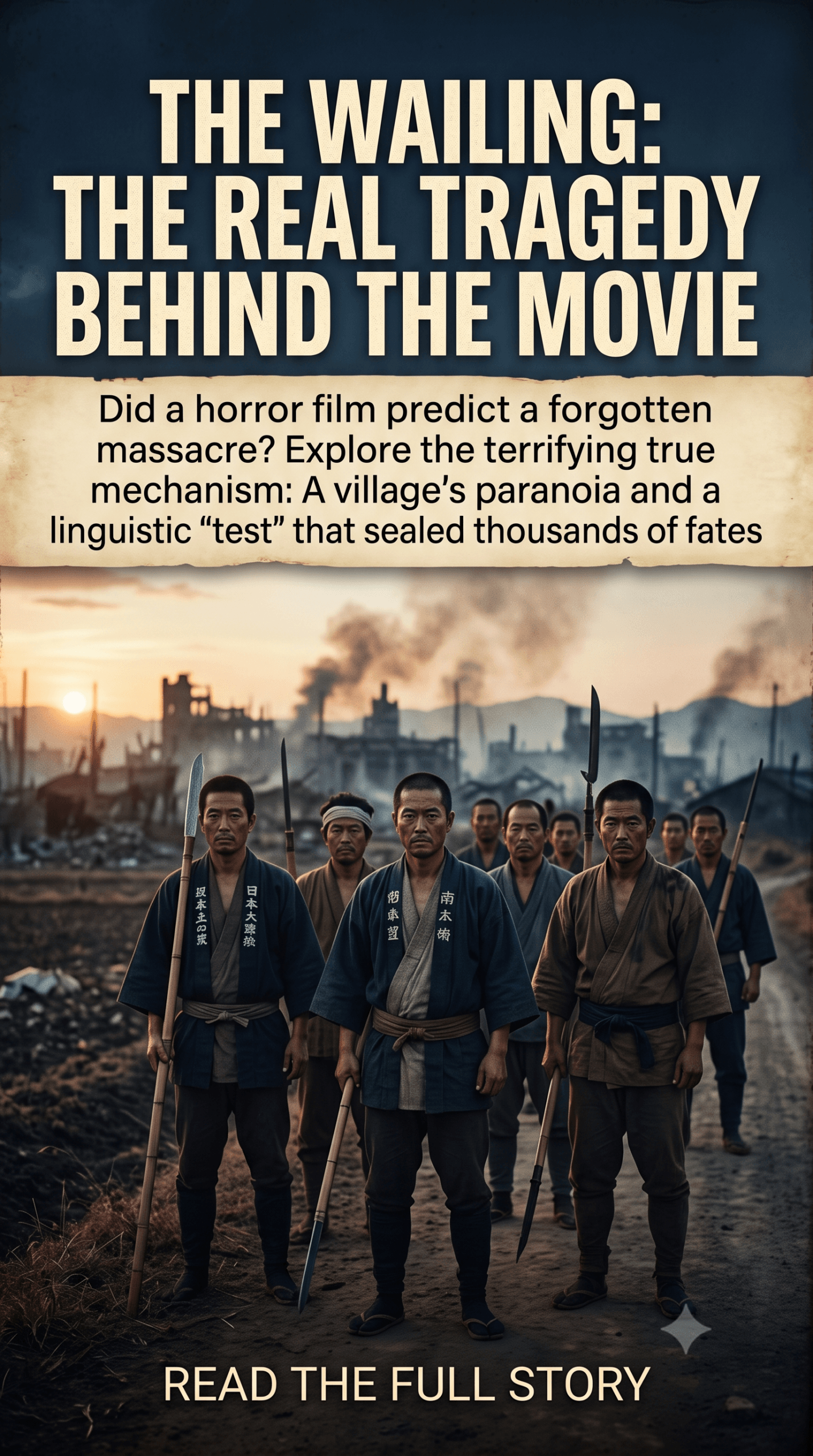
The Wailing true story question has one honest answer: no, not directly. Na Hong-jin wrote an original screenplay, not an adaptation of a real case. But the mechanism at the center of his film, a village testing a stranger for guilt that was never really there to find, already happened in recorded history, on a scale that makes Gokseong’s rumor mill look almost restrained. In September 1923, in the aftermath of an earthquake that leveled Tokyo and Yokohama, Japanese vigilantes stopped strangers on the road and asked them to say a phrase out loud. Getting it wrong could mean death.
So could getting it right, if the mob had already decided who you were before you opened your mouth, because by then the decision had stopped being about evidence at all.
The Wailing True Story: A City on Fire, and a Rumor Moving Faster Than the Fires Did
The Great Kanto Earthquake struck the Kanto Plain at 11:58 a.m. on September 1, 1923, with a magnitude estimated between 7.9 and 8.2. It remains one of the deadliest earthquakes in recorded history. Between 105,000 and 140,000 people died, the overwhelming majority in the firestorms that followed the shaking, fires that fed on a capital built largely from wood and paper in the middle of lunch hour, when cooking fires were lit in tens of thousands of homes at once.
Within hours, a second disaster began moving through the wreckage, and this one had nothing to do with tectonics. Rumors spread that ethnic Koreans living in Japan were poisoning wells, setting fires deliberately, looting the ruins, and preparing an organized uprising in retaliation for Japan’s colonial rule over Korea. None of it was true. All of it spread anyway, carried by word of mouth through a population already in shock, primed by decades of state-sponsored contempt for the colonial subjects living among them.
The rumors weren’t just street gossip. A cable sent under the name of Fumio Gotō, then director general of the Home Ministry’s Police Affairs Bureau, told regional authorities: “Taking advantage of the earthquake, Koreans are setting fires in various places, and in Tokyo there are those who possess bombs, pour oil, and set fires.” It instructed local governments to “strictly control the behavior” of Koreans in their jurisdictions. A government charged with restoring order had, within a day of the earthquake, put its own signature on the exact panic it should have been containing.
Colonial Contempt Went In Ahead of the Rumor
None of this happened in a vacuum of sudden, inexplicable hatred. Japan had annexed Korea outright in 1910, ruling it as a colony and treating Koreans within the empire, including the roughly 20,000 to 40,000 living in the Kanto region at the time of the earthquake, as a subordinate population by law and by custom. Colonial-era textbooks, newspapers, and government policy had spent over a decade building a hierarchy that placed Koreans beneath ethnic Japanese, and that hierarchy didn’t need an earthquake to exist. It needed an earthquake to become an excuse.
That distinction matters because it explains why a rumor this specific and this baseless could travel faster than accurate information about the disaster itself. A population primed for over a decade to see Koreans as a threat requiring “strict control,” to borrow the Home Ministry’s own phrase, didn’t need much convincing that the chaos of a shattered capital was being made worse on purpose by the people they’d already been taught to distrust. The earthquake didn’t manufacture the prejudice. It gave the prejudice something to do.
The Test
Self-defense groups called jikeidan formed almost immediately, roughly 3,689 of them across the affected region, usually organized around a local figure of standing — a landlord, a shopkeeper, a former soldier. They armed themselves with swords, bamboo spears, and whatever else was on hand, and they set up checkpoints on the roads leading out of the disaster zone.
The mechanism they used to sort friend from enemy was linguistic. Korean speakers of Japanese, even fluent ones, tend to struggle with certain sounds that don’t exist in the same form in Korean phonology — specifically the elongated vowels and the distinction between certain consonant sounds in words like “ba,” “bi,” “bu,” “be,” “bo” versus their voiced/unvoiced counterparts. Vigilantes exploited this by demanding that anyone they stopped repeat a specific phrase: jyūgo-en gojissen — fifteen yen, fifty sen. Get the pronunciation wrong, even slightly, and the crowd had its answer.
It is worth sitting with how thin that test actually was. All it measured was whether a frightened, exhausted stranger, possibly separated from everything they owned, possibly grieving people they’d just lost, could produce a specific vowel sound on command in front of an armed crowd that had already decided what the correct answer needed to sound like — nothing about guilt, nothing about intent, just pronunciation under duress.
Fukuda Village
On September 6, 1923, a group of fifteen traveling medicine sellers were stopped on the road in Fukuda Village, in what is now the city of Noda in Chiba Prefecture. They were peddlers, part of a long-standing itinerant trade that moved through rural Japan selling household remedies. They were also, as it turned out, ethnic Japanese — members of the burakumin, a hereditary outcaste group that had faced centuries of discrimination within Japanese society itself, entirely separate from the anti-Korean panic sweeping the country that week.
They spoke with a regional accent from Kagawa Prefecture, on the far side of the country. The vigilantes at the checkpoint couldn’t place it, decided it sounded foreign enough to be suspicious, and administered their test. Nine of the fifteen were killed, including a pregnant woman and children.
I want to be exact about what that means, because the specifics are the entire horror. These weren’t Korean people killed by a test built to identify Koreans, which would already be an atrocity. These were Japanese citizens, already marginalized by their own government for reasons that had nothing to do with Korea, killed because a mob administered an unreliable linguistic test to strangers whose only actual crime was traveling for work and sounding like they came from somewhere else.
The test caught people it was never designed to catch, and the crowd killed them anyway rather than admit the tool in their hands might be worthless.
One of the merchants survived and testified decades later, in a postwar civilian investigation: “I heard two gunshots. I remember thinking, oh they must’ve gotten killed. They kicked and pushed the merchants to the brink of death. For those who were still breathing, they tossed them into the Tone River.” Asked to characterize what he’d watched, he didn’t reach for a word like “cruel” or “brutal.” He said: “It was something a human wouldn’t do.” I’ve read a lot of survivor testimony over the years.
That specific refusal to supply an adjective, that flat statement that the category “human behavior” simply didn’t stretch far enough to cover it, is one of the more honest descriptions of mass violence I’ve come across.
What the Numbers Refuse to Settle Into
Nobody agrees on how many people died in the three weeks of violence that followed the earthquake. The Japanese government’s contemporary accounting listed a few hundred deaths, nearly all attributed to “self-defense” by private citizens acting without official sanction. Independent investigators, Korean community organizations, and later historians have put the number closer to 6,000 Korean and Chinese residents killed, alongside an unknown number of Japanese citizens like the Fukuda Village victims, misidentified and killed by the same mechanism.
The gap between those numbers isn’t a rounding error. It exists because Japanese authorities destroyed evidence in the massacre’s immediate aftermath — burning bodies, obstructing the investigations that might have produced a real count, and maintaining to this day that no official government records of the killings exist. A disaster that could be measured in seismographs produced a death toll that can be measured only in the space between what a government admits and what everyone else has spent a century trying to prove.
The Trials
Japanese authorities arrested somewhere between 600 and 700 jikeidan members in the weeks and months after the massacre, a number that on its own suggests the scale of what had happened was impossible to fully suppress even with bodies burned and records destroyed. Of those arrested, only 125 were formally prosecuted. Of those 125, 91 received suspended sentences and 2 were acquitted outright. Only 32 people served any prison time at all for a killing spree that left thousands dead, and the longest sentence handed down was four years.
The jikeidan, for what it’s worth, weren’t operating with improvised weapons alone. Testimony and contemporary accounts describe the military supplying clubs, iron pipes, and other arms to the same vigilante groups the government would later describe as private citizens acting outside official sanction. A state that armed the mobs, arrested a fraction of them, prosecuted a fraction of that fraction, and then spent the following century insisting no official records of the killings exist has done more than fail to prevent an atrocity. It has spent a hundred years managing the story of one.
A Hundred Years of Not Answering
The anniversary came and went in September 2023, the hundredth since the earthquake and the massacre both. At a press conference three days before it, Japan’s Chief Cabinet Secretary, Matsuno Hirokazu, was asked directly whether the government would investigate. His answer: “We cannot find records that can confirm facts.” That same year, a civilian research group in Kanagawa Prefecture surfaced a document the government itself had produced two months after the massacre — dated November 21, 1923, naming 145 murder victims by occupation and age.
The record the Chief Cabinet Secretary said didn’t exist had existed the entire time, sitting in an archive nobody in his office had apparently thought to check, or wanted to.
Tokyo’s memorial park has a stone engraved with a death count of 6,000. Its accuracy is disputed by a right-wing women’s group called Soyokaze, which has lobbied since 2016 to have the stone removed and holds its own competing memorial event it calls, without any apparent sense of irony, the “Memorial Service of Truth.” Tokyo’s current governor, in office since 2016, sent a condolence letter to the massacre victims’ annual ceremony her first year and has declined to send one every year since 2017, while continuing to send one to the general earthquake memorial without interruption.
In 2022, the Tokyo Metropolitan Human Rights Plaza canceled a scheduled screening of a short film that included a single scene referencing the massacre, offering only the explanation that the content “did not align with the objectives of the display event.”
None of this is ancient history filed away and settled. It’s an argument still being had, in the present tense, over whether an acknowledged historical event deserves to be acknowledged by the government whose own officials helped spread the rumor that caused it. The earthquake resolved itself the way earthquakes do — the ground stopped moving, the fires burned out, the city got rebuilt. The massacre never got the equivalent of any of that. There was no formal reckoning, no accounting of the dead that both sides accept, no apology delivered with enough authority to end the argument.
A hundred years is long enough for a wound to become a fact of the landscape rather than an event anyone expects resolved.
The Traffic Stop
I got pulled over once on a Texas highway, late at night, driving back from an assignment. I hadn’t done anything. The officer was polite, I was polite, because politeness was the only tool available to me in that situation regardless of whether I’d earned suspicion or not. License, registration, where are you coming from, where are you going. I was released in ten minutes with nothing on my record and nothing wrong with my car.
What stayed with me afterward was a specific, low-grade fury at the logic that had put me there in the first place, more than any anger at the officer himself — the fact that a uniform and a badge can require you to prove your legitimacy on demand, and that “prove it” is a request you cannot actually refuse.
I think about that ten minutes every time I read about the fifteen yen fifty sen test, scaled up by a factor I can’t fully process. I was asked for a license. The people stopped on those roads in 1923 were asked to perform a vowel sound correctly while surrounded by armed men who had already decided, before the test began, what result would justify what they were about to do. My ten minutes ended with an apology and a taillight I hadn’t realized was out. Nine of theirs ended in a ditch in Fukuda Village.
What The Wailing Gets Right, and What It Can’t
The Wailing builds its entire structure around a village that cannot verify who the real threat is, and it refuses, to the end, to hand the audience a clean answer either. That refusal is the film’s most defensible artistic choice. It denies the comfort of a solved mystery because the mystery, in the story it’s telling, was never solvable from where its characters were standing.
The Kanto Massacre denies something worse: a real historical record of a test that was never designed to verify anything at all, deployed by people who had already decided on the outcome before the test began, applied against Koreans and, when convenient, against Japanese citizens who simply didn’t sound like they belonged. Na Hong-jin’s fictional village at least gets the epistemological question honestly wrong — nobody in Gokseong could have known for certain what they were looking at.
The men who stopped fifteen medicine peddlers on a road in Chiba Prefecture in September 1923 didn’t have that excuse. They had a phrase, a sword, and a decision already made, and they used the first two to dress up the third as something that looked, for exactly as long as it took to kill nine people, like justice.
The surviving merchant reached for the same absence of language I keep reaching for whenever I try to describe how a government can lose 145 named victims in its own archive for a century. He couldn’t call it cruel. Cruelty implies a recognizable motive, a person doing a comprehensible bad thing for a comprehensible bad reason. What he watched didn’t have that shape. It had the shape of ordinary neighbors administering a test they knew, on some level, couldn’t actually prove anything, and killing nine people rather than sit with the discomfort of not knowing.
Gokseong’s mob gets that same discomfort in a two-and-a-half-hour film with a script, a director, and an ending. Fukuda Village got it on a Thursday afternoon in 1923, with no script at all, and nobody has ever agreed on how it ends.
The Wailing True Story: Quick Answer
No — The Wailing true story searches turn up nothing, because Na Hong-jin wrote an original screenplay. What’s real is the mechanism the film dramatizes: a community testing a stranger for guilt using a method that can’t actually detect it, then acting on the result anyway. That exact pattern killed thousands of people after the 1923 Great Kanto Earthquake.