
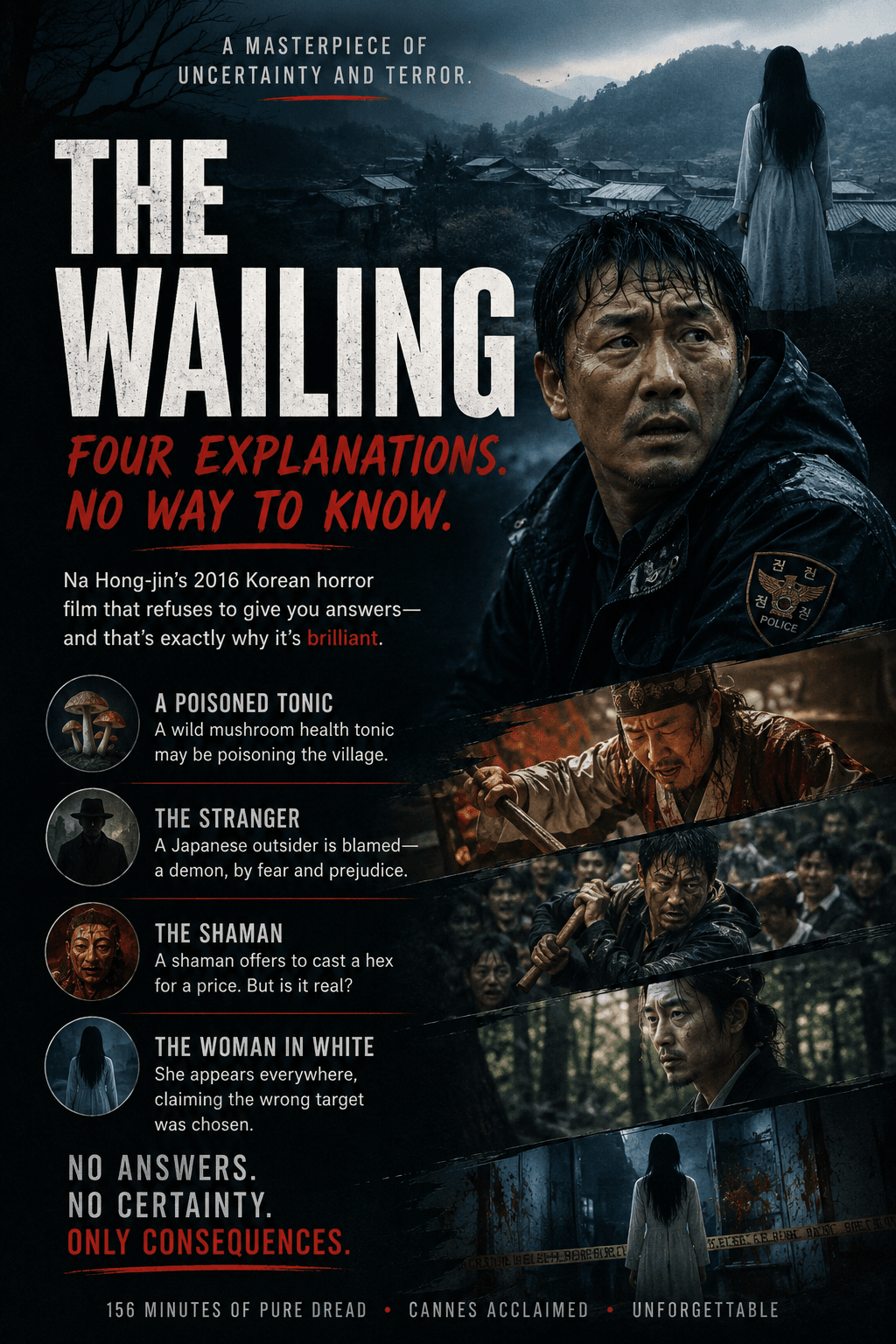
The Wailing ending explained, in plain terms: Jong-goo’s family dies because he breaks a three-second test of patience one crow early, a shaman he trusted turns out to have been working for the thing killing his daughter, and a scene late in the film all but confirms the demon was real — arriving after it can no longer save anyone. That’s the mechanical answer. The review already made the case that the mystery stays open by design, and I’m not walking that back.
But there’s a difference between the mystery staying open and the plot staying vague, and the last twenty minutes of The Wailing are far more specific than the film’s reputation for ambiguity usually gets credit for.
Something concrete happens to Jong-goo’s family. A specific betrayal gets revealed. A specific choice gets made, at a specific moment, and it’s the wrong one. The film just refuses to let that specificity add up to comfort. Here’s what actually happens, in order, and what it costs.
The Wailing Ending Explained: The Three Crows
The mechanism the ending turns on is almost absurdly simple for a film this thematically dense: Moo-Myung, the woman in white, tells Jong-goo to stay put. She has warded the house. A rooster will crow three times. If he waits for the third crow without moving, his family survives. That’s the whole test — not a puzzle, not a ritual with steps to get wrong, just patience measured against a bird’s throat.
Jong-goo doesn’t make it. He hears the first crow, then the second, and by the time the third one starts he’s already moving, already convinced that staying still one second longer is the mistake and not the solution. He breaks for the house. The film shows us, in a single small image most people register only on a second watch, the flower Moo-Myung placed on the door shriveling the moment he steps outside the ward. Evil gets a door. It takes it.
What makes this unbearable instead of just cruel is the specific shape of the failure. Jong-goo doesn’t fail because he’s stupid, or weak, or unloving. He fails because he’s a father who has spent the entire film being told to trust people who kept giving him reasons not to, and the one time trust would have worked, his nerve runs out three seconds early.
The tragedy sits less in the wrong choice itself than in how thoroughly he’d been trained by everything preceding this scene to make it — the training worked exactly as efficiently as the film needed it to.
Hyo-jin’s Last Scene
Kim Hwan-hee plays the killing itself completely differently from the cursing and thrashing she’s given earlier in the film. The mid-film possession is loud — Hyo-jin screaming obscenities at her father, thrashing against restraint, the kind of performance that reads, correctly, as a child channeling something enormous and furious. The final scene drops nearly all of that. What’s left is quiet, almost administrative, a girl completing a task without any of the earlier performance’s visible rage behind it.
That shift is the more disturbing choice, and it’s a harder one to act than the screaming was. Rage is legible. A child killing her family with the flat affect of someone finishing homework is not, and Kim holds that flatness through the scene without reaching for a single moment of readable emotion to give the audience somewhere to land. By the time Jong-goo comes home to find what’s left of his family, the girl standing in the wreckage isn’t performing horror at him.
She’s just there, and that absence of performance is what makes the scene function as an ending rather than a climax.
What Il-gwang Actually Was
The clearest, coldest piece of information the ending delivers is about the shaman. Moo-Myung’s warning to Jong-goo carries more than “don’t go home” — underneath it is an accusation. She tells him Il-gwang has been lying, that the ritual he performed had actually been accelerating whatever the stranger had already started — the exact opposite of the cleansing the family paid for, and that the two of them — shaman and stranger — have been working together the entire time.
Sit with what that recontextualizes. The ritual sequence, which the review spent real time praising for how physically convincing Hwang Jung-min makes it — the shaking, the gagging, a body working like it’s actually being fought over — was never a rescue attempt. It was the mechanism.
The family paid a shaman ten thousand dollars to perform the thing that was killing their daughter faster, and the scene sells it so completely as effort and risk that there’s no way to watch it a second time without a specific kind of dread: the realization that you were rooting for the wrong side of the intercut, that the mob outside beating a man half to death was closer to right than the ritual you found compelling.
Whether Il-gwang was a true believer who’d made a deal he didn’t fully understand, or a cynic who knew exactly what he was charging for, the film doesn’t clarify — and here the ambiguity from the review does hold, because that distinction matters enormously and Na Hong-jin declines to resolve it. What he doesn’t decline to resolve is the outcome. The shaman was not on Jong-goo’s side. That part isn’t a matter of interpretation anymore.
Who — or What — Is Moo-Myung
Her name is Moo-Myung, which translates to something close to “no name” — she’s never given a proper one, which is itself a small piece of information about how the village and the film both regard her. A woman without a name is a woman nobody has bothered to fully account for, and that’s true of how every character treats her right up until the ending forces the question of who she actually is.
Some readings of the film place her alongside a specific figure in Korean folk religion: the seonangsin, a village guardian spirit tied to a particular place, whose job is protecting a community from exactly the kind of calamity spreading through Gokseong. Under that reading, her white clothing carries a color association most Western viewers miss entirely — purity, and the Yang half of the yin-yang balance — warmth, protection, the daylight half of a cosmology the film otherwise spends its runtime in the dark half of.
She shows up at crime scenes because a guardian would be exactly where the damage is, following the wreckage rather than causing it.
The film gives that reading real support. She’s the one who tells Jong-goo what the stranger actually is before anyone else will say it plainly. She’s the one who constructs the ward on his house. She’s the one whose warning turns out, per the accusation she levels at Il-gwang, to have been accurate about where the real threat was coming from. Weighed against the shaman’s track record in this story, her batting average is considerably better.
And yet the film never fully clears her, either. Il-gwang’s counter-accusation — that she is the evil spirit, not the stranger — gets delivered with enough weight and conviction that a first-time viewer has no clean way to rule it out in the moment. Jong-goo doesn’t rule it out either, which is precisely why he doesn’t wait for the third crow. He’s not just impatient.
He’s choosing between two competing warnings from two people who each have reasons to be believed and reasons to be doubted, and he picks wrong under exactly the kind of pressure that makes picking wrong understandable.
What the ending confirms, retroactively, is that her account was the accurate one — the shaman was compromised, the stranger was real, the family needed him to wait. What it can’t retroactively fix is that “accurate” and “believable in the moment” are different qualities, and Moo-Myung had the first without ever fully securing the second. A guardian spirit whose warnings aren’t trusted in time protects no one.
That failure is built into the position itself, more than into anything she did wrong — you can be right about the danger and still lose, if being right doesn’t come packaged with anything that makes a frightened, exhausted father choose you over the man he already paid to help.
The Cave
The strongest single piece of evidence for what the stranger actually is arrives almost as an afterthought, late, to a secondary character. Yang I-sam — the deacon-in-training who spent the film’s middle stretch as an interpreter and go-between, useful precisely because he had no strong position of his own — follows a lead into a cave and finds the stranger there. What he sees is not a frightened old man.
Multiple critics who’ve written about the ending describe this as the moment the film finally shows its hand: something genuinely monstrous, a true form the stranger had been concealing the entire time he was being hunted, humiliated, and eventually killed by Jong-goo and his friends.
Critic David Ehrlich, reviewing the film for IndieWire out of Cannes, wrote a line that’s since become the closest thing this ending has to an epitaph: “It’s bad to see the devil, but it’s much worse when the devil sees you.” Yang I-sam sees it. The audience, briefly, sees it too.
Here’s the part that makes this revelation land as grief instead of vindication: it arrives after Hyo-jin is already dead. The confirmation that the stranger really was what the village feared doesn’t save anyone. It doesn’t even reach Jong-goo in time to change his choice at the door — narratively, it can’t, because his choice has already been made by the time this scene plays out.
The film gives its clearest answer to “was the threat real” at the exact moment that answer stops being useful to anyone, which is the entire thesis of the film compressed into one scene: the truth exists, it was always there to be found, and finding it doesn’t help.
The Scene Most People Never See
There’s a deleted ending — not part of the theatrical cut, and I want to be precise about that distinction because it’s load-bearing. In it, the stranger is shown sitting on a bench, offering candy to a little girl, until her mother notices and pulls her away. The stranger and Il-gwang then drive off together, presumably toward whichever town is next.
If Na Hong-jin had kept this scene in the release, it would have answered nearly everything the theatrical ending leaves open. It confirms the stranger survives. It confirms the shaman’s complicity as an ongoing partnership, running well past whatever a single lapse would look like. It reframes Jong-goo’s family as one stop on a repeatable route this pair has apparently run before, will run again, and will keep running for as long as parents are distracted enough to look away.
It’s also, notably, the only place in any version of this story where we see the mechanism of selection made explicit — a mother’s attention is what saves her child, which makes Jong-goo’s absorption in police work during the exact stretch his own daughter needed watching feel less like coincidence and more like the film quietly grading him against a standard he didn’t know he was being held to.
Cutting it was almost certainly the right call. By every account it’s a competent, chilling scene on its own terms, but keeping it would have solved the mystery the entire rest of the film works to keep unsolved. Na Hong-jin apparently understood that a film built for three hours around “you cannot verify this” shouldn’t end with a scene that verifies it. The theatrical cut trusts the audience to sit with not knowing. The deleted scene would have let them off that hook. I’m glad it stayed in a drawer.
A Director Who Keeps Writing This Failure
This isn’t the first time Na Hong-jin has built a chase around a protagonist who does everything right and still loses the person the chase was supposedly about. In The Chaser, his 2008 debut, ex-cop Joong-ho spends the film’s back half racing to save a woman named Mi-jin from a serial killer, following every lead correctly, arriving at the right building — and getting there just after she’s already been murdered. What he salvages instead is her daughter, which the film offers as something closer to a consolation than a resolution.
In The Yellow Sea, the pattern repeats at a larger scale. Gu-nam crosses illegally from China into Korea on a mission that starts as a search for his missing wife and metastasizes into a manhunt he never fully controls. He survives an enormous amount of violence to get there. What he finds at the end is his own death, or something close enough to it that the director himself has said audiences are free to read it either way — his wife is nowhere in it.
Jong-goo fits this same shape exactly. He investigates. He confronts the stranger directly, with a pickaxe, before anyone else does. He calls in a shaman, spends money he apparently doesn’t have to spare, and later runs for home the instant he suspects delay might cost him more than waiting would. Every single action he takes is the action a determined father is supposed to take.
Na Hong-jin’s filmography turns this into something like a house style, more than a flaw specific to Jong-goo’s judgment: give a man a concrete, physical goal, let him pursue it with everything he has, and then make sure that effort and outcome were never actually connected in the way the character believed they were.
Why the Stranger Chose a Japanese Face
One thing worth clearing up, because it changes how the ending should sit with you: Na Hong-jin has said directly that the choice to make the stranger Japanese wasn’t about xenophobia as theme, even though the film stages the village’s xenophobia as a real and damning force within the story. In a 2016 interview with Pierce Conran at Cannes, he explained the casting logic this way: “As time went by he would reveal his true nature and we would realise that he is different and that even communication is impossible.
I wanted to express the fear coming from this impossibility of communication.” The threat he wanted looks almost exactly like you, right up until the moment it doesn’t, and by then it’s already inside the house — nothing about it announces itself as foreign or obviously wrong going in.
The film is careful, throughout, to make the village’s suspicion of an outsider look ugly and unearned in the moment it’s happening, mob violence included, and the cave scene doesn’t retroactively excuse that. What it confirms instead is something colder: that the villagers were pointing at the right shape for the wrong reasons, which is arguably worse than being simply wrong. Being fully wrong is at least clarifying.
Being right by accident, while behaving cruelly the entire time you’re doing it, doesn’t let anyone off the hook — not the mob, not Jong-goo, not the audience that spent two hours deciding who to believe based on evidence the film was quietly stacking against every character equally.
Not everyone buys the director’s account of his own intentions, and I think the pushback is worth taking seriously rather than waving off. Some critics have argued that the film’s final act undercuts whatever critique of xenophobia it seemed to be building, that a story which spends two hours making a village’s suspicion of a foreign outsider look ugly and unearned, and then confirms in its last act that the outsider really was the threat, risks handing that suspicion a retroactive justification it spent the entire runtime arguing against.
The casting also doesn’t happen in a vacuum: Japanese characters have played the malevolent outsider in more than one major Korean film, against a backdrop of real colonial history between the two countries, and a director’s stated intent doesn’t erase what an audience carrying that history brings into the theater with them. I don’t think that reading cancels out the impossibility-of-communication idea Na Hong-jin describes. I think both are true at once, which is a less comfortable place to leave this section than resolving it either way would be.
The Wailing Ending Explained: What It All Adds Up To
Na Hong-jin has talked about the reaction to this ending in terms that sound almost bemused. He’s said, in press around the film’s release, that he expected the range of interpretations he got — that with an audience of hundreds, you’ll get hundreds of readings, and that watching people argue about what “really” happened wasn’t a problem for him so much as the expected outcome of the film he’d built.
I believe him, and I think it’s the correct posture for a director whose ending is this carefully engineered to reward multiple readings without validating any single one as definitively correct.
But engineered ambiguity is still ambiguity you can describe precisely, and here’s the precise shape of it: a family is dead because a father needed three more seconds of faith than he had, a stranger was likely exactly the demon the village claimed even though the village had no right to be so sure, a shaman who accepted money to help was working for the thing he claimed to be fighting, and a woman who told the truth the entire time was believed by almost no one, including, fatally, at the one moment it would have mattered.
The takeaway is closer to a Tuesday-afternoon fact than a lesson: sometimes the people trying to warn you sound exactly like the people trying to manipulate you, and you only find out which is which after the choice is already made and can’t be unmade.
Hyo-jin completes the cycle the film opened with — one family member left standing amid the wreckage, the same rash, the same catatonic stare that marked every victim before her. The stranger, so far as the theatrical cut confirms, is still out there. Whatever Yang I-sam saw in that cave, he saw it too late to matter to anyone who needed it to matter in time.
It plays instead like a film telling you, as directly as a film built entirely on withheld information can tell you anything, that some truths only arrive once there’s nothing left for them to save.
The Wailing Ending Explained: Quick Recap
Moo-Myung told the truth, Il-gwang was working with the stranger, and Jong-goo broke the three-crow test one call early, letting the demon into a house that had already been warded against it. The cave scene confirms the stranger was real, but only after it’s too late for that confirmation to save anyone.