The Witch 2015 hidden details you missed start in the first ninety seconds — before anything supernatural happens. William is banished not for vague “religious pride,” but for a specific heresy: he’s too separatist for a colony of separatists.That’s the first of six details this film tells you outright and then buries under overlapping dialogue, a children’s rhyme, a whispered game, a court-ready style of testimony three centuries old, and a dying boy’s fever list.I reviewed this film. I wrote about the real trial records behind it. Neither piece caught what I found this week, sitting with the script open against the finished film, tracking every line the family says out loud before anyone claims to know anything supernatural is happening.Every accusation that destroys Thomasin gets rehearsed, in miniature, by children playing a game — long before any adult raises a formal charge. Every piece of testimony that convicts her would have been admissible in a real seventeenth-century court, for reasons that have nothing to do with whether any of it was true. Here’s where the film shows its hand.
The Witch 2015 Hidden Details You Missed in the Opening Scene
The Heresy Nobody Catches
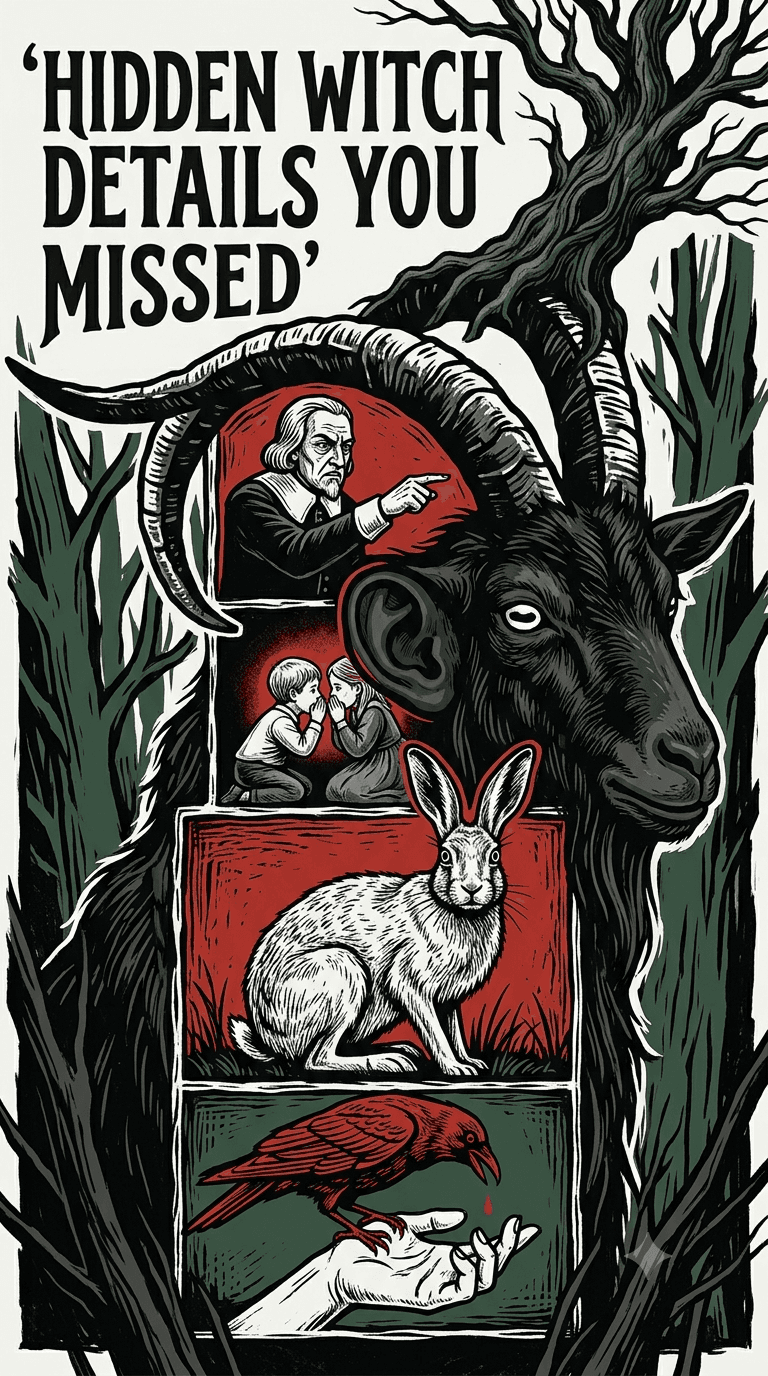
William stands before the governor and a panel of black-clothed magistrates. The charge: “prideful conceit,” for refusing to accept the plantation’s church as sufficiently pure.“I cannot be judged by false contented Christians under an un-separated church,” he says. “An English king’s church.” A Puritan, exiled from a colony of Puritans, for being more Puritan than the Puritans.This isn’t an invented conflict dressed up in period language. Roger Williams was banished from Massachusetts Bay in 1636 for arguing the colony’s churches hadn’t fully separated from the corruption of the Church of England.Anne Hutchinson was banished three years later for claiming a direct, personal channel to God that bypassed the colony’s ministers entirely. Both were exiled by a community of people who had themselves crossed an ocean to escape religious control they considered insufficiently pure — and then built a new authority structure exacting enough to expel its own most devout members for wanting more of what the colony was founded on.William fits that lineage exactly. He isn’t exiled for believing too little. He’s exiled for believing with more intensity than the system that raised him can tolerate, and the film establishes that fact in a courtroom scene most viewers experience as texture rather than information.Watch how the scene is staged. William and the deputy governor talk over each other. The minister cuts in mid-sentence. That overlap is sound design doing concealment work — dense information delivered as noise, so you come away with an impression (banished, prideful) instead of a fact (banished specifically for out-purifying the purifiers).The film hands you the whole machine in minute one, then buries the gears in cross-talk. William rebuilds that exact judgment structure at the edge of the wood, with himself in the judge’s seat this time. The film never spends a scene explaining that irony. It assumes you caught it already, files it under atmosphere, and moves on to the crops.
The Coronation Nobody Notices
About fifteen minutes in, Jonas and Mercy chase Black Phillip around the farmyard, waving sticks, singing:
“Black Phillip, Black Phillip, king of sky and land. Black Phillip, Black Phillip, king of sea and sand. We are ye servants, we are ye men. Black Phillip eats the lions from the lions’ den.”It plays as nonsense — kids inventing a rhyme about the farm goat. But the content isn’t nonsense. It names Black Phillip king of every domain a psalm reserves for God, and it has two children declare themselves his servants and his men.This is a coronation, sung as a skipping-rope chant, in the first act. The scene is staged exactly like a children’s game because it needs to be dismissible as one. Your own instinct to file it under “kids being weird” does the concealment work the film needs done.The film backs the rhyme with something uglier a few scenes later, half-hidden in the background of a farmyard shot: Black Phillip mounting one of the nanny goats, violent and unceremonious, muck kicking up around them while the family works nearby and nobody reacts.It’s easy to read as incidental barnyard realism — Eggers wanted authenticity down to the livestock. But the film has already crowned this animal king of everything. Showing him as the most physically dominant creature on the farm, before he ever headbutts a wall or runs a man through with his horns, isn’t incidental. It’s the film letting you watch the violence accumulate in a body nobody’s watching closely, right up until the day it walks into the farmhouse and the accumulation cashes out all at once.
Hidden Clues Inside the Family’s Own Games
The Goat Told Them First
Later, Jonas and Mercy sit in the goat shed wearing their own goat bells, whispering into Black Phillip’s ear and reporting what he “says.”“What ails Caleb, Black Phillip? Did Thomasin make him sick in the wood?” Thomasin objects. Jonas answers: “Black Phillip saith you are wicked.” Mercy backs him: “He saith you put the Devil in Caleb.”By the time the family turns on Thomasin in earnest, the actual content of the accusation has already been manufactured — complete — by two five-year-olds relaying what they claim a goat told them. Days before any adult voices the theory.I want to be specific about why this detail is worse than it first looks, because the film is being more historically precise here than it gets credit for. Real New England courts, within a decade of when this story is set, accepted something called spectral evidence: testimony that a person’s spirit, or specter, had appeared to a witness in a dream or vision and caused them harm, even while that person’s physical body was demonstrably somewhere else.It made up the majority of evidence used at Salem in 1692. A witness didn’t need to produce an act. They needed only to claim that something invisible had communicated something damning, and the court was structured to receive that claim as testimony rather than rumor.That is exactly the evidentiary standard Jonas and Mercy invoke against Thomasin, three decades early, at goat height, in a shed. Nobody can cross-examine Black Phillip. Nobody can ask him to repeat himself in front of William. The claim is unfalsifiable by design, and unfalsifiable claims are precisely what a system built on spectral evidence is engineered to reward.The film isn’t dramatizing a quirky bit of childhood cruelty. It’s dramatizing the exact legal architecture that would go on to hang nineteen people, sixty years before that architecture had a courtroom to operate in.I don’t think the film wants you to read these children as secret agents of the Devil. It’s simpler and worse than that: frightened kids looking for somewhere to put the fear, in a household already primed to treat accusation as evidence.The court that convicts Thomasin doesn’t require witnesses or proof. It requires someone to say the sentence first. In this family, the someones who said it first were young enough to still be playing, and the system waiting to receive their testimony didn’t care.That’s the detail that earns the anger in this piece. Not the Devil. Not even William’s theology. The machinery that kills this family runs on the least reliable testimony available, dressed in exactly the procedural legitimacy real courts would later grant it, and nobody in the story ever asks where two toddlers got the idea. They got it from a game. The game was enough, because the system was never built to ask for more than that.
The Hare That Keeps Showing Up
Twice, at two of the film’s most consequential turning points, an oversized hare appears out of nowhere, holds still, stares directly at a family member, and vanishes into the wood.First during William and Caleb’s failed hunt — the script describes its fur as “coarse and odd.” It doesn’t flee like a panicked animal. It turns and stares before finally bolting. Nothing about that hunt succeeds afterward; the traps stay empty for the rest of the sequence.Second, alone in front of Caleb, shortly before he wanders deeper into the wood than he’s ever gone and finds the cottage that ends with him possessed and dying in his family’s bed.European and Scandinavian witch-folklore treats a hare crossing your path as exactly this kind of omen: a witch’s familiar, sometimes a witch herself in another shape, sent out to scout or to lure. Crossing paths with one was considered bad luck for a specific reason — you couldn’t be sure you weren’t looking at a person.Eggers never confirms the reading on screen. The hare never speaks or transforms. It watches, at the two moments this family is most vulnerable, and leaves, which is a harder thing to stage convincingly than a monster reveal and a much harder thing for an audience to register as a clue rather than a nature documentary cutaway.A hare that turned into a woman would be a special effect. A hare that stares and says nothing is a warning system nobody in this family has the folk knowledge left to read — they crossed an ocean specifically to escape the culture that would have taught them what it means, and the wood on the other side of that ocean turns out to run on the same rules anyway.
What Caleb Named, Katherine Becomes
I covered the craft of Caleb’s death scene in my review — Scrimshaw’s performance, the convulsions, the Song of Solomon language. Here’s the detail underneath it that neither of my earlier pieces on this film mentioned.Delirious, Caleb names what’s been sent against him: “A cat. A crow. A raven. A three-legged dog. A wolf.” The script originally had “a toad” and “a great black dog.” Neither survived to the finished film — what made the cut is leaner, and stranger. A three-legged dog isn’t just menacing in the abstract. It reads as a specific, damaged animal, which fits how this film keeps making its supernatural details feel like distorted natural ones instead of pure invention.A raven is on that list. Later, alone in the dark farmhouse, believing she’s holding baby Samuel, Katherine opens her nightgown to nurse him. The camera holds. What’s actually at her breast is a raven. What’s actually happening isn’t nursing.The film never states that Katherine has been marked by anything. It doesn’t need to. Her son named a raven, out loud, as one of the things sent against this family. The film waits until she’s alone and unwitnessed to show you the raven found her specifically — doing to her body what a nursing child would do, except it draws blood instead of milk.This is a chain of cause and consequence, assembled from a detail spoken in delirium to an image delivered in total silence, with nobody left alive in the story who could ever connect the two out loud. Katherine never hears Caleb’s list. She’s not in the room for it.The film lets the audience make a connection none of its own characters are positioned to make, which is a colder trick than it first appears — the family’s unraveling isn’t visible to the family. It’s only visible to whoever’s paying enough attention to hold two separate scenes in their head at once.Every detail in this piece does the same thing. Each one tells you what’s coming, plainly, through a channel built to be dismissed — courtroom cross-talk, a children’s rhyme, a whispered game with the evidentiary weight of a real seventeenth-century court, a fever list. None of it hides the way a twist hides.It hides the way a warning hides when the person delivering it is a child, an animal, or a defendant nobody in the room is inclined to believe. This film knew what that looked like before I did, and I’ve spent a decade in journalism specifically learning to notice when the person with the real information is the one nobody’s bothering to listen to.I’ve watched
this film more times than the two articles I’d already written about it should account for, and I still missed most of this until I put the script and the subtitles side by side and refused to let a single overlapping line of dialogue pass as atmosphere.For the historical research behind the family’s theology, I dug through the real trial records in
my piece on whether The Witch is a true story. For the craft and performances,
my review covers Blaschke, Korven, and the cast in full. And if this format is your thing, I ran the same rewatch exercise on a very different family in
Hereditary’s hidden details.
Frequently Asked Questions
What are The Witch 2015 hidden details you missed?
The biggest ones include the specific separatist heresy William is banished for in the opening scene, a children’s rhyme that crowns Black Phillip king of sky and sea, a whispered “goat oracle” game that invents the accusation against Thomasin using the same logic as real spectral evidence, a recurring hare that appears at the family’s two worst turning points, and a raven that pays off a detail from Caleb’s deathbed litany.
What was William banished for in The Witch?
William is exiled from his Puritan plantation for “prideful conceit” — specifically, for being a separatist who considers the colony’s own church insufficiently pure. It’s the same offense real historical figures like Roger Williams and Anne Hutchinson were banished for: wanting more religious purity than the authority around them could tolerate.
What does the raven symbolize in The Witch?
Earlier in the film, Caleb’s deathbed litany names a raven among the things sent against his family. Later, Katherine believes she’s nursing baby Samuel, but the film reveals a raven at her breast, drawing blood instead of milk — a payoff of Caleb’s list that the film never explains out loud.
Does Black Phillip really talk in The Witch?
Black Phillip only speaks on screen once, at the very end. Earlier, Jonas and Mercy claim the goat “says” Thomasin is wicked during a whispered game in the goat shed — a children’s invention that becomes the actual accusation the family later acts on.
What is spectral evidence, and how does it relate to The Witch?
Spectral evidence was testimony accepted in real New England witch trials claiming a person’s spirit appeared in a dream or vision and caused harm, with no physical proof required. It made up most of the evidence at Salem in 1692. The goat-shed scene in The Witch mirrors that exact logic decades early — an unfalsifiable claim treated as fact.