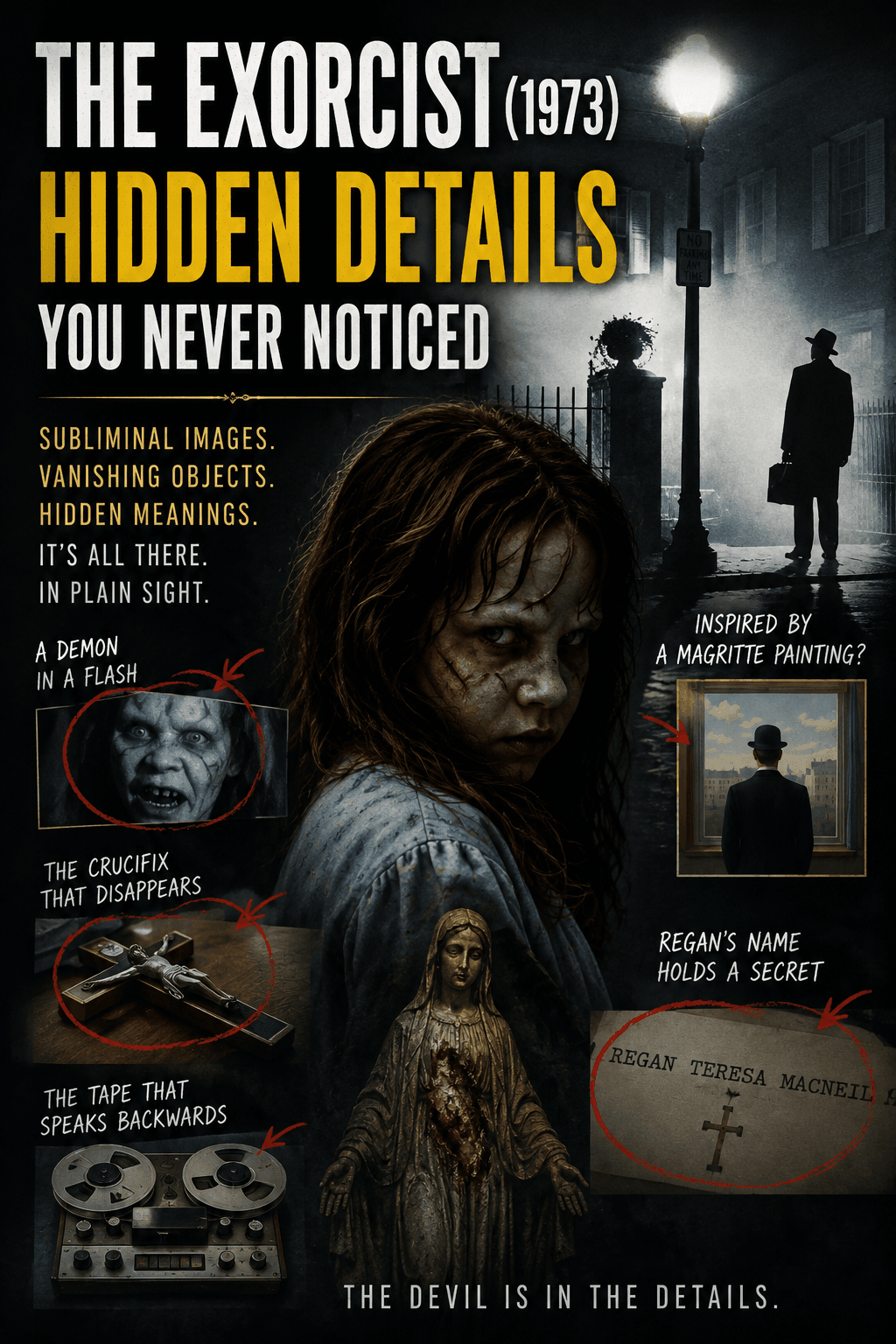
The Exorcist (1973), directed by William Friedkin, hides its most striking details in plain sight: a subliminal demon face spliced into a dream sequence, a language-lab tape that only makes sense played backward, a vanishing crucifix nobody comments on, and a poster shot composed after a René Magritte painting. None of it requires special features or a director’s commentary. It’s already in the theatrical cut, for anyone willing to look twice.
The first time through, you watch The Exorcist for the plot. A girl gets sick, the sickness has no name doctors are willing to give it, and by the end three men have tried to remove something from her that none of them can fully describe. The second time through is a different film. Once you know how it ends, the movie stops hiding things from you and starts showing you exactly how much it was hiding all along. If you’re still deciding whether the film holds up at all, that’s a separate question, answered here.
I went back through Friedkin’s film scene by scene this month, screenplay open in one window, notes in the other, hunting for the Exorcist 1973 hidden details a first-time viewer isn’t equipped to catch. Some of what’s below is confirmed by the production record. Some of it is confirmed by the film itself, sitting in plain sight, doing nothing to announce itself. All of it survives a second look better than most horror films survive a first one.
The Demon Was Never Only in the Bedroom
The single most controlled piece of visual information in this entire film is a demon’s face that most audiences in 1973 never consciously registered seeing at all. At roughly forty-five minutes in, during Father Karras’s dream sequence — the one that opens with his mother emerging from a subway stairwell, ignoring him, disappearing into the crowd — the frame cuts, for about two-tenths of a second, to a dead-white face. Protruding teeth. Exposed gum line. Red-rimmed eyes caught somewhere between agony and a snarl. A handful of frames at most, gone before your conscious mind can process that you saw a face at all.
That’s a flash frame, a technique with a history in advertising and psychological experimentation long before Friedkin borrowed it for a horror film, and it does exactly what flash frames are built to do: it deposits an image below the threshold of recognition, where you can’t argue with it, dismiss it, or look away from it, because you never got the chance to look at it in the first place. The image reappears elsewhere in the film — a face in a mirror, a shape resolved out of shadow on a wall, a reflection that isn’t quite tracking with what should be reflected — scattered through scenes that have nothing to do with Regan’s bedroom, which is the point. The film wants you to feel, without being able to say why, that whatever this thing is, it was never contained by one room in one house. It was already loose in the frame before the story admitted it existed.
The demon’s real arrival predates the convulsions by a full act. It arrives with the film’s first shot of a face that isn’t supposed to be there.
The Clue That’s Sitting on a Hallway Table
Early in the film, Chris MacNeil finds a crucifix tucked under Regan’s pillow. She doesn’t recognize it, confronts Karl about it — he denies putting it there — and sets it down on a table in the hallway, treating it as a minor domestic mystery. It’s the kind of prop a film introduces and then, you assume, forgets about, the way films constantly introduce objects that never pay off.
Watch the hallway in the background of the following scenes and the crucifix is gone, without comment, without a single shot ever framing its absence. The film trusts you either not to notice or to do the work of explaining it yourself. The likeliest explanation sits in the same sequence: during the scene where Regan’s dresser drawer starts moving on its own, Karl is visible at the edge of the frame, unconscious, on the floor near Regan’s bed — a detail easy to miss entirely on a first watch, since the moving furniture is doing all the work of pulling your eye. Put the two images together and the film has quietly told you, without a line of dialogue, how the crucifix got back into Regan’s hands for the scene that follows, the one the marketing department was never going to put in a trailer.
A Statue Made From the Wrong Kind of Clay
Partway through the film, an elderly bishop walks into Dahlgren Chapel to find a statue of the Virgin Mary defiled — grotesquely, sexually, in a way the film shoots as a genuine shock and then largely drops as a plot thread. The case goes uninvestigated and uncharged, and nobody in the film’s world connects it to the MacNeil house. It functions as atmosphere, one more sign that something has come loose in the world around Regan.
Except the material used to deface the statue is clay. Specifically, the same material Regan is shown working with in her own bedroom earlier in the film, sculpting the kind of small figures a twelve-year-old makes to pass the time. The film never states outright that Regan left that house and desecrated a statue across town while everyone around her assumed she was sedated and asleep. It doesn’t need to. It shows you the clay, shows you where else that clay appears, and lets you do the arithmetic. This is the same mechanism the crucifix uses — one more Exorcist 1973 hidden detail placed early, uncommented on, waiting for a second viewing to actually resolve.
The Toy That Convicts Her Before Anyone Says a Word
Burke Dennings, Chris’s friend and the director of the film shooting on campus, dies falling from Regan’s bedroom window. The official mystery of how sits open for a long stretch of the film — Lieutenant Kinderman investigates, asks careful questions, gets nowhere definitive. But the film plants its answer early and quietly: at the scene of Dennings’s death, Kinderman finds one of Regan’s small clay figures. He mentions it almost in passing. The film doesn’t underline it.
Chris eventually says the thing outright, in a whisper to Karras, almost unable to make herself say it: “She killed Burke Dennings. She pushed him out of the window.” It’s one of the quieter line deliveries in the film, and it’s easy to let it pass as one confirmation among many by that point in the runtime. But the film told you before Chris did. It told you with a toy at a crime scene, the same way it told you about the statue with a color of clay.
Later, once Merrin and Karras are both in the room, the demon confirms it directly and cruelly, in Regan’s voice, twisting toward Chris: “Do you know what she did, your cunting daughter?” It’s the film’s ugliest line, and it’s also, structurally, the closing of a loop that opened an hour earlier with a small sculpted object nobody thought to look at twice.
There’s a detail buried inside Kinderman’s own account of the death that most viewers lose entirely, because it’s delivered as a single clause in a much longer conversation. Describing the body to Karras, Kinderman notes that Dennings was found with his head turned completely around, facing backwards — information Karras deflects as possibly consistent with a fall, and the scene moves on before anyone sits with the wrongness of it. It’s not until much later, when the demon twists Regan’s head in the same impossible rotation directly in front of Karras, that the detail resolves. The film described the method of Dennings’s death an hour before it showed you the thing capable of doing it, and it did so in a throwaway line of dialogue easy to file away as procedural color.
The Voice on the Tape Is Talking Backward
Karras, still working the case like the psychiatrist he trained to be rather than the priest he’s become, records a session with Regan and takes the tape to a university language lab, hoping a linguist can identify whatever garbled, guttural language the demon is speaking. The lab director plays it once, stops it, and delivers a correction that lands harder than almost any jump scare in the film: the tape is English, playing in reverse.
He flips a switch and runs the tape backward, and the gibberish resolves into plain sentences: “Give us time! Let her die!” Later, alone in his room, Karras listens to more of it decoded the same way, and the demon’s voice says something that reframes everything else on this list: “I am no one! I am no one! He is a priest!” A creature that has spent the entire film refusing to give Karras a real name — deflecting in French, mocking in Latin, letting its identity get guessed at through a statue nobody in the story can definitively connect to it — finally answers the question directly, backward, in the one format guaranteed not to be understood in real time. I am no one. That’s the truth, delivered in the only direction it was willing to tell it.
The film even shows you the mechanism working on Karras’s own words. When his recorded voice asks the tape “Who are you,” played forward it comes back as nonsense — “Uoy era ohw” — and only decodes into his real question once you know to run it the other way. The trick sits right there for the audience the whole time, demonstrated on screen, in real time — most people watching are simply too unsettled by what the reversed voice is saying to notice that the film just taught them exactly how to unlock every other backward-masked detail in the movie, and never circled back to point out that it had.
A Demon That Won’t Tell You Its Name
The most quietly funny scene in The Exorcist is also one of its most theologically loaded, and most viewers remember it, if they remember it at all, as just another beat in the exorcism’s escalating chaos. Karras, testing whether he’s dealing with a genuine possession or a psychiatric case dressed up as one, switches to Latin — a language Regan has no education in — and demands to know what he’s facing: “Quod nomen mihi est?” What is my name.
The demon answers in French instead: “Bon Jour.” Pressed again for a real name, it delivers the punchline: “La plume de ma tante.” The pen of my aunt. It’s a phrase every American student of French has been handed in a first-year textbook, functionally useless outside a classroom, chosen for no reason except that a French speaker learning nothing but conjugation drills would have it memorized. The demon is mocking the question, performing a linguistic fluency it has no intention of using honestly — a stage direction in the script has it laughing “full and mockingly” immediately after.
It never gives Karras a real name in this film. That refusal echoes something I dug into researching the demon’s actual mythological source separately — the film’s possessing entity is popularly assumed to be Pazuzu, the ancient Mesopotamian wind demon whose statue opens the film, but the word “Pazuzu” is never spoken once in the 1973 theatrical dialogue. Both silences are the same silence. Whatever is in that room, on screen and in the history the film borrowed from, it does not introduce itself. You’re expected to recognize it by what it does; what it calls itself is never on offer.
The Name the Film Saves for the Ritual
There’s a smaller, quieter version of the same idea buried in the exorcism rite itself. Throughout the film, everyone calls her Regan — mother, doctors, priests, the demon itself, mockingly. It’s only during the formal Catholic ritual, spoken in the fixed language of the rite, that her full name surfaces: Regan Teresa MacNeil. It appears exactly where formal names appear in Catholic liturgical practice — baptism, confirmation, last rites, exorcism — the ceremonial contexts where a person is addressed by the complete name the Church has on record, not the name their family uses at the breakfast table.
The film slips this in without comment, quietly, in the middle of the ritual’s Latin cadences, and the effect on a second viewing is a small, specific chill: the only time this movie treats Regan as a full legal and spiritual person, named completely, is the moment it’s trying hardest to save her.
What the Camera Caught by Accident
Some of the film’s most effective moments were never planned as effects at all. The most famous is the pea soup. Regan’s projectile vomit toward Karras was choreographed to hit him in the chest — the practical rig was aimed and timed for it — but the tubing misfired on the take that made it into the film, and the vomit caught Jason Miller directly in the face instead. His full-body recoil and disgust register as genuine because they are: an actor hit with cold pea soup he wasn’t expecting, filmed once, kept because nothing scripted could have matched it.
More Exorcist 1973 Hidden Details From the Set
Max von Sydow’s aging is a different kind of trick entirely, closer to endurance than accident. Von Sydow was in his mid-forties during production, playing a priest meant to read as considerably older, and the transformation came from a daily process: liquid latex applied to his face and allowed to dry and tighten before shooting, stretching his own skin into the texture of age each morning, stripped off again each night. Where Regan’s transformation announces itself in a single “reveal” shot, Von Sydow’s works through accumulation, scene by scene, until Merrin’s exhaustion reads as physical fact rather than makeup.
And there’s a small, morbid footnote buried in the medical sequence that has nothing to do with special effects at all. The radiologic technician performing Regan’s angiogram in the hospital scenes is a real hospital worker, cast in the role after Friedkin watched him perform the actual procedure and decided the authenticity was worth more than a trained performance. That worker was Paul Bateson. Six years after the film’s release, Bateson was convicted of murdering film journalist Addison Verrill — a documented, uncontested fact. Investigators at the time also connected him to a string of unsolved killings of gay men in Manhattan that press coverage dubbed the “bag murders,” an allegation repeated constantly in true-crime retellings since, resting on suspicion and jailhouse claims a court never tested. The murder conviction is a matter of court record; the wider body count that true-crime retellings keep attaching to him is rumor dressed up as fact. The film that built its horror on institutions failing to see what was in front of them ended up, unknowingly, employing a man institutions would spend the rest of his life failing to fully account for.
Even Mercedes McCambridge’s vocal process, already legendary for how far she pushed her own body to create the demon’s voice, has a footnote that rarely makes it into the highlight reel: McCambridge had her own history with alcoholism, and during the sessions where she was drinking raw eggs and whiskey and chain-smoking to wreck her voice on purpose, she asked for a priest to be present to counsel her through it. The film about a possession that medicine can’t treat and faith eventually does was being voiced, off camera, by a woman managing her own well-documented struggle the only way she’d found that worked.
The Painting Hiding Inside an Establishing Shot
One of the film’s most striking images functions as an art-historical quotation. When Father Merrin steps out of his taxi outside the MacNeil house — the shot used on the film’s poster, one streetlamp throwing a cone of light up toward a single lit window while the rest of the house sits in darkness — the composition borrows directly from René Magritte’s “Empire of Light” series, paintings from the 1950s built entirely around the same unsettling trick: a night sky and a daylit house occupying the same frame, so that the ordinary geometry of light stops making sense before anything supernatural has even happened.
It’s the most purely painterly shot in the film, and it works for exactly the reason Magritte’s paintings work — it registers as wrong before you can articulate why. Merrin hasn’t done anything yet. He’s just standing under a streetlamp. The unease is entirely compositional.
The Window That Was Never Actually There
The MacNeil house is a real address — 3600 Prospect Street NW, in Georgetown, a short walk from the university — and the steps Karras falls down after his final leap sit exactly where the film shows them, at the corner of Prospect and 36th, running down toward M Street. In 2015, the city made both official: Mayor Muriel Bowser unveiled a landmark plaque at the base of the steps in a ceremony Friedkin and Blatty both attended, forty-two years after the film opened.
Tourists who make the walk to the actual house looking for Regan’s bedroom window — the one lit from within on the poster, the one Karras goes out through — won’t find it. That wing of the house, the section containing the room where most of the film’s second half takes place, was never real. It was a false front built onto the side of an existing home for exterior shots, attached to a structure that has no matching room behind it. The most photographed window in horror movie history belongs to a house that was never built.
It’s a strange, fitting footnote for a film this committed to grounding the supernatural in documentary texture — real steps, a real address, a real Jesuit university a few blocks away, and, bolted onto the side of all of it, one window that was always just a flat piece of construction with a light behind it. Friedkin spent the entire film insisting that everything you were watching could, in principle, be verified. The one piece of the house tourists actually travel to see turns out to be the one part that can’t be.
What These Exorcist 1973 Hidden Details Actually Teach You on a Second Viewing
These details leave the plot exactly where it always was — Regan still possessed, Merrin and Karras still dying to save her, the ending landing where it lands. What they actually shift is your relationship to the film’s authority: the sense that it earned every one of its scares by working this carefully even in the places it never expected anyone to check. A movie that plants a crucifix and quietly removes it, that colors a vandalized statue with the same clay a child was sculpting three scenes earlier, that lets a name go unspoken by a mocking demon and an entire marketing campaign alike — that’s a film that trusted its craft more than it trusted exposition.
The Exorcist showed you what to be afraid of in a frame you weren’t fast enough to consciously catch, then waited fifty years to see if you’d go back and look properly.