Is The Exorcist Still Scary in 2026?
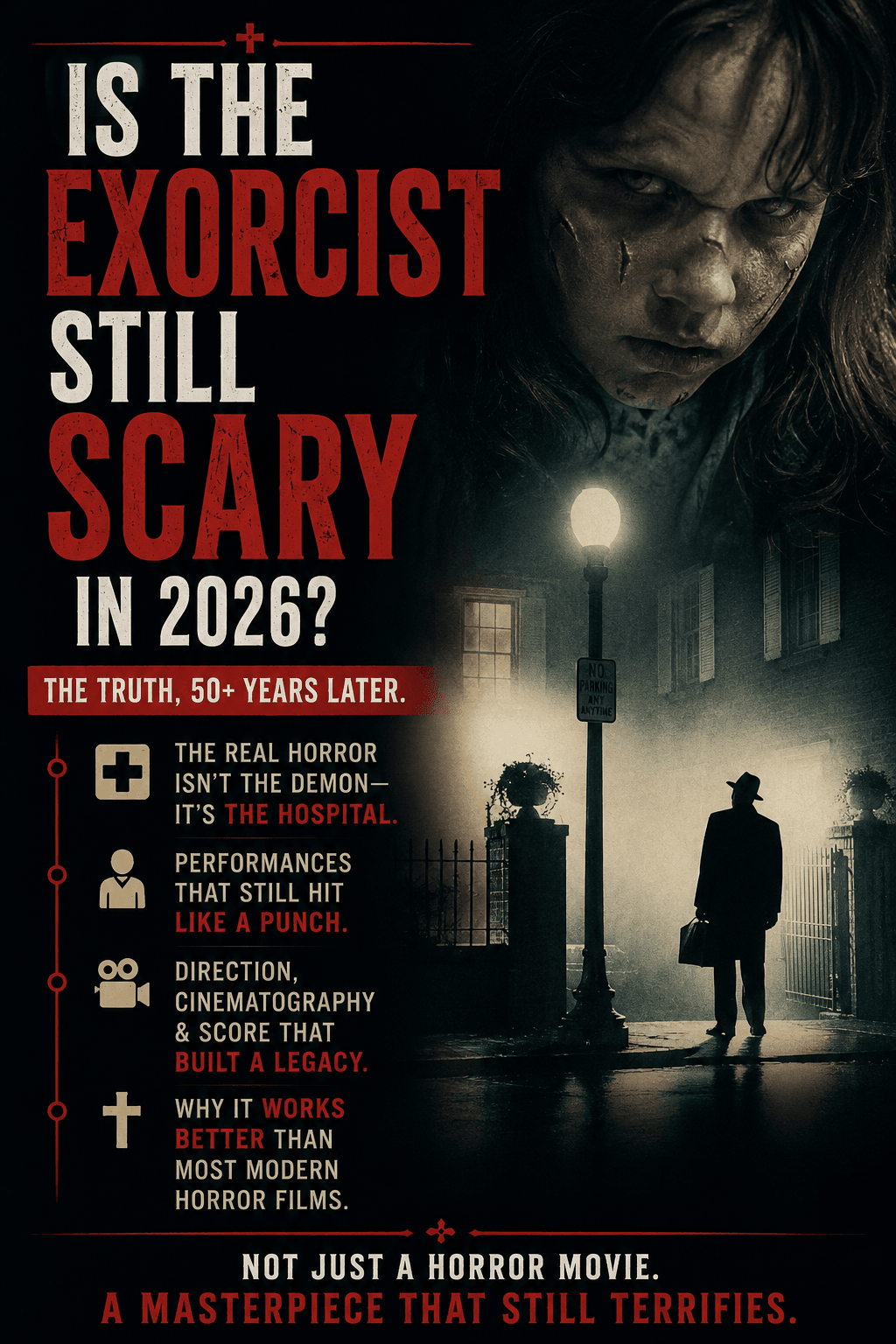
Is The Exorcist still scary in 2026? Yes — William Friedkin’s 1973 film, adapted by William Peter Blatty from his own novel, remains overwhelmingly effective more than fifty years after release. It is, technically, a possession horror movie — and it spends most of its runtime refusing to behave like one, which is not the reason modern horror trains audiences to expect.
Every few years someone writes the “does it hold up” piece about this film. I’ve read them. This month I watched The Exorcist again specifically to answer the question honestly instead of reflexively, and my answer isn’t hedged: it holds up, and it holds up hard.
What’s Aged Badly in The Exorcist
What’s dated is exactly what you’d predict. The pea soup reads as pea soup now. The head-turn effect, built on a Dick Smith dummy standing in for Linda Blair, has the slightly rubbery quality of a practical effect that’s been imitated ten thousand times since.
If you’ve come to this film primed by fifty years of gross-out horror trying to top it, some of the individual shocks will land soft. I won’t pretend otherwise — pretending otherwise is how you lose an audience’s trust for the rest of the argument.
The Real Horror Is the Hospital, Not the Demon
None of that is where the film’s power lives, and this is the part that gets lost every time somebody reduces Friedkin’s film to its makeup effects. What actually gets under your skin lives in everything that happens before anyone in the movie is willing to say the word “possession” out loud.
Regan MacNeil starts making noises in the attic and ends up strapped to a table getting a pneumoencephalogram — a spinal procedure, on a twelve-year-old, because Dr. Tanney wants to “pin down that lesion” that the EEG and arteriogram already failed to find. Watch that sequence again with the sound design turned up.
The machinery swivels over the camera. Regan yelps in pain, actually restrained, actually distressed, and the doctors keep working through a checklist that keeps coming up empty, because the checklist is the only tool they have. Admitting it has failed means admitting there’s nothing left to try.
Chris MacNeil sits through consultation after consultation getting phrases like “we still think the temporal lobe” from men visibly running out of temporal lobe to think about. This is institutional competence grinding forward past the point where it’s actually helping anyone — the most frightening stretch of the film, and it doesn’t require a single special effect. It’s the same institutional dread I found more explicitly rooted in real history in Get Out’s Tuskegee reference — medicine as the site of real horror, not the set piece.
Friedkin understood that a hospital bureaucracy failing to explain what it’s looking at is exactly as frightening as any demon, maybe more, because everyone watching has sat in that waiting room in some version of their own life.
The Performances That Still Work
Jason Miller’s Father Karras
That’s the throughline that makes the rest of the film cohere: institutions — medicine, then psychiatry, then finally the Catholic Church, which spends most of its screen time resisting an exorcism rather than rushing toward one — all get exhausted in sequence before the film allows itself to go supernatural.
Father Karras, a Georgetown Jesuit who is also a trained psychiatrist, is the hinge between all three institutions. Jason Miller plays him as a man being slowly ground down by competing forms of failure: he can’t save his dying mother with medicine or money, and he can’t save his own faith with theology.
By the time Chris MacNeil calls him about her daughter, he is already hollowed out in a way that makes him the worst possible person for the job — and, because of that specific damage, exactly the right one. Miller plays doubt as a posture: shoulders forward, eyes down, a man absorbing blows he’s stopped trying to block.
Ellen Burstyn Is the Real Protagonist
Ellen Burstyn is doing something harder, and it gets less credit. Chris MacNeil has to carry disbelief, then fear, then a very specific kind of maternal rage, across a film that keeps taking her competence away from her one institution at a time.
She’s a successful actress, financially secure, capable — and none of that buys her daughter anything once the problem stops being medical. It’s a version of the same architecture I found in my Rosemary’s Baby review: a woman surrounded by institutions that keep insisting, gently, that she’s the problem.
The scene where Regan’s bed slams against the floor is the one people remember for the wrong reason: Burstyn’s scream in that shot is real. A stunt harness was pulled harder than agreed, her back was genuinely injured on camera, and Friedkin kept rolling because, in his words, it had to look real. It does.
But watch Burstyn’s face in the quieter scenes instead — the hospital corridors, the moment she asks Karras if her daughter is going to die and he says no with a conviction he hasn’t earned yet. There’s a controlled fury under the performance that never once tips into the hysterical-mother cliché the genre still leans on. She’s the actual protagonist of this film.
Linda Blair and Dick Smith’s Makeup Effects
Linda Blair, twelve years old during filming, is asked to carry something no child actor should have to carry, and Blair does it with a physical commitment that makes Dick Smith’s effects work as well as they still do.
Smith’s makeup is the reason “Help me” rising in welts across Regan’s stomach still reads as upsetting fifty years later — built with a solvent drawn onto Blair’s skin and filmed as hot air dried it. Smith had a young assistant on that production, an unknown named Rick Baker, years before Baker became the most decorated makeup artist in the industry’s history.
Mercedes McCambridge’s Uncredited Demon Voice
The voice belongs to Mercedes McCambridge, and she fought for a year to get even a compromised credit line after Warner Bros. tried to let audiences assume the demon voice was some kind of processed effect rather than a specific actress’s deliberate, physically brutal choice.
She chain-smoked, drank raw eggs mixed with whiskey, and had herself bound to a chair during recording sessions so her voice would carry the sound of something actually straining against restraint. It’s one of the great uncredited performances in American cinema — and it took legal threats to get her name on the print at all.
The Craft Behind Why The Exorcist Still Scares
Owen Roizman’s Cold, Unglamorous Cinematography
Owen Roizman’s cinematography does the same work the sound design and makeup are doing: refusing to announce itself as horror imagery until the film has no other option. Friedkin wanted Regan’s bedroom cold enough that you could see the actors’ breath, so the crew built a refrigeration system that could drop the room to twenty below before every take.
Roizman lit it with hard, motivated light and sharp shadows, shooting the room the way you’d actually shoot a cold room rather than the way horror movies conventionally light one. The exorcism itself is lit almost entirely low-key — Merrin, Karras, and Regan pressed into a harsh, steely light closer to a surgical theater than a horror set.
The Editing Nobody Would Greenlight Today
The editing does the same disappearing act. Jordan Leondopoulos, Bud Smith, Evan Lottman, and Norman Gay cut the film with a patience a modern edit bay would flag as slow — the medical sequences sit in something close to real procedural time, and silences get held well past the point where a contemporary horror cut would drop in a musical sting.
That patience is the whole strategy. The Exorcist picked up an Academy Award nomination for editing by refusing to hurry toward the scenes everyone bought a ticket for, which is exactly why those scenes still land as hard as they do. Almost nobody making this kind of film trusts an audience to sit in discomfort anymore.
Jack Nitzsche’s Score and the Theme Nobody Wrote for the Film
Jack Nitzsche’s original score is barely present, surfacing mostly in transitions. The theme everyone actually associates with this film — Mike Oldfield’s Tubular Bells — wasn’t written for it at all.
Friedkin found it in his studio’s music library after telling an executive he wanted something with a childhood feel, closer to a lullaby than a horror cue. That’s exactly what it does: it undercuts the dread instead of announcing it, right up until the moment that stops being possible.
How Friedkin Got Reactions He Couldn’t Direct
None of this happened by accident on a comfortable set. Friedkin’s directing methods on this production have their own ugly, well-documented history: firing a shotgun blank behind Jason Miller’s head to catch a genuinely startled reaction, slapping Father William O’Malley — an actual Jesuit priest playing Father Dyer — across the face on a rolling camera, lying to Miller about where the pea soup would land.
I won’t pretend that’s an acceptable way to run a set, and I don’t think Friedkin himself defended it in his later years either. But it’s part of the same obsession running through every other craft decision here: Friedkin wanted reactions he couldn’t direct actors into performing, so he engineered situations where the reactions would be real.
The Spider-Walk Scene 1973 Audiences Never Saw
That same instinct made Friedkin cut his own most famous unfilmed effect — the spider-walk, Regan descending the staircase on all fours — from the 1973 theatrical release entirely, because the wire rig supporting the stunt was visible enough to break the illusion he’d spent the whole film building.
He restored it in 2000, once CGI could paint the wires out. It’s a genuinely unsettling scene. But I understand exactly why 1973 Friedkin cut a good effect rather than ship a visible one — that’s a director who trusted restraint over spectacle even when the spectacle was already in the can. I went deeper on the demon at the center of that opening Iraq sequence in a separate piece on the real Pazuzu, if you want that rabbit hole.
The Exorcist’s Place in Film History
The film became the first horror movie ever nominated for the Academy Award for Best Picture, one of ten nominations total, and it won two — Blatty for Adapted Screenplay, the sound team for Sound Mixing.
Critics split hard and immediately: Pauline Kael dismissed it as shallowness asking to be taken seriously, Vincent Canby called it elegant occultist claptrap, and Gene Siskel, watching the same film, put it in his top five of the year. Audiences didn’t split at all.
It became Warner Bros.’ highest-grossing release at the time and stayed the highest-grossing R-rated horror film in history for over four decades — a record that held until Andy Muschietti’s It broke it in 2017. The Library of Congress added it to the National Film Registry in 2010. Kubrick, Eggers, Fincher, and Proyas have all named it a formative influence.
So, Is The Exorcist Still Scary in 2026?
Fifty-plus years on, the pea soup looks like pea soup. The rest of it — the cold room, the real scream, the uncredited voice, the institutions failing in careful, documented sequence — still works exactly the way Friedkin built it to work.
I watched it again this month specifically to check whether The Exorcist is still scary, and it is. It doesn’t scare you with what’s on screen. It scares you with how carefully everything off screen was built to make you believe what’s on it.
Ethan’s Score: 9.6 / 10