Beau Is Afraid, Ari Aster’s 2023 surrealist odyssey starring Joaquin Phoenix, runs 179 minutes, cost roughly $35 million, and made about $12 million back — numbers that answer the question a lot of people type into a search bar before they’ve even finished watching it: is Beau Is Afraid too long. The short answer is that it mostly isn’t, though not evenly, and the reasons have less to do with meaning (The Horror Cave already covered the ending and its full symbolic weight in a separate deep dive) and everything to do with whether a film this in love with its own duration earns the specific minutes it spends.
Is Beau Is Afraid Too Long? Breaking Down Its Four-Act Structure
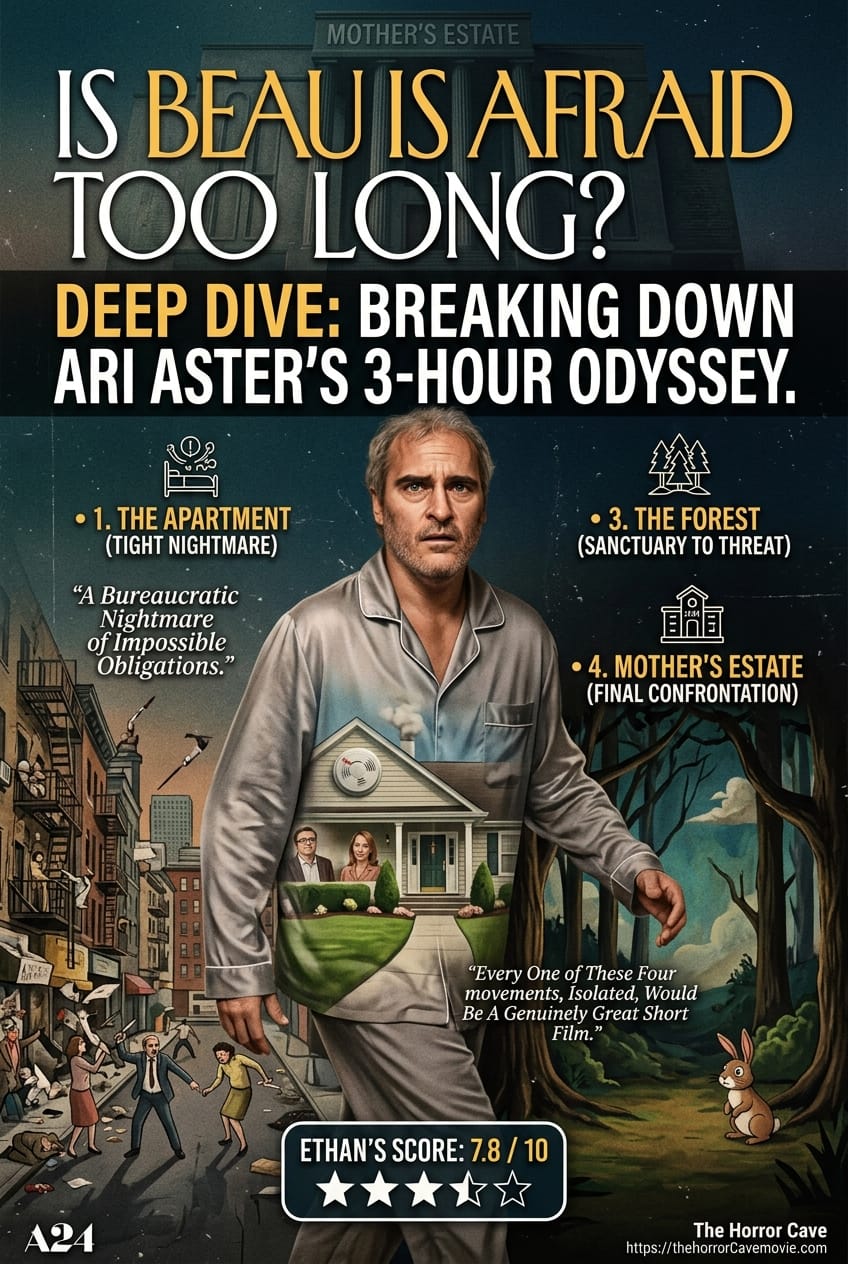
Reduced to a skeleton, the plot is almost insultingly simple: a man named Beau Wassermann tries to get home to his mother, and the world keeps finding new ways to make that impossible — the same skeleton the Odyssey runs on, which Aster leans into hard, breaking the film into distinct movements: an apartment nightmare, a suburban house, a forest, a mother’s estate, each shot, cast, and paced like its own short film.
That’s the film’s real discipline, and it’s easy to miss underneath all the noise about its runtime — nothing here is sloppy.
It is tightly, almost compulsively organized, sprawling in effect while staying rigorous in structure, and Aster seems incapable of trusting an emotional beat to land once, so nearly everything gets stated, restated, turned into an image, then occasionally handed to a twelve-minute animated sequence in case the point still hasn’t registered.
The Four Movements, and Why Each One Argues for a Different Runtime
The apartment section needs to feel suffocating before anything supernatural or absurd happens to it, which means it needs time to accumulate small humiliations before the escalation earns its scale.
The suburban house needs room for dark comedy to breathe — jokes about grief and dead soldiers don’t land if they’re rushed past on the way to the next beat.
The forest section needs to shift gradually from sanctuary to threat, which is a slower trick than it sounds, and the mother’s estate needs the accumulated weight of everything before it or the final confrontation plays as arbitrary rather than inevitable. Each act, in other words, is asking for a different kind of patience, and the film’s real gamble is betting that an audience will grant four different kinds of patience back to back.
That’s a defensible use of 179 minutes. It’s also, undeniably, a demanding one.
The Craft Behind Beau Is Afraid’s Four Worlds
The clearest evidence of that discipline is the production design, credited to Fiona Crombie, who gives each movement its own material logic instead of just its own set.
The apartment is airless and over-detailed, cluttered with objects that all sit slightly too close to the camera. The suburban house is aggressively wholesome — manicured lawn, family photos, a guest room built for healing that starts to feel like a holding cell the longer Beau stays in it.
The forest sequence turns theatrical on purpose, painted backdrops and visible artifice, which is what makes the animated interlude growing out of it feel like a natural continuation rather than a stylistic detour.
Pawel Pogorzelski’s camera and Bobby Krlic’s score, both carried over from Aster’s earlier films, do their usual controlled work, but it’s Crombie’s environments doing the heaviest lifting on this particular film — four distinct worlds built around four distortions of the same fear.
Paul Hsu’s sound design earns its own mention too: the suburban segment is scored less by music than by the wrong ambient sounds sitting in the right places — a smoke alarm that won’t stop, a phone ringing at the wrong register, silences that run exactly one beat too long.
Credit belongs further down the chain as well — foley artist Marko Costanzo and foley supervisor Dave Flynch build the small, wet, physical sounds that make the domestic scenes feel tactile in a way that pure dialogue never could. It’s unglamorous work, the kind that wins no year-end awards, and it’s precisely why the suburban act is as unsettling as it is funny: the house sounds correct in every way except the ways that matter.
That suburban segment is the strongest sustained stretch in the film, and it works because Nathan Lane and Amy Ryan understand something the script needs badly: comedy is scarier than dread when it’s played completely straight.
Lane plays Roger as a man performing the role of Successful American Father so thoroughly that the performance seems to be the only thing holding the character up — there’s a running, deliberately unresolved question of whether he’s actually the surgeon he claims to be, and Lane answers every scene with the same unblinking warmth whether he’s saying grace or explaining a dead soldier’s uniform hanging in the hallway.
Ryan’s Grace is worse, in the best way: the moment she asks, mid-dinner, whether her dead son wants to weigh in on the blessing is one of the only points in the whole film where the horror lands without a music cue or a lighting shift — a woman asking a question she genuinely believes is reasonable, the silence left to answer it.
Kylie Rogers, as the couple’s teenage daughter Toni, is doing quieter work underneath both of them that’s easy to undersell. Toni has grown up watching her dead brother get treated as a shrine while she gets treated as an afterthought, and Beau’s arrival — another wounded man absorbing all the attention in the house — reads to her as the same insult in a new body.
Her resentment curdles into something self-destructive rather than aimed outward, and the consequences of that ripple directly into the next act: Grace’s grief and rage need somewhere to go, and she sends Jeeves after Beau because she needs someone to blame more than she needs to be right. That’s the actual mechanism connecting the suburban act to the forest act — not a random shift in tone, but one household’s grief looking for a target.
Denis Ménochet’s Jeeves, the traumatized veteran camped in the yard, spends the whole segment as a pressurized background hum until he stops being background.
Worth stating plainly here, since a version of this scene has been circulating that turns Jeeves into a machine-gun-wielding mass murderer wiping out an entire forest cult: that isn’t what happens in the released film. Jeeves ambushes a troupe of traveling actors in the woods and is eventually killed back at the house — a smaller, stranger beat than the action-movie version making the rounds online, played by Ménochet like a nervous system finally failing rather than a soldier finishing a mission.
It’s worth pausing on how a scene this specific gets reinvented in fan circulation at all — A24 films tend to attract exactly this kind of mythology, alternate scripts and deleted-scene rumors treated as gospel by people who never checked them against the released cut.
Institutions get too much benefit of the doubt in this business, but so does the rumor mill, and the corrective is the same in both cases: go back to the actual film.
Around the two-hour mark, the film hands its audience something close to a gift: a twelve-minute stop-motion sequence called “Hero Beau,” directed by Cristóbal León and Joaquín Cociña, the team behind La Casa Lobo.
The technique is worth naming specifically, because it’s doing real thematic work and not just novelty: paintings on large canvases photographed at twelve frames per second, models sculpted and then destroyed on camera with the footage played backward so destruction reads as growth, paper flowers and trees built through time-lapse so an entire life visibly blooms in seconds.
It imagines the life Beau might have lived if he’d escaped his mother, raised three sons on a farm, and grown old having actually lived something. It’s the emotional summit of a three-hour film, a strange thing to say about a sequence made of puppets and painted canvas, until you notice it’s also the only stretch where Beau gets to want something without the wanting being immediately punished.
Every other movement treats his desire as a provocation the universe is obligated to answer. Here, for twelve minutes, desire gets to just be desire, textured and handmade enough that the relief is almost physical. Then it ends, because nothing in this film gets to stay good for long.
Parker Posey shows up not long after as the adult version of Elaine, Beau’s adolescent almost-love, now someone who has clearly spent decades waiting for a reunion that could never be what she needed it to be. Her scene with Phoenix curdles the film’s humor into something genuinely sad — two people trying to consummate a fantasy they built as teenagers, discovering in real time that the fantasy can’t survive contact with either of their actual adult bodies. It’s a short scene, and one of the few places in the film where restraint is doing the work most horror scripts hand to a bigger moment.
Underneath the tragicomedy, this is a film about a man who was never once allowed to want something without a cost attached, and the suburban and animated sequences exist specifically because they’re the two places the film briefly lets him cheat that rule before taking it back.
Aster and his interviewers have located the film explicitly in a Kafkaesque, Oedipal lineage — a bureaucratic nightmare of impossible obligations layered onto a mother-son bind Beau can’t out-argue or outrun — and that framing tracks better than most of the “what does it mean” readings the film invited on release, because it explains the tone as much as the plot: Kafka’s protagonists are rarely destroyed by a single villain, they’re worn down by a world that keeps relocating the goalposts, and that’s precisely the texture of Beau’s three hours.
Released in 2023 at a reported $35 million budget, Beau Is Afraid actually opened well: four theaters in New York and Los Angeles, an $80,000-plus per-screen average, the best specialty opening of that year at the time and A24’s strongest limited debut since Uncut Gems.
Then it expanded to 965 theaters and made $2.7 million, expanded further to over 2,100 theaters and made $1.4 million, and the momentum that made headlines in week one had evaporated by week three — a trajectory that says less about the film’s quality than about how badly platform-release enthusiasm translates into wide-release commitment for a three-hour tragicomedy with no franchise behind it.
It closed out at roughly $12 million domestic, a real loss against its budget, and remains the most polarizing entry in Aster’s short filmography — a hard swerve away from the folk-horror lineage of Hereditary and Midsommar into something closer to a tragicomic odyssey, horror imagery used as punctuation rather than genre.
Critics landed somewhere between admiration and exhaustion: the Rotten Tomatoes consensus calls it “overstuffed to the point of erasing the line between self-flagellation and self-indulgence,” crediting Aster’s bravura and Phoenix’s commitment for the film’s power anyway.
I’d take that consensus with the same suspicion I take any critical consensus — it’s a committee’s compromise sentence, not an argument — but this is one of the rare times I land close to where it lands.
Aster himself has described the film, in press interviews around its release, as the work he’s proudest of, one meant to be wrestled with rather than simply liked.
So, Is Beau Is Afraid Too Long, or Does It Earn Its Runtime?
Yes and no, and the honest answer sits closer to “yes, and it mostly earns it anyway” than either camp wants to admit. Any one of these four movements, isolated, would be a genuinely great short film. Stacked on top of each other for three hours, the accumulation eventually works against the material — by the time the ending arrives, the film has asked you to feel shattered so many times that the actual shattering has to compete with everything that came before it for whatever attention you have left. Call that a pacing problem, not a moral one, and pacing problems are the hardest kind to forgive in a film this capable of precision when it wants to be.
What holds the three hours together, more than plot or theme, is craft that never once looks lazy: Crombie’s four distinct worlds, Hsu’s sound design turning ordinary noise into dread, Lane and Ryan finding the funniest and most upsetting scene in the film without raising their voices once. Beau Is Afraid is a three-hour argument for its own excess, made by a filmmaker talented enough that the argument mostly holds up despite itself.
Ethan’s Score: 7.8 / 10
Frequently Asked Questions About Beau Is Afraid
Is Beau Is Afraid too long?
At 179 minutes, Beau Is Afraid asks a lot of its audience, and critics remain split on whether it earns that length. The film’s four distinct movements each work well in isolation, but stacked together the cumulative effect dilutes some of the impact — a pacing problem more than a storytelling one.
How much money did Beau Is Afraid make at the box office?
Beau Is Afraid opened to the best per-screen average of 2023 at that point, then expanded wide and stalled, finishing with roughly $12 million domestic against a $35 million budget — a box-office loss despite one of the strongest limited openings of the year.
What is the ending of Beau Is Afraid about?
The Horror Cave covers the ending and its full meaning in a separate deep dive. This review focuses on structure, craft, and whether the film’s length is justified, rather than re-explaining the finale.
Is the Beau Is Afraid script different from the released film?
Alternate scripts circulating online contain invented characters and a different ending that never appear in the released film, including a fabricated machine-gun massacre. The actual film’s version of these scenes is smaller and stranger than the fan-made variants suggest.