The Nun (2018) Review — Valak’s Origin, Stunning Craft, Hollow Horror
There is a moment in The Conjuring 2 that works better than anything in The Nun (2018). It lasts four seconds. Lorraine Warren, seated in her living room, notices something in the background of a painting she has lived with for years — a form that had not been there before, standing at the edge of the canvas in a nun’s habit, its face carrying the specific wrongness that the eye cannot immediately name. She turns. The painting is as it has always been. Those four seconds contain everything the character Valak is capable of doing: peripheral, brief, mocking something the viewer holds without being told what it is. James Wan added that moment during additional photography, three months before The Conjuring 2‘s 2016 release. In documented interviews he cited Lorraine Warren’s love and reverence for nuns as the inspiration — a form chosen to target the specific faith of the woman it was meant to torment. It worked because Wan assembled it under pressure, with no time to explain what it was. The Nun, directed by Corin Hardy and produced through Wan’s Atomic Monster company, is the Conjuring universe’s attempt to tell Valak’s origin story — and its most commercially successful entry at $366 million against a $22 million budget. It is the film built to explain in ninety-six minutes what worked in four seconds.
What The Nun (2018) Changed About Valak’s Origins
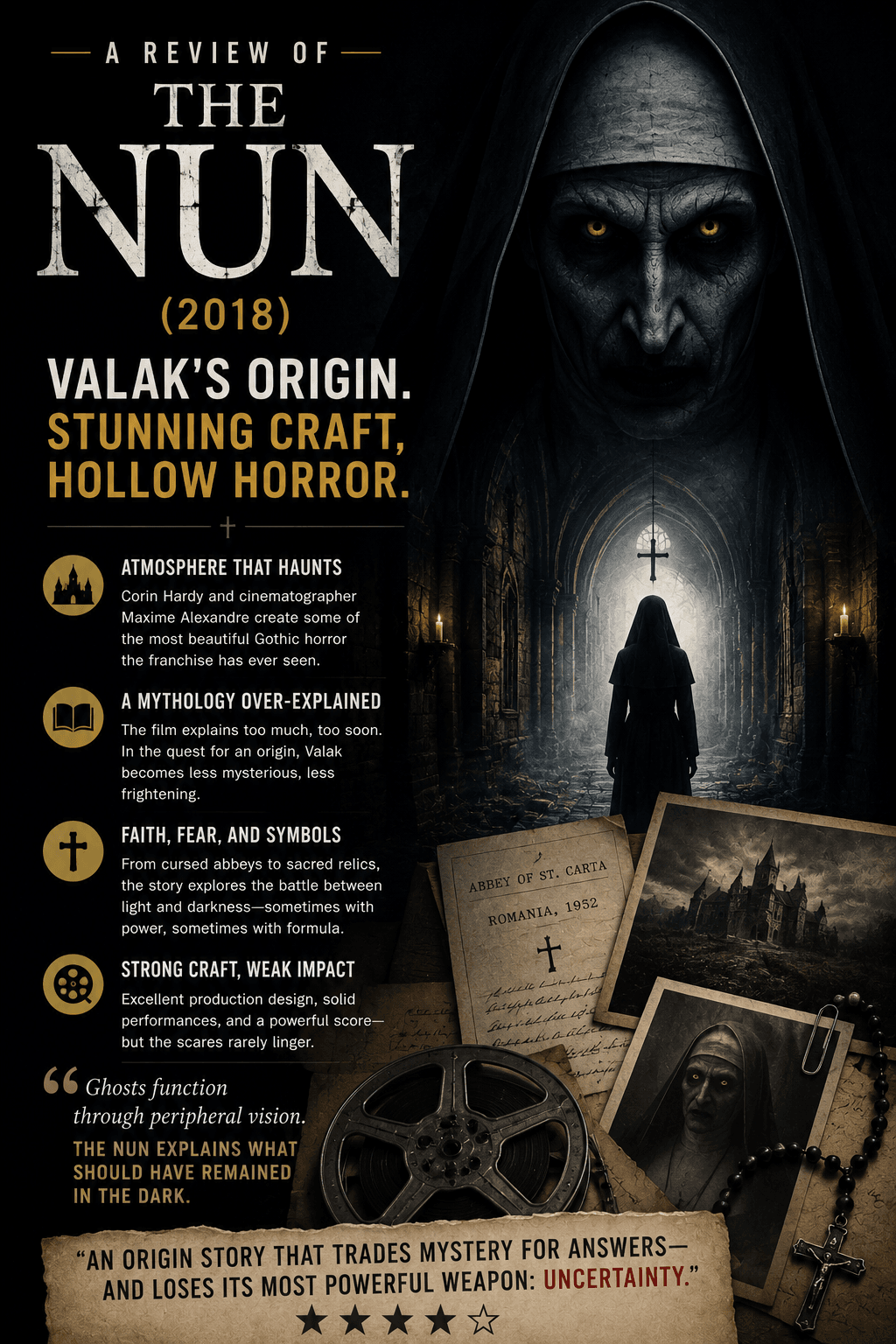
Every mythology the franchise deploys begins with a historical record it then discards. Valac — sixty-second spirit of Hell, catalogued in the Ars Goetia and in Johann Weyer’s Pseudomonarchia Daemonum in 1577 — appears in demonological literature as a boy with angel’s wings mounted on a two-headed dragon, whose office is to reveal hidden treasures and show where serpents can be found. There is nothing in those texts about Romanian abbeys, cloistered convents, or a medieval duke who opened a gateway to hell through witchcraft rituals. The Conjuring universe took the name, discarded every documented quality attached to it, and replaced them with a visual design invented during a creative panic and a mythology assembled by Gary Dauberman’s screenplay to fill a franchise prequel slot. The film does not attempt to disguise this. It opens with the text “Abbey of St. Carta, Romania, 1952” and a nun who hangs herself so the entity cannot take her soul — history manufactured because the franchise required an origin. What the film cannot anticipate is what that decision costs: an origin story demands completeness, and completeness is the specific condition in which this monster stops working.
What Corin Hardy and Maxime Alexandre Built in The Nun (2018)
What Corin Hardy brought to the production is the reason the first act achieves something the Conjuring universe had not previously attempted. Hardy made The Hallow in 2015 — a Celtic folklore horror he had conceived and developed over eight years before it premiered at Sundance. He understands how landscape becomes psychology, how the specific weight of a fortified wall or a mountain fog operates on the body before the mind has named what it is registering. The production gave him Corvin Castle in Hunedoara, the Palace of Parliament in Bucharest, the medieval streets of Sighișoara. These are places that carry centuries without being asked to, that produce meaning as a function of what they are. Hardy uses them with care: the cemetery in fog, its rope bell connected to a coffin below — a remnant of plague-era burial anxiety, repurposed; the ice house where a body has been moved from the position it was left in; the convent at the edge of the mountain, its crosses oriented, a local guide observes, to keep evil in. This is Gothic horror working as architectural argument — the location as something with weight that precedes the characters’ arrival and persists after they leave. The first act of The Nun is the most atmospherically serious thing the Conjuring universe had attempted at that point in its history.
Maxime Alexandre shot the film with a grammar matched to Hardy’s instincts. Deep shadow. Practical light sources functioning as isolated islands inside genuine darkness, each one creating a pool of visibility surrounded by what cannot be seen. The camera rests in compositions that use the castle’s geometry to create enclosed spaces without relying on Dutch angles or tight close-ups to signal threat — a more difficult approach and a more honest one. In the ice house sequence, Alexandre frames the body at a distance that makes the distance itself threatening. In the early chapel interiors, the light sources are candles and the architecture earns every shadow it casts. What these images share is patience: they are willing to let the frame hold what is there before announcing what it means. That patience is a form of trust in the material, and the material, in these thirty minutes, deserves it.
Gary Dauberman writes the kind of scripts franchise machinery runs on: navigable, efficient, cause-and-effect architecture that moves characters from scene to scene with no wasted motion. The Nun requires something that kind of precision cannot supply: a mythology held open long enough for dread to accumulate inside it. Dauberman closes the mythology in the second act. Sister Oana explains the Abbey’s history with complete legibility — the Duke of St. Carta, his witchcraft texts, the gateway, the relic containing the blood of Christ, the Second World War bombing that cracked the seal. Every element has a corresponding function: the key opens the tunnel, the tunnel leads to the catacombs, the catacombs hold the relic, the relic seals the gateway. Sister Irene’s recurring vision — “Mary points the way” — operates as a divine delivery mechanism, producing directional information at precisely the moments the plot requires it. The resources the first act assembled meet a screenplay that provides answers, and the provision of answers converts atmospheric horror into an adventure with Catholic infrastructure. Horror requires doors that might not open. The screenplay provides keys.
Taissa Farmiga and Demián Bichir in The Nun (2018)
Taissa Farmiga carries the film’s emotional weight with a seriousness the material does not consistently earn. She shares something with Vera Farmiga that goes beyond family resemblance — a quality of interior processing that manifests as small physical adjustments before the face commits to its expression, as though information arrives at the body first and the performance catches up afterward. The film uses Sister Irene’s visions as plot infrastructure: “Mary points the way” delivers directional information at key moments. Farmiga plays each vision as genuine rupture, something costing something each time, the certainty they produce sitting in productive tension against a novitiate still in the process of deciding. Her choice to take her vows in the catacombs — under immediate threat, without ceremony, as an act of will reached under the worst possible conditions — is the film’s most earnest gesture. The idea underneath it is real: faith chosen at the moment it costs the most means something different from faith received as inheritance. The screenplay does not build the architecture this moment needs. Farmiga plays it as though it does, and the gap between the character she found and the one the screenplay delivered is where her performance lives.
Demián Bichir grounds Father Burke in the film’s most serious material. The boy Daniel — whose exorcism Burke authorized in France during the war, and who died of injuries sustained in it — haunts the film in the nightmare sequences where his ghost returns to Burke in corridors and in confined spaces that the castle provides in abundance. Burke’s culpability is the kind of dread the Warren mythology has never had room for: a priest who may have destroyed a child in the name of institutional certainty, who cannot locate the line between faith as medicine and faith as blunt instrument. The nightmare sequences are the film’s most unsettling passages because they carry genuine moral weight — the specific fear of what the character himself may have done. The screenplay uses them for startle moments and moves on. Bichir holds the guilt throughout regardless, in a performance that runs alongside the film that was made, in parallel with one that was not.
What Abel Korzeniowski’s Score Reveals About The Nun (2018)
Abel Korzeniowski studied composition under Krzysztof Penderecki at the Academy of Music in Kraków, and his score announces its ambitions in the opening minutes. Two themes run through The Nun: one for Valak, built from feral orchestral writing, extended techniques, and a seven-foot drum that registers in the chest before the ear has processed it; one for Sister Irene, drawn from medieval chant, something cloistered and human attempting to persist inside chaos. The score is serious compositional work — Korzeniowski was writing for the same film Hardy was directing, and both of them heard something the screenplay was building in a different register. Where the score reveals this most clearly is in the quiet between the jump scares: the slow atmospheric pressure of the choral writing, the moments where the two themes approach each other without resolving. This is where the film underneath the film makes itself audible. The jump scares end in a beat; the silence around them is where Korzeniowski is doing his real work; and the silence does not get enough room to do it.
Why The Nun (2018) Is Scarier as a Glimpse Than a Feature Film
The insight that matters about Valak’s design is that it was assembled in three months for a peripheral role. Wan needed something to occupy the background of a painting, to appear and vanish before the eye had fully registered it. The incompleteness was functional: a design assembled under pressure for a glimpse carries an ambiguity that fully realized monsters lose. The Nun must show Valak completely — in mud, in corridors, rising from water, crossing the catacombs in pursuit. Shown completely, the design does not survive the scrutiny. What worked at the edge of a canvas in a living room cannot scale to feature-length antagonist and retain the specific quality that made it unsettling. Ghosts function through peripheral vision. Center them in the frame with sufficient light, and they become figures in costume. What the Conjuring universe converted into a franchise engine was a four-second accident of instinct, and the film that had to explain the accident paid the price that explanation always extracts.
This is the argument the franchise keeps making with different materials: that the Warren mythology requires completion, and completion is incompatible with what horror needs to function. The Nun makes it most visibly because the gap between what the locations and the craftspeople were reaching for and what the screenplay required of them is wider here than anywhere else in the universe. The castle is too real, the score too serious, the performances too interior for the jump-scare architecture the film eventually commits to. The mismatch is not a failure of execution. It is a structural condition.
The Nun ends with institutional satisfaction. The gateway is sealed. Maurice Theriault — Frenchy, the French-Canadian who guided them to the convent and paid for it in ways that unfold twenty years later in Ed Warren’s lecture on demonic possession — becomes the retroactive bridge between the franchise’s newest entry and its oldest. The puzzle is completed. The box closes.
What stays is Corvin Castle at dusk. Hardy knew what he had been given. Korzeniowski’s score was written for the same film. Taissa Farmiga and Demián Bichir brought more interiority than the screenplay had room for. The castle needed no instruction.
The screenplay had other obligations. They were met.
Ethan’s Score: 5 / 10
Frequently Asked Questions About The Nun (2018)
Is The Nun (2018) based on a true story?
No. The Abbey of St. Carta, the Duke who opened the gateway, and the WWII-cracked seal are invented. The demon’s name, Valak, derives from the Ars Goetia — a seventeenth-century grimoire listing the 62nd spirit of Hell as a winged boy on a two-headed dragon whose function is to reveal hidden treasures and serpent locations. There is no documented connection between that entity and Romanian convents, nun habits, or anything depicted in the film. The demonic nun design itself was invented three months before The Conjuring 2‘s 2016 release.
How does The Nun connect to The Conjuring universe?
The Nun (2018) serves as a prequel establishing Valak’s Romanian origin. James Wan added the demonic nun to The Conjuring 2 during additional photography, inspired by Lorraine Warren’s reverence for nuns. The Nun’s epilogue — Maurice Theriault’s possession revealed in Ed Warren’s lecture twenty years later — connects directly to the opening of The Conjuring (2013), making Frenchy the franchise’s hidden thread between its first and sixth entries.
Who directed The Nun (2018) and who is in it?
The Nun (2018) was directed by Corin Hardy, written by Gary Dauberman from a story by Dauberman and James Wan. It stars Taissa Farmiga as Sister Irene, Demián Bichir as Father Burke, and Jonas Bloquet as Maurice Theriault. The score was composed by Abel Korzeniowski, who studied under Krzysztof Penderecki, with cinematography by Maxime Alexandre. It grossed $366 million worldwide against a $22 million budget.