Get Out (2017) opens with a man walking alone at night, clocking danger from the posture before he can say why — and it never lets that feeling go. I once shared a journalism-school apartment in Austin with a guy named Peter — the kind who walked into a bar and left with three new friendships and a number he hadn’t asked for.
One night I watched a man cross the room toward him and clocked the trouble before I could have said why. Something in the shoulders. I told Peter to ease off. He laughed, mid-charm, and what I said must have sounded paranoid. Forty seconds later I was throwing the worst punches of my life. What stayed with me was the gap — the seconds where my body knew what was coming while everyone around me, Peter included, sat easy.
That gap is the engine of Get Out (2017), Jordan Peele’s directorial debut. It’s a film about a man whose every instinct is screaming at him, dropped into a world built to make him doubt the screaming. Chris Washington spends a weekend at his girlfriend’s family estate certain that something is deeply wrong, and every time the certainty rises, someone warm and reasonable hands him a reason to sit back down. It’s just awkwardness. They mean well. You’re being paranoid, bae. The brain surgery waiting at the bottom of all this is the part everyone remembers.
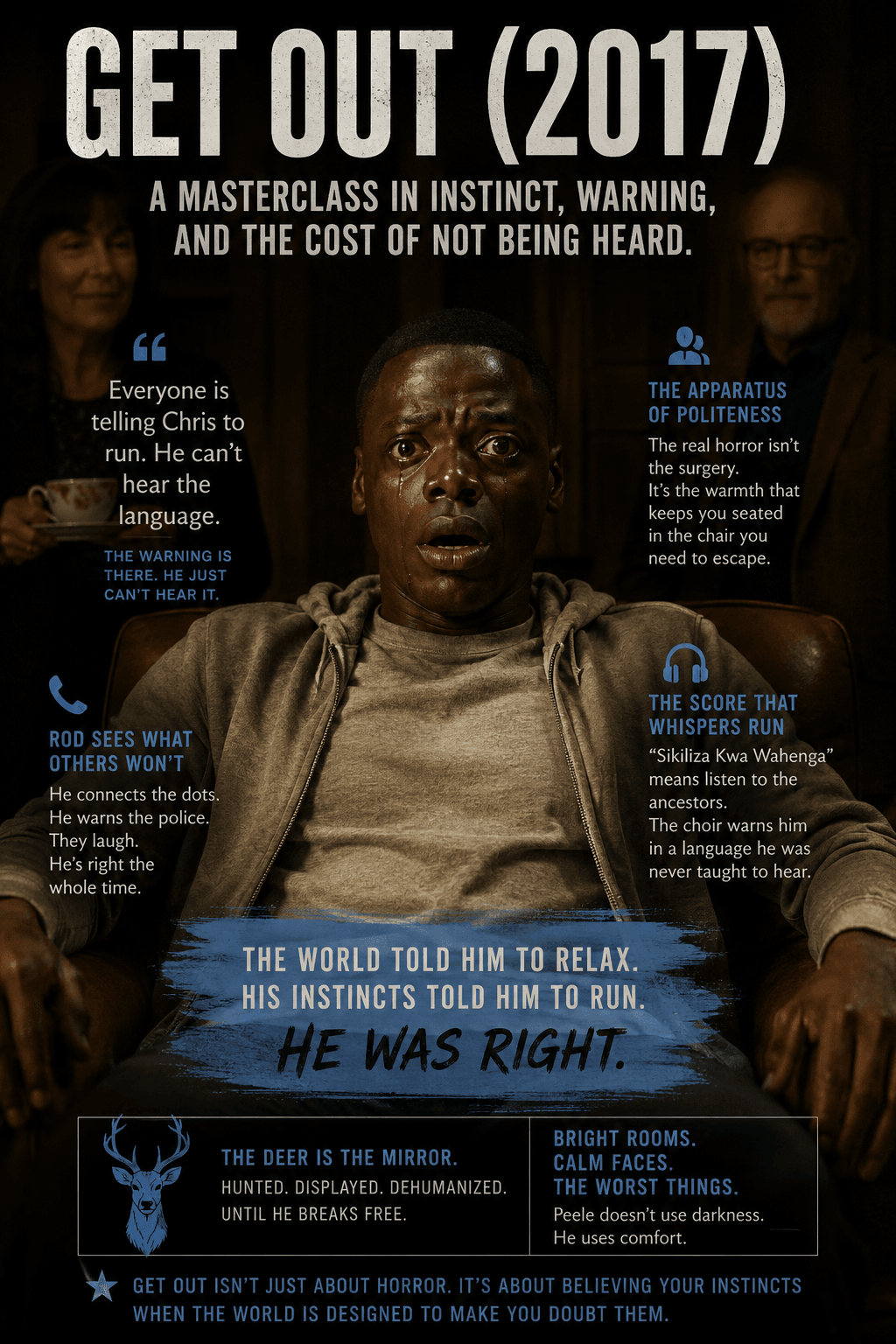
The part that stays with me is quieter — the apparatus of politeness that keeps a person seated in a chair his body has been begging him to leave.
What Get Out (2017) Is Actually About
I’ll be clear about where I land, because I’m not going to make you wait for it: this Get Out (2017) review is the work of someone who thinks Peele made one of the most precisely engineered horror debuts of the century, and the rare one whose meaning outlived the war that got fought over it. It survived because the meaning grew out of the craft.
Get the order backwards and you get a sermon. Peele builds the scares first and lets the politics fall out of the gears, which is the same reason the best horror earns its monsters instead of announcing them.
Peele calls it a “social thriller,” and he placed it in a real lineage when he said so — Guess Who’s Coming to Dinner, The Stepford Wives, Rosemary’s Baby. That last one matters most to me. Polanski ran the same trick in Rosemary’s Baby: the most frightening room in the world is the one where everyone is so kind to you that doubting them feels like the symptom.
Peele takes that mechanism, moves it onto an estate in upstate New York, and aims it at a specific kind of erasure — the theft of a Black man’s body, his sight, his self, dressed up as admiration. He did it on four and a half million dollars and it grossed north of two hundred and fifty. The economics of that are their own small horror story for every studio that still treats horror as a budget line.
What the Get Out (2017) Score Is Really Saying
Start with the sound, because that’s where the film shows its whole hand and almost nobody catches it the first time through. Michael Abels — a music teacher Peele found through an orchestral piece on YouTube, a man Steven Spielberg later told Peele was his own John Williams — built the main title, “Sikiliza Kwa Wahenga,” out of a Swahili choir. The phrase means listen to the ancestors. The voices belong to the dead — enslaved people, lynched people — and Abels has explained what the choir is actually saying: run, listen to the truth, save yourself. He chose Swahili because words you can’t quite parse land scarier than words you can. So the warning sits in the room the entire time, sung by the people who would know, in a language the man it’s meant for was never taught to hear.
The whole film is a deck stacked around that one cruel fact. Everyone is telling Chris to run. He can’t hear the language.
Why Rod Is the Most Important Character in Get Out (2017)
Which brings me to Rod, and to why this particular film got to me in a way I wasn’t braced for. Rod Williams — Lil Rel Howery, a TSA agent and Chris’s best friend — is the comic relief, and he’s also the only fully awake node in the entire network. He’s the guy on the other end of the phone connecting dots that sound completely deranged out loud. White family, hypnosis, missing Black men, a coven. He carries it to the police, lays the whole thing out, and three detectives laugh him out of the station.
I know that man. I’ve been that man at a bar, leaning into someone’s ear, watching them not hear me. Rod sounds insane for ninety minutes, and the credits exist to prove he was right the entire time. Get Out (2017) is built on that irony — the gap between the person who sees it and the world that won’t hear them. There’s a particular loneliness in being the one who sees it coming and can’t make the seeing land in anyone else, and Peele writes that loneliness as comedy, which is the only humane way to write it.
How Get Out (2017) Shoots Its Most Disturbing Scenes in Bright Light
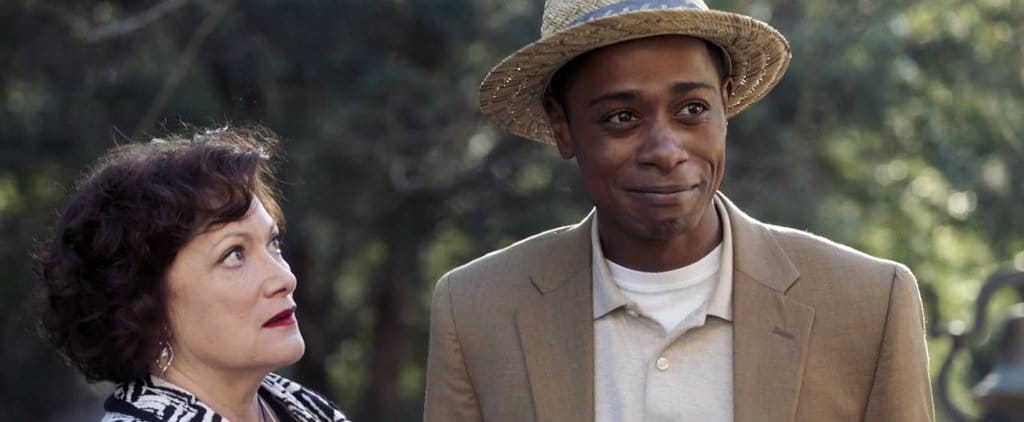
The craft underneath the dread is quietly radical. Toby Oliver shot the film, and the move that should be taught in classes happens in the third act. When the worst is finally confirmed, when the family drops the act, a normal horror film accelerates — fast cuts, darkness, chaos. Oliver and editor Gregory Plotkin, who of all things came off the Paranormal Activity films, do the reverse. They slow down and they turn the lights up. The brightest, calmest rooms in the movie are the ones where a man’s skull is being opened, and that calm is far worse than any amount of chaos would have been.
Watch the deer thread while you’re at it: the buck Chris hits on the drive, the way Dean talks about deer like vermin to be culled, the mounted head Chris finally rips off the wall and drives through Dean’s body. Peele voices the dying deer himself. The hunted thing and the man become the same animal, and the film never once stops to spell it out for you.
Daniel Kaluuya and Betty Gabriel Carry Get Out (2017)
Daniel Kaluuya is the reason the whole apparatus holds. The performance is built almost entirely in the eyes and in restraint — a man holding composure he no longer feels, smiling through a party that has quietly turned him into a specimen, doing the exhausting arithmetic of deciding which of his own perceptions to trust. When Missy drops him into the Sunken Place and a single tear tracks down his frozen face while his body sits paralyzed, Kaluuya plays two people at once: total stillness on the outside, a drowning man underneath.
He gives us an everyman who keeps apologizing for his own radar, and that’s the most devastating choice in the film, because it’s the one most of us would recognize from our own lives.
Then there’s Betty Gabriel, who has maybe forty seconds of screen time I’d put up against anything any actor did that year. As Georgina, the housekeeper, she tries to reassure Chris and produces the most frightening human sound in the movie — a smile fighting a flood of tears, a voice repeating no, no, no, no while her face does something the words can’t govern. You are watching two people trapped behind one set of eyes, one of them screaming through glass.
LaKeith Stanfield runs a colder version of the same horror as Andre, a man whose stolen body knows it’s been stolen, clawing back to the surface for one flash-lit instant to scream the title at Chris like a diver surfacing for one breath. And Allison Williams deserves real credit for Rose, a role written to weaponize everything an audience assumed about her. The detail of her sipping milk while she calmly scrolls through her next victim was added right before shooting, and it tells you everything.
Williams has noted that some viewers — white ones in particular — kept reading Rose as a victim anyway. That misreading is the film’s thesis proving itself out in the lobby. The Armitages are charming, hospitable, recognizable, which is exactly why they work; the genre runs better when the villain stays a person, the way Bear does in Obsession.
The Get Out Backlash, Armond White, and the Golden Globes
Now the part everybody fought about, because we can’t have nice things. Get Out (2017) arrived and instantly became a battlefield. A loud online contingent called it anti-white and racist, most of them having watched roughly none of it. Armond White, performing the contrarian act that is his entire brand, called it a “Get-Whitey movie” in the National Review. Rex Reed put it on his ten-worst list and later said he didn’t care that all the Black men get turned into robots, which would be a hell of a critique if there were a single robot anywhere in the film.
Then Universal submitted it to the Golden Globes as a comedy — a cynical play for a softer category — and the internet spent a week litigating whether that trivialized racism, until Peele defused the whole thing by tweeting that Get Out is a documentary.
The Academy took it more seriously than the timeline did. Get Out (2017) won Best Original Screenplay, with Peele the first Black writer ever to win the category, and pulled nominations for Best Picture, Director, and Actor — only the sixth horror film ever nominated for Best Picture. Some of the older Academy members reportedly couldn’t be bothered to watch it. If you’ve been paying attention to what the movie is about, that’s a punchline it wrote in advance.
Here’s my unfashionable position on all of it. The movie is meaner, funnier, and far less interested in lecturing you than the war waged in its name. It’s a great horror film that happens to be about something, and the people flattening it into a morality test were doing it a disservice from the same direction as the people calling it propaganda. Both camps treated the craft as a delivery system for an argument, and the craft is the argument.
So before you go to war over Get Out — before you draft the thread, before you quote-tweet a stranger — crack a beer and let the thing scare you first. It earned the right to be enjoyed before it gets litigated. Most films talked about this much can’t survive being watched closely. This one rewards it.
Why Get Out Changed Its Original Ending (2017)
A word on the ending, because there are two of them and the difference is the whole movie. In the version Peele shot first, the red and blue lights at the climax mean exactly what they have always meant: real police arrive, Chris is arrested over a yard full of dead white people, and he’s sent to prison, where Rod visits him and a hollowed-out Chris says he’s at peace because at least he stopped it.
Peele filmed that. Test audiences cratered. He pulled it and made the lights belong to Rod’s airport-security car instead — the dread, then the laugh, then the rescue, Black brotherhood arriving in a TSA vehicle. The theatrical choice is the right one as horror, even though the original was the colder truth.
For a full breakdown of every layer of that ending — the Sunken Place, the Armitage auction, Walter’s final choice — read the Get Out ending explained.
And it works because of the thing Peele understands about all of us: the second those lights hit, your stomach drops before your brain catches up. The film never has to argue that the institution might fail Chris. You already believe it in your body. That dread crosses every line anyone likes to draw, and everyone in the theater braced.
I keep going back to that bar, and to Peter. The fight was clumsy and pointless. What it left behind was heavier: I had seen it coming and still couldn’t make him believe me in time.
Get Out is that failure built into a machine — a film about how the warmest room is the one that should frighten you most, and about a friend on the far end of a phone line who turns out to be the only person in the story who stayed awake. The dead were right. The score told Chris from the first frame, in a language he was never taught to hear. Listen to the elders. Run.
Ethan’s Score: 9.4 / 10
Get Out (2017): Frequently Asked Questions
Is Get Out (2017) based on a true story?
No. Get Out is an original screenplay by Jordan Peele, his directorial debut, which he calls a “social thriller” in the lineage of The Stepford Wives and Rosemary’s Baby. Peele has said the story is personal to him in its treatment of race, though it is not autobiographical and not drawn from a real case.
What is the Sunken Place in Get Out?
The Sunken Place is the hypnotic limbo where a victim’s consciousness is trapped after the Armitages’ procedure. The person can still see and hear through their own eyes but cannot control their body — reduced to a passenger watching their life run on a screen while someone else drives.
Why did Jordan Peele change the ending of Get Out?
Peele shot a darker original ending where Chris is arrested and imprisoned for killing the Armitages. After test screenings found it too bleak, he replaced it with Rod arriving to rescue Chris — keeping the dread of the police lights but releasing the audience into relief rather than despair.
What does the Get Out score mean?
The main title, Michael Abels’s “Sikiliza Kwa Wahenga,” is a Swahili warning sung by the voices of the dead — enslaved and lynched ancestors — urging Chris to listen, run, and save himself. The catch is that Chris cannot understand the language warning him.