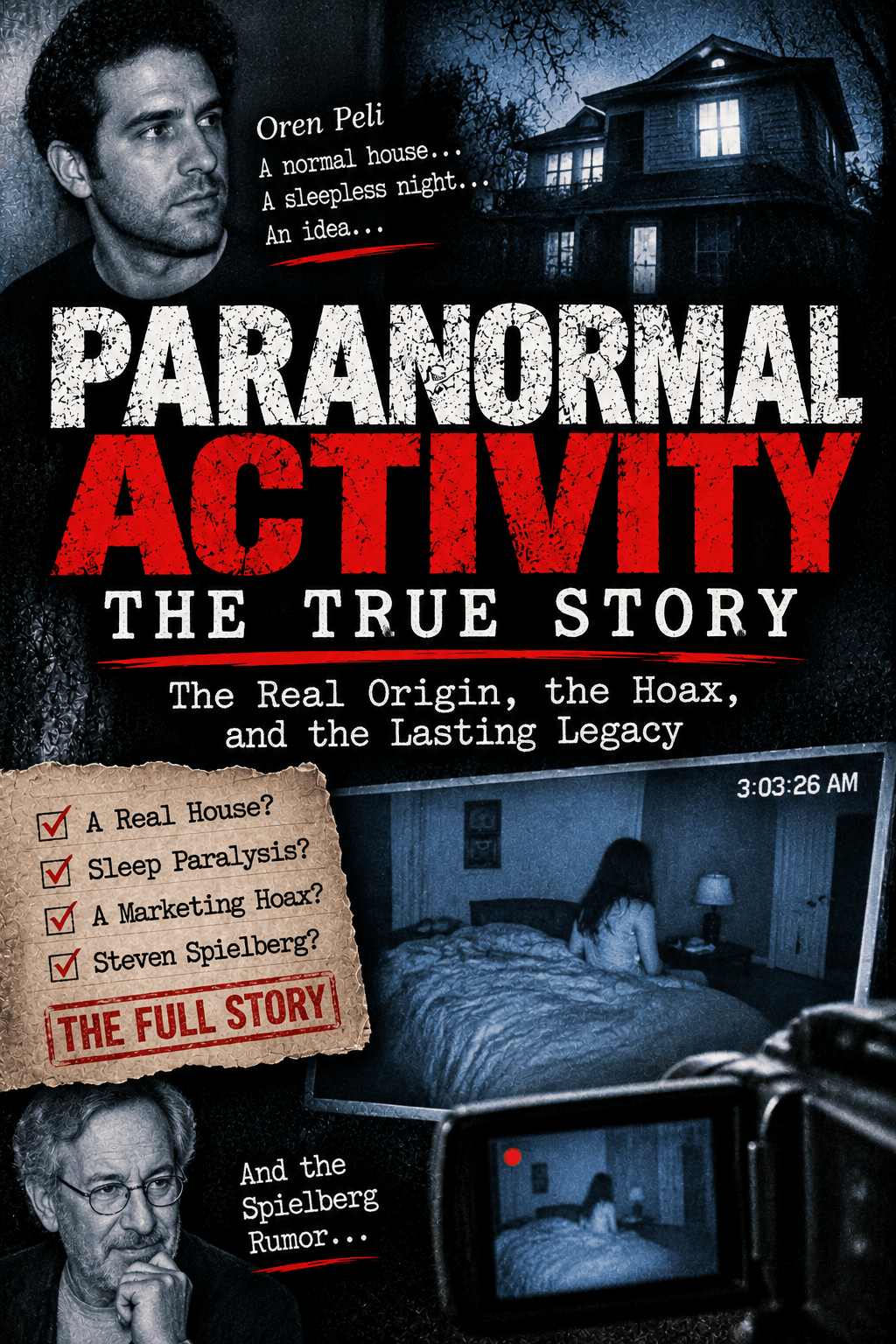
The Paranormal Activity true story is not a story at all in the way the title implies. There is no haunted house with a documented history behind
the 2007 film, no demon with a decades-old claim on a family. What is real is smaller and stranger: director Oren Peli built the film after hearing unexplained noises in his own new house, feeling afraid despite knowing better, and asking what that gap between disbelief and dread would look like on camera.The explanation for why that fear felt so convincing has far more to do with a well-documented sleep phenomenon than with anything supernatural.Before Oren Peli built a demon, he had a house that made noises. That is the whole origin story, stripped of marketing. In interviews he has given about the making of the film, he has described hearing sounds in his own home at night after moving in, around 2005, the kind of settling and shifting a new house makes, and he has said plainly that he never believed anything supernatural was happening to him. He felt the fear anyway.That gap, between what he knew and what he felt, is the real subject of this piece, more than the film itself. What does it mean that knowing better was not enough?It is worth sitting with how small that origin story actually is. There is no haunted object, no inherited curse, no prior tenant with a violent history. There is a man lying awake in a house that was, by every available account, entirely ordinary, listening to it make the sounds that ordinary houses make while it settles, cools, and shifts on its foundation. He has described trying to reason himself out of the fear in the moment and failing, which is the detail that matters most here.Knowing a sound has an explanation and feeling safe because of that knowledge turned out, for him, to be two separate things that did not automatically arrive together. The film is an attempt to externalize that failure, to build a situation where the audience has to sit with the same gap between information and feeling that he did, night after night, in a house no one has ever claimed was built on anything.
A Rational Man Building an Irrational Film
Peli was not a horror obsessive chasing a franchise. He was a software engineer with a camcorder and an idea he could not stop turning over: what if the noise in the night had a face, and what if the only way to see it was to leave a camera running while everyone slept. How he answered that question with the camera itself is its own subject, covered in
this site’s review of the film’s craft. He wrote no conventional screenplay.He gave his two actors a situation and a rough shape for each scene and let them improvise the dialogue, scene by scene, across a shoot that reportedly took about a week inside the house he was renting at the time. The performances sound unrehearsed because they were. That decision, born partly out of necessity, is also the reason the film still works on people who have seen a hundred haunted-house movies since. Improvised dialogue carries the cadence of memory, loose and overlapping, the way people actually talk when a line has not been rehearsed in advance.The film found its first audience far from a multiplex. It premiered on the festival circuit in 2007, got picked up, and then sat for roughly two years while a studio tested it on preview audiences and experimented with how it should end. Several different endings were shot and screened before the version that reached theaters in 2009 was locked in. The ending audiences eventually saw was not the ending Peli shot first.It was the one that tested as the most frightening, which is its own quiet admission: even a film built on the premise of unedited, undirected reality went through the same audience-driven revision process as any other horror picture once money was involved.That two-year gap is worth pausing on, because it reshapes what the film actually is by the time most people saw it. The version that premiered at a small festival in 2007 was closer to a document of one man’s private unease, tested on strangers one room at a time. The version that opened nationwide in 2009 had been shaped, re-shaped, and re-cut by a studio paying close attention to which specific moments made preview audiences flinch. The raw material never changed.The house, the camera, the two actors improvising their way through a loose scaffold of situations and prompts, all of that stayed intact. What changed was the ending, chosen the way a focus group chooses a paint color, after the fact, from test-screening data. A film about something ordinary curdling into something it should not be went through exactly that same market-tested process on its way to theaters.Somewhere in that gap between the festival cut and the theatrical release, a story started circulating that Steven Spielberg, one of the executives involved in acquiring the film, watched a copy at home and had an experience with it strange enough that the disc ended up locked away, pulled entirely out of general circulation. Peli has said in interviews that he believes this story. He has not claimed to have witnessed it himself, and no one has produced documentation that confirms it beyond the people who were reportedly there.It functions less as verified fact and more as
the found-footage genre’s own founding conceit escaping the screen: a studio executive, the most commercially successful director alive, supposedly rattled by the same cheap, static, nothing-happens footage that rattled general audiences in test screenings.Whether or not the specific details are accurate, Peli’s own willingness to say he believes it sits oddly next to the skepticism he applies to the supernatural reading of his own house. That contrast is its own small piece of evidence for how differently people reason about a secondhand story versus their own lived sensation. He can be skeptical about what happened to him and credulous about what supposedly happened to someone else. Most people manage exactly that same inconsistency without noticing it.
What Actually Happens When the Brain Can’t Move
Here is the part of the story that has nothing to do with Oren Peli, and everything to do with why his noises felt like something standing over him.During REM sleep, the body goes into a state of near-total muscle paralysis, called atonia, which exists so that a dreaming brain cannot act out its dreams and injure itself or whoever is next to it. Normally this paralysis lifts in the same moment consciousness returns. Sleep paralysis is what happens when it does not: the mind wakes up, fully aware of the room, the ceiling, the sound of its own breathing, while the body stays locked exactly where sleep left it. People describe it as drowning while lying perfectly still.The paralysis alone is frightening enough. What makes it close to the experience Peli was describing in his own house is what tends to accompany it: hypnagogic and hypnopompic hallucinations, the vivid, often terrifying sensory intrusions that can arrive at the edges of sleep, on the way down or on the way back up. A pressure on the chest. The specific, bodily certainty that something else is in the room, standing near the foot of the bed or sitting on top of the sleeper, even when the eyes report an empty doorway.Some people describe the sound of footsteps approaching before the paralysis even sets in, which is close enough to the opening minutes of this exact film that the overlap is hard to ignore.Researchers studying the condition have found it is far from rare: general population estimates run around 8 percent of people experiencing it at least once, with that figure climbing toward 30 percent among groups like students and psychiatric patients, according to a widely cited 2011 review of the research. It is also strongly associated with ordinary sleep disruptions: stress, sleep deprivation, irregular hours, alcohol use, and conditions like narcolepsy and sleep apnea all raise the odds of an episode.A person who has just moved into a new house, adjusting to an unfamiliar bedroom, sleeping worse than usual while they settle in, is, in other words, living through almost every condition on that list at once. The house does not need to be haunted for the body to behave as if it is under watch.None of that requires a demon. It requires a brain doing something it does constantly, slightly out of sync, at the exact moment a person is most defenseless and least able to reason their way out of what they are feeling. The felt presence functions as the fear itself, manufactured whole by a nervous system that has woken up ahead of the body it is attached to and is scanning a dark room for the threat that would justify being unable to move.
A Fear With a Thousand Names
What makes sleep paralysis worth lingering on at length is how consistently cultures that have never spoken to each other have arrived at the same explanation for it: something came into the room.English folklore calls it the mare, the root of the word nightmare itself, a creature believed to sit on a sleeper’s chest while they slept, pinning them down until morning. In parts of Newfoundland it is the Old Hag, pressing down on the body in the dark, with a whole local tradition of remedies passed down for what to do if she visits. Italian tradition has the Pandafeche, a nocturnal witch-figure with her own folk prescriptions for warding her off.In Brazil it is the Pisadeira, an old woman with long nails said to step onto the chests of people who go to bed on a full stomach, a detail so specific it reads like a culture trying to pin an explanation onto something it could feel but not otherwise account for. Inuit traditions have described the same core experience through the lens of shamanistic attack, a spirit assault woven into a broader cosmology where the body is porous to outside forces during sleep.In parts of China it is described as being pressed down by a ghost, a phrase still used colloquially by people who have never studied the folklore behind it and are simply reaching for the nearest available language to describe what just happened to them.Different continents, different religions, different centuries, and the description that keeps surfacing is almost identical: paralysis, pressure, and a presence that feels unmistakably real and unmistakably hostile. None of these traditions were in contact with each other when the names were coined. Each one, independently, arrived at some version of a body pinned down and a visitor standing over it, because that is apparently what the experience itself hands a person, regardless of what they already believed about ghosts going into it.That consistency is the real haunting here, more than anything staged for a camera. A film can be set in one house, on one street, during one specific week in 2006. This phenomenon has been reported in nearly every house, on every continent, for as long as people have been able to write down what happened to them in the dark, under names that have nothing to do with each other and a description that has almost everything to do with each other.
Why Believing Makes It Worse
There is one more piece of the research worth sitting with, because it complicates the comforting idea that understanding the biology makes the fear go away on its own. A comparative study looking at people in Egypt and Denmark who had experienced sleep paralysis found that the two groups reported the episodes with similar frequency, but the level of distress diverged sharply depending on what each culture had taught them to believe was happening.Where the surrounding belief system framed the experience as a spiritual or supernatural attack, the fear reported afterward was measurably worse, sometimes severe enough to affect how people slept for days afterward. Where it was understood as a known, explainable sleep phenomenon, the same physical experience was easier to walk away from, filed away simply as unpleasant, with the room understood to have been empty the whole time.The mechanism in the body is apparently close to universal. The meaning layered on top of it travels on a completely separate track, culturally specific and learned, and that meaning appears to change how much the experience actually hurts in the moment and afterward. If belief can move the needle on pain this precisely, it raises a quieter question than the one this piece opened with: how much of what gets called a haunting is really just a story a culture hands someone to explain a feeling it had no other name for.This is where the comparison to Peli’s own account earns its place in the argument. He has described himself as someone who did not believe anything otherworldly was in his house, who could reason his way to the mundane explanation without much effort, and who still, by his own account, carried a residue of fear from being frightened badly as a child by The Exorcist. Disbelief and dread were apparently sitting in him at the same time, occupying the same nervous system without canceling each other out, and he built his two lead characters around exactly that split.One of them keeps insisting there is a rational explanation for a house that has clearly stopped obeying rational explanations, performing the same reassurance to his own panic that Peli performed to his, with the same limited success.There is a reason this detail from Peli’s biography matters more than it might first appear: it means the film’s most famous skeptic character was not invented as a straw man for the plot to knock down. He was built from a documented case of one, the director’s own difficulty trusting his own certainty in the dark.
The Paranormal Activity True Story: What’s Real and What’s Invented
The honest version of the Paranormal Activity true story has no Katie, no demon with a decades-long claim on her family, no exorcism performed on a child in the 1980s. That part is invention, assembled by a filmmaker who understood exactly what he was borrowing from to make the invention land.
The demon mythology built around Katie’s family, the childhood photographs, the Ouija board nobody in the house should have touched: these exist because a ninety-minute film about a man who cannot sleep well needed somewhere to go, a mechanism to escalate, a reason for the camera to keep running past the point where a real couple would have simply moved out. None of that machinery is being claimed as fact here, and none of it needs to be for the rest of this argument to hold.What is real, confirmed by the director’s own account of his own life and independent of anything in the script, is the shape of the fear underneath the invented mythology: the specific, ordinary terror of lying in bed, awake, aware, unable to move, certain something has entered the room, for reasons a body can generate entirely on its own, with no demon required to explain any part of it. Peli did not need to invent that feeling.He had already had it, in a house with no history, for reasons a sleep lab could probably have explained to him if he had ever gone looking for one. Whether that makes the fear smaller or only better explained is not a question this piece can settle. He just pointed a camera at the ceiling and let an audience sit in it with him, the way people have been describing that exact sensation, under a dozen different names, for as long as anyone has kept a written record of what happened to them in the dark.That, more than any demon, is the real Paranormal Activity true story.
FAQ
What is the Paranormal Activity true story?
No single documented case matches the film’s plot. Director Oren Peli has said the idea grew out of his own experience hearing unexplained noises in his house, which he never attributed to anything supernatural, combined with childhood fear left over from watching The Exorcist as a kid.
What did Oren Peli actually say inspired the film?
Peli has described hearing ordinary household noises at night after moving into a new home and feeling unsettled despite not believing anything paranormal was occurring. He turned that private, rational-versus-emotional tension into the film’s premise.
What is sleep paralysis, and why does it matter to this film?
Sleep paralysis occurs when the body’s normal muscle paralysis during REM sleep persists into waking consciousness, often accompanied by hallucinations of a sinister presence or pressure on the chest. It offers a documented, non-supernatural explanation for sensations the film dramatizes as hauntings.
Did Steven Spielberg really have a strange experience with the film?
A story claiming a copy of the film unsettled Spielberg enough that it was locked away has circulated for years. Peli has said he believes the story, but it remains unverified beyond accounts from people reportedly involved, and its status stays that of legend, still unconfirmed as documented fact.