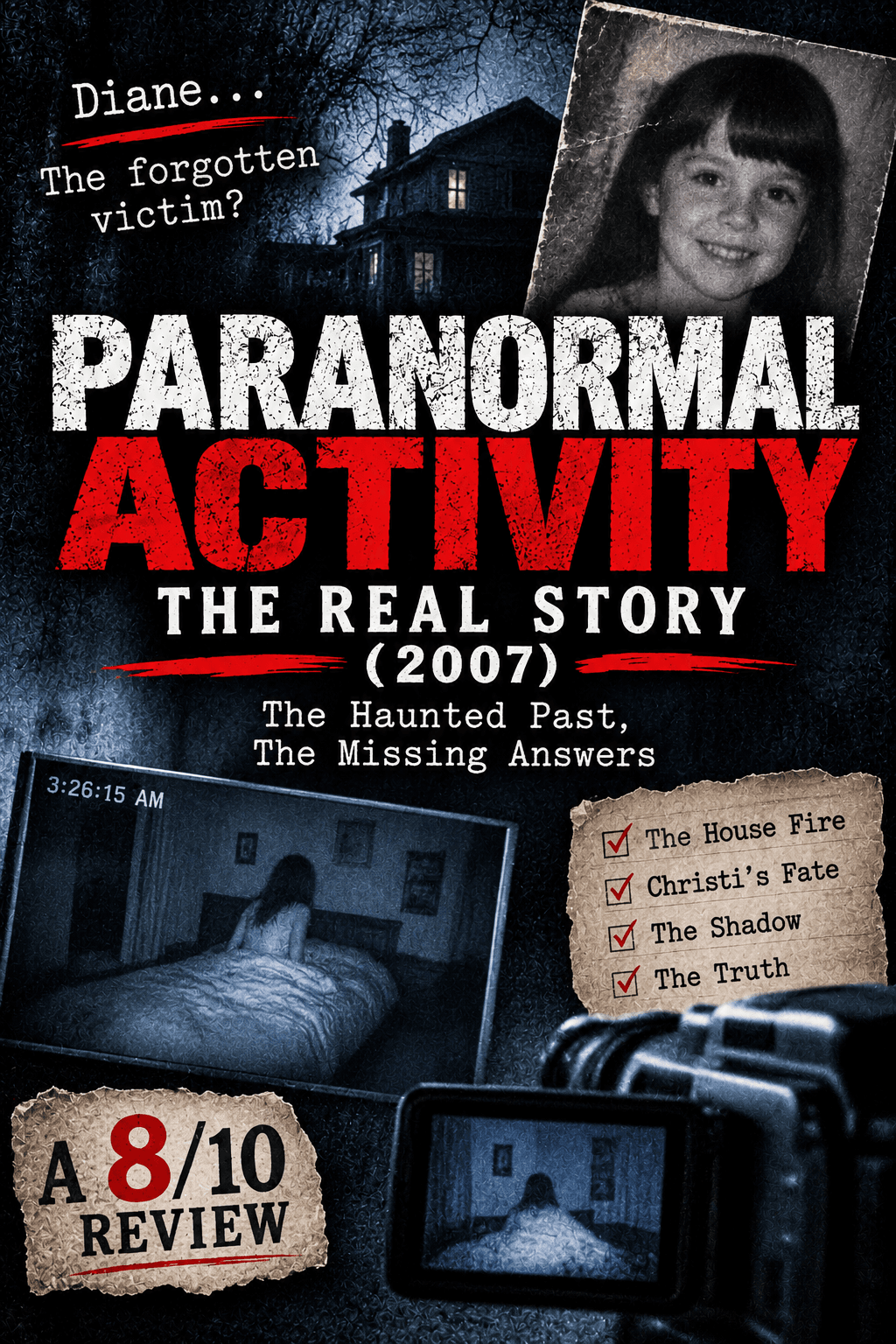
Diane in Paranormal Activity (2007) is the name Micah finds buried in an internet search while trying to decode an Ouija board message — a woman from the 1960s whose childhood, by his own account, matches Katie’s in exact detail, down to an unexplained house fire at age eight. She’s never named on screen again after that, her fate never confirmed, and that small, unresolved thread turns out to be the clearest window into everything else this film is actually about.Nobody in
Paranormal Activity (2007) ever asks Katie Featherston what she remembers. They ask her what happened, which is a different question, and one she can only half-answer, because most of what happened to her happened while she was asleep, or possessed, or eight years old in a house that later burned down for reasons nobody determined. Every fact about Katie’s haunting arrives secondhand: through a psychic’s intake interview, through Micah Sloat’s internet research, through a camera running in a room she didn’t choose to be filmed in.By the time the film ends, a woman has been dragged through twenty-one nights of escalating terror, and somehow the only account of what it did to her belongs to everyone except her — a dynamic our
review of the film’s camera and craft traces from the very first scene.This is a different film than the one most people describe. The surface story is a haunting that becomes a possession that becomes a death. Underneath it is a woman’s history getting rewritten by other people in real time, and nobody in the house seems to notice this is the actual emergency. Dr. Fredrichs rewrites her fear as a taxonomy. Micah rewrites her fear as content. The demon, whatever it is, apparently rewrites entire families this way on a schedule nobody can predict and nobody survives long enough to explain.Katie spends the whole film trying to narrate her own experience and loses that argument every single time, long before anything drags her out of bed.
The House That Burned Before the Story Started
Katie’s account to Dr. Fredrichs is the only sustained piece of her own history she gets to deliver in the entire film, and it is worth sitting with exactly how little of it resolves into anything. She was eight. She shared a room with her younger sister, Christi, who was five at the time. Something would wake her at night — a weight of breathing in the room — and she’d wake Christi, and the two of them would watch a shapeless, shadowy mass take form at the foot of Katie’s bed. Never Christi’s bed.Both girls were old enough to be permanently marked by it and young enough to have no language for it beyond lying still and praying it would leave, which, for a while, it did.Then the house burned. Everyone got out. Nothing was lost except, in Katie’s flat phrasing, everything — the family’s possessions, the physical record of a childhood, and, as it turns out fifteen years later, almost all proof that any of this ever happened. Fredrichs asks the obvious question: was the cause of the fire ever determined? It wasn’t — the fire department’s own investigation ended without settling on electrical failure, arson, or anything else, a dead end Katie seems almost relieved to report, since an unsolved mystery is at least less complicated than a conclusion she’d have to defend.She is careful, almost defensively careful, to say she isn’t claiming the fire and the haunting are connected. She says this to a psychic she’s paying to take the haunting seriously, which tells you something about how exposed she feels even raising the possibility.The entity went quiet after the fire and came back when she was thirteen, recurring on and off ever since, through an unspecified number of years during which a twenty-something woman carried an unexplained childhood trauma around without, as far as the film shows us, any adult in her life treating it as more than a story she tells.What makes this origin so quietly devastating is how little of it survives as evidence by the time the film needs it. The fire took more than a house. It took the one piece of evidence that might have let somebody other than Katie corroborate her own account of her own childhood — photographs, records, anything beyond her memory and Christi’s. From the very first scene of her life that the film lets us hear about, Katie’s history exists only as testimony. No artifact. No second witness who speaks on camera.Just a woman repeating a story she was eight years old when it started, to a stranger with a clipboard, hoping he believes the parts she can’t prove.
Christi, the Unmentioned Witness
The film raises a second victim in that first scene and then drops her for good. Christi was five. She saw the same shadow at the foot of a bed that wasn’t even hers to be afraid of, and she was, in Katie’s own description, every bit as terrified as her older sister. And then Christi disappears from the story entirely, her fate reduced to pure absence, unmarked by death or explanation, the way a childhood friend you shared something enormous with can become a name you mention to a psychic once and never bring up again.There’s no scene where the adult sisters compare notes on what they remember, no suggestion that Christi was ever consulted about any of this, no acknowledgment that a second person’s memory of that house might corroborate or complicate Katie’s own. Whatever Christi carries from those nights, she carries it off-screen and alone, which makes her the film’s smallest and saddest reminder that Katie’s isolation started well before Micah and his camera — in a shared room, with a shared fear, and a family that apparently never spoke of it again once the house that held it burned down.
A Taxonomy That Explains Nothing About Her
Dr. Fredrichs’ contribution to the film is a vocabulary, and the vocabulary is where the story quietly stops being about Katie at all. Ghosts are the spirits of human beings, tethered to places and tied to specific deaths. Demons, in his telling, are never human to begin with — malevolent intelligences that attach to a person rather than a place, capable of stalking someone for years or decades, existing, as far as he can tell, purely to cause pain and take pleasure in doing it.Once Micah hears that whatever is following Katie doesn’t feel human, that it feels like a monster, he has his answer and, more importantly, he has his genre. What settles over his face is undisguised delight — he’s got a rare phenomenon on tape, and he says so, plainly, with the enthusiasm of someone who has just confirmed a theory. That the person who confirmed it is his girlfriend, describing a fear she has apparently carried since she was eight years old, doesn’t appear to register with him as the more urgent fact in the room.Katie, watching him light up, points out — flatly, without theatrics — that she’s surprised he isn’t as frightened as she is, given that she’s the one actually living inside whatever this is.That exchange is the whole film in miniature. A taxonomy gets established — ghost or demon, human or not, random or targeted — and everyone treats naming the thing as a form of progress, as though a category were the same as an explanation. Fredrichs tells them a demon can stalk people for decades and sometimes outsmarts the people trying to study it.He never tells them why this demon chose Katie specifically, what it wants from her beyond the generic appetite he’s already described, or what, short of what it may have already done to whoever it attached to before her, actually ends it. The information Micah accumulates over the following weeks is genuinely extensive — a referral to a demonologist, hours of tape, pages of research — and none of it answers the one question that would actually help Katie: why her, and how does this stop. The demon gets a category.Katie gets a diagnosis with no treatment attached, and a boyfriend who finds the diagnosis more interesting than the patient.Fredrichs’ own fix for this is a referral to Dr. Johann Averies, a demonologist he says is better equipped for whatever this actually is. Averies turns out to be out of the country for days, which the film treats as a mere scheduling inconvenience — even though it leaves the one professional suited to help this specific woman unreachable for the entire length of her crisis. Diane, whoever she really was, apparently didn’t have the luxury of waiting for a demonologist’s calendar to clear. She called an exorcist directly, and by Micah’s own account, her condition worsened once he arrived.Between a demonologist nobody can reach and an exorcist who reportedly made things worse, Katie’s actual options narrow to one person: a boyfriend with a camera and a working theory.
Diane in Paranormal Activity (2007): A Pattern With No Ending
The film’s most quietly tragic piece of information arrives through Micah’s laptop, during what starts as an ordinary night of research. Trying to make sense of a possible name spelled out through the Ouija board — Edina, Diane, maybe Nadine without the second N — Micah finds a woman online from the 1960s whose childhood matches Katie’s circumstances in exact detail: eight years old, an unexplained house fire, shadows at night, the whole pattern repeating itself a generation earlier.According to what he’s reading, she called an exorcist, and the exorcist’s visit left her condition worse than it had been before he arrived. Micah proposes a theory on the spot, almost gleefully: maybe the same thing that is attached to Katie did this to Diane first, and simply moved on once it finished with her. He calls this its pattern of behavior — language that turns a woman’s destroyed life into a repeat offender’s case history, a habit to be documented, stripped of the possibility that it was also, for someone, a death worth mourning.And then Katie asks the only question in the whole exchange that actually matters: how did she die. Micah’s answer, delivered as a glance at an old photograph, is barely an answer at all: “She’s pretty. Now she is.” He never finds out what happened to Diane. He never really tries to. The question gets raised and then drowned under his own research momentum, and Diane stays exactly what she started as — a cautionary data point in Micah’s theory of the case, a woman whose ending nobody in this film cares enough to locate.If the entity does have a pattern, if it really does move from victim to victim across decades the way Fredrichs suggested, then Diane is proof the pattern has already run its full course once, off-screen, with no satisfying resolution for anyone — including, eventually, for Katie. Nobody in the house registers that the question Katie actually asked is also, functionally, a forecast.
What the Camera Caught That She Didn’t
Something takes a piece of Katie’s own experience away from her and hands it back only as something Micah watched. Katie gets out of bed one night, and the camera — fixed, indifferent, running the way it always runs — simply records what happens: she stands, she moves, eventually she’s outside in the cold on the porch.Micah finds her there and brings her in, and when he asks what she remembers, the honest answer is a blank — no memory of getting up, of walking, or of whatever, if anything, was going through her mind while her body did all of this on its own. The one fragment that survives is narrower than that: standing in a doorway, with Micah pointing a camera at her. That’s the entire content of her own memory of a night that is supposedly happening to her. Not the walk outside. Not whatever drew her there.Just the moment she became aware of being watched.Set this against the fire investigation that opened the film’s backstory, and the shape of the pattern gets clearer. The fire department couldn’t determine a cause; nobody else was in the room to corroborate the shadow at the foot of Katie’s childhood bed; and now her own memory joins that same category of evidence that simply isn’t there. Whatever is moving through this house is quietly auditing every source she might ever use to tell her own story independently of someone else’s account of it, and finding, night after night, that the source has gone missing again.
Two Photographs, One Face Erased
The attic scene plays like a jump scare on first viewing and like something sadder on a second one. Micah climbs up looking for the source of a noise and comes back down holding a photograph connected to the house Katie grew up in, the one that burned — an object that, by her own account, shouldn’t exist.She hasn’t seen that picture in fifteen years, she says, and keeps repeating that none of this makes any sense, because an object surviving a fire she’s already explained in detail to a stranger with a clipboard now contradicts the one clean fact she thought she still had.Elsewhere in the same stretch of nights, a quieter version of the same violation happens to a photograph that never went anywhere near a fire. A framed picture the couple already owns, hanging in their own house, turns up with Katie’s face scratched out. Micah’s face in the same photograph is untouched. Neither of them can explain how or when it happened.Between an old photograph that survives a blaze it has no business surviving and a recent one that gets damaged with what looks like real precision, the pattern lands twice in two different directions — toward the past Katie can’t verify and toward the present she’s living through — and both times it singles out her face specifically, never his. Dr. Fredrichs spent an entire session building a vocabulary for what’s doing this. Neither photograph needed any of it to make its point.
The Board That Burned
The Ouija board is the one piece of this film’s mythology that refuses to resolve into a clean answer, and it’s worth resisting the urge to force one onto it. Micah brings a borrowed Ouija board into the house despite Katie’s objection to having one there at all. Left alone, on camera, the planchette moves without either of them touching it, and the board itself catches fire, leaving its surface marked in a way neither of them put there.What it may have spelled out, in the ambiguous reading Micah and Katie argue over afterward, narrows to three candidates: Edina, Diane, or possibly Nadine without the second N.Micah treats this as a puzzle with a solution, something to be cross-referenced against internet research until it produces an answer — it’s how he arrives at Diane in the first place.
Found footage has built entire mythologies out of less —
The Blair Witch Project’s own backstory took years of fan theorizing to half-explain — but this board never gets that treatment from anyone in the house. Still, the ambiguity itself might be the more honest piece of information here.A name that could be three different names demonstrates something else entirely: that whatever is in this house can leave behind evidence precise enough to invite exactly the kind of obsessive, misdirected research Micah is already inclined toward, and vague enough to never actually be confirmed. Its situation turns into an interpretive problem for someone else to solve, when what it actually represents, underneath the puzzle, is a person’s suffering that needs to stop.
What the Ending Takes Away Last
By the time Katie is dragged from her bed by something unseen on the night everything ends, she has already lost the argument about her own fear a dozen times over — to Fredrichs’ taxonomy, to Micah’s research, to a camera that remembers things more reliably than she does, to two photographs that only ever seemed to be after her. What the final nights take is the last thing she had left: her own voice in the room. The woman who stands in the doorway at the end, who looks at the camera the way she does, says nothing.She offers no explanation the way she once did with Fredrichs — haltingly, defensively, but in her own words. She’s just there, and then she’s gone, and the story closes on an epilogue written in the flattest possible register: a police report, a body, a woman whose whereabouts are unknown.That last fact is the cruelest inheritance of everything that came before it. Katie spent the entire film being described, diagnosed, researched, and recorded by other people, and the film’s final word on her comes from a line of text summarizing an investigation, written by people who never knew her — the same bureaucratic register Fredrichs used when he first reduced her fear to a category. Nobody ever got around to asking Katie what she remembered, and by the end, there’s a real question whether there was still a Katie left to ask.The haunting was never really about whether the thing at the foot of her childhood bed was a ghost or a demon. It was about how completely a frightened woman’s own account of her life can be overwritten — by science, by curiosity, by love that keeps filming anyway — until the only story left standing is the one nobody bothered to get from her directly. Diane in Paranormal Activity (2007) never got her ending back. By the film’s own logic, there was never much reason to expect Katie would get hers either.
FAQ
Who is Diane in Paranormal Activity (2007)?
Diane is a woman Micah finds through internet research, said to have experienced an identical haunting in the 1960s — an unexplained house fire at age eight, followed by a demonic presence. She called an exorcist, and the film strongly implies this made her situation worse. Her ultimate fate is never confirmed on screen.
What does the Ouija board spell out in Paranormal Activity (2007)?
The planchette moves on its own while the board catches fire, leaving a mark the couple struggle to read. The candidates they debate are Edina, Diane, or possibly Nadine without the second N — an ambiguity the film never fully resolves.
Is Paranormal Activity (2007) about a ghost or a demon?
Dr. Fredrichs classifies the presence as a demon. He explains that ghosts are human spirits tied to places, while demons are non-human entities that attach to a specific person and can follow them for years or decades.
What happened to Katie as a child in Paranormal Activity (2007)?
Katie says the haunting began when she was eight, sharing a room with her five-year-old sister Christi, both of whom saw a shadowy presence at the foot of Katie’s bed. Their childhood home later burned down under causes investigators never determined.