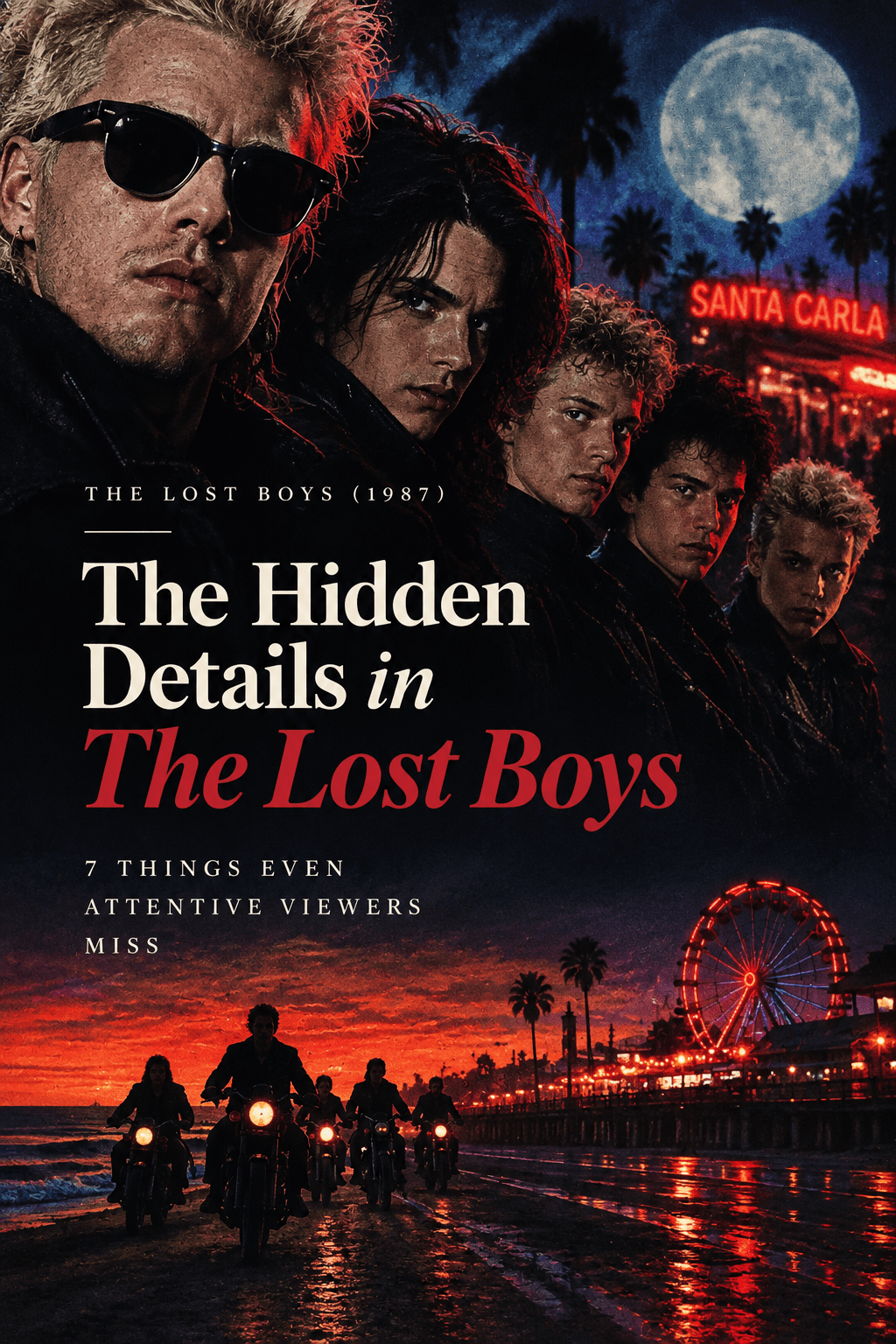
The Lost Boys is a 1987 vampire film directed by Joel Schumacher, written by Jeffrey Boam, Janice Fischer, and James Jeremias, built on a screenplay that everything else in the production, the photography, the cast, the soundtrack, works hard enough to cover for. Underneath the neon and the motorcycles, what’s become known as the Lost Boys addiction metaphor runs the whole show: a well-behaved kid gets pulled toward a group with its own initiation rites, handed something dangerous in a bottle, and left to deal with what his body does with it.Richard Donner’s original version of this story starred thirteen-year-olds. The vampires rode BMX bikes instead of Harleys, the Frog brothers were meant to be chubby eight-year-old Cub Scouts, and the whole pitch played closer to The Goonies with fangs, a PG family adventure with a safe, sanitized bite. Donner left the project. Schumacher inherited it, decided the only interesting version of this story starred teenagers with motorcycles and eyeliner, and brought in Boam to age everybody up by roughly half a decade.That single executive decision is the reason the film works at all, and it’s also the reason the screenplay never quite catches up to everything built around it.I want to be clear about what I’m reviewing, because the film has accumulated so much affection over four decades that people tend to describe the movie they remember rather than the one that’s actually on screen. What’s on screen is a competently plotted teen horror picture, divorced mom, resentful older son, precocious younger son, seaside town crawling with something worse than surf gangs, dressed in some of the best studio horror photography of its decade and cast with a specificity that borders on alchemy.Kiefer Sutherland, fresh off Stand by Me, broke his wrist doing a motorcycle wheelie and finished the shoot with his cast concealed by a glove. Corey Feldman was told by his director to go study Chuck Norris movies until he understood what a fourteen-year-old vigilante actually believes about himself. Dianne Wiest, an Academy Award winner four months removed from Hannah and Her Sisters, said yes to playing a single mother who works the counter at a video store. None of that is written into the script. All of it is why the script survives.The Lost Boys figured out exactly which of its problems it could outrun with style, speed, and needle drops, and it was right about every single one of them except the plot mechanics of its own back half, which it outpaces without ever actually solving. That’s a defensible strategy for ninety-seven minutes.It’s also the reason the film’s staunchest defenders tend to talk about vibe, cast, and soundtrack, and change the subject fast when the actual mystery-plot machinery comes up, who the head vampire is, how obviously the movie tips its hand, how little Michael Emerson does to solve his own crisis once the reveal lands.
Michael Chapman’s Cinematography Turns Vampires Into Beach-Town Predators
Michael Chapman shot this. Two pictures out from Raging Bull, and a decade removed from Taxi Driver, and Schumacher handed him a vampire movie set almost entirely in blinding California daylight, on a boardwalk, in a beach town. That’s the smartest formal decision anybody made on this production. Every prior American vampire picture worth mentioning up to that point had leaned into fog, castles, and candlelight.Chapman and Schumacher throw all of that out and shoot Santa Carla the way a music video shoots a beach party, all practical neon and bonfire glow and long lenses picking faces out of a moving crowd, and then drop the vampire cave underneath it like a bruise under tanned skin. The photography argues that the horror is standing in the sun here, wearing a leather jacket, while nobody looks hard enough to notice.
Thomas Newman’s Score Knows Exactly When to Get Out of the Way
Thomas Newman scored it, three years into his solo career and barely out of ghostwriting orchestrations for other composers. His father won nine Oscars. His cousin wrote “Short People.” The family had been running Hollywood’s music departments since sound pictures existed, and here’s Thomas, on maybe his third real credit, building a score around organ and orchestra that sounds like a kid finding his own instrument inside somebody else’s studio, prestige or not.It’s a blunt, unsubtle score by design, and it knows exactly when to get out of the way of “Cry Little Sister,” the Gerard McMahon theme that does more tonal work in its opening seconds than most of the dialogue in the back half of the picture. It knows exactly when to lean into dread under the cave scenes, too, where Newman’s organ does the one job gothic horror actually needs from an instrument: it makes a beach cave sound like a church that stopped believing in anything but appetite.
Kiefer Sutherland, Corey Feldman, and Jason Patric Carry a Thin Script
Sutherland is the reason David works as a fully realized character. The screenplay gives him almost nothing, gang leader, motorcycle, cheekbones, some lines about freedom and no rules that could have come out of any 1950s hot-rod picture with “vampire” find-and-replaced in for “hoodlum.” What Sutherland adds is control. Watch how rarely David raises his voice, how much of his menace is delivered at a near-whisper, how the “you’re one of us now” refrain that Boam layered into the trestle sequence lands as pure seduction because Sutherland plays every line like he already knows the answer.He’s twenty years old in this movie and he’s doing screen-star math that most actors twice his age never figure out, that stillness reads as power and volume reads as need.Corey Feldman is doing something almost opposite and just as calibrated: Edgar Frog is pure, committed, unembarrassed overcompensation, a kid who has clearly watched too many action movies and decided that’s a personality he can wear like armor, and Feldman plays every beat of the character’s self-seriousness completely straight, which is the only way the Frog brothers’ comic-relief subplot survives contact with a horror movie that also wants you to take its stakes literally.Jason Patric, meanwhile, plays Michael as close to blank as the part allows, which works well enough, since the role mainly exists to walk the audience through everyone else’s more interesting problems.
The Lost Boys Addiction Metaphor Hiding Inside a Vampire Movie
What the film is actually about, and this is where I think its reputation undersells it, got written up properly a few years back in an academic paper on addiction metaphors in eighties horror, and the argument holds up scene by scene once you’re looking for it.The paper reads the whole cave sequence as an addiction narrative with the serial numbers filed down to look like folklore: a well-behaved kid gets pulled toward a transgressive group with its own initiation rites, hanging off a bridge while a train roars past, jumping into the void, taking an illegal substance handed to him in a bottle by someone he wants to impress, and the drug in question just happens to be blood. The withdrawal symptoms play as body horror.The title is a Peter Pan reference on purpose, and Peter Pan is a story about children who refuse to grow up because growing up is where the pain lives. Frame it that way and the whole vampire conceit stops being a genre choice and starts looking like the most eighties possible way to tell a Just Say No story without anybody involved having to use that phrase out loud. The film never says any of this outright. It just keeps handing Michael a bottle and watching what his body does with it.The Lost Boys addiction metaphor is compelling precisely because the movie never announces it as one. I’ve gone back and forth on how far to trust that reading, though. It doesn’t fully explain why Michael gets to walk away clean by the credits while nobody else in David’s gang does, and I don’t have a tidy answer for that gap.
A Divorce Story Wearing Fangs
There’s a second, quieter anxiety running under that one, and it’s the one Elaine Showalter identified when she called this “mythic male bonding that resists growing up, commitment, especially marriage,” the film is exactly as interested in Lucy Emerson’s divorce as it is in her sons’ transformation, and it treats both as versions of the same wound. A broken home produces boys who go looking for a family that doesn’t ask anything of them. David offers Michael exactly that: no parents, no rules, no consequences, forever.The film’s actual villain is an alternative to adulthood dressed up as freedom, and Edward Herrmann’s Max, genuinely the film’s best-kept secret, playing the world’s most reasonable-seeming stepfather candidate right up until the last ten minutes, turns out to want the same nuclear family Lucy already has, just undead. “Just like one big happy family,” he says, and it’s the single creepiest line reading in the movie, because Herrmann delivers it like a man who’s done nothing wrong.
Santa Carla Is a Real Place With a Real Body Count
The town itself carries its own history into the joke. Santa Cruz, filmed almost entirely on location, renamed Santa Carla for the picture, was actually called the “murder capital of the world” in the early 1970s, after Edmund Kemper and Herbert Mullin killed close to two dozen people between them in a span of a few years. It’s a real, documented civic nightmare that the production borrowed wholesale for a spray-painted joke on the back of a welcome sign,
the same impulse that turns real historical panic into folklore in the first place.It’s the kind of gag that works if you don’t know the history and works differently, and better, once you do: the film is haunted by an actual body count it never explains, hiding in plain sight under a story about the fictional kind.
What the Screenplay Changed About the Trestle Scene
I want to flag one specific place where the screenplay and the finished film genuinely diverge, because it’s instructive about what Boam and Schumacher were actually doing under the hood. In the shooting script, the trestle sequence is staged as something closer to literal stunt work: the boys climb down and hang from the underside of a railroad bridge, a passenger train thunders past a foot above their heads, and they drop into a fog-covered gorge one at a time while the others catcall from below.The finished film trades almost all of that legibility for pure vertigo, falling, weightlessness, disembodied voices calling Michael’s name out of white fog, David repeating “you’re one of us now” like a mantra instead of a dare, cutting every literal detail that would let you track what’s actually happening to these bodies in physical space.The trade works: refusing to let you track the geography of the scene is exactly what makes it frighten harder than the script’s version would have, and it tells you something about which parts of this screenplay the production actually trusted and which parts it decided worked better as sensation than as scene.
Where the Ending Falls Apart
The ending is a mess it never quite earns its way out of, and Ebert clocked this on release better than almost anyone since: “the same old cornball, predictable action climax with everybody chasing everybody around with lots of screams and special-effects gore,” he wrote, giving the film two stars and calling it a movie that “starts out well but ends up selling its soul.” I don’t think he’s wrong about the mechanics.The back third of this film abandons almost everything interesting it built, the addiction metaphor, the divorce anxiety, Max’s genuinely unsettling patience, in favor of a house under siege by garlic, holy water, and a stereo speaker used as a weapon, and the emotional stakes get resolved less by character than by household objects.What Ebert’s review misses, watching it fresh instead of forty years removed, is that the film knew exactly what kind of ending audiences of 1987 wanted from a vampire comedy and delivered it without apology.The fact that it’s cornball doesn’t cancel out the fact that Grandpa driving his jeep through the living room to impale Max on a fence post, then pouring himself a drink and grumbling about how the one thing he could never stomach about Santa Carla was “all the damn vampires,” is one of the great final lines in eighties horror, precisely because nobody in the scene treats it as a punchline. David, notably, survives where the rest of his gang doesn’t, impaled on a set of antlers and left conspicuously, deliberately alive.Schumacher wanted a sequel and wrote toward one for most of the next decade and never got it, which means the film’s most magnetic performance ends on an ellipsis nobody ever finished.
How The Lost Boys Aged Into a Reference Point
Variety called this “a horrifically dreadful vampire teensploitation entry” the week it opened. Rotten Tomatoes retroactively hands it 75% and a consensus that calls it “flawed but eminently watchable.” Both of those are correct descriptions of the same object, which tells you most of what you need to know about how this film has aged: into a reference point, cited constantly, argued over rarely. It’s part of why the film earns its spot on
our survey of the best vampire movies, sitting right at the start of the genre’s whole 1980s turn toward teenage stakes over continental ones.Buffy the Vampire Slayer inherits those teenage stakes directly, along with the refusal to treat vampirism as exclusively continental. What We Do in the Shadows quotes its cave directly, as a joke that only works if you already know the original by heart. A Broadway musical adaptation picked up four Tony Awards earlier this year, which is either the strangest possible afterlife for a film about beach-town bloodsuckers or exactly the afterlife a film this confident in its own style always deserved.
The Sax Player Who Outlived the Movie
There’s a twelve-second cameo in the middle of this movie, a bare-chested, oiled, bandana’d saxophone player named Tim Cappello, playing a Gerard McMahon deep cut on the boardwalk stage while the whole cast filters past him toward the plot, that has genuinely outlived the film that contains it. Cappello showed up to a Lethal Weapon audition late because he was listening to a song on the radio, missed his slot, ran into Schumacher in a hallway at Warner Bros., and got cast in a different movie entirely because somebody remembered he used to play saxophone behind Tina Turner.That’s the whole production philosophy of The Lost Boys in one anecdote: hire people who are magnetic, point a camera at them, and trust that the accumulated confidence will cover for a script that was never actually the point. It mostly does.
Ethan’s Score: 7/10 — a film that earns its cult the honest way, on craft and nerve, and asks you not to look too closely at what’s actually holding the plot together underneath all that neon.
Frequently Asked Questions
What is the Lost Boys addiction metaphor?
An academic reading of the film treats David’s vampire cave as an addiction narrative in disguise: Michael is pulled toward a transgressive group with its own initiation rites, handed blood in a bottle by someone he wants to impress, and suffers withdrawal as body horror. The Lost Boys addiction metaphor is never stated outright. The film just keeps handing Michael the bottle and watching what his body does with it.
Is The Lost Boys based on a true story?
Santa Carla itself is a stand-in for a real place, Santa Cruz, California, actually called the “murder capital of the world” in the early 1970s, after Edmund Kemper and Herbert Mullin killed close to two dozen people between them. The production borrowed that real history for the spray-painted “Welcome to Santa Carla” joke on the town’s sign, though the vampires themselves are entirely fictional.