Thirst (2009), Park Chan-wook’s Cannes Jury Prize-winning vampire film starring Song Kang-ho and Kim Ok-vin, hides its best material in plain sight. A shoe motif the director himself has called the film’s most romantic image. A mahjong scene where a stroke-silenced woman spells out her son’s murder in front of the two people who killed him. A fourteen-minute director’s cut almost nobody outside Korea has ever seen. These are the real Thirst 2009 hidden details — the mechanical choices that make the film’s cruelty land, rather than some deeper meaning the film was ever actually hiding.Most “hidden details” pieces about a Park Chan-wook film are an exercise in finding things he already pointed a spotlight at. He wants you to notice the fishing hook, the axe, the shot composed like a Vermeer painting of a crime scene. So a film this loud makes for a strange candidate. It is built almost entirely out of foreground. The blood functions as blood. The confession booth is exactly what it looks like. Everything is already on the table.Which is exactly why the handful of things Park did bury are worth digging up. He told you what he was doing in the first ten minutes and never lied to you about it again, so this isn’t a search for some hidden meaning that recontextualizes the movie.What he buried instead are the small mechanical choices that make the film’s cruelty land the way it does: a piece of footwear that quietly narrates the entire relationship, a stroke victim spelling a word with her one remaining finger while a room full of people laugh past her, a number that keeps surfacing like it’s trying to tell you something the characters themselves have stopped listening for.None of what follows requires you to have read a shooting script, because for once that isn’t where the interesting material is. It’s sitting in plain sight in the finished film, and almost nobody has bothered to write it down.
Thirst 2009 Hidden Details: Seven Things Even Attentive Viewers Miss
A shoe motif that doubles as the film’s real emotional register. A stroke-silenced woman spelling an accusation at a mahjong table. A number that shows up twice with no explanation offered for either time. A monster-movie rulebook the film refuses to open even once. A dead man who won’t stay under the water he was put in. A historic first the trade coverage buried under a bigger headline. And an entire fourteen minutes of the movie that almost no one reading this in English has actually seen. Each gets its own read below, in the order they’re easiest to miss.
The Shoes Are the Only Honest Character in the Movie
Start with the ending, because Park did. In
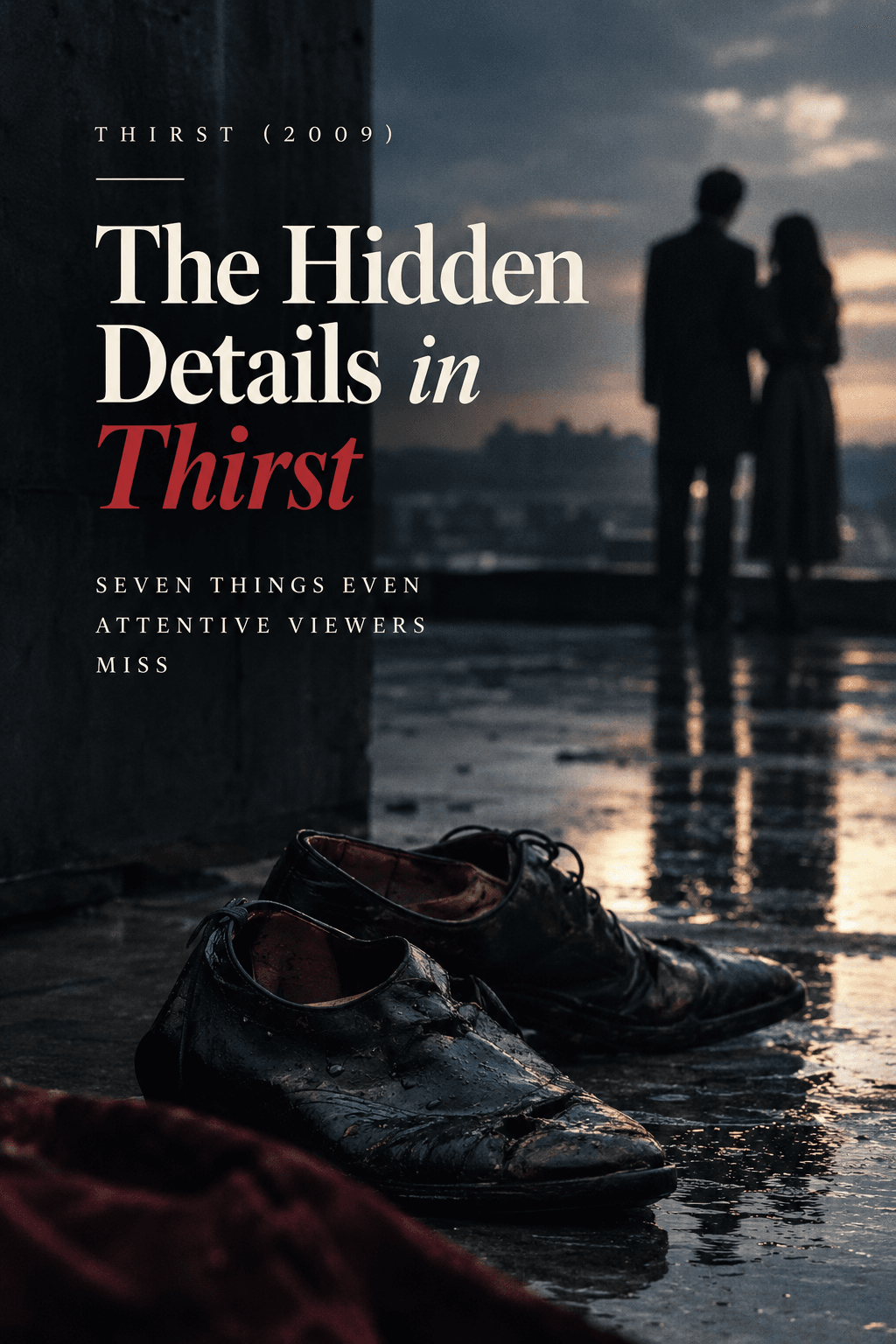
a 2010 interview, discussing the film’s final image — Sang-hyun and Tae-ju’s burnt bodies on the rooftop at dawn — Park singled out one specific detail as the shot he considers the film’s most romantic: their two burnt feet, still inside an old pair of shoes from an earlier scene. He said it himself, without being asked to justify it, which is the closest thing to a confession a director this controlled ever gives you.Go back and the pattern is there from the beginning, hiding in plain sight the way Park’s best material always does. Early in the affair, before either of them has admitted what they are to each other, Sang-hyun gives Tae-ju his shoes. It is a small gesture, staged like nothing, the kind of thing a viewer tracking plot will let pass without a second look. But shoes in this film are never nothing.As Tae-ju’s arc curdles — as she moves from a barefoot, trapped domestic servant into someone actively enjoying her new capacity for violence — her footwear escalates with her. The heels get higher. The shoes get sharper, more performative, more like weapons she’s chosen for herself rather than ones assigned to her by a household that used her as unpaid labor for fifteen years.Then, at the end, when the performance finally breaks — when what’s left of Tae-ju stops being the woman who terrorized Mrs. Ra with a television remote and becomes, one more time, the frightened teenager who was raised in that house since she was three years old — she takes the heels off. She puts on Sang-hyun’s shoes instead. They don’t fit. That’s the point.A close reading of the scene, published a few years after the film came out, put it about as precisely as it can be put: the shoes are unfit for her feet but exactly sized for what she’s feeling in that moment — something closer to surrender than to seduction or rage.It’s worth sitting with how quiet this device is, because Park doesn’t usually do quiet. He built his reputation on baroque, over-the-top gestures — a hammer, an octopus, a tongue where you don’t expect one. The shoes are the opposite of that. They’re a piece of blocking that could be mistaken for wardrobe continuity if you weren’t paying attention, and Park apparently trusted that most of us wouldn’t be. He was right.The people who wrote about this film’s craft in the weeks after Cannes talked about the cinematography, the score, the nudity, the audacity of putting a priest at the center of a story this explicit about appetite. Almost nobody talked about the shoes.There’s a second layer to this that’s easy to walk past. Tae-ju spends the first act of the film barefoot, or close to it, inside the house she’s lived in since she was three years old — a household that has treated her less like a daughter-in-law than like staff. Bare feet, in that context, read as ownership. Mrs. Ra doesn’t need to lock her in; the house itself, and the labor expected inside it, does the job.The heels arrive with the affair and escalate with the killing, and by the time Tae-ju is dragging a body toward the water she’s doing it in shoes built for a different life than the one the house assigned her. That she abandons them at the very end, for a dead man’s oversized loafers, isn’t a costume change. It’s the only piece of the film’s wardrobe that gets to complete its own arc — poverty to ownership to performance to, finally, something that looks almost like grief.
The Word Mrs. Ra Spells at the Mahjong Table
Here is the detail that should be the most talked-about thing in
Thirst‘s back half, and instead sits almost entirely unremarked-upon outside the film itself.After her stroke — brought on, not coincidentally, by watching her son die in front of her in a killing staged to look like a drowning accident — Mrs. Ra loses her ability to speak. She can move one finger. That’s the whole inventory of what’s left to her: a finger, and whatever she can point it at. Late in the film, during one of the household’s recurring mahjong nights with the “Oasis” social circle, she uses that finger to point, letter by letter, at mahjong tiles.The people around the table — including the two people who murdered her son — treat this like a parlor trick. They guess along cheerfully, floating joke acronyms as the letters accumulate, genuinely delighted with themselves for playing along with grandma’s game.The scene plays out with a specificity that makes it worse, not better. The first letter lands and someone asks what it means. A second letter arrives and gets misread as an instruction about the television’s remote control. A third, a fourth. Someone strings the growing pile of letters into a jokey backronym — Ladies Delaying, Killing the game — pleased with their own cleverness, still nowhere near the actual word. The group keeps rearranging the letters like it’s a party game, debating whether the last one goes first or last, before someone finally gets there.The letters spell KILLED.Someone at the table even says it out loud, confirms it — “See? It’s KILLED!” — and then, because the scene has spent this whole time training you to read it as comic relief, the beat gets swallowed. “Killed who?” someone asks, and the table moves on to the next hand without anyone answering. Mrs. Ra has just accused her son’s killers to their faces, in the one language she has left, and the film lets the moment evaporate into background noise exactly the way the characters do.No interview, no retrospective, and no piece of criticism turned up in the research for this article discusses this scene directly, which is worth flagging plainly rather than dressing up as more than it is: this is a reading, not a confirmed authorial statement. The scene itself is not in dispute — it happens exactly as described, dialogue and all, and the word on those tiles is not ambiguous.What’s genuinely open to interpretation is only the size of the joke Park is playing with it: a woman silenced by the people who put her in that chair, spelling out the truth in a game everyone else is too busy having fun to actually read.
A Number That Keeps Finding Its Way Back to Him
Early in the film, Sang-hyun volunteers for
the Emmanuel Virus vaccine trial at Emmanuel Labs — a disease the film’s own dialogue nicknames the “Curse of Bazira,” and one that had already killed most of the missionaries and volunteers who came before him. He isn’t drafted into this. He asks for it, the same instinct that will later make him unable to simply let Tae-ju die when he could save her. The dialogue itself won’t settle on a figure for how many people that trial actually cost. At one point the number of prior volunteers gets put at fifty.At another, five hundred. It’s not a detail the film seems interested in nailing down. Outside reviews and summaries of the trial split on it too, roughly evenly, which suggests the ambiguity was baked into the film’s own dialogue from the start rather than introduced by whoever happened to be transcribing it.What makes it worth noticing is where the number resurfaces. Much later, deep into the affair, Tae-ju needles Sang-hyun about the cost of his own survival — how many people have had to die, one feeding at a time, to keep him alive since the trial. Her guess, tossed off as a taunt rather than an actual calculation: maybe around five hundred. How’s that, Father?Nothing in the film confirms these two numbers are meant to rhyme. There’s no scene where a character draws the line between them, no interview where Park connects the vaccine trial’s uncertain body count to Tae-ju’s mocking arithmetic. This has to be labeled for what it is — an interpretation, not a documented fact, named here as such rather than asserted as intent. But it’s difficult to un-notice once you have noticed it.The film opens with an institution that can’t or won’t say exactly how many people its ambitions cost, and it closes on a woman throwing the same number back at the man that institution created, this time as an accusation instead of a statistic.
What the Film Refuses to Give Him
Thirst is, on paper, a vampire movie, and it spends almost no time behaving like one. Sunlight kills him — that rule survives, and matters enormously to
the ending — but the rest of the standard inventory quietly evaporates: the cross, the stake, the coffin, the garlic. A century of
vampire cinema trained audiences to expect a scene where the old rules get tested, and this film never bothers writing one.Park has been fairly direct, in interviews given around the film’s release, about what he was after instead. He’s described the film’s biggest departure from other vampire stories as its interest in a man’s moral collapse and the suffering that comes with it, at the expense of the genre’s usual romanticism, approached with the kind of realism he uses to set the film apart from other vampire pictures.That’s a director’s stated intent, and it lines up with what’s actually on screen — a film that treats vampirism as a disease with theological consequences, closer in spirit to the Emmanuel Virus that caused it than to Dracula.The absence is easy to miss precisely because the film never announces it. A lesser script would have given Sang-hyun one scene where he tests the old rules and finds them empty — flinches instinctively at a crucifix, feels nothing, files it away as one more broken expectation. Park skips that beat entirely. The old vampire mythology simply goes unconsulted, the same way a film about a disease outbreak has no reason to stop and disprove folk remedies nobody in the story ever believed in.The choice makes more sense once you know where Park says the whole project started: with the memory of watching a priest drink sacramental wine as a stand-in for the blood of Christ, and noticing how close that ritual already sat to vampirism without anyone in the room treating it as strange. If the entire premise is built from an image the Church itself supplied, there’s no need to import a second, unrelated mythology to menace the protagonist with. The theology he’s already living inside does that work.A crucifix has nothing to frighten in a man whose condition was seeded by the Church’s own central metaphor for consuming blood to survive.
The Body That Won’t Stay Under
Kang-woo’s murder is staged to look like a drowning, his body weighted down with a rock and hidden in the same lake where Sang-hyun and Tae-ju first start meeting in secret. The film doesn’t let him disappear once the plot has finished using him, and the dialogue is more explicit about this than it needs to be. Not long after the killing, Tae-ju turns to Sang-hyun, soaked, and asks him flatly: “Was he here, too?” He doesn’t understand. “He? Who?” She never answers.Later, the two of them talk themselves down from the same fear in almost identical language — “Don’t fall for it,” one says, “it’s all just an illusion,” “it’s just psychological.”That’s the detail worth catching: the film never confirms whether Kang-woo’s ghost is actually there, and it doesn’t need to. Both of his killers independently reach for the exact same phrase to talk themselves out of what they’re seeing — psychological, an illusion — as if they’d rehearsed the denial together without ever discussing it. His presence recurs visually across the back half of the film in the scenes Sang-hyun and Tae-ju share near or on the water: the physical symptom of two people sharing a guilt they’ve agreed never to name out loud.
A Historic First the Trade Coverage Buried Under Cannes
Thirst is, by most accounts, the first mainstream Korean film to feature full-frontal male nudity — a fact that got a line or two of coverage around Cannes and then mostly vanished under the bigger story of the Jury Prize. It’s worth pulling back out for what it says about how deliberately unguarded this film makes its characters, on top of everything else it already does to them.Park doesn’t use nudity here as spectacle, the way plenty of horror and erotic thrillers do, where a body is unveiled as a reward or a shock. It functions closer to the shoes and the mahjong scene: another register in which characters are stripped, sometimes literally, of the defenses they’ve spent the rest of the film building up. A priest who has spent a career performing composure, a wife who has spent a marriage performing obedience — both of them end up physically as exposed as the film can make them.The choice to push past what Korean mainstream cinema had done before is the same instinct that puts a dying man’s actual, unglamorous panic on screen instead of a tasteful cutaway.
The Cut Almost Nobody Outside Korea Has Seen
The version of
Thirst that played in theaters worldwide and picked up the Jury Prize at Cannes runs a shade over two hours. It is not the only version that exists. A director’s cut, released on DVD and Blu-ray in Korea only, runs roughly fourteen minutes longer — extended material that the vast majority of the film’s international audience, including most of the people who’ve written about it in English, has simply never seen.This is Park’s own preference at work, not a studio trim forced on him against his wishes — his cuts of his other films tend to grow once they no longer have to answer to a theatrical release window. What matters for a piece like this one is narrower and more practical: nearly everything written about
Thirst in English is written about the shorter cut. There’s a whole extra quarter-hour of this story that the vast majority of its reputation was built without.
Final Verdict
None of these seven details change what
Thirst is about. Park told you what it was about in the opening scenes and never once broke that promise. What they change is how carefully the film is actually listening to itself — a mother spelling out an accusation nobody at the table will hear, a number that keeps finding its way back to the man it belongs to, a pair of shoes doing the emotional work that the film’s more explicit gestures get all the credit for.That’s the real tally of Thirst 2009 hidden details — quieter than the blood, the nudity, and the Cannes prize that got all the coverage, spelled out one tile at a time, waiting for someone to actually read the table.
What Are the Biggest Thirst 2009 Hidden Details?
The most overlooked is the mahjong scene where a paralyzed Mrs. Ra spells out “KILLED” letter by letter while the table treats it as a party game. Close behind: the shoe motif Park Chan-wook himself called the film’s most romantic image, and the fourteen-minute Korean-only director’s cut that most of the film’s English-language reputation was built without seeing.
Is There an Extended Cut of Thirst (2009)?
Yes. A director’s cut released on DVD and Blu-ray in Korea runs roughly 148 minutes, about fourteen minutes longer than the 134-minute theatrical version that played internationally and won the Jury Prize at Cannes. It has never had a wide release outside Korea.