The best Barbarian (2022) hidden details are quiet evidence of how much thought Zach Cregger put into a film most people remember for one basement and one water tower: a book in the wrong bag, a character’s name changed in an old draft, a word planted in a 1982 flashback and cashed in forty years later. I’ve watched Barbarian three times now, and each time I’ve come away with a slightly different list of things I missed the pass before. That’s not a complaint. It might be the most honest thing I can say about the film.
A movie built around withheld information is going to reward you differently depending on how much you already know going in, and by the third viewing I’d stopped watching the story and started watching the house instead — the props, the throwaway lines, the choices sitting quietly in the corners of scenes that are ostensibly about something else. What I found there wasn’t a pile of Easter eggs planted for their own sake. It was a film that had done its homework in places nobody was required to look, and I want to spend this piece in those places specifically.
A note before I start: I worked from an earlier draft of Cregger’s screenplay alongside the finished film, and the two don’t always agree with each other. Some of what follows is the same in both. Some of it changed on the way to the screen, and where that’s true, I’m going to tell you, because a detail that got cut or altered is its own kind of hidden thing — evidence of a decision, which is sometimes more interesting than the decision’s result.
The Book in the Wrong Hands
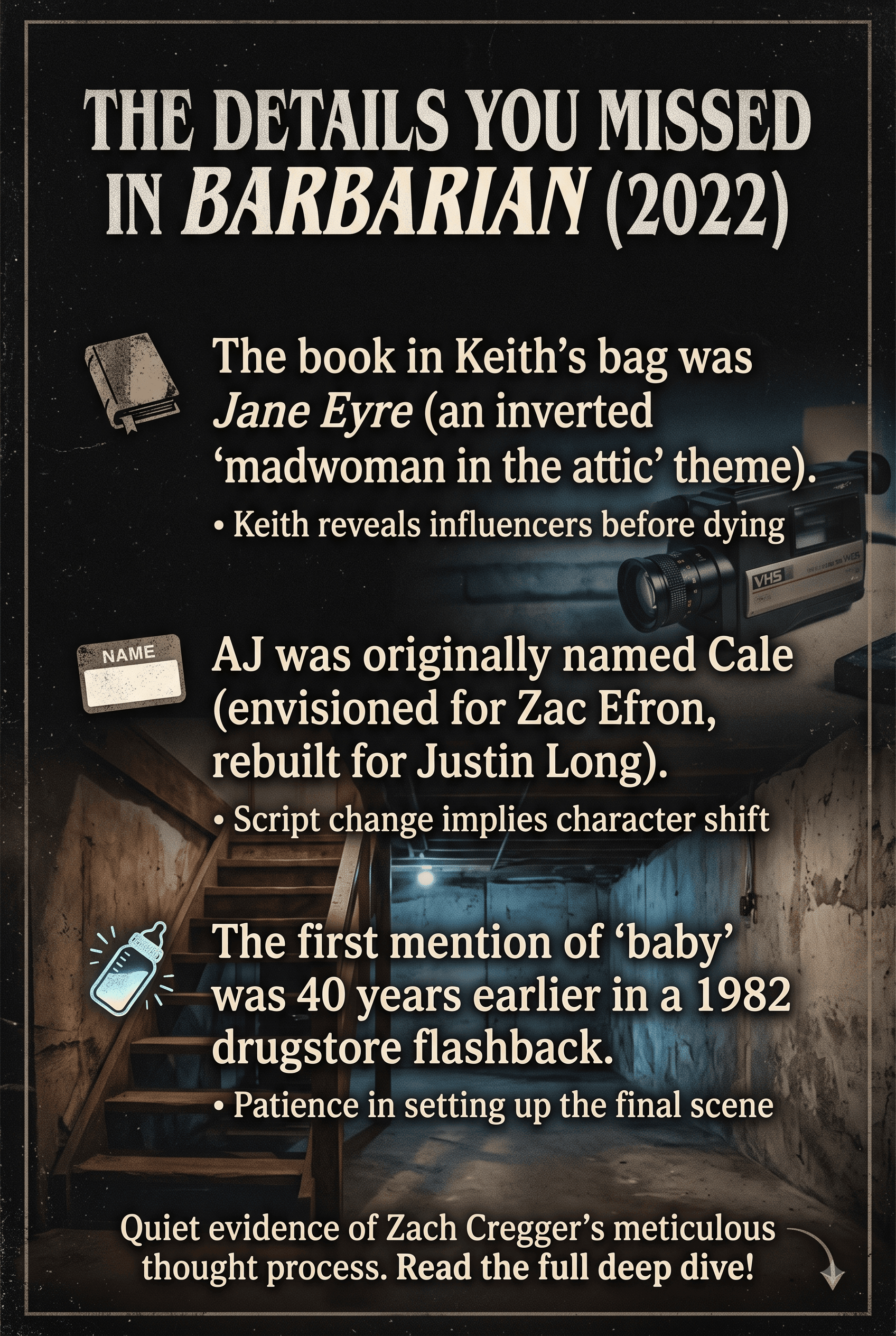
Early in the film, after Tess has vanished into the tunnel beneath the house and Keith hasn’t come back either, AJ — freshly arrived, freshly panicked, trying to figure out whose house this actually is and who these strangers’ belongings belong to — tears through Keith’s luggage looking for anything useful. Clothes come out first, thrown on the floor without much interest. Then a book. He looks at it for exactly as long as it takes to register that it isn’t going to help him, and he tosses it aside with the rest.
The book is Jane Eyre.
It’s easy to watch that beat and register nothing but a man rifling through a stranger’s bag, because that’s precisely what it’s staged to look like. But the choice of book is not incidental, and it belongs to Keith, not to Tess — a detail I want to be precise about, because it’s been misattributed online more than once.
Charlotte Brontë’s novel is narrated by a governess who falls in love with a brooding, secretive man, and who discovers partway through the story that he is already married — to a woman he keeps locked in the attic of his house, a woman driven half-feral by confinement, violent, barely verbal, referred to by other characters less as a person than as a problem to be managed.
Bertha Mason is horror fiction’s original madwoman in the attic, and the phrase has outlived the novel that coined it, becoming shorthand for an entire tradition of women hidden away by men who’d rather not explain what they did to put them there.
Barbarian takes that architecture and turns it upside down. Where Brontë’s house hides a wife in the attic, this one hides a daughter — several generations removed — in the basement. The vertical logic flips, but the underlying shape doesn’t: a man built a structure specifically so a woman he was responsible for could exist without anyone ever having to look at her, and the people who eventually do look are punished for it, one way or another, same as Jane nearly is when she gets too close to Rochester’s secret.
I don’t think it’s an accident that the book turns up in Keith’s bag rather than sitting on a shelf as set dressing, either. Keith is, by the end of the film, revealed to be exactly what he appeared to be — an ordinary, if oblivious, man who happens to be sleeping in the wrong house.
Giving him a novel about a hidden, suffering woman he’ll never get to meet, and having him die without ever learning what’s actually underneath him, reads less like a coincidence than like Cregger quietly signing his influences before killing off the character who was carrying them.
The Man Who Used to Have Another Name
Here’s a smaller thing, and I want to flag it honestly as coming from the draft of the script rather than from anything you’d notice on a single watch. In the version of the screenplay I read, the character who becomes AJ Gilbride in the finished film is called Cale throughout — in the dialogue headers, in the scene descriptions, everywhere. By the time the film reached theaters, he was AJ, played by Justin Long, and the name Cale had disappeared from the finished work entirely.
I bring this up not because it changes anything about how the film plays, but because of what it implies about how the character was built. Cregger has said publicly that he originally envisioned this role for Zac Efron — pictured him as, in Cregger’s own phrase, a “beefcake kind of himbo,” a good-looking guy whose charm was mostly physical. When Efron passed on the part, Cregger didn’t just recast it.
He rebuilt it, reportedly around what he felt Justin Long specifically could bring that Efron couldn’t: a warmth and a disarming quality that would make an audience like AJ before the film needed them to distrust him. A name change alone doesn’t prove any of that history, but it’s consistent with it — a small piece of physical evidence, sitting in an old draft, that the character we watch today took shape around Justin Long specifically, reassembled from whatever Cregger had first imagined for Efron.
A Man Buying Diapers for No One
The film’s 1982 flashback opens on Frank — the house’s original owner, decades before Tess ever books it on a whim — walking into a drugstore with a cart. He asks a clerk for plastic sheets. Then diapers and baby supplies. The clerk, warm and chatty in the specific way strangers were allowed to be with each other in scenes like this before it became suspicious, assumes the obvious thing: a nervous first-time father, stocking up before the big day. She asks how old his little one is. He tells her: not here yet.
She asks if he’s taking his wife to Mercy for the delivery. He tells her it’s a home birth, no midwife, just him. She presses her hand to her chest — bless your hearts — and keeps helping him fill the cart.
I want to flag something about that scene that I don’t think gets said often enough: it’s the first time the film plants the word “baby” as an idea, four decades before it becomes the only word the Mother knows how to say, before it becomes the pet name she uses on AJ in the pit, before it becomes the needle drop the film closes on.
A drugstore clerk drops a phrase like “your little one” into a stranger’s shopping trip in 1982 with no idea what she’s actually helping assemble, and the film waits forty years and three separate timelines to pay that word off. Most viewers clock the drugstore scene as unsettling and move on. Fewer notice that it’s doing quiet, patient set-up work for a word the film won’t cash in until its final scene.
The Room at the End of the Hallway
By the time Tess finds the hidden room beneath the house — trapped in the basement, discovering a passage nobody mentioned, walking down a hallway that shouldn’t exist behind a laundry room — the film has already spent its whole first act training you to expect something. What it actually shows you, when you get there, is almost aggressively mundane: a bed. A camera, an old VHS-era camcorder, sitting exactly where you’d leave it if you used it regularly and had no reason to hide it from anyone who wasn’t supposed to be there. A bucket.
A bloody handprint smeared across the wall at roughly the height of someone reaching for support while being dragged somewhere they didn’t want to go.
None of those objects individually would scare anyone in a hardware store. Together, in that room, they do the specific work that the best horror set-dressing always does: they let you build the worst version of the story yourself, out of parts too ordinary to censor. A bed is just furniture. A camera is just a camera.
It’s the arrangement — the bed with the camera pointed at it, the bucket where a bathroom should be, the handprint at exactly the wrong height — that turns three inoffensive objects into a room your imagination finishes furnishing whether you want it to or not. The film never tells you what happened in that room in this scene.
It just gives you the objects and steps back, and by the time Andre and Frank later fill in the actual history, your imagination has usually already gotten there first, which is its own quiet trick — confirming a fear rather than introducing one.
The Man Nobody Wanted to Look At
I want to spend some real time on Andre, because I think he’s the most undersold hidden detail in the entire film, and I don’t mean hidden in the sense of a prop tucked into a corner of frame. I mean hidden in plain sight, structurally, in a way the film is counting on you not noticing until it’s too late to matter.
When Tess returns from her job interview in the first act, a filthy, agitated man runs at her on the street, and she flees inside the house in a full panic, certain she’s just escaped an assault. The scene is shot and scored to make you certain of that too. Every genre instinct a horror audience has trained into them says: that man is a threat, and Tess was right to run.
It isn’t until much later — after AJ has fallen into the pit, after Tess is trapped underground with him, after the film has spent its middle stretch letting you assume you already know who the dangerous people in this story are — that the same man reappears, helps Tess escape, and turns out to be the only person in the entire film who understood what was actually happening in that house and tried, however incoherently, to warn her about it from the very first scene. His name, per the film’s own credits, is Andre.
That’s the reversal that gets discussed. What doesn’t get discussed as often is what it does to the earlier scene once you know it. Structurally, retroactively, Andre chasing Tess down that street has to have been some version of a warning, even if the film never gives you the dialogue to prove it outright — a man who’d presumably watched other women walk into that house and not walk back out, trying to stop one more, and being read by both Tess and the audience as exactly the kind of threat he was actually trying to prevent.
It’s the cruelest kind of dramatic irony a horror film can build, because it isn’t aimed at a character. It’s aimed at the audience’s own instincts, and it doesn’t ask you to feel bad about having them — Tess’s fear is entirely reasonable given what she knew in that moment — so much as it asks you to notice, afterward, how easily a warning and a threat can look identical from the wrong angle.
Andre gets one more job before the film is done with him, and it’s the film’s most important piece of exposition, delivered almost as an aside.
Sheltering with Tess and AJ, trying to explain what’s actually living in the tunnels beneath the house, he offers a single sentence that does more explanatory work than anything else in the script: “And you make a copy, of a copy, of a copy, and you end up with something like that.” It’s Andre’s answer to the question the whole film has been quietly building toward: how the thing in the basement came to exist in the first place.
The line does that work without a single frame of flashback, without a chart, without anyone saying the word “incest” out loud. Generations of Frank’s captivity, each one a degraded reproduction of the last, until what’s left barely resembles the women it descended from. It’s a photocopier metaphor for one of the ugliest ideas the film is willing to sit with, and it works precisely because it refuses to dress the idea up in anything more clinical than a phrase you’d use to complain about a bad printer.
A Title Cregger Never Actually Chose
The word “barbarian” is never spoken once in the entire film. Not by Tess, not by AJ, not by Frank, not by Andre. If you went into this movie without having read the title on a poster beforehand, you would leave it without a single character ever having handed you the word the story is asking you to walk out thinking about.
Cregger has been fairly candid about this in interviews: the title started as a placeholder while he was writing, something to call the file before he had a better idea, and it simply never got replaced. That’s a strange thing to sit with, because a placeholder title implies the word wasn’t chosen for its meaning at all, and yet it’s almost impossible to watch this specific film and not go looking for one.
The nearest the story comes to explaining itself is geographic — the house sits at 476 Barbary Street, in a fictionalized, hollowed-out stretch of Detroit, and “Barbary” sitting one or two letters away from “Barbarian” is about as close as the text ever gets to showing its work.
From there, the interpretations fan out, and I don’t think the film particularly wants you to settle on just one. The Mother is the most literal candidate — feral, violent, driven by instinct rather than intention, the thing in the basement that most people would reach for the word “barbaric” to describe on sight. But Frank is arguably the more accurate one, if you take the word back to its older, less monstrous-sounding meaning: someone operating entirely outside the rules of the civilization around him, methodically, over decades, while that civilization’s attention was pointed somewhere else.
And there’s a third reading that doesn’t require picking between the two — that “barbarian” describes neither of them individually so much as the particular strain of masculine entitlement running underneath both of them, the version of manhood that assumes access to a woman’s body and time is simply owed, whether it’s expressed as Frank’s decades of captivity or as AJ’s own casual, self-serving cruelty once he’s cornered.
The film gives you evidence for all three readings and declines to rank them, which is either a shrug or the most honest thing a title has ever done — I’ve gone back and forth on which, and I’m not sure I’ve landed anywhere final.
A Screenwriting Trick With a Name
I’ll end on something less a hidden object than a hidden mechanism, and I want to credit where I actually found the language for it, because it isn’t mine. Screenwriter William C. Martell, writing a craft column for Script Magazine, coined a term for what Barbarian keeps doing to its own story: the “Change Up.” His definition is specific: a moment where the story appears to become an entirely different story, bigger than an ordinary twist, only to reveal, once the new piece lands, that it was the same story all along, told from an angle you hadn’t been given yet.
Martell counts four of them here. The film opens as a two-hander about a double-booked Airbnb. Then it cuts, cold, to a sunlit Hollywood story about a disgraced actor fielding a phone call from his agent — a scene that seems, for a few seconds, to have wandered in from a different production entirely. Then it cuts again, decades backward, to a quiet domestic scene in 1982.
Each Change Up plays like the film has abandoned its own premise, and each time, the discarded thread turns out to have been load-bearing the whole time: the actor owns the house; the man in 1982 built what’s underneath it. Martell’s point, and it’s a sharp one, is that a technique like this only works if the writer already knows how the pieces fit before any audience does — you can’t discover a Change Up while writing it, the way you can stumble into a smaller twist. It has to be engineered backward from an ending you’ve already decided on.
What I find genuinely rare about it, watching the film a third time with Martell’s term in my head, is how little the trick announces itself. Most films that swerve this hard between registers want you to notice the swerve — it’s the whole marketing hook. Barbarian plays each Change Up completely straight, as if the Hollywood scene or the 1982 flashback were simply the next thing that happens, and lets the audience do the work of feeling disoriented on their own.
That restraint is its own kind of craft, and it’s the specific thing that made me go looking for a name for what the film was doing to me instead of just calling it a “twist” and moving on.
I keep returning to that image: a story that only fully makes sense in hindsight, about a room that was only ever discovered because someone eventually looked. I’m not sure that’s a coincidence either. I’ve watched this film three times now, and I still can’t tell you with any confidence whether Cregger built that parallel on purpose or whether it’s simply what happens when a story about hidden things is told by someone paying enough attention to hide them well. Maybe that’s the same question, asked two different ways. I haven’t decided yet.
Barbarian (2022) Hidden Details: Quick Answers
What Are the Best Barbarian (2022) Hidden Details?
Among the strongest Barbarian (2022) hidden details is the copy of Jane Eyre tossed from Keith’s luggage — a novel about a woman locked in an attic, quietly inverted by a film about a woman locked in a basement, and easy to miss on a single watch.
Is Barbarian Based on a True Story?
No. Barbarian is an original screenplay written by Zach Cregger, not based on a true story or a specific real crime, though its Detroit setting and themes draw on the real economic history of neighborhoods like Brightmoor.