This Let the Right One In 2008 hidden details piece focuses on what’s easy to miss in Tomas Alfredson’s 2008 film,
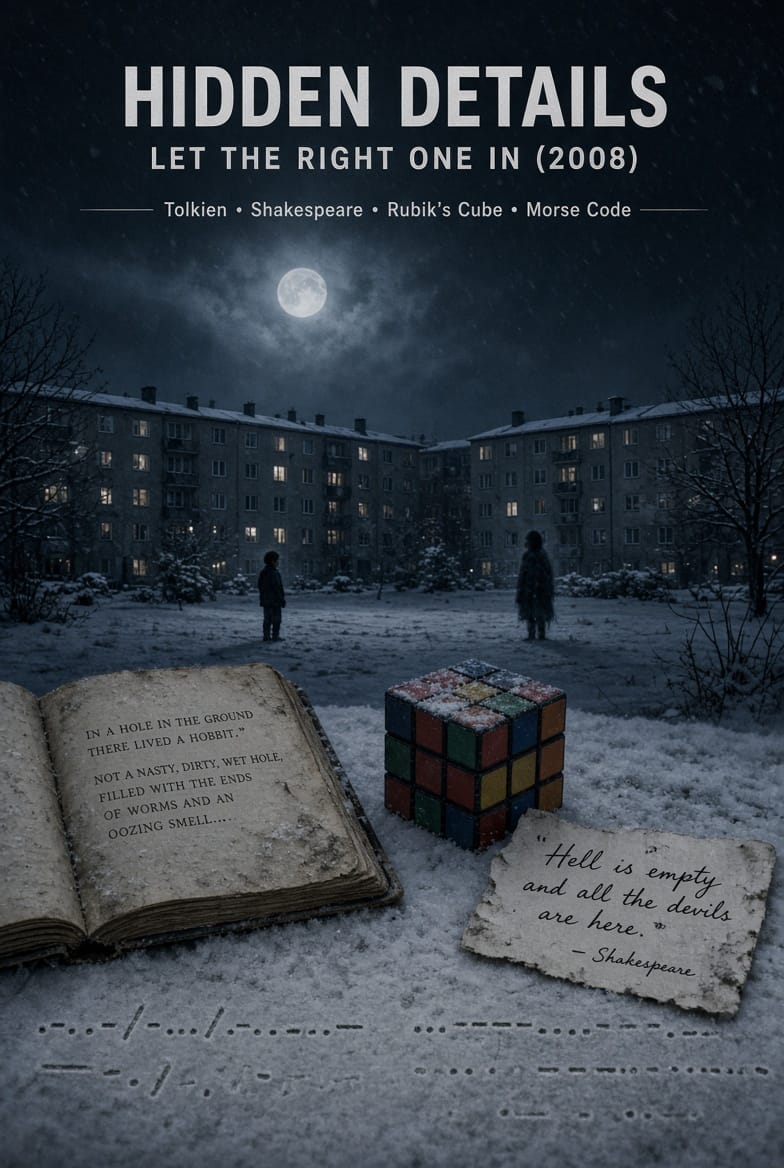
already one of the coldest vampire stories on screen: a real Tolkien passage read aloud in an early classroom scene, a Shakespeare line hidden inside a note, and a children’s toy that pins the story to a specific year, none of it a single visual Easter egg. The hidden details in Let the Right One In are almost never visual. There’s no freeze-frame Easter egg buried in a background poster, no prop you have to pause on to catch.What’s actually hidden is textual, and it’s hidden the way a well-read person hides things: inside an assigned reading nobody expects to matter, inside a note signed with somebody else’s words, inside a title that’s already telling you the truth in a language you don’t speak yet. Tomas Alfredson and John Ajvide Lindqvist did the research and then declined to point at it. Nobody underlines the reference. You either caught it on your own, or the film let you leave without it, and either way it kept working.Start with the reading. Early in the film, Oskar’s class is doing what English-class scenes in Swedish films about twelve-year-olds do — someone is called on, someone reads aloud from whatever’s assigned that week. The passage the subtitles give us describes something “slipping in and out of the shadow of the trees, running quick and quiet and keeping out of the sun,” while pursuers give up, “grumbling and cursing,” and go back “to guard the door.” The line that closes it: “Bilbo had escaped.” This is J.R.R.Tolkien, verbatim, from the end of the fifth chapter of The Hobbit — the chapter usually remembered for the riddle game with Gollum, but this line comes just after, when Bilbo has the ring on and is fleeing the goblins who chased him out of the mountain. The full context makes the choice sharper than it looks in isolation: the goblins can’t follow him into daylight. “They don’t like the sun,” the text says, “it makes their legs wobble and their heads giddy.”A monster that loses its power the moment the light hits it, staying alive by staying in shadow, is being read out loud in a Stockholm classroom scene before this film has said the word vampire even once.Nobody in the scene reacts to it. There’s no cutaway, no meaningful look, no score cue. It’s just a school reading assignment happening to a kid whose new next-door neighbor already can’t come out during the day, weeks before Oskar or the audience has been told why. The joke, if it’s fair to call it that in a movie this cold, is that the answer was sitting in a required text the whole time, filed under fantasy fiction for children, treated with exactly the seriousness a bored classroom gives any assigned reading. Alfredson doesn’t ask you to notice.He just doesn’t stop you from noticing.
A Tolkien Passage Hidden in a Classroom Reading Assignment
Eli’s Note Is a Line From Romeo and Juliet
The second buried reference belongs to Eli, and it’s stranger, because it’s not incidental the way the Hobbit reading might be — someone had to choose to write it. Partway through the film, before the pool, before any of what the ending is built on, Eli leaves Oskar a note. What the subtitles give us, in full, is this: “I must be gone and live, or stay and die.” Signed, “Yours, Eli.” That sentence is not Lindqvist’s.It’s Shakespeare’s, lifted with only a slight compression from Romeo’s line to Juliet in Act 3, Scene 5 of Romeo and Juliet — the morning-after scene, dawn breaking over Verona, Romeo already banished for killing Tybalt and arguing with Juliet about whether the light outside is really daybreak or just a trick of the stars, because if it’s day, he has to run or he dies. “Night’s candles are burnt out, and jocund day / Stands tiptoe on the misty mountain-tops,” he tells her. “I must be gone and live, or stay and die.” He’s not being dramatic.That’s the literal choice in front of him: leave immediately, or stay for one more minute of her company and be executed for it.Eli signs a note to a twelve-year-old with that line, and the film trusts you to either recognize Shakespeare or not — it doesn’t gloss it, doesn’t have Oskar ask what it means, doesn’t cut to a book on his shelf to explain the reference for the back row. What it does instead is quietly promote Romeo’s one specific morning into Eli’s every morning. Romeo has one dawn to survive.Eli has all of them, forever, on a loop that never resolves into a wedding or a reconciliation or anything else Shakespeare’s version gets to end on — just the same ultimatum, replayed nightly, with no possibility of the exile ever being lifted. The note arrives well before Eli says the equivalent sentence in her own words near the very end of the film.By the time she tells Oskar plainly that she has to go, he — and a reader paying attention — has already been told once, dressed up in borrowed language, because saying it plainly the first time would have meant explaining herself, and explaining herself was never something the film was going to let this character do easily.
The Title’s Other Meaning: A Morrissey B-Side
The title carries its own quiet citation, and this one is confirmed, on the record, by the author himself, rather than pieced together from subtitle text the way the others are.
Lindqvist has said in interviews that Let the Right One In refers to two things at once: the folk rule that a vampire cannot cross a threshold uninvited, which the film dramatizes explicitly and painfully in its own uninvited-entry scene, and a Morrissey song.Specifically, a relatively obscure B-side called “Let the Right One Slip In,” which Lindqvist — by his own account a serious, long-standing Morrissey listener — used the same way he says he uses Morrissey generally when he writes: as a kind of emotional tuning fork for a chapter’s mood before a word of it exists. The invitation-rule half of the title gets discussed constantly, because the film needs you to understand it to follow the plot.The Morrissey half gets discussed almost never, because it isn’t load-bearing for anything — it’s just true, and a little bit lonely, the way most things about this director’s sense of humor turn out to be lonely once you look at them directly.
A Rubik’s Cube That Pins the Film to 1982
The film also tells you, with more precision than most reviews bother repeating, exactly when it’s happening, and it does this through objects rather than dates on screen. A radio broadcast names Communist Party Chairman Brezhnev in passing, unremarkable period wallpaper for anyone who lived through it. More specifically, Oskar is given a Rubik’s Cube — first by way of teaching Eli how it works, then it becomes hers, a small transferred possession that recurs as a stand-in for their whole relationship’s logic of trade. The object dates the scene almost to the month.The Rubik’s Cube launched internationally at toy fairs in early 1980, became the genuine worldwide craze — hundreds of millions sold — through 1981, and by October 1982 the fad had already crested and begun its decline, even as the object itself kept selling steadily for years afterward. Wikipedia’s own account of the film states its setting plainly: Blackeberg, 1982. Which means the cube in Oskar’s hands is not a generic period prop somebody’s production designer grabbed because it reads as “the ’80s.”It’s an object at the exact tail end of its own cultural moment, already slightly out of fashion by the time this story is set — a small, correct detail nobody needed to get right, done right anyway, the same way the Hobbit reading and the Shakespeare note are things nobody needed to get right.
Let the Right One In 2008 Hidden Details: The Morse Code Lesson Nobody Talks About
This Let the Right One In 2008 hidden details entry keeps circling back to the cube for a reason beyond dating the story, because it’s a movie built on systems where the right sequence of small moves unlocks something otherwise sealed. That is, structurally, exactly what the film is doing with Morse code, and it’s worth separating what
most writing about this film’s ending gets right from what it never mentions, which is that the tapping in the final scene is Oskar’s second lesson, not his first.Earlier — the same stretch of the film where Oskar is joining the after-school weightlifting program, taking instruction from a coach who tells him “if you practice, you can make strong” — Eli is teaching him the code directly, letter by letter. The subtitles catch it mid-lesson: “short, short,” then a spelled sequence, “S… W… E… E… T,” then “D… R…” — and the scene moves on before the word finishes.It reads, unfinished, like it’s building toward “sweet dreams,” though the film never confirms that and I won’t pretend otherwise; what matters isn’t the specific word so much as the fact that a lesson happened at all, on-screen, well before the ending needs you to believe these two people share a private language. The final scene’s silence only works as an ending because this earlier, chattier, half-finished scene already did the actual teaching. By the time Oskar taps back on the train, he’s finishing homework somebody already assigned him.
Two Deaths, One Hospital, One Night
The film’s two most consequential deaths happen in the same building, on what the editing suggests is roughly the same stretch of time, and it stages them so differently that most viewers process them as unrelated events rather than as a matched pair. Håkan, disfigured by his own acid, sits under police guard in a restricted hospital ward.Elsewhere in what appears to be the same hospital, a different character — Virginia, called Ginia by her friends, the on-again-off-again girlfriend of a Blackeberg local named Lacke who drinks with the same small circle Håkan’s first victim ran with — is recovering, or appearing to. Her path there runs through a smaller, stranger scene earlier in the film: she pays a visit to her friend Gösta, whose apartment is full of cats, and the cats turn on her the moment she’s inside, attacking with no provocation the film bothers to explain.It reads, in hindsight, like animals responding to something in her that people can’t yet see — the same infection Eli left behind after an earlier attack now developing into something a house full of cats recognizes before any doctor does. A nurse tells her, cheerfully, that she can probably go home today. Then Virginia asks for something specific: “Could you open the blinds?” The nurse agrees, with no hesitation, because there’s no reason on earth a hospital nurse would refuse that request. “Sure. No problem.”The film does not immediately follow through on what that request means. It cuts away — to Oskar’s bullies, to the invitation-threshold scene between Oskar and Eli, to other pieces of the film’s climax assembling themselves in parallel — and it’s several intercut scenes later, minutes of screen time removed from the blinds being opened, that a voice off-screen says, flatly, “What? Christ!” followed immediately by “Call the fire department! Fire!” No character explains the connection on screen, because none of them, at that moment, are in a position to see it happen.Virginia, sensitized past any tolerance for daylight by whatever she caught from Eli’s attack, is exposed to direct sun the moment those blinds open, and by the time anyone in the building registers what’s happening, she is burning. The request and its consequence are separated by enough other plot that a viewer can watch the whole sequence once and never connect a polite question about window coverings to a fire alarm going off in a different scene. That gap is the point.The film isn’t hiding the cause of Virginia’s death; it’s hiding the fact that you were already told the cause, calmly, in a sentence that sounded like nothing.
Håkan’s Death On Screen vs. In the Novel
Håkan’s death, elsewhere in the same hospital, is staged as the inverse of that — no surprise at all, nothing hidden, just quiet permission. Eli visits him. He asks almost nothing and offers everything: his throat, without negotiation, the last of years of service rendered without ever once being thanked for it, the closing entry in a ledger nobody but him was ever keeping. There’s no struggle in what the subtitles preserve of the scene, no argument, no attempt by Håkan to survive it. He opens the window himself.What the film shows afterward is implication rather than image — the fall isn’t dwelled on — but the plotting is unambiguous: Eli feeds until there’s nothing useful left to take, and Håkan goes out the window she’s just opened, already drained past the point where the fall itself is really what kills him.Two people, in the same building, dying because of what happened when a window let something in from outside — one by accident, from a request nobody thought twice about; one by design, from a man who spent the whole film making sure nobody would ever need to ask him for anything twice.What’s cut from Håkan’s story is worth sitting with precisely because the film’s version is so clean. In Lindqvist’s novel, Håkan’s hospital-room feeding doesn’t finish him off outright — a guard interrupts before Eli can complete it, and though the resulting fall does kill him, he doesn’t stay dead. He comes back mindless, mute, mechanically drawn toward Eli with none of the devotion that defined him when he was alive, functionally a monster with none of the tragedy that made him worth watching in the first place.He has to be dealt with a second time, and multiple sources on the novel agree that this happens through a prolonged, ugly beating rather than anything resembling a mercy. The film’s Håkan gets none of that afterlife. He gets one scene, one request granted, one fall, and the story lets him go.It’s the same restraint the film applies everywhere else — Lindqvist and Alfredson had a genuinely grotesque piece of material available to them in their own source novel and chose, in adapting it, to let a man die once and mean it, rather than drag his body through a second, degrading resurrection just because the book had the space for one.
Oskar’s Own Hidden Habit
Oskar’s own hidden detail isn’t a reference to something outside the film — it’s a habit the film establishes about him early and then trusts you to remember without repeating it. The very first classroom scene isn’t really about vampires at all. It’s a teacher walking students through how investigators determine foul play in a house fire, specifically how the absence of smoke in a victim’s lungs can indicate the person was already dead before the fire started.That’s a simplified version of a real principle in forensic pathology — soot found deep in a victim’s airways is genuine evidence they were still breathing when a fire broke out, which is exactly why its absence gets treated as suspicious rather than routine — presented here as ordinary schoolwork, with Oskar as the student who already knows the answer before it’s asked, admitting only that he “reads a lot.” He isn’t lying.His bedroom keeps a collection of books on real serial killers alongside newspaper clippings about violent crimes in his own country — a detail the film shows rather than states, and one that critics writing specifically about the film’s portrait of repressed rage have singled out as the clearest evidence of what Oskar is carrying underneath the bullying he never fights back against. The film’s own on-screen text keeps feeding that habit throughout: tabloid headlines flash past reading “KILLER TAPS BLOOD” and “VICTIM’S BLOOD WAS TAPPED,” documenting a killer neither Oskar nor the audience has met yet.By the film’s end, that same idiom returns one final time, in a headline that closes the loop rather than opening a new one: “WHO KILLED THE MAN IN THE ICE?”It’s the exact genre of true-crime question Oskar has been rehearsing, in miniature, since the opening classroom scene — a question about a body, a cause, a killer who got away clean — except this time the body belongs to a story we watched happen, and the answer belongs to a boy who is, by that point, on a train, tapping it out in code to the only person who will ever actually know.The film spends its whole runtime training its own protagonist to read exactly this kind of headline correctly, then leaves him — and us — one last one to solve, unassisted, off-screen, with the person who could answer it already gone.
Why None of This Needed to Be Explained
None of this changes what the film is about, and none of it is offered as a twist waiting to be unlocked.That’s the thing worth sitting with about all of it: a Tolkien passage that happens to describe a creature exactly like the one next door, a stolen line of Shakespeare that says the quiet part of Eli’s whole existence out loud once and then never again, a song title borrowed from a B-side nobody but the author was thinking about, a toy that pins the year down to the month, a code taught in half a scene long before it’s needed, two deaths in one building that rhyme without ever touching.Somebody did the actual reading — the real Shakespeare, the real Tolkien, the real physics of what fire investigators look for in a corpse’s lungs — and then made the disciplined choice not to explain any of it to you.It’s a melancholy thing to notice, in the end, how much of this film’s intelligence is built to be found alone, on a second or third viewing, well after the story has already done its damage to you the first time, in the quiet stretch where you’re no longer watching for what happens next but for what you missed the first time through. Nobody claps you on the shoulder for catching the Shakespeare. Nobody rewards you for clocking the Rubik’s Cube’s exact expiration date as a cultural fad.It stays one of
the best vampire movies ever made precisely because it goes on being exactly as sad with or without you noticing, the same way Eli goes on needing someone new every few decades whether or not that someone ever finds the note explaining why — and the same way Oskar goes on carrying his own quiet reading habit, alone, whether or not anyone ever asks him what he’s been reading.
Let the Right One In (2008) Hidden Details — Frequently Asked Questions
What Are the Best Let the Right One In 2008 Hidden Details?
The strongest Let the Right One In 2008 hidden details are textual rather than visual: a real passage from Tolkien’s The Hobbit read aloud in an early classroom scene, a line from Shakespeare’s Romeo and Juliet quoted inside a note Eli leaves Oskar, and the film’s own confirmation, via a Rubik’s Cube, that its story is set in 1982.
Is the Title a Reference to a Morrissey Song?
Yes. John Ajvide Lindqvist has said in interviews that Let the Right One In refers to two things at once: the folklore rule that a vampire must be invited in, and a Morrissey B-side called “Let the Right One Slip In,” which he has cited as a direct influence on the title.