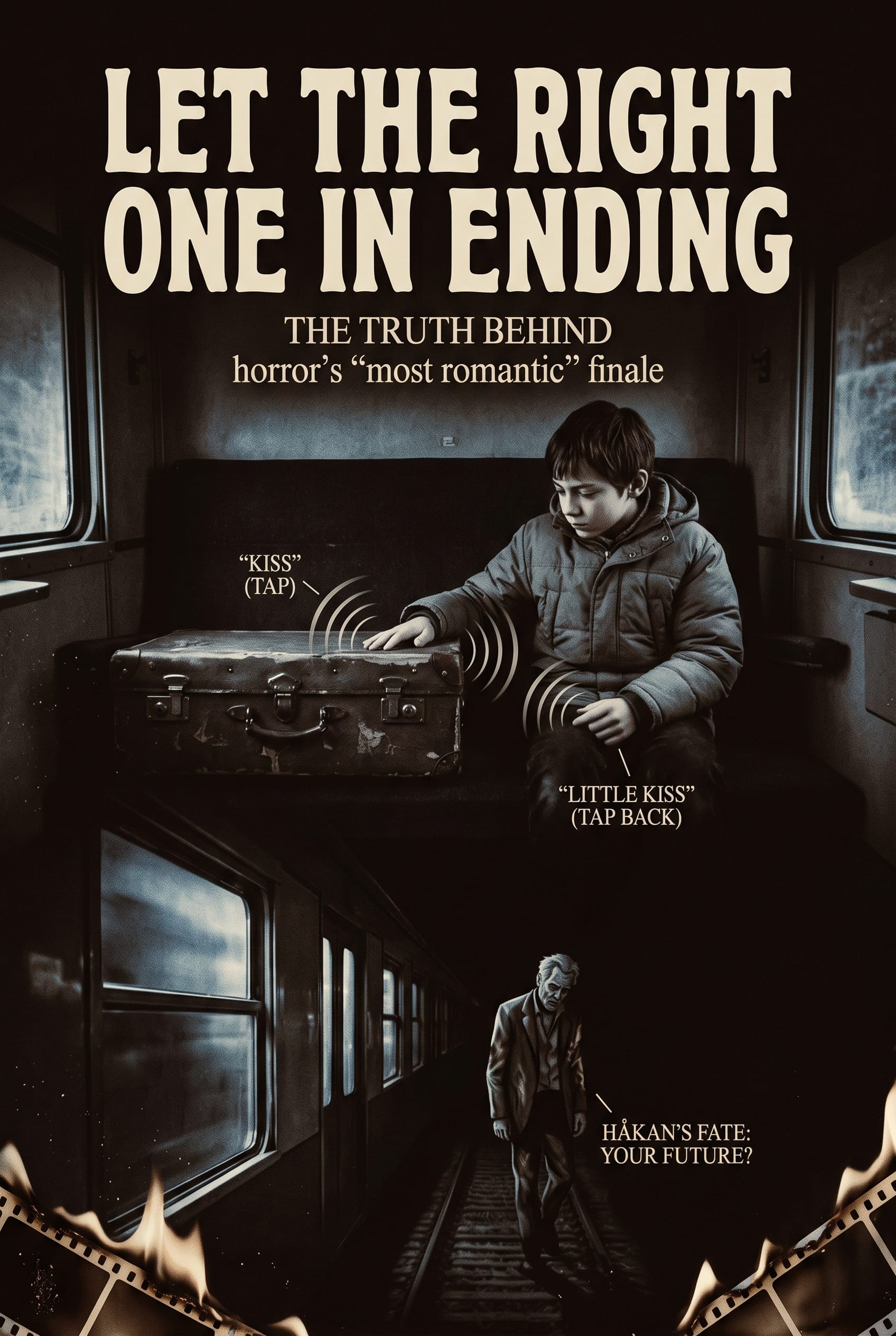
This Let the Right One In 2008 ending explained breakdown starts with the direct answer: in Tomas Alfredson’s film, one of
the best vampire movies ever made, Oskar boards a train with Eli hidden in a trunk, and the two exchange the word “kiss” in Morse code — a moment
widely read as romantic that this piece argues is actually the beginning of Oskar taking over Håkan’s exact role. Here is what actually happens at the end of Let the Right One In. A twelve-year-old boy boards a train out of Blackeberg with a large trunk at his feet.Something inside the trunk taps against the lid. The boy taps back. What he’s tapping, in Morse code, is the word “kiss.” People who write about this scene call it sweet. Some call it the most romantic ending in modern horror.I have read a genuinely alarming number of comment threads where someone says some version of “at least they have each other now,” as if that sentence describes a happy ending and not the exact sentence Håkan’s whole miserable life could have been summarized by, twenty years earlier, on a different train, in a different decade, with the same girl.Tomas Alfredson’s film, and John Ajvide Lindqvist’s novel and screenplay underneath it, spend their final scene in near-total silence. No dialogue. No score, for most of it. Just tapping, and a boy’s face doing very little. Critics have taken that silence as an invitation to project onto — an open ending, ambiguous, up to interpretation, a Rorschach test the film is generous enough to let each viewer pass or fail on their own terms.Quiet is not the same thing as ambiguous, and the fact that so much writing about this film treats them as interchangeable is the reason this piece exists.
The Swimming Pool Scene, Explained
The swimming pool sequence that precedes the train is the last time the film tells you anything in specifics, so start there. Conny and his crew corner Oskar during a swim class, hold his head under the water, and run a timed contest against him with the exact bureaucratic calm of someone reading out terms: “We’re going to have a little contest. You stay under water for three minutes. If you can do it, I’ll just nick you. But if you can’t, I’ll poke one of your eyes out.An eye for an ear, right?” — a direct callback to a stick injury Oskar caused earlier in the film. Oskar points out, correctly, that holding his breath for three minutes is impossible. “That’s your problem,” the boy answers, and starts the countdown anyway. Five, four, three, two, one. Eli arrives before it finishes.What she does to Conny’s crew isn’t rendered in loving detail — the camera stays on the water, the edge of the pool, the panic of the kids who aren’t involved — but secondary accounts of the shot list are consistent and specific: one bully is decapitated, another, Jimmy, has an arm torn from its socket, and at least one boy is left alive, sobbing, on a bench at the pool’s edge, having watched the rest happen.That last detail matters more than the film lets it seem to. Someone survives this. Someone survives to describe what he saw, to give a description to the police, to put a name and a face on whatever gets found in that pool once the water’s been drained and the reports get filed. The story cuts away before any of that happens, which lets a viewer assume it simply doesn’t — that Oskar and Eli vanish onto their train and the story just ends, clean, no consequence.One piece of published analysis on the ending makes the point plainly: Sweden is a small country, the case is now a multiple-murder investigation with an eyewitness, and the honest odds of two fugitives — one of them a conspicuous, chronically undernourished-looking child — staying ahead of that indefinitely are not good. The tenderness of the train scene is only available to you if you’ve already forgotten what’s still open behind it.
The Invitation Rule and the Train Scene’s Real Meaning
There’s a piece of vampire folklore sitting underneath all of this that the film takes seriously enough to build an entire earlier scene around, and it’s worth pulling forward here rather than leaving it back where it happened: a vampire cannot cross a threshold uninvited. Someone inside has to say yes, out loud or in effect, before the harm can start. The film treats that rule as literal earlier on — invoke it wrong and you bleed from every pore — but it’s also, obviously, a metaphor the story has been building toward using again. Nobody makes Oskar tap back.Nobody forces the trunk onto that train, or forces his hand against the wood. The rule that governs vampire mythology in this story is the same rule governing the ending: harm requires permission, and permission was given, freely, by someone young enough that “freely” is doing an enormous amount of unexamined work in that sentence. A twelve-year-old can say yes to an arrangement he doesn’t have the information to understand the cost of. The folklore doesn’t ask whether the invitation was informed. Neither, it turns out, does the story.
How Critics Have Talked Around This Ending
Even the film’s original critical reception seems to have sensed there was something under the ending worth not looking at directly, and mostly chose the joke instead.
Roger Ebert’s review is a good example — three and a half stars, genuine admiration for the film’s seriousness about vampire mythology, and then a closing line that ducks the ending entirely rather than engaging it: “They’ll get it, all right. In the neck.” It’s a good line.It’s also exactly the move I keep finding everywhere I look at this film’s reception — reach the point where the story asks you to sit with what its ending actually implies, and reach for a joke, a genre reference, an “at least they have each other” instead. It reads like the same silence the film itself uses, applied by a critic this time instead of a director, just relocated from the screen to the review.
Let the Right One In 2008 Ending Explained: What the Morse Code Really Means
This Let the Right One In 2008 ending explained argument is where I’ll state the position plainly, because I don’t think there’s any value in building slowly toward it: the ending of Let the Right One In is not a tender resolution interrupted by ambiguity. It’s the beginning of Oskar’s replacement of Håkan, staged with just enough restraint that audiences keep mistaking restraint for romance — the exact confusion this film runs on in every other scene, now applied to its very last one. The silence isn’t the film declining to answer a question.The silence is the answer, delivered in the only register this story has ever used for its worst information.The film cuts from the pool directly to the train, and it does so without giving either character a single line to explain what just happened, where they’re going, or what they think they’re doing. There is no conductor scene of the kind some viewers misremember — no dialogue at all in the sequence, verified directly against the film’s own English subtitle track, which runs completely silent from the moment the pool countdown begins until the closing credits roll nearly four minutes later. That is not a translation gap. There is nothing to translate.The filmmakers chose to let the sound design carry the entire ending — water, breathing, then a train car, then knuckles against wood — and chose not to let either character narrate what any of it means. A film willing to do that in its bullying scenes, its invitation scene, its every prior moment of restraint, doing it one final time at the exact point where the emotional stakes are highest, is not an accident of pacing. It’s the same directorial hand that’s been making this choice for ninety minutes, applied to the one scene where the choice matters most.What gets tapped out, specifically, has been independently confirmed across enough sources that I’m comfortable stating it as settled: Eli taps the Swedish word for “kiss,” and Oskar taps back a slightly longer message — “small kiss,” or “little kiss,” depending on the translation. It is, on its face, a tender gesture. It is also, on any closer look, exactly the kind of tenderness this film has spent its whole runtime dressing a transaction in.A kiss tapped through a trunk lid by someone who just killed two boys and left a third traumatized for life, addressed to the one person now legally and practically responsible for keeping that secret indefinitely, reads less like evidence against the servitude reading than like its opening line — the first entry in a ledger Håkan, per the novel’s own backstory, presumably started filling somewhere just as small.
Håkan’s Fate, and What It Predicts for Oskar
It’s worth being specific about what that job actually costs, because the film gives you a full worked example and most writing about the ending skips straight past him. Håkan is not a stranger to Eli when the film begins — he is her provider, her procurer, the adult who kills so she doesn’t have to be seen doing it, and by the time we meet him he is already failing at the job in ways that read as exhaustion rather than incompetence. He botches a kill in the film’s opening act badly enough to draw police attention.He pours acid on his own face in a parked car rather than risk being identified and connecting Eli to what he’s done — a detail the film’s own diegetic news broadcast confirms, describing “self-inflicted facial wounds” that made him impossible to identify. He dies not long after, used up, replaced within the same story by a child who hasn’t yet done any of the things that hollowed him out. The film never states that Oskar is Håkan’s successor. It doesn’t have to.It already showed you the full life cycle of the position once, start to finish, before the opening credits had a name for anyone.
The Novel’s Ending vs. the Film
The novel goes one step further than the film is willing to, and it’s worth being precise about where that line sits, because this is exactly the kind of detail that gets sloppily attributed to “the story” when it only exists in one version of it. In Lindqvist’s book, a conductor comments on the weight of Oskar’s trunk, and Oskar answers him: “It’s not as heavy as it looks.” That line is novel-only — it was never filmed, never subtitled, never shown to an audience watching Alfredson’s cut.But it’s the clearest textual evidence anywhere in this story for what the filmmakers chose to leave unstated. It’s a twelve-year-old already rehearsing the specific tone of denial that keeps a lifetime of service livable: minimizing the load out loud, to a stranger, before he’s carried it for even a single day. Håkan, by every account the novel and film both give of him, must have said some version of that sentence to himself for years before it stopped being true.
How Let Me In (2010) Changes the Ending
The American remake makes a choice here worth sitting with, because it tells you how at least one other set of filmmakers read this same material.Let Me In, Matt Reeves’s 2010 adaptation, doesn’t leave the Morse code exchange as a piece of found intimacy the audience stumbles onto in the final scene — it establishes earlier in the film that Owen is the one who taught Abby the code in the first place, so that by the time the train scene arrives, the tapping is a skill Owen was given, deliberately, by the person who now needs him to have it — installed rather than discovered, and the film makes sure you can tell the difference. One version of this story leaves the mechanism ambiguous.The other version shows you, on screen, exactly how the mechanism got installed. That reads like confirmation that more than one group of people looking hard at this material arrived at the same dark reading, with only one of them choosing to leave it in the room’s shadows rather than under a light. Writing on the remake’s ending has described what Owen becomes in that closing scene in blunt terms — a new caretaker locked into what one analysis calls a parasitic partnership, the word “parasitic” doing exactly the work “romantic” is usually asked to do about the original. The original film buries its own earlier, incomplete version of that same Morse code lesson — a detail Ethan digs up in
Let the Right One In (2008) Hidden Details.Same trunk, same code, same boy. The only real difference is which word critics reached for when nobody made them reach for the gentler one.
Is Eli a Predator? One Theory, and Its Problems
There’s a specific version of this argument, made in print by at least one critic directly, that goes further than I have so far: that Eli didn’t stumble into Oskar by accident, that Håkan’s usefulness was already ending by the time she moved into that apartment complex, and that everything in the film reads differently once you consider the possibility that she was already looking for a replacement before Håkan had finished failing her. It’s a reading I find compelling in places and too tidy in others.It’s compelling because the film gives Eli real tactical patience — she takes weeks to test Oskar’s loyalty, watches him rehearse violence against an imaginary tormentor before she ever reveals what she is, waits for the invitation rather than forcing it even when forcing it would clearly work. That’s not the behavior of someone acting on impulse. But it’s too tidy because it turns Eli into a pure predator with a plan, and the film doesn’t actually support that read as cleanly as it wants to.She risks real exposure to save Oskar at the pool — an act with no strategic upside if her only goal is recruitment, since a dead Oskar would have simply sent her looking elsewhere. Calculated predators don’t usually spend their only cover on a rescue nobody was forcing them to attempt. The film seems to want both readings alive at once: genuine attachment and cold utility, occupying the same girl, without ever resolving which one is driving the actual decisions. I’m not certain that ambivalence is a flaw. I think it might be the most honest thing the film does.
Why This Isn’t Really an Ambiguous Ending
What I keep coming back to, though, is that even the ambivalence has a shape, and the shape points one direction. Every fact the story gives you about what happens to companions of Eli’s kind — Håkan’s exhaustion, his self-loathing, the acid, the years of killing on command that visibly hollowed out an adult man before we ever meet him as anything but hollow — sits on one side of the scale. What sits on the other side is a single tapped-out word and a child’s optimism. The scale simply doesn’t balance, no matter how generously you weight the tapping.A film can refuse to state its ending’s meaning and still weight the evidence so heavily in one direction that refusing to state it stops functioning as real ambiguity and starts functioning as plausible deniability — for the characters, and for the audience that would rather not carry the weight of the darker reading home with them.Lindqvist himself has had more chances than anyone to resolve this, and has pointedly declined every one of them. Decades after the novel and film both end on that train, he wrote a follow-up short story, “Let the Old Dreams Die,” set long after the Blackeberg killings, built partly around two detectives who worked the original unsolved case and never closed it. The story confirms, in passing, that Oskar and Eli got away clean enough that the case stayed open for years.It does not confirm, deny, complicate, or even directly address what their relationship became, or whether Oskar ended up living some version of Håkan’s life. Readers of the story have described Lindqvist as deliberately, almost stubbornly resistant to resolving it — as if the not-knowing were the actual point of the exercise, and had been since the first ending. That’s not an author who forgot to answer the question. That’s an author who built a career-spanning structure specifically so the question would never have to be answered, by him or by anyone he handed the material to next.The story’s own description of what an unsolved case does to a place — how it sits there for decades like a splinter nobody can quite locate, felt more than seen — could just as easily describe what an unresolved ending does to an audience. Lindqvist gave his readers, twice now, the exact same object: a case that never closes, and a couple who are never seen again, and the specific discomfort of a story that keeps declining to tell you whether it ended well.Which is, in the end, the thing that makes the “ambiguous ending” framing so unsatisfying to me. Ambiguity implies a real fifty-fifty split, two readings held in genuine tension, a coin that hasn’t landed. This isn’t that.This is a story that has been asked directly, across a novel, a film, an American remake, and a follow-up short story spanning decades of the same author’s career, whether the boy on the train is walking into the same life that broke the man who came before him — and has answered, every single time, by changing the subject to how quiet the room got. Silence used once might be restraint.Silence used four separate times, across four separate tellings, by everyone who ever had the authority to end it, stops reading as restraint and starts reading as a decision dressed up to look like one.So here’s the actual answer, stated instead of implied: nothing in Let the Right One In tells you Oskar is safe. Nothing tells you the arrangement he just tapped his agreement to is any different from the one Håkan spent his life failing to survive. The film gives you a boy, a trunk, a word for “kiss,” and just enough silence to let you decide you didn’t see what you saw. I saw it. I don’t think it’s ambiguous at all.I think it’s the saddest ending this genre produced that decade, dressed carefully enough that most of the people watching it walked out calling it romantic, and precise enough, if you actually sit with everything the story has shown you about what happens to the people who take this particular seat on this particular train, that it never had to say a single word to make its point.
Let the Right One In (2008) Ending — Frequently Asked Questions
What Does This Let the Right One In 2008 Ending Explained Piece Argue?
This Let the Right One In 2008 ending explained piece argues the train-scene finale isn’t really ambiguous. The evidence — Håkan’s fate, the novel’s cut epilogue, the American remake’s more explicit staging, and the author’s own refusal to resolve it in a later short story — all points to Oskar beginning the same servitude that consumed Håkan, dressed in just enough silence to read as romantic instead.
What Does the Morse Code at the End of Let the Right One In Mean?
In the film’s final scene, Eli taps the Swedish word for “kiss” to Oskar in Morse code from inside her trunk, and he taps back a slightly longer message, “small kiss.” The gesture reads as tender on its surface, though the film gives no dialogue or score to confirm what it means for either character going forward.